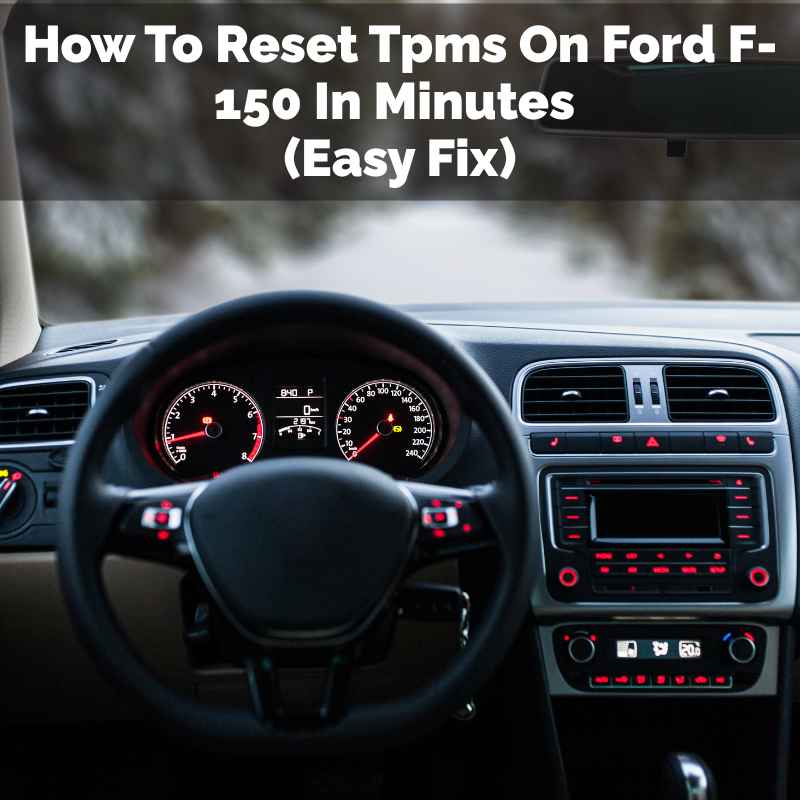
How To Reset Tpms On Ford F-150 In Minutes (Easy Fix)
Your Ford F-150 has a system called TPMS. It stands for Tire Pressure Monitoring System. This system is important for your safety.
It keeps an eye on the air pressure inside your tires. If a tire’s pressure gets too low, the TPMS light comes on. This is a warning.
Driving on underinflated tires can be dangerous. It can make your truck harder to steer. It can also cause your tires to wear out too fast.
In some cases, it can even lead to a blowout.
Modern F-150 trucks usually have direct TPMS. This means each wheel has its own sensor. This sensor measures the tire pressure and sends the info to your truck’s computer.
When you buy a new set of tires or replace a sensor, the system needs to learn the new sensor’s ID. This is where the reset comes in. Your truck’s computer needs to recognize the sensors again.
When Does Your F-150 TPMS Need a Reset?
There are a few common times you might need to reset your F-150’s TPMS. The most frequent reason is after you have adjusted the tire pressure. Maybe you checked your tires and added some air.
Or perhaps you let some air out for a smoother ride on rough terrain. If the pressure was significantly off, the system might flag it. Even if you correct it, the light might stay on until you tell the system it’s okay.
Another common trigger is tire rotation. When you move tires from one spot to another, the sensors move too. Your truck’s computer might get confused about which sensor is where.
So, it needs a reset to re-learn their positions. If you get a flat tire and use your spare, that’s a big change. The spare tire doesn’t have a sensor.
The system will definitely notice this. It will likely trigger the TPMS light.
Replacing a damaged TPMS sensor is another big one. Sensors can fail over time. They can get damaged during tire changes.
When a sensor is
Personal Experience: That Moment of Dread
I remember one crisp autumn morning. I was heading out for a long drive, excited for a weekend getaway. I got into my F-150, turned the key, and there it was.
The dreaded little tire icon, glowing red on my dashboard. My heart sank a little. I had just put new tires on a few weeks prior.
I double-checked the tire pressure gauge I keep in my truck. All four tires were inflated to the correct PSI. Not too high, not too low.
Just right. I was confused and a bit frustrated. Was something seriously wrong?
The thought of taking it to a dealership and waiting for hours crossed my mind. I really didn’t want that to happen on a Friday afternoon. I felt a knot of worry in my stomach.
Was this going to cost me a lot of money? I took a deep breath and decided to do some quick research on my phone. I was hoping for a simple fix, not a major repair.
That’s when I learned about the TPMS reset procedure. It sounded so simple, I almost didn’t believe it could work.
Quick TPMS Reset Checklist
Before you start:
- Ensure all tires are inflated to the recommended pressure.
- Have a tire pressure gauge handy.
- Check your owner’s manual for specific F-150 instructions.
You might need:
- A tire inflation tool or air compressor.
- A TPMS reset tool (for some models, but often not needed for basic resets).
How to Reset Your Ford F-150 TPMS: The Standard Method
Most Ford F-150 models from around 2008 onwards use a pretty standard procedure for resetting the TPMS. You don’t usually need a special tool. This method involves cycling the ignition and adjusting tire pressures.
It’s designed to be done by the owner. Let’s break it down into simple steps that anyone can follow. This is the most common way to get that light to go off after you’ve made adjustments.
Step 1: Inflate Your Tires
First, make sure all your tires have the correct air pressure. You can find the recommended PSI on a sticker inside your driver’s side doorjamb. It’s usually not the number on the tire sidewall.
That number is the maximum pressure. Use a reliable tire pressure gauge. Add or remove air as needed until you hit the right PSI for all four tires.
This is a critical first step. The TPMS system won’t reset if the pressures are still wrong.
Step 2: Turn the Ignition to ‘ON’
Now, get into your driver’s seat. You don’t need to start the engine. Just turn the key to the ‘ON’ position.
This is the setting where all the dashboard lights come on, but the engine isn’t running. Some newer F-150s might have a start button. In that case, press the button twice without your foot on the brake pedal.
You want the dashboard to be lit up.
Step 3: Locate the TPMS Reset Button (or Menu)
This is where it can vary slightly by year and trim level. On many F-150s, there’s a physical button. It’s often located on the dashboard, sometimes near the steering column or on the lower dash panel.
Look for a button labeled “TPMS” or “SET/RESET.” If you can’t find a button, your truck likely uses a menu system on the instrument cluster. You’ll navigate this using buttons on your steering wheel.
If you have a physical button, press and hold it for a few seconds. You should hear a chime or see a message on the dashboard confirming that the TPMS has been reset or that the system is learning new sensors. If you are using the steering wheel controls, you’ll need to cycle through the menus.
Look for “Settings,” then “Vehicle,” and then “TPMS.” Select the option to reset the tire pressure.
Step 4: Adjust Tire Pressure (If Necessary for Training)
In some cases, you might need to deliberately let a little air out of one tire to signal the system to start learning. If your truck beeps or flashes the TPMS light twice after you press the reset button, it means it’s ready to learn. You then need to go to the driver’s side front tire and let out a little air.
You’ll hear a horn honk when the system has successfully registered that tire. Then, move to the passenger side front, then passenger side rear, and finally the driver’s side rear. After the last tire, you should hear another horn honk, confirming the reset is complete.
You can then re-inflate the tires you let air out of to the correct pressure.
If your truck doesn’t require this specific tire-by-tire adjustment, simply pressing the button or using the menu option should be enough after ensuring correct tire pressures. The light should turn off within a few minutes of driving. Sometimes, it takes a short drive for the system to fully recalibrate and turn off the warning light.
F-150 TPMS Reset: Key Points
1. Correct Pressure First: Always ensure tires are properly inflated before attempting a reset.
2. Ignition On, Engine Off: This is the power state needed for the system to communicate.
3. Button or Menu: Locate the physical button or navigate the instrument cluster menu.
4. Listen for Chimes/Horns: These sounds are your confirmation the system is responding.
5. Drive to Confirm: A short drive often finalizes the reset and turns off the light.
Alternative Methods for Specific F-150 Models
While the above method covers many F-150s, some specific model years or packages might have slight variations. For example, trucks equipped with the advanced trailer tow package or certain off-road trims might have integrated TPMS settings within their infotainment system. Newer models, especially those with a digital instrument cluster, will rely heavily on the steering wheel controls and the dashboard display.
If you have a 2015 or newer F-150, the process is almost always done through the instrument cluster. You’ll press the “OK” or “Menu” button on your steering wheel to access the main menu. Navigate to “Settings,” then “Driver Assist,” or “Vehicle Settings.” Within that menu, you’ll find “TPMS” or “Tire Pressure Monitoring System.” Here, you can select the “Reset” or “Train” option.
The system will guide you through the rest, often prompting you to inflate tires to a specific pressure for training.
For older F-150s, particularly those before 2008, the system might be different. Some earlier models might have required a special diagnostic tool to reset the TPMS. If you have a very old truck and can’t find a reset button or menu option, consult your owner’s manual or a professional.
It’s always best to check your specific owner’s manual for the most accurate instructions for your truck’s year and model. Ford’s website also offers digital manuals for download.
What If the TPMS Light Stays On?
It can be disheartening if you follow all the steps and the TPMS light stubbornly remains lit. Don’t panic; there are still a few things to check. The most common reason for a persistent light is that the system didn’t properly recognize the new sensors or the adjusted pressures.
Sometimes, the sensors need to be “trained” in a specific order, as we discussed, and if one step is missed, it won’t complete.
Another possibility is a faulty TPMS sensor. These sensors are electronic devices that can wear out or fail. If one sensor is dead or sending incorrect data, the system will keep reporting an issue.
You might see a warning light that flashes initially and then stays solid, indicating a system malfunction rather than just low pressure. In this case, you’ll need a diagnostic scan to identify which sensor is problematic. A mechanic can read the error codes.
The TPMS receiver or the control module itself could also be the culprit, though this is less common. Environmental factors can sometimes interfere with the wireless signals from the sensors, especially if you’re carrying large metallic objects in the truck bed or have aftermarket accessories that might cause interference. If the light stays on after a day or two of normal driving, it’s time to consider having a professional take a look.
They have the tools to diagnose the exact problem.
Troubleshooting Persistent TPMS Lights
Check Tire Pressures Again: Seriously, double-check them. Ensure they are spot on.
Drive for 10-15 Minutes: Sometimes the system needs a sustained drive to register changes.
Re-attempt Reset: Try the reset procedure one more time, carefully following each step.
Inspect Sensors: Visually check the valve stems where the sensors are located for any damage.
Consult Your Manual: Your F-150’s owner’s manual is your best friend for specific codes or unusual behavior.
Seek Professional Help: If all else fails, a mechanic with a TPMS tool can diagnose the issue accurately.
When to Call a Professional
While resetting your F-150’s TPMS is often a DIY job, there are times when you should definitely seek expert help. If you’ve tried the reset procedure multiple times and the light still won’t go off, it suggests a deeper issue than just needing a simple reset. This could be a failing sensor, a problem with the receiver, or even an issue with the truck’s computer module.
Furthermore, if you’ve recently had new tires installed and the light came on immediately after, it’s possible the tire shop didn’t properly train or install the sensors. In such cases, it’s best to return to the shop that performed the work. They have specialized equipment to diagnose and fix TPMS problems.
They can read the sensor IDs, check their battery levels, and properly train them to your vehicle.
Also, if your TPMS light is flashing and then stays solid, this usually indicates a system malfunction. This isn’t just a low-pressure warning. It means there’s a fault within the TPMS itself.
Trying to reset a system malfunction without diagnosing the root cause might not fix the problem and could lead to other issues. Professionals can also recalibrate the system after replacing a faulty component, ensuring it works correctly.
The Importance of Correct Tire Pressure
Beyond the annoying dashboard light, maintaining correct tire pressure is crucial for your F-150. Underinflated tires are a major safety hazard. They increase stopping distances, make steering less responsive, and can lead to uneven wear.
This means you’ll be buying new tires sooner than you should. Overinflated tires can also be dangerous. They reduce traction, making it easier to skid or lose control, especially in wet or icy conditions.
They also cause the ride to be bumpy and uncomfortable.
Proper tire pressure also affects your fuel economy. When tires aren’t properly inflated, your engine has to work harder to move the truck. This means you’ll be using more gas.
Keeping your tires at the recommended PSI can actually save you money at the pump. It’s a small change that makes a big difference. Regularly checking your tire pressure should be part of your routine vehicle maintenance.
It’s a simple task that contributes significantly to safety, tire longevity, and fuel efficiency.
TPMS: More Than Just a Light
Safety: Prevents blowouts and improves handling.
Economy: Boosts fuel efficiency by reducing rolling resistance.
Longevity: Ensures even tire wear, making tires last longer.
Performance: Maintains optimal traction and braking capabilities.
Alerts: Warns of potential issues before they become dangerous.
Understanding TPMS Sensor Lifespan and Replacement
TPMS sensors are built to last, but they are not immortal. Most sensors have a battery inside that powers them. This battery typically lasts between 5 to 10 years.
As the sensors age, the battery will eventually die. When this happens, the sensor stops sending data, and your TPMS light will likely come on. You can’t replace just the battery in most TPMS sensors; you have to replace the entire unit.
The cost of
When replacing TPMS sensors, it’s often recommended to replace all of them at once, especially if your truck is older. If one sensor is failing, others might be close to the end of their life as well. It makes sense to do them all at once to avoid having to go through the reset process again soon after.
Remember that after replacing any sensors, a TPMS relearn procedure (a reset) will be necessary for the system to recognize the new sensors.
TPMS Reset vs. Tire Training
It’s important to understand the difference between a TPMS reset and TPMS training. A TPMS reset is typically the general procedure you perform after adjusting tire pressures or if the system has a minor glitch. It essentially tells the truck’s computer to re-evaluate the current tire pressures.
This can often be done by pressing a button or selecting an option in the vehicle’s menu.
TPMS training, also called relearning or re-pairing, is a more involved process. This is required when you have new TPMS sensors installed or when you rotate tires and want the truck to recognize which sensor is in which wheel position. This process involves using a special TPMS activation tool to “wake up” each sensor and transmit its unique ID to the truck’s control module.
Your F-150’s owner’s manual will specify when training is needed and the exact procedure, which may or may not involve the manual steps of letting air out of tires.
For most simple resets after inflating tires, the “reset” button or menu option is sufficient. But if you’ve replaced a sensor or had tires swapped, the truck might need to go through the full training cycle to learn the new sensor IDs and their locations. If you’re unsure, it’s always best to consult your owner’s manual or a trusted mechanic.
Reset vs. Training: Key Differences
Reset:
- Purpose: After inflating tires, minor system glitches.
- Method: Often a button press or menu option.
- Goal: Re-evaluate current pressures.
Training:
- Purpose: New sensors, tire rotation.
- Method: TPMS tool, specific inflation/deflation steps.
- Goal: Program sensor IDs and locations.
Quick Fixes & Tips for Your F-150 TPMS
Here are some quick tips to help you manage your F-150’s TPMS system:
- Keep a Tire Gauge: Always have a reliable tire pressure gauge in your F-150. Check your pressures at least once a month and before long trips.
- Know Your PSI: Memorize or keep a note of your F-150’s recommended tire pressure. It’s usually found on the sticker in the driver’s doorjamb.
- Owner’s Manual is Key: Your F-150’s owner’s manual is the ultimate guide for your specific model year. It will detail the exact TPMS reset and training procedures.
-
Spare Tire Caution: If you use your F-150’s spare tire, the TPMS light will likely come on because the spare doesn’t have a sensor. This is normal. The light should go off once you
- Seasonal Checks: Cold weather causes tire pressure to drop. Check your pressures more often in the winter.
- After Tire Service: Always ask the tire shop if they performed the TPMS relearn procedure after installing new tires or sensors.
- Don’t Ignore Flashing Lights: A flashing TPMS light usually indicates a system malfunction, not just low pressure. Get it checked.

Frequently Asked Questions About F-150 TPMS
How long does it take for the TPMS light to turn off after a reset?
Typically, the TPMS light should turn off within a few minutes of driving. Sometimes, it might take up to 10-15 minutes of consistent driving for the system to fully recalibrate and register the correct pressures. If it stays on longer, there might be another issue.
Can I drive with the TPMS light on?
Yes, you can drive with the TPMS light on, but it’s not recommended for extended periods. A solid light usually means at least one tire is significantly underinflated, which affects safety and fuel economy. A flashing light indicates a system malfunction that needs attention.
What happens if I don’t reset my TPMS?
If your TPMS light is on because of incorrect tire pressure, ignoring it means you’re driving with potentially unsafe tires. This can lead to poor handling, increased wear, and reduced fuel efficiency. If the light is on due to a system fault, it means the system isn’t monitoring your tires, leaving you unaware of potential pressure issues.
Do all F-150 models have TPMS?
Most Ford F-150 models manufactured from 2008 onwards are equipped with a direct TPMS as standard equipment. Earlier models may not have this feature, or they might have a less sophisticated version. Always check your specific F-150’s features or owner’s manual.
Can I use a universal TPMS sensor?
Yes, universal TPMS sensors can be used on many Ford F-150 models. However, these sensors usually need to be programmed with your truck’s specific TPMS module. This programming often requires a special TPMS scan tool.
Your mechanic or tire shop can usually handle this process.
How do I know if my TPMS sensor battery is dead?
If your TPMS light comes on and stays on, and you’ve confirmed all tire pressures are correct, it’s a strong indicator that one or more TPMS sensor batteries may be dead. The TPMS control module will report a communication error or a lack of signal from that specific sensor. A mechanic can diagnose this with a scan tool.
Final Thoughts on F-150 TPMS
Dealing with a TPMS light on your Ford F-150 can feel like a mystery, but it’s usually a solvable puzzle. By understanding why the light comes on and following the correct reset procedures, you can often fix it yourself. Remember that proper tire inflation is key, not just for the TPMS but for your safety and your truck’s performance.
Don’t hesitate to consult your owner’s manual or a professional if you’re ever unsure. Keeping that little tire light off means a safer, more efficient, and more enjoyable drive in your F-150.
Products related to this article
Sponsored / affiliate links. As an Amazon Associate I earn from qualifying purchases. I may earn additional commission from eligible campaigns.