HP Finance vs PCP
PCP usually brings the lower monthly payment; HP usually costs more each month but gives you the car outright after the final instalment is paid. Pick the wrong one and you can pay more overall, miss a mileage cap, or face a bigger end-of-term bill than expected. This guide compares the same car over the same term, then maps your end-of-contract options so you can choose on cash flow or total cost.
| Decision factor | HP Finance | PCP | Winner |
|---|---|---|---|
| Monthly payment | Higher, because you are paying toward full ownership | Lower, because part of the car’s value is deferred to the end | PCP |
| End-of-term ownership | You own the car after the final instalment and any option-to-purchase fee | You can hand it back, pay the balloon payment, or part-exchange it | Tie |
| Mileage risk | No mileage limit | Mileage allowance applies; excess mileage charges can apply | HP Finance |
| Total cost if you keep the car | Often easier to predict, because there is no balloon payment | Can be higher if you keep the car, because the balloon is still due | HP Finance |
| Short-term cash flow | Less friendly to a tight monthly budget | Usually better for keeping monthly payments down | PCP |
How HP and PCP work: instalments, balloon payments and GMFV

HP Finance and PCP are the two most common car finance types. HP means you spread the cost of the car in fixed monthly instalments and own it after the final payment. PCP keeps more of the car’s value to the end, so the monthly payment is usually lower.
How Hire Purchase works
Hire Purchase uses fixed monthly instalments over an agreed term. You are paying off the car itself, and once the final instalment and any option-to-purchase fee are paid, the car becomes yours. Car buyers can use HP for new or used cars, and there is no mileage limit.
How personal Contract Purchase works
Personal Contract Purchase also uses monthly payments, but a large part of the car’s value is deferred to the end. PCP usually includes a mileage allowance and an optional final payment, often called a balloon payment. At the end, you can hand the car back, keep it by paying the balloon, or part-exchange it.
What APR, GMFV and a balloon payment mean
APR is the comparison standard for finance deals because it reflects the cost of borrowing. On PCP, the monthly payment is shaped by the Guaranteed Minimum Future Value, or GMFV, which is the predicted end-of-term value of the car. The balloon payment is the deferred final sum needed if you want to keep the car, and it can make the total cost higher than HP if you buy the vehicle at term.
Is PCP the same as finance?
No. PCP is one type of car finance, not the whole category. It is a way to borrow for a car, with a lower monthly payment trade-off and an end-of-term choice, while finance overall also includes HP and other forms of borrowing.
That distinction matters because PCP is not the same as owning the car outright. You only become the owner if you pay the balloon payment and any final fee. Until then, the agreement is built around use and options, not immediate ownership.
Monthly payments and total cost
PCP usually brings the lower monthly payment on the same car because the lender expects to recover some of the value later. HP usually costs more each month because the whole car cost is being paid down during the agreement. That difference is why PCP can look cheaper at first, while HP can be better value if you plan to keep the car.
Same-car cost example
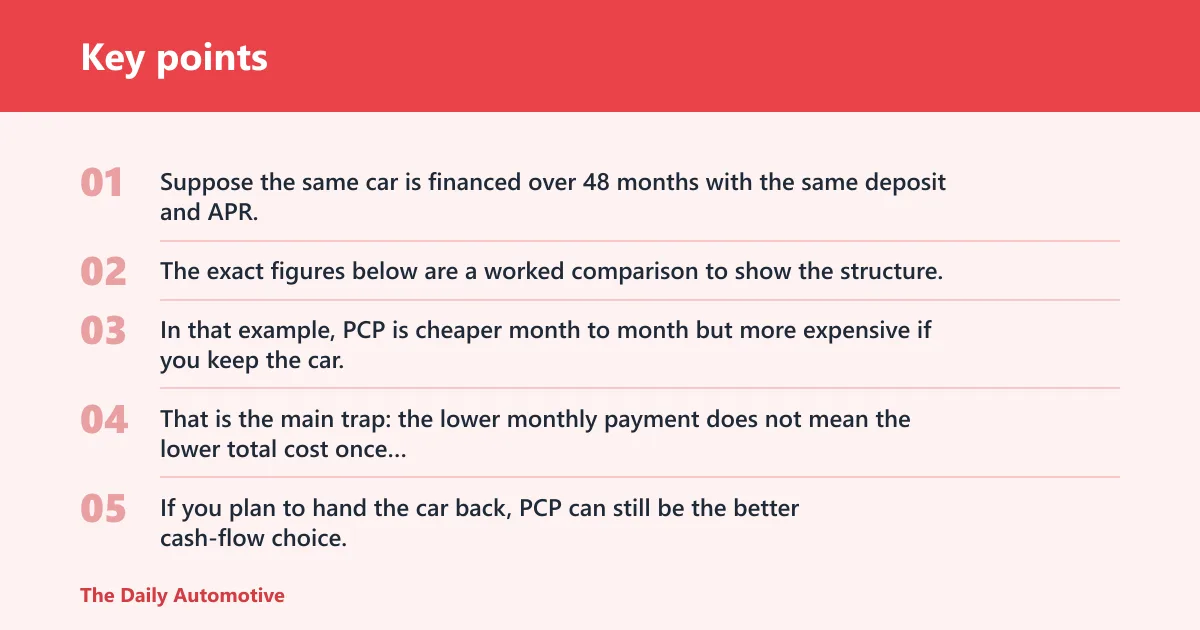
Suppose the same car is financed over 48 months with the same deposit and APR. The exact figures below are a worked comparison to show the structure, not a quote for any specific car.
| Cost item | HP Finance | PCP |
|---|---|---|
| Deposit | £2,000 | £2,000 |
| Monthly payment | £360 | £240 |
| Term | 48 months | 48 months |
| Final payment | None beyond the last instalment, apart from any option-to-purchase fee | £8,000 balloon payment if you keep the car, plus any option-to-purchase fee |
| Option-to-purchase fee | £10 | £10 |
| Total to own the car | £19,330 | £21,530 |
In that example, PCP is cheaper month to month but more expensive if you keep the car. That is the main trap: the lower monthly payment does not mean the lower total cost once the balloon payment is added. If you plan to hand the car back, PCP can still be the better cash-flow choice.
Why APR still matters
APR matters because it lets you compare finance deals on the same borrowing basis. But APR does not tell the whole story by itself. Deposit size, term length, GMFV, mileage cap, and the final payment all change the amount you actually pay over time.
A common mistake is to focus on the monthly instalment without checking the balloon payment or total cost over the agreement. Say your budget can handle £240 a month but not £360. PCP may fit that monthly cap, yet the final balloon could still be a problem if you want to keep the car. HP spreads the cost more evenly, but the monthly bill is higher from day one.
What happens at the end of a PCP agreement?
At the end of a PCP agreement you usually have three choices: hand the car back, pay the balloon payment and keep it, or part-exchange it into a new deal. That end-of-term decision is a core part of PCP, not an afterthought.
Hand the car back
If you return the car, you walk away from the balloon payment. That can suit people who want a fresh car every few years and do not want to own the vehicle long term. You still need to stay within the mileage allowance and keep the car in acceptable condition, or charges may apply.
Pay the balloon and keep it
If you want to keep the car, you pay the balloon payment plus any option-to-purchase fee. This is where PCP can stop being the lower-cost route in total terms. The deferred balance may be large, because the agreement was built around a predicted future value rather than full repayment during the monthly instalments.
Part-exchange into a new deal
You can also trade the car in and start another finance agreement. That can work well if the car is worth more than the settlement figure, but it can be awkward if it is worth less. Negative equity at the end of PCP is a real risk when the market value falls below what is left to pay.
Mileage limits, condition charges and used cars
PCP includes a mileage limit set when the agreement is written, and excess mileage charges can apply if you go over it. HP has no mileage limit, which makes it simpler for drivers who rack up miles quickly. PCP can also bring condition charges at handback if the car is damaged beyond fair wear and tear.
How mileage limits work on PCP
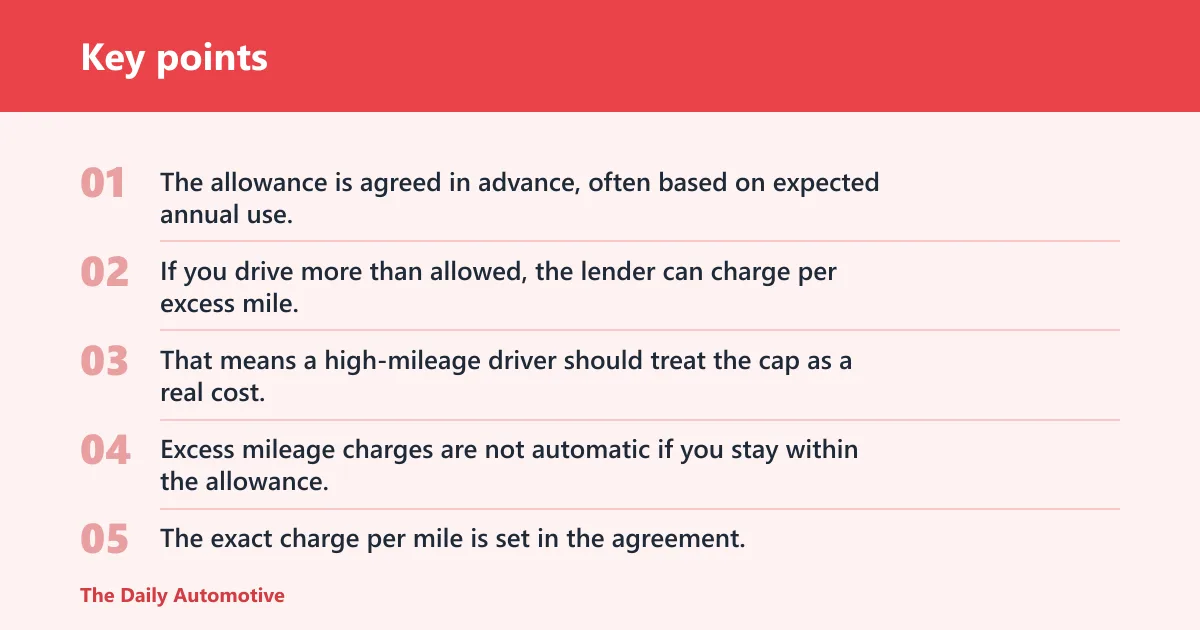
The allowance is agreed in advance, often based on expected annual use. If you drive more than allowed, the lender can charge per excess mile. That means a high-mileage driver should treat the cap as a real cost, not a minor detail buried in the small print.
What excess mileage charges mean in practice
Excess mileage charges are not automatic if you stay within the allowance. They apply when you exceed it. The exact charge per mile is set in the agreement, so the financial impact depends on how far over the allowance you go and how the contract is written.
Suppose two drivers choose the same PCP deal. One covers 8,000 miles a year and stays within the allowance. The other covers 18,000 miles a year and exceeds it by a wide margin. The second driver can end up paying far more at the end than the lower monthly figure suggested.
Can you buy a used car on HP or PCP?
Yes. HP can be used to buy a new or used car, and PCP can also be used on used cars, although PCP is more commonly associated with new cars. If you are buying used, HP is often the simpler route when the goal is eventual ownership.
That also affects trim and engine choice. A higher-spec trim, a stronger engine, or a model with weaker residual value can push the GMFV down or the monthly payment up, especially on PCP. Two cars that look similar on paper can produce very different payments once the lender prices in expected value at term.
HP Finance vs PCP decision matrix
| Buyer scenario | Monthly payment | End-of-term ownership | Mileage risk | Likely best fit |
|---|---|---|---|---|
| Keep the car 5+ years | HP Finance is usually higher each month, but it is working toward ownership | HP Finance ends with ownership after the final payment | HP Finance has no mileage limit | HP Finance |
| Change every 2-4 years | PCP usually keeps monthly payments lower | PCP gives hand back, keep, or part-exchange options | PCP mileage allowance needs managing | PCP |
| High annual mileage | HP Finance is often easier to budget for once mileage penalties are removed | HP Finance ends with ownership if you want to keep the car | HP Finance has no mileage cap | HP Finance |
Choose HP Finance if… / Choose PCP if…
Choose HP Finance if you want to own the car at the end, plan to keep it for 5+ years, or expect to cover high annual mileage. HP also suits buyers who want a simpler agreement with no mileage cap and no balloon payment waiting at the end.
Choose PCP if your priority is lower monthly payments, you like changing cars every 2-4 years, or you want the option to hand the car back instead of committing to ownership. PCP fits buyers who value cash flow and flexibility more than eventual ownership.
HP is often the cleaner fit for used-car buyers and long-term keepers. PCP can be a poor fit if you regularly exceed mileage allowances, if you are likely to want the car but struggle with the balloon payment, or if a part-exchange looks weak at the end of term.
Here is the short version: if you want ownership and fewer end-of-term surprises, HP Finance is usually the safer pick. If you want the lower monthly payment and the option to walk away, PCP is usually the better fit.
Frequently asked questions
What is PCP and HP finance?
PCP and HP are the two most common finance types for car buyers. HP uses fixed monthly instalments and ends with ownership. PCP uses lower monthly payments, a mileage allowance, and an optional final payment that decides whether you keep, return, or replace the car.
What is the difference between PCP and HP car finance?
The main difference is how much of the car’s cost you pay during the term. HP pays the car down in full over the agreement, so monthly payments are higher. PCP leaves a deferred amount at the end, so the monthly payment is usually lower, but ownership is optional.
Is PCP finance a good option?
PCP is a good option if you want lower monthly payments and the flexibility to change cars every few years. It is less attractive if you plan to keep the car long term, drive high miles, or want to avoid end-of-term charges tied to mileage or condition.
Is HP cheaper than PCP?
HP is usually more expensive each month, but it can be cheaper in total if you keep the car. PCP often wins on short-term monthly cash flow, yet the balloon payment can make the total cost higher when you buy the car at the end.
Products related to this article
Sponsored / affiliate links. As an Amazon Associate I earn from qualifying purchases. I may earn additional commission from eligible campaigns.