Car Finance Dealer Fee Cost: What It Really Adds
A dealer fee rolled into a financed car raises the amount borrowed, and a $699 fee can cost roughly $750 to $950 after interest over a typical 60- to 72-month loan. Compare the out-the-door total, not the monthly payment alone. Skip that step, and you can pay more for the same car while the deal looks unchanged. This guide shows how dealer fees change total financing cost and gives a buyer checklist to spot fee inflation before you sign.
What dealer fees actually change
Dealer fees change more than the sticker price. They change the amount financed, which changes the monthly payment and the total interest you pay over the loan term. A fee that looks small on paper can cost much more once it is rolled into 60 months of interest.
Amount financed versus sticker price
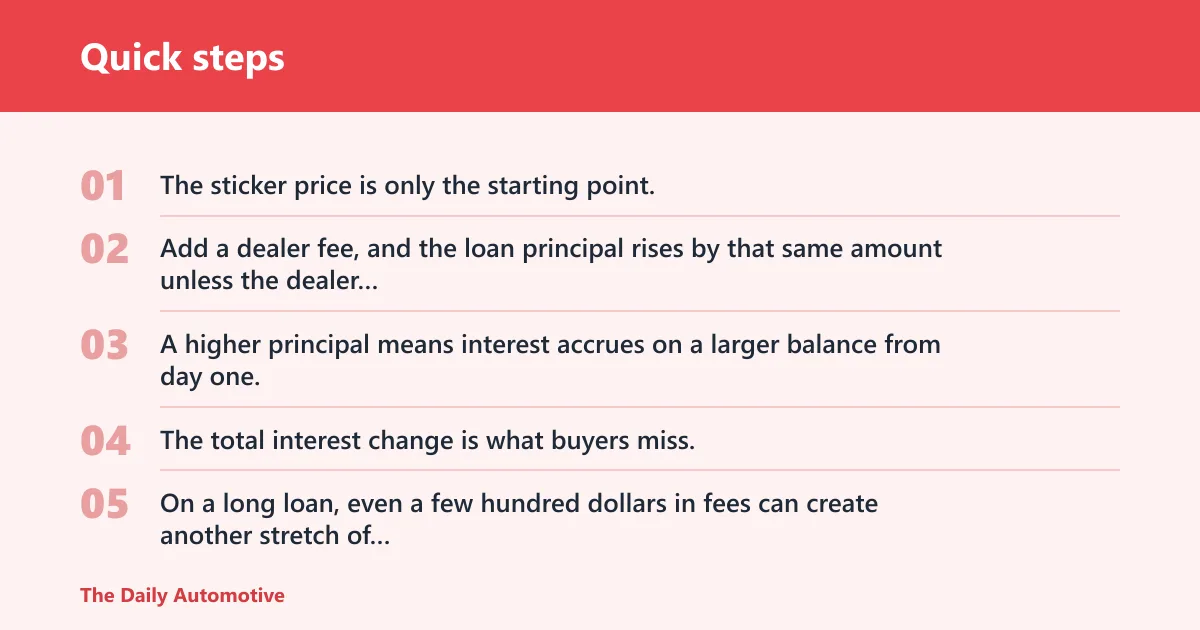
The sticker price is only the starting point. Add a dealer fee, and the loan principal rises by that same amount unless the dealer cuts the vehicle price or you pay the fee in cash. A higher principal means interest accrues on a larger balance from day one.
Monthly payment versus total interest
The monthly change may look minor. The total interest change is what buyers miss. On a long loan, even a few hundred dollars in fees can create another stretch of interest charges, especially at 9% or 12% APR.
Why small fees matter more on long loans
Long terms spread a fee across more months, but they also keep that fee outstanding longer. That means the lender charges interest on the fee for the full life of the loan. The longer the term, the more the fee acts like a financed purchase price increase.
Dealer fee financing table
The table below shows the financing impact of adding dealer fees to a 60-month auto loan. The baseline comparison is a $500 fee at each APR, then the table shows the added cost of $250, $800, and $1,000 instead of $500. Those differences are the payment and interest change caused by the fee amount alone.
| Dealer fee added to loan | 6% APR monthly payment change | 6% APR total interest change | 9% APR monthly payment change | 9% APR total interest change | 12% APR monthly payment change | 12% APR total interest change |
|---|---|---|---|---|---|---|
| $250 | $4.83 | $39.80 | $5.20 | $61.91 | $5.58 | $85.10 |
| $500 | $9.66 | $79.60 | $10.41 | $123.82 | $11.17 | $170.20 |
| $800 | $15.45 | $127.36 | $16.66 | $198.11 | $17.87 | $272.32 |
| $1,000 | $19.31 | $159.20 | $20.81 | $247.64 | $22.34 | $340.40 |
How to read it: if a fee moves from $500 to $1,000, the extra cost of that extra $500 is about $9.65 more per month at 6% APR and about $80 more total interest. At 12% APR, the same extra $500 costs about $11.17 more per month and about $170 more interest over 60 months.
A common first-timer mistake is fixing on the monthly payment while ignoring the loan length. Suppose a buyer rolls a $900 doc fee and a $500 add-on package into a 72-month loan. The payment rise may look modest, but the extra interest keeps stacking for six full years.
Which fees are dealer charges?

Dealer charges are fees the store adds to the deal, not charges set by the DMV or state tax office. That includes the documentation fee, dealer add-ons, market adjustment, and sometimes advertising or processing charges. CarBuyingTips says dealers charge many fee types, some necessary and some negotiable, and says dealer prep is a common scam.
Documentation fee
The documentation fee, or doc fee, is a dealer processing charge for paperwork. State caps vary widely. CarWhere says the documentation fee can range from about $0 to nearly $1,000, and its state table lists California at $85 and Maryland at $800. In uncapped states, the fee can be large and often is fixed for all buyers at that store.
Dealer add-ons and market adjustment
Dealer add-ons include paint protection, tint, nitrogen, VIN etching, and warranties. They are often sold as optional extras, or pushed as a package with high markup. Market adjustment, often called ADM, is dealer markup above MSRP on high-demand vehicles. That should be negotiated or avoided, not treated like a required charge.
What to leave out of dealer-fee math
Do not treat every line on the buyer’s order as a dealer fee. Government charges and manufacturer charges belong in different buckets. Grouping them together hides where the money really goes and makes it harder to spot where the deal got padded.
Which fees are not dealer fees?
Title fee, registration fee, sales tax, and destination fee are not the same as dealer fees. Title and registration are usually government charges. Sales tax is set by state and locality rules. Destination fee is a manufacturer charge. Mix those into dealer-fee math, and the comparison becomes sloppy fast.
Title fee and registration fee
Title fee is paid to the DMV. Registration fee is usually state-collected and fixed by the jurisdiction. These are typically non-negotiable because the dealer is collecting or forwarding them, not inventing them.
Sales tax and state rules
Sales tax varies by state and locality. In some states it is calculated before trade-in value is applied, and in others after trade-in credit. That rule can change the out-the-door number without changing the dealer’s own fee stack. Keep tax separate from dealer charges when you compare offers.
Destination fee from the manufacturer
Destination fee is a manufacturer charge, not a dealer-imposed fee. It is usually the same for all dealers on a given model and is typically not negotiable. The same source lists destination and delivery as a real cost range of $1,095 to $1,995.
How to read the buyer’s order
The buyer’s order should be itemized line by line. That worksheet, often handled by the finance manager, is where hidden charges are easiest to catch. The key number is the out-the-door price, which includes fees and taxes and is the best comparison number between dealers.
Line-by-line fee review
Read each line before discussing monthly payment. Separate the vehicle price, doc fee, add-ons, destination, title, registration, and sales tax. If a line is vague, ask for the exact name and amount. A line called “dealer service” or “prep” deserves the same scrutiny as a larger fee.
Out-the-door price as the comparison number
Out-the-door price tells you what leaves your account, not just what the car costs on the lot. Compare that number across dealers on the same model and trim. If one store quotes a lower payment but a higher out-the-door total, the payment is just being stretched or loaded with fees.
Where hidden charges usually appear
Hidden charges often show up as duplicate paperwork fees, preinstalled accessories, nitrogen, fabric protection, window etching, or “protection” bundles. They may also appear as vague dealer-imposed processing charges that are not tied to a government filing or a factory charge.
Can you negotiate dealer fees?
Sometimes yes, sometimes no. A doc fee may be fixed by state rule or charged the same to every customer, so it may not be negotiable in the store. Even then, the total deal can often be improved by lowering vehicle price, removing add-ons, or walking away.
When a doc fee is fixed by rule
If the dealer must charge the same doc fee to everyone, you will not win by arguing over that single line. Ask for the fee amount in writing, then shift to the selling price or another charge. The same source says a reasonable dealer fee total should be under $500 in most states, but Florida dealers frequently charge $700 to $1,000 plus in doc fees.
When to seek a price offset instead
Ask for a price offset when the fee is large relative to the deal or when the loan term is long. A $1,000 fee on a 72-month loan can turn into far more than $1,000 once interest is included. A clean offset is better than paying a fee and pretending it costs nothing.
When to walk away from add-ons or ADM
Walk away when the dealer will not remove unwanted add-ons, adds a market adjustment to a high-demand car, or refuses to give a clear itemized sheet. The same source reports 31.9% of deals include dealer add-ons averaging $1,184. That is enough to move a deal from fair to expensive in one line.
How to spot fee inflation before signing
Ask for the out-the-door quote in writing before you talk monthly payment. Then compare the same model across multiple dealers. Fee inflation usually shows up in the details, not in the ad headline. The best defense is a full worksheet before any signature or deposit.
- Request an itemized out-the-door quote, not a payment estimate.
- Separate doc fee, title, registration, tax, destination, and add-ons.
- Reject unwanted packages, paint protection, tint, etching, and nitrogen.
- Check for market adjustment or duplicate processing charges.
- Compare at least two dealers on the same trim and equipment.
- Review the finance manager’s buyer’s order line by line before signing.
Say your quote shows a $795 doc fee, a $1,095 destination fee, and a $699 protection package on a compact SUV. The destination fee belongs in the comparison, but the package may not. If the dealer will not remove it, compare the out-the-door total against another store that leaves the package off.
Frequently asked questions
How much are car dealer fees?
Car dealer fees vary a lot by state and store. Doc fees may run from about $0 to nearly $1,000, and add-ons can push the total higher. The same source says a reasonable dealer fee total should be under $500 in most states, but some states allow much more.
How much does car finance cost?
Car finance cost depends on APR, term, down payment, and fees rolled into the loan. A dealer fee increases both the amount financed and the interest charged on that amount.
How much is car finance?
Car finance is the sum of the loan principal plus interest, and that total rises with every fee you roll in. Taxes, title, and registration also affect the amount due, though they are not dealer fees. The best comparison point is the out-the-door total, not the advertised monthly payment.
What are the fees car dealers charge?
Common dealer charges include doc fees, dealer add-ons, market adjustment, and sometimes advertising or processing charges. The same source says dealers charge many fee types, some necessary and some negotiable. Government items like title, registration, and sales tax belong in a separate category.
Why do car dealerships charge doc fees?
Dealers charge doc fees to cover paperwork and processing costs, but the amount is set by the dealer and limited by state rules in some places. That is why the fee can range from about $0 to nearly $1,000. The key question is whether the fee is fixed, capped, or padded.
Do dealerships charge you for financing?
Some dealers may add finance-related charges through rate markup, lender participation, or reserve arrangements, though those terms may not appear as a simple “finance fee.” Ask for the lender rate and every line on the buyer’s order. If the payment looks convenient but the total is padded, the financing is costing more than it should.
Products related to this article
Sponsored / affiliate links. As an Amazon Associate I earn from qualifying purchases. I may earn additional commission from eligible campaigns.