PenFed Auto Loan Review: What to Know Before You Apply
PenFed is a solid auto-loan option if you want a credit-union lender for purchase financing, refinance, or a TrueCar-linked car-buying path. It is less useful if you need public rate and eligibility details before you apply. Compare first, or you can end up with a higher APR, the wrong term, or wasted time on a lender that does not fit your credit profile. This review breaks down PenFed’s rates, terms, refinance option, buying flow, and where borrowers should compare it with other lenders.
This guide is part of our Car buying, financing, and selling guide series.
Bottom line on PenFed auto loans
PenFed earns a recommendation for borrowers who can use its purchase or refinance paths and are comfortable joining the credit union before moving forward. The strongest case is for shoppers who want one place for loan shopping, financing, and add-on protection. The main weakness is transparency: PenFed does not clearly publish the underwriting details shoppers usually need to compare offers with confidence.
That missing detail matters. Without clear public guidance on credit score, income, debt-to-income ratio, vehicle age, and fee structure, it is harder to tell in advance whether PenFed is the best fit or just one option among several.
Main strengths
- Offers both purchase financing and refinance options.
- Has a TrueCar-powered shopping path for buyers who want to browse and finance in one place.
- Lists protection add-ons such as GAP Coverage and Debt Protection.
- Frames the auto area as an end-to-end destination, with FAQs, forms, and title resources.
Main limits
- Public qualification details are thin.
- Rate and term disclosures are not clear enough to compare upfront.
- Borrowers who need private-party or older-car clarity may need to call before applying.
- The member login and join requirement adds a step that some direct lenders do not require.
Pros and cons of PenFed auto loans
PenFed’s auto offering works best for borrowers who value a credit-union structure and want both purchase and refinance paths under one roof. It is less attractive for anyone who wants a quick yes-or-no decision based on public qualification rules alone.
Pros
- Credit-union lender with auto purchase and refinance loans.
- TrueCar-linked car buying service can reduce the back-and-forth between shopping and financing.
- Vehicle protection add-ons are available in the auto area.
- Member login and join paths are easy to find.
Cons
- No clear public minimum score, income threshold, or debt-to-income rule.
- Vehicle-age and mileage limits are not clearly disclosed on the pages reviewed.
- Private-party purchase support is not clearly spelled out.
- APR drivers and total-interest impact are not shown in a borrower-friendly way.
Who is PenFed best for?
PenFed is best for borrowers who want a credit-union lender, especially if they may need refinance later or want to compare vehicles through a guided shopping flow. It is a stronger fit for eligible members and shoppers who are willing to do a little extra work up front.
It is a poorer fit for borrowers who need complete public qualification rules before they spend time applying, or for shoppers with complicated deals such as older used cars, private-party purchases, or borderline credit profiles.
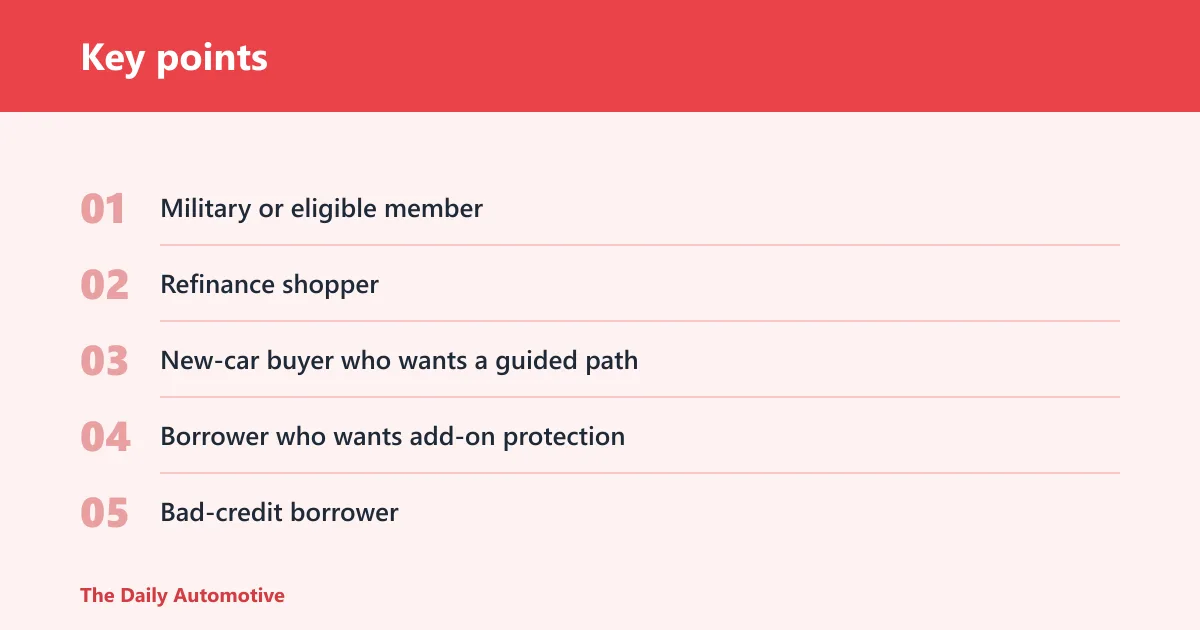
Best-fit borrower profiles
- Military or eligible member: A natural fit if you already qualify for membership and want to keep banking and borrowing in one place.
- Refinance shopper: Good if you are trying to lower a payment, change your lender, or adjust term structure.
- New-car buyer who wants a guided path: Useful if you like shopping first and then linking financing.
- Borrower who wants add-on protection: Helpful if GAP Coverage or Debt Protection is part of your plan.
Poor-fit borrower profiles
- Bad-credit borrower: Weak fit because PenFed does not clearly publish the approval floor or the full screening rules.
- First-time buyer with no prior auto credit: Possibly workable, but not easy to judge from the public information available.
- Private-party purchase shopper: Poor fit unless PenFed clearly confirms support before you proceed.
- Older used-car buyer: A weaker fit if vehicle-age limits matter and you need them stated in advance.
Say your credit score is solid, but you want to refinance a 2021 sedan into a lower payment. PenFed may be worth a look because refinance is a separate path, not an afterthought. A different shopper with a 14-year-old pickup, however, may need to confirm vehicle limits first.
PenFed auto-loan fit matrix
This matrix is the quickest way to decide whether PenFed is likely a strong, neutral, or poor fit for your situation. The labels below reflect fit based on the public structure of the auto offering, not a promise of approval.
| Scenario | Fit | Why | Watch out |
|---|---|---|---|
| New car | Strong | Purchase financing is part of the core auto offering. | Compare APR and term length with other lenders before applying. |
| Used car | Strong | PenFed supports purchase financing for used vehicles. | Check vehicle-age and mileage limits before you choose the car. |
| Refinance | Strong | Refinance is explicitly available as a separate path. | Make sure the payment savings outweigh any refinance costs or term extension. |
| Bad credit | Poor | Public approval criteria are not detailed enough to judge the floor. | Do not assume membership alone improves approval odds. |
| First-time buyer | Neutral | Possible fit, but the site does not give enough detail on underwriting flexibility. | Ask about income, credit, and co-borrower rules before you apply. |
| Military or eligible member | Strong | Membership routing makes PenFed a logical option if you already qualify. | Membership is not the same thing as loan approval. |
| Private-party purchase | Poor | The public auto pages do not clearly spell out private-party financing support. | Confirm seller and title requirements before making an offer. |
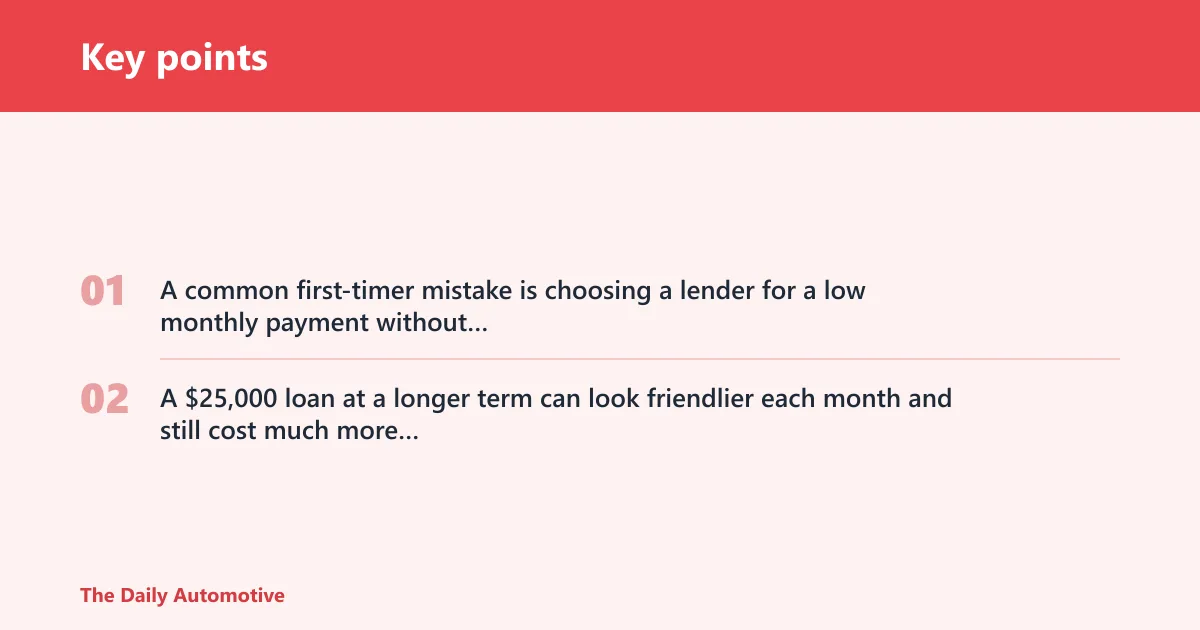
A common first-timer mistake is choosing a lender for a low monthly payment without checking total interest. A $25,000 loan at a longer term can look friendlier each month and still cost much more over time, so compare term length, APR, and expected fees together.
How PenFed auto loans work
PenFed’s auto process has two separate paths: purchase financing and refinance. The purchase path is for a new or used vehicle you are buying now, while refinance is for replacing an existing auto loan with a new one. Membership and login steps sit in front of the application flow.
Purchase financing path
Purchase financing is the entry point for new and used vehicles. PenFed’s auto navigation centers that path inside PenFed Auto, with forms, FAQs, and title resources nearby. The public pages do not clearly show exact underwriting rules, so you should be ready to verify your income, vehicle details, and membership status during the process.
Refinance path
Refinance is not the same as purchase financing. With a refinance, PenFed is evaluating your existing auto debt, current vehicle, and new loan request instead of the dealership transaction itself. That matters if you want a lower payment, a different term, or a lower rate than your current lender offers.
Membership and login steps
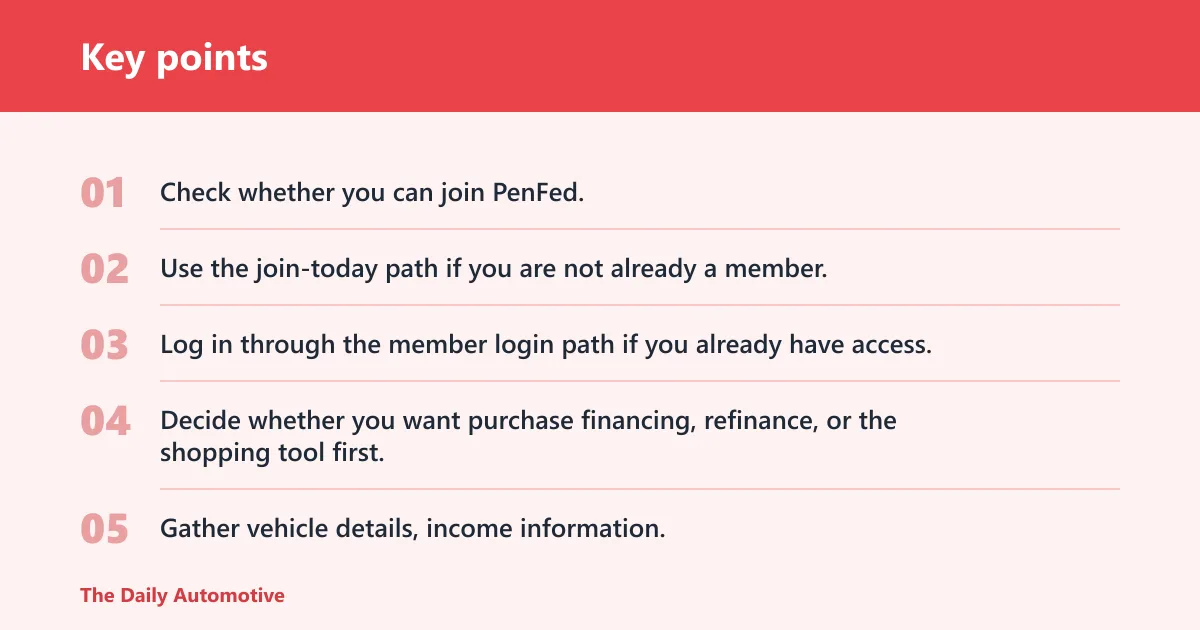
- Check whether you can join PenFed.
- Use the join-today path if you are not already a member.
- Log in through the member login path if you already have access.
- Decide whether you want purchase financing, refinance, or the shopping tool first.
- Gather vehicle details, income information, and any trade-in or payoff details before applying.
How does PenFed auto loan work in practice? A buyer shopping for a 2024 compact SUV can use the purchase route, while a driver with an existing 2019 loan may use refinance instead. The key difference is simple: one path funds a purchase, the other replaces a loan you already have.
Can you use PenFed’s car buying service?
Yes. PenFed’s car buying service is powered by TrueCar and sits alongside the lending flow, not inside it. That makes it useful for shoppers who want to compare vehicles and then move into financing without switching to a separate site for every step.
TrueCar-powered shopping flow
The shopping tool can help you compare vehicles, see price context, and connect the buying step to the loan step. PenFed frames the auto area as an end-to-end destination, so the service fits its broader design. It is a convenience feature, not a requirement for financing.
When to use it
- When you want to shop and finance in one path.
- When you are comparing new or used vehicles before choosing a lender.
- When you want a more guided process than a standalone loan application.
When to skip it
- When you already have a specific car and dealer lined up.
- When you are focused on refinance, not purchase shopping.
- When you want to compare direct loan offers first and shop later.
Protection add-ons and membership steps
PenFed markets vehicle protection alongside loans, and that matters if you are worried about total loss or payment disruption. GAP Coverage and Debt Protection are add-ons, not automatic parts of the loan. Joining the credit union is a separate step from deciding whether to add protection.
GAP Coverage
GAP Coverage is listed as an auto protection option. It may matter if you are financing a vehicle that will depreciate faster than your loan balance. That can be especially relevant on a longer term or a smaller down payment, but you still need to compare the cost of the add-on against the risk it covers.
Debt Protection
Debt Protection is also offered in the auto area. The point is payment-risk mitigation, not vehicle repair coverage. Borrowers should read the exact terms carefully, because the value depends on the event covered, the exclusions, and how much the protection adds to the loan cost.
Joining PenFed before applying
PenFed shows both a member login path and a join-today path. That signals a membership-first structure, which is common for credit unions. If you are not a member, plan on handling that step before or alongside your auto application so you do not delay the process.
Frequently asked questions
Is PenFed good for auto loans?
PenFed is good for borrowers who want a credit-union lender with both purchase and refinance options, plus a shopping flow tied to TrueCar. It is less compelling if you need clear public approval rules, vehicle limits, and pricing details before you decide whether to apply.
What credit score does PenFed use for auto loans?
PenFed does not clearly publish a minimum credit score for its auto loans on the public pages reviewed. That makes it harder to judge approval odds in advance. If score is a concern, compare PenFed with lenders that disclose more about minimum criteria and credit bands.
What are PenFed auto loan rates and terms?
PenFed’s public pages do not clearly lay out the rate grid, term range, or the main APR drivers in a borrower-friendly way. That means you should treat any offer as something to compare, not assume it is the best available. The total cost depends on APR, term, and fees.
Does PenFed finance used cars and refinance loans?
Yes. PenFed offers both used-car purchase financing and refinance loans. Those are separate decisions: purchase financing helps you buy a vehicle, while refinance replaces an existing loan. If you are shopping an older used vehicle, confirm age and mileage limits before you commit.
How do I join PenFed to get an auto loan?
Use PenFed’s join-today path if you are not already a member, then move through the member login or application flow as directed. Membership is not the same as approval, but it is part of the process. That extra step matters if you are comparing with direct lenders.
Does PenFed offer GAP coverage or payment protection?
Yes. The same source lists GAP Coverage and Debt Protection in the auto area as add-on protection options. Neither should be treated as standard. Whether either one makes sense depends on your down payment, term length, vehicle value, and how much you want to pay for extra protection.
Products related to this article
Sponsored / affiliate links. As an Amazon Associate I earn from qualifying purchases. I may earn additional commission from eligible campaigns.