Is a Car With 200k Miles Bad? Proven Essential Facts
A car with 200,000 miles is not automatically bad. Its reliability depends entirely on its maintenance history, the brand’s reputation for longevity, and a thorough pre-purchase inspection. Many modern, well-cared-for vehicles can easily drive well beyond 200k miles, often providing excellent value for a savvy buyer. The key is to verify its past, not just its mileage.
Hello, I’m Md Meraj. Seeing “200,000 miles” on a car’s odometer can feel scary. For years, that number was like a stop sign for most buyers. But what if I told you that high mileage isn’t the deal-breaker it once was? It’s a common worry, but you don’t have to be a master mechanic to figure it out.
Cars have changed a lot. They are built better and last longer. The real story of a car isn’t just in its mileage, but in how it was treated. In this guide, I’ll walk you through everything you need to know. We’ll look at what really matters and how you can find a hidden gem. Let’s learn how to make a smart choice together.
Why 200k Miles Isn’t the End of the Road Anymore
If you were buying a car in the 1980s, hitting 100,000 miles was a huge milestone. Hitting 200,000 was almost unheard of. But today, things are completely different. Advancements in technology have changed the game for car longevity.
Here’s why modern cars are built to last longer:
- Better Engines: Car makers now use stronger materials and more precise engineering. This means engines wear out much more slowly.
- Advanced Fluids: Modern engine oils and transmission fluids are incredible. They protect parts better and for longer periods, reducing friction and heat.
- Smarter Computers: The computers in today’s cars constantly adjust the engine for the best performance and efficiency. This prevents unnecessary stress on mechanical parts.
- Rust Protection: Manufacturers have gotten much better at preventing rust. Better coatings and materials mean a car’s body and frame can survive for decades.
Because of these improvements, a car with 200,000 miles on the clock can still have plenty of life left. The secret ingredient? Consistent and proper care.

The Golden Ticket: A Detailed Maintenance History
If you remember only one thing from this guide, let it be this: maintenance history is more important than mileage. A car with 200,000 miles that has been perfectly maintained is a much better bet than a car with 80,000 miles that has been neglected.
A thick folder of receipts is a beautiful sight. It shows the previous owner cared. It’s proof that the car received the attention it needed to reach such a high mileage in the first place.
What to Look For in Service Records
When you see service records, don’t just glance at them. Look for specific, important jobs. These are the big-ticket items that show the owner was serious about maintenance.
- Regular Oil Changes: This is the lifeblood of an engine. The records should show oil changes every 5,000 to 7,500 miles.
- Transmission Service: The transmission fluid should have been changed at recommended intervals (usually every 60,000 to 100,000 miles).
- Timing Belt or Chain: This is a critical one. If the car has a timing belt, it usually needs to be replaced around 100,000 miles. If it breaks, the engine can be destroyed. Records of this are a huge plus.
- Coolant Flushes: Fresh coolant prevents the engine from overheating and stops corrosion.
- Other Major Parts: Look for replacements of parts like the water pump, alternator, spark plugs, and suspension components.
Key Maintenance Milestones for High-Mileage Cars
Here’s a simple table to show you what major services should have been done on a car approaching or passing 200,000 miles. Having records for these is a very good sign.
| Maintenance Item | Typical Replacement Interval (Miles) | Why It’s Important |
|---|---|---|
| Timing Belt | 60,000 – 100,000 | If this belt breaks, it can cause catastrophic engine damage. Proof of replacement is crucial. |
| Water Pump | Often replaced with the Timing Belt | This part circulates coolant to keep the engine from overheating. A failure can lead to major damage. |
| Transmission Fluid | 60,000 – 100,000 | Clean fluid keeps the transmission shifting smoothly and prevents expensive internal damage. |
| Spark Plugs | Around 100,000 | New plugs ensure the engine runs efficiently and starts easily. |
| Shocks & Struts | 75,000 – 100,000 | Worn suspension affects ride comfort and safety. Fresh components make the car feel newer. |
Not All Miles Are Equal: Highway vs. City Driving
Have you ever heard someone say a car has “all highway miles? There’s a good reason that’s a selling point. The type of driving a car has done makes a huge difference in its overall wear and tear.
Highway Miles: The Easy Life
Imagine driving for hours on an open highway. The engine runs at a steady, cool temperature. The transmission stays in top gear. The brakes are barely used. The suspension glides over smooth pavement. These are highway miles, and they are very gentle on a car.
City Miles: The Hard Knock Life
Now, picture driving in a busy city. It’s a constant cycle of stop, go, accelerate, brake. The engine and transmission are always working, shifting gears, and getting hot. The brakes are used constantly. The suspension hits potholes and speed bumps. These city miles cause significantly more wear on every part of the car.
A car with 200,000 highway miles may be in much better mechanical shape than a car with 100,000 city miles. Ask the seller about their daily commute. Did they drive long distances on the freeway, or was it mostly short trips around town? The answer can tell you a lot about the car’s hidden condition.
Some Cars Are Built to Go the Distance
Let’s be honest: not all car brands are created equal when it comes to long-term reliability. Some manufacturers have earned a stellar reputation for building cars that can easily pass the 200,000-mile mark and keep going.
Generally, brands like Toyota and Honda are famous for their durability. Their sedans, SUVs, and trucks are often seen on the road with incredibly high mileage. Other brands like Subaru and some domestic truck makers (Ford, Chevy) also produce models known for their longevity.
On the other hand, some complex luxury vehicles, especially certain European models, can become very expensive to maintain as they age. While they might be beautiful and powerful, a simple repair on a high-end German sedan could cost more than a similar repair on a Japanese economy car.
Research the specific year, make, and model you are considering. Websites like Consumer Reports offer reliability ratings based on real-world data from thousands of car owners. This research can save you from a potential headache down the road.
Your Step-by-Step Guide to Inspecting a 200k-Mile Car
Okay, you’ve found a car with 200,000 miles. The price is right, and the owner says it runs great. Now it’s time to put on your detective hat. A careful inspection and test drive are essential. You don’t need to be an expert, just observant.
Step 1: The Visual Walk-Around
Before you even get in the car, walk around it slowly. Look for these things:
- Rust: Check the bottom of the doors, the wheel wells, and the frame underneath the car. Surface rust might be okay, but flaky, bubbling rust is a major red flag.
- Tires: Are the tires from a reputable brand? Do they have good tread left? Uneven tire wear (more wear on the inside or outside) can signal an alignment or suspension problem.
- Fluid Leaks: Look under the car for any drips or puddles. Black or brown drips could be oil, red or pink could be transmission fluid, and green or orange could be coolant. Any active leak is a concern.
- Body Panels: Do the gaps between the doors, hood, and trunk look even? Uneven gaps can be a sign of a past accident.
- Lights and Glass: Check for any cracked or foggy headlights and any chips or cracks in the windshield.
Step 2: The Test Drive
This is your chance to see how the car really feels. Turn the radio off so you can listen carefully.
- Starting Up: Does the car start easily? Listen for any strange noises right after it starts.
- Listen for Noises: As you drive, listen for clunking or banging sounds when you go over bumps (suspension issues). Listen for humming or grinding sounds that get louder as you speed up (wheel bearing issues).
- Check the Brakes: Find a safe, empty area. Press the brakes firmly. Does the car pull to one side? Do you feel a pulsation in the pedal? Do you hear any squealing or grinding?
- Test the Transmission: Pay attention to how the car shifts gears. It should be smooth. Jerking, hesitating, or clunking during shifts is a bad sign.
- Engine Performance: Does the engine feel powerful and responsive when you accelerate? Any hesitation or sputtering could mean it needs a tune-up or has a bigger issue.
Step 3: The Golden Rule – Get a Pre-Purchase Inspection (PPI)
This is the most important step of all. No matter how good the car looks or feels to you, always get a professional opinion. A Pre-Purchase Inspection (PPI) is when you pay an independent mechanic to thoroughly inspect the car.
A mechanic will put the car on a lift and check things you can’t see, like the frame, suspension, exhaust system, and engine seals. They will scan the car’s computer for any hidden trouble codes. A PPI costs around $100-$200, but it can save you thousands of dollars in unexpected repairs. If the seller is hesitant to let you get a PPI, that is a huge red flag. Walk away.
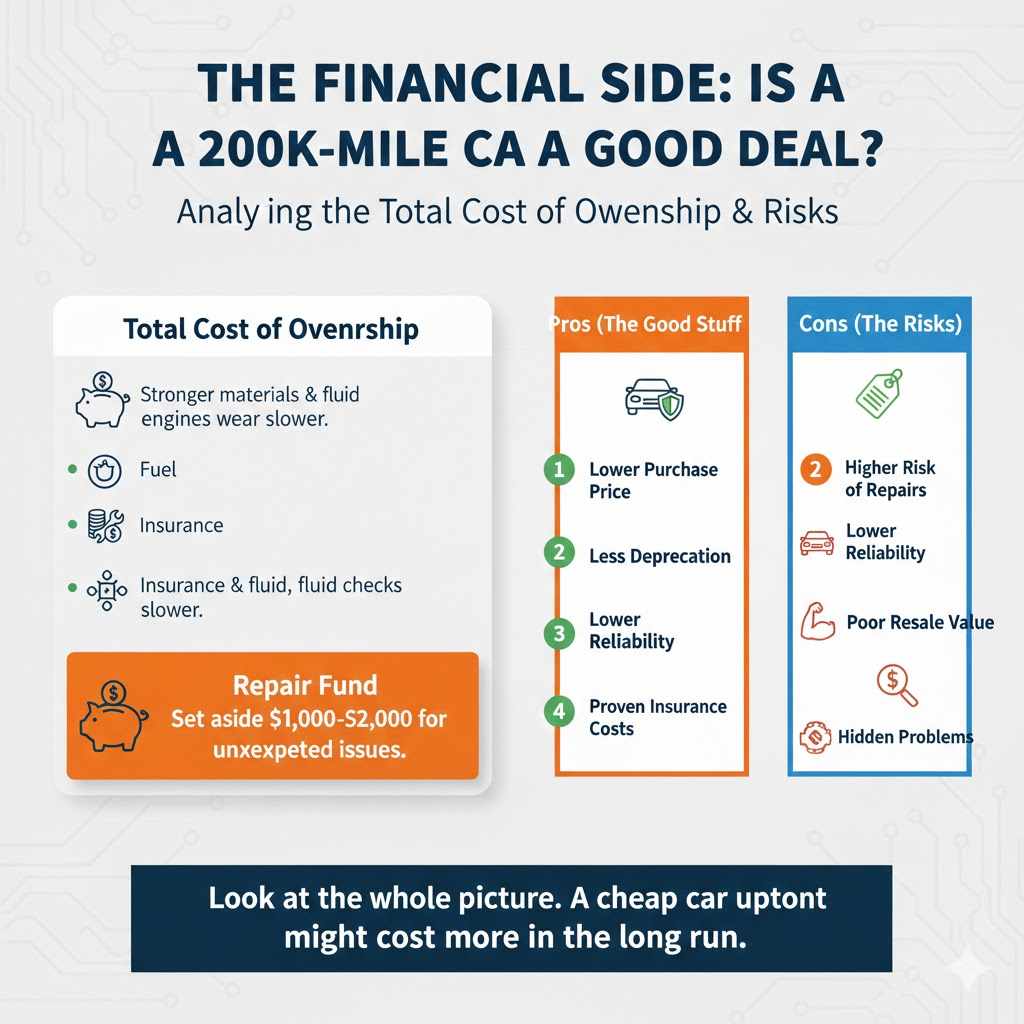
The Financial Side: Is a 200k-Mile Car a Good Deal?
One of the biggest appeals of a high-mileage car is the low price tag. You can often get a car that was once expensive for a fraction of its original cost. This can be a fantastic way to save money, but you need to look at the whole picture.
The Total Cost of Ownership
The purchase price is just the beginning. You also need to consider the total cost of ownership. This includes:
- Fuel: Older cars may not be as fuel-efficient. You can check estimated fuel costs for specific models on the government’s FuelEconomy.gov website.
- Insurance: The cost to insure the vehicle.
- Repairs: This is the big one. With a 200,000-mile car, it’s not a question of if it will need repairs, but when.
It’s wise to set aside a repair fund. A good rule of thumb is to have at least $1,000 to $2,000 saved for any unexpected issues that might pop up in the first year of ownership. If you buy the car and a major component fails a month later, this fund will be a lifesaver.
Pros and Cons Summary
Let’s break down the good and the bad of buying a car with over 200,000 miles.
| Pros (The Good Stuff) | Cons (The Risks) |
|---|---|
| Lower Purchase Price: You save a lot of money upfront compared to a low-mileage car. | Higher Risk of Repairs: Parts wear out. You are more likely to face repair bills. |
| Less Depreciation: The car has already lost most of its value, so it won’t lose much more. | Lower Reliability: It may be less dependable than a newer car, which can be an issue if you need it for a daily commute. |
| Lower Insurance Costs: Often, insurance premiums are cheaper for older, less valuable cars. | Poor Resale Value: When it’s time to sell, it will be harder to find a buyer for a very high-mileage vehicle. |
| Proven Durability: If a car made it to 200k miles, it’s likely a well-built model. | Hidden Problems: Without a proper inspection, you could be buying someone else’s expensive problems. |
Frequently Asked Questions (FAQ)
1. How long can a well-maintained car really last?
Many modern, well-maintained cars can last for 250,000 to 300,000 miles or more. The key is consistent maintenance, especially regular oil changes and addressing problems as soon as they appear.
2. Is a 200k-mile car reliable for daily driving?
It can be, but only if it has a proven history of good maintenance and passes a pre-purchase inspection. A well-cared-for Toyota or Honda with 200k miles might be more reliable than a neglected luxury car with half that mileage.
3. What are the biggest red flags on a 200k-mile car?
The biggest red flags are a lack of service records, any sign of rust on the frame, smoke from the exhaust (blue smoke means burning oil, white smoke can mean a coolant leak), and a seller who won’t allow a professional inspection.
4. Should I buy a high-mileage car with no service records?
It is very risky. Without records, you are buying a complete unknown. You have no idea if the oil was changed regularly or if major services like the timing belt were ever done. It’s usually best to walk away unless the price is extremely low and you are prepared for major repairs.
5. What’s more important: a car’s age or its mileage?
For most modern cars, mileage and maintenance history are more important than age. A 10-year-old car with 200,000 well-maintained highway miles is often a better choice than a 5-year-old car with 100,000 hard-driven city miles and a spotty service history.
6. Are highway miles really that much better than city miles?
Yes, absolutely. Highway driving involves less stress on the engine, transmission, brakes, and suspension. A car used for a long daily commute on a freeway will be in much better shape mechanically than a car used for delivery services in a city.
7. How much should I budget for repairs on a 200k-mile car?
A safe bet is to have at least $1,000 to $2,000 set aside specifically for potential repairs in the first year. This “rainy day” fund ensures that a surprise issue doesn’t turn your great deal into a financial disaster.
The Final Verdict: A Smart Choice for the Smart Buyer
So, is a car with 200,000 miles bad? The answer is a clear and confident “not necessarily.” That number on the odometer is just one part of a much bigger story. It’s a clue, not a conclusion.
By focusing on the things that truly matter—like a solid maintenance history, the reputation of the model, and a thorough inspection by a trusted mechanic—you can turn a high-mileage car into a fantastic value. It’s about being informed and patient. Don’t rush the process. Do your homework, check the records, and always get that professional inspection.
Buying a car with high mileage doesn’t have to be a gamble. When you know what to look for, you are in control. You can drive away with a reliable car that saves you money and serves you well for years to come. Happy driving!