Is the Audi A4 Reliable? 3.5/5 RepairPal Score Explained
The Audi A4’s 3.5/5 RepairPal reliability score points to average ownership risk, not a buy/no-buy verdict; the safer bet is a later-year car with complete service records. Ignore that score and you can face surprise repair bills, downtime, and deferred maintenance. This guide explains what the score means, which A4 model years carry more risk, and what to check before you buy.
Is the Audi A4 reliable?
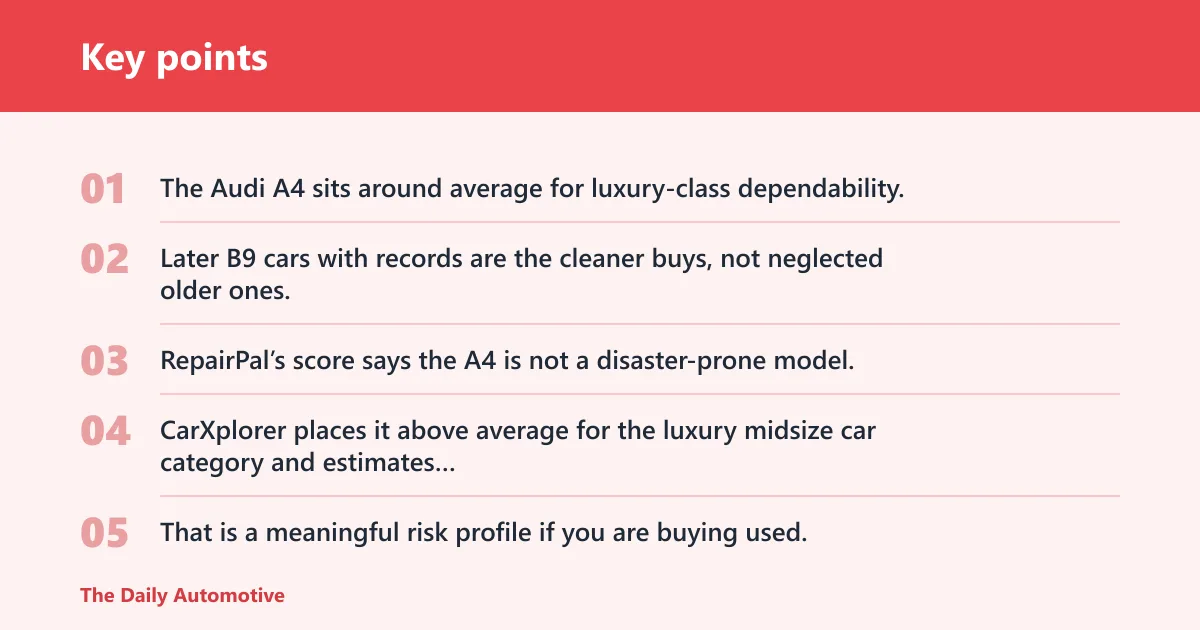


Yes, but only in context. The Audi A4 sits around average for luxury-class dependability, with RepairPal rating it 3.5 out of 5.0 and other owner-survey sources showing year-to-year variation rather than a fixed yes-or-no answer. Later B9 cars with records are the cleaner buys, not neglected older ones.
What the 3.5/5 score means
RepairPal’s score says the A4 is not a disaster-prone model, but it is also not a low-cost commuter sedan. CarXplorer places it above average for the luxury midsize car category and estimates about $739 in average annual repair cost, with a 13% chance of a severe repair. That is a meaningful risk profile if you are buying used.
Think of the score as a filter for buying, not a verdict. A maintained A4 can be a solid daily driver. A skipped-service car can turn into a chain of small repairs, then one expensive one. That gap is why service history matters more here than on many mainstream sedans.
How to read the score against repair cost and risk
The score becomes useful when you pair it with mileage and care history. Routine items such as oil changes and transmission service are manageable. The budget shock usually comes from neglected cooling parts, delayed dual-clutch service, or older B8 engine problems that were common enough to shape the model’s reputation.
Audi’s reputation is not uniform across years. J.D. Power’s dependability framework, which uses owner-reported problems per 100 vehicles, often tells a different story from a one-number rating because it separates long-term problem frequency from the general brand image. Consumer Reports owner surveys do the same job in another way, and they tend to show stronger results for newer B9 models than for older B8 cars.
What is the RepairPal score for the Audi A4?
RepairPal gives the Audi A4 a reliability rating of 3.5 out of 5.0. That lands it in the middle zone for a luxury sedan: better than a bargain-bin problem child, but still expensive enough that missing maintenance can erase the advantage of buying German used.
How it compares with owner-survey data
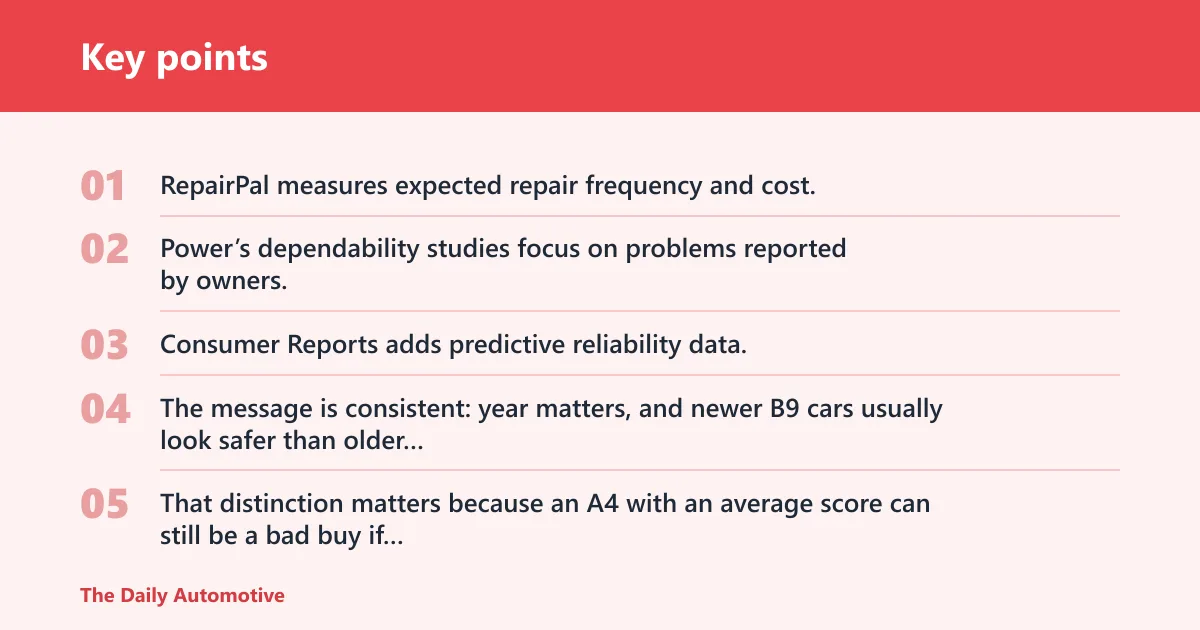
RepairPal measures expected repair frequency and cost. J.D. Power’s dependability studies focus on problems reported by owners, usually by model year and by age. Consumer Reports adds predictive reliability data, which helps explain why some A4 years age well while others do not. The message is consistent: year matters, and newer B9 cars usually look safer than older B8 cars.
That distinction matters because an A4 with an average score can still be a bad buy if it has the wrong engine history, skipped fluid service, or warning signs in the cooling system. The score is a filter. It is not a final answer.
Which Audi A4 model years are the most reliable?
The safer used-buy target is the B9 generation, which CarXplorer identifies as 2017 and newer. The riskier zone is the B8 generation, 2009 to 2016, because those cars are tied to excessive oil consumption and timing chain tensioner failure. That difference changes the entire ownership budget.
Why the 2009-2016 B8 is the riskier buy
B8 cars can still be worth buying, but only with a narrow set of conditions: proof of engine care, no oil-use complaints, and a clean inspection. Without that, the chance of paying for deferred work rises fast. A cheap B8 can become expensive when oil consumption, chain-related concerns, or cooling repairs stack up.
Why 2017-present B9 models are the better target
B9 models use a revised EA888 2.0-liter turbocharged engine family, and that matters. The updated engine architecture improved the ownership picture, especially compared with the older B8. Newer B9 cars are still not maintenance-free, but they are the safer choice for shoppers trying to limit surprise repair exposure.
Say your budget is fixed and you are comparing a clean 2018 A4 with records against a cheaper 2014 A4 that has spotty paperwork. The 2018 is usually the better risk trade, even if the purchase price is higher, because the older car is more likely to bring expensive deferred work with it.
What are the most common Audi A4 problems?
The main risk areas are the EA888 engine’s cooling parts, oil- and carbon-related wear, the S tronic dual-clutch transmission, and AWD inspection points on Quattro or Quattro Ultra cars. Catch them early, and the repairs are often manageable. Let them slide for years, and the bills climb fast.
EA888 engine issues
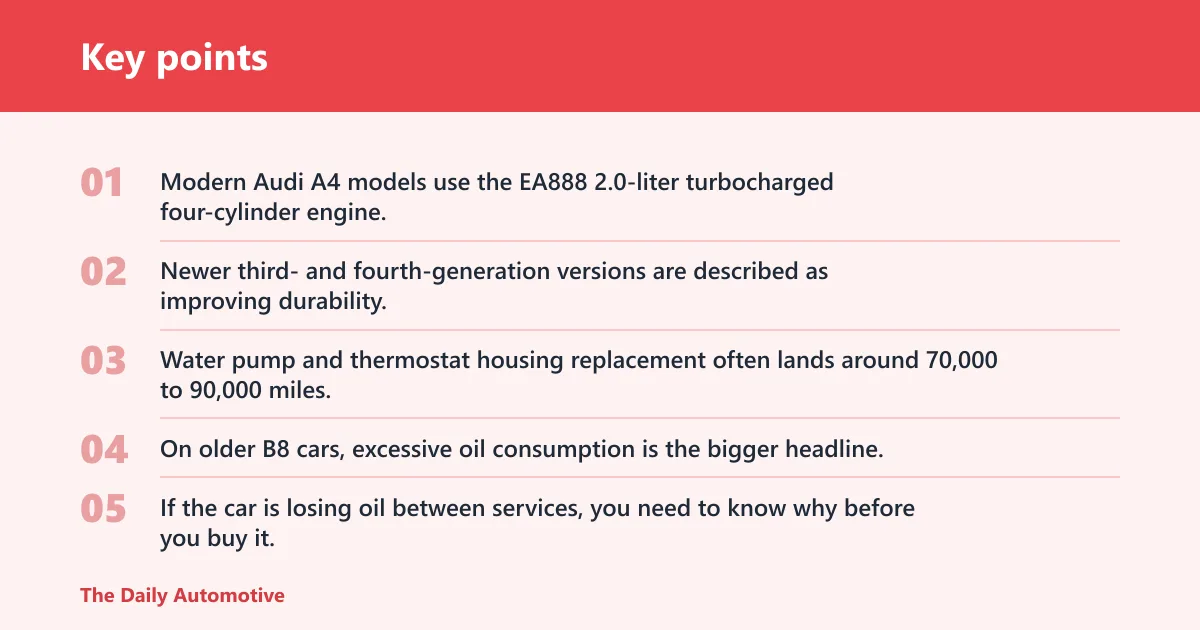
Modern Audi A4 models use the EA888 2.0-liter turbocharged four-cylinder engine. Newer third- and fourth-generation versions are described as improving durability, including better piston rings and dual-injection on some applications, but several weak points still matter. Water pump and thermostat housing replacement often lands around 70,000 to 90,000 miles, and carbon buildup remains a concern on direct-injection engines.
On older B8 cars, excessive oil consumption is the bigger headline. That is not a nuisance repair. If the car is losing oil between services, you need to know why before you buy it. Timing chain tensioner failure is another major B8 issue and can become a deal-breaker if there is any sign of rattle, noise, or poor maintenance history.
S tronic transmission service and symptoms
The 7-speed S tronic dual-clutch gearbox needs service about every 40,000 miles, and Capital Motor Cars estimates DSG service at $350 to $550. Skip that fluid service and you raise the odds of mechatronic shudder, rough shifts, and costly drivetrain complaints. On a used A4, missing transmission records should move your inspection closer to the “walk away” side.
A common first-timer mistake is to check the Audi A4’s service history for oil changes and overlook recurring suspension or electrical repair records. Suppose the car drives fine on a short test loop but has no record of a 40,000-mile S tronic service. That is not a minor paperwork gap. It is a real ownership risk that can show up later as jerky engagement or delayed shifts.
Quattro and Quattro Ultra inspection points
Quattro all-wheel drive helps in snow and wet weather, but it does not fix maintenance neglect. Quattro Ultra is tuned for efficiency and can decouple under light load, so buyers should still inspect for fluid leaks, odd noises, and uneven tire wear. On AWD A4s, mismatched tires and neglected drivetrain service can create extra wear.
The traction benefit is real. So is the cost of ignoring the system. AWD does not change the need for fluid service, clean tires, and a careful look at the underbody for leaks or previous repair work.
A4 reliability decision grid
This grid turns the RepairPal score into a buy decision. Treat B9, later-year cars with records as the lower-risk lane. Treat B8 cars, or any A4 with missing service history, as inspection-heavy purchases. When two problems appear together, the risk usually rises faster than the repair bill alone suggests.
| Model year range | Most likely failure points | Buyer action |
|---|---|---|
| 2009-2012 B8 | Excessive oil consumption, timing chain tensioner concerns, cooling-system wear | Avoid unless documentation is excellent and inspection is clean |
| 2013-2016 B8 | Oil use, chain-related risk, water pump and thermostat housing issues | Inspect closely; buy only with full records and no warning signs |
| 2017-2019 B9 | Cooling components, carbon buildup, S tronic service gaps | Inspect and buy if records show regular maintenance |
| 2020-present B9 | Water pump or thermostat housing, infotainment or electrical faults, transmission service neglect | Buy if service history is complete and test drive is clean |
First-year ownership exposure
This second table focuses on what can hit your wallet first, not every possible repair over the life of the car. Use it to separate routine spend from the kinds of repairs that can change a deal. Mileage is the trigger, but service history decides how hard that trigger lands.
| Maintenance item | Repair severity | Mileage trigger |
|---|---|---|
| Engine oil service | Routine | Every service interval, then sooner if oil use is present |
| S tronic fluid and filter service | Moderate | Around 40,000 miles |
| Water pump | Moderate to major | About 70,000 to 90,000 miles |
| Thermostat housing | Moderate to major | About 70,000 to 90,000 miles |
| Carbon buildup service | Moderate | Higher-mileage cars, especially with short-trip use |
| Timing chain tensioner concern on B8 cars | Major | Older B8 cars with unknown service history |
How to use the grid at a dealership
- Check the model year first.
- Confirm whether it is a B8 or B9 car.
- Ask for proof of the 40,000-mile S tronic service.
- Look for oil-consumption history on B8 cars.
- Inspect cooling-system records, especially at higher mileage.
- On Quattro cars, check tire wear and underbody leaks.
- Walk away if the seller cannot explain missing maintenance.
How much does an Audi A4 cost to own?
The A4’s ownership cost depends more on deferred maintenance than on the sticker price alone. CarXplorer’s $739 average annual repair cost gives a baseline, but a neglected example can jump far beyond that once the cooling system, transmission service, or engine issues come due. A clean service file is worth real money here.
Routine maintenance versus repair exposure
Routine items are manageable: oil changes, brake service, and the S tronic fluid service around 40,000 miles. That is the zone where a good buy can stay reasonable and a bad buy can become costly fast.
Picture a 2019 A4 with complete records and 58,000 miles. Now picture the same car with no proof of transmission service and a cooling-system warning history. Same badge. Very different risk. The second car is not automatically bad, but the repair exposure is much harder to control.
Why service history matters more on a used A4
Service history tells you whether the car has been treated as a long-term ownership product or a short-term sale. That matters most on B8 cars, where oil consumption and chain issues can hide behind a shiny detail job. It also matters on B9 cars, because cooling parts and dual-clutch service still cost money even when the engine itself is the better design.
When repairs are nuisance-level, a buyer can budget around them. When they are deal-breaker-level, the right answer is to pass. Timing-chain-related concerns, repeated overheating history, or a neglected S tronic service record belong in the second group.
Is the Audi A4 reliable after 100,000 miles?
Yes, if the car has records and the right model year. After 100,000 miles, the A4 becomes more sensitive to cooling-system wear, carbon buildup, and transmission maintenance gaps. A well-kept B9 can still be a reasonable buy. A poorly maintained B8 at that mileage is much easier to regret.
What changes as mileage rises
High-mileage A4s need sharper inspection, not automatic rejection. You should expect wear items to show up sooner, and you should assume the chance of a larger repair rises if fluid services were skipped. The main question is not “Can it last?” The question is “Was it maintained well enough to justify the risk?”
Mileage is part of the story. Records tell the rest.
Frequently asked questions
How much does it cost to maintain an Audi A4?
CarXplorer lists an average annual repair cost of approximately $739, with a 13% chance of a severe repair. That is only a baseline. Actual cost depends on mileage, whether the S tronic service was done around 40,000 miles, and whether cooling-system work is already due.
What years of Audi A4 should I avoid?
They are not all bad, but they are less forgiving than later B9 models. If the history is thin, another car is usually the smarter buy.
Products related to this article
Sponsored / affiliate links. As an Amazon Associate I earn from qualifying purchases. I may earn additional commission from eligible campaigns.