How Much Does a Car Cabin Air Filter Replacement Cost?
A cabin air filter replacement can be less expensive for a DIY job and cost more at a shop, with some vehicles reaching about $200 if the filter is hard to access. A neglected filter cuts airflow, can strain the blower motor, and turns a simple service into paid labor. This guide breaks down parts cost, labor cost, and how access type changes the final bill.
Breakdown of filter part and installation labor
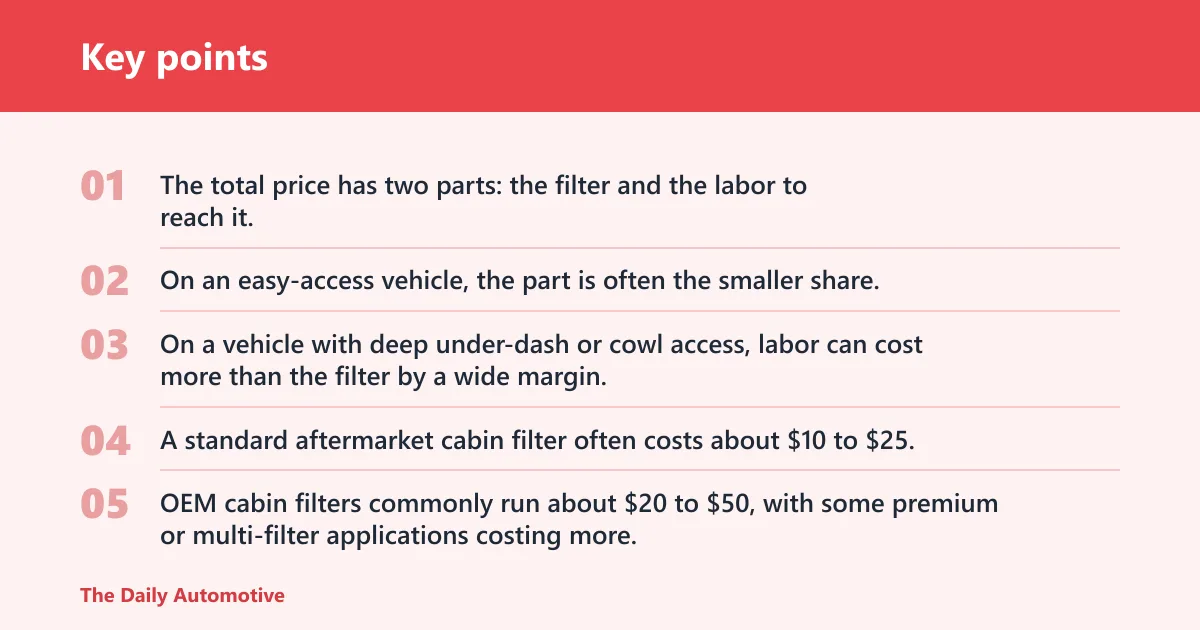


The total price has two parts: the filter and the labor to reach it. On an easy-access vehicle, the part is often the smaller share. On a vehicle with deep under-dash or cowl access, labor can cost more than the filter by a wide margin.
Typical parts cost by filter type
A standard aftermarket cabin filter often costs about $10 to $25. OEM cabin filters commonly run about $20 to $50, with some premium or multi-filter applications costing more. Activated carbon filters usually add $5 to $20 over a standard media filter because the media is denser and often better at odor control.
Parts cost also changes with fitment. Some vehicles use one panel filter, while others use two elements or an odd-size cartridge that limits cheaper options. Fitment errors are costly because the wrong filter may not seat correctly or may rattle, leak, or restrict airflow.
Typical labor cost by access type
Labor is driven by location, not just by the filter itself. A glove box cabin filter job may take about 10 to 20 minutes. A cowl or under-dash cabin filter job may take about 30 to 60 minutes, and some vehicles can take longer if trim panels, screws, or brackets must come off first.
Independent shops usually price that labor at a lower hourly rate than dealerships. The final bill can still climb if the shop adds a diagnostic fee, charges a minimum labor amount, or bundles the filter with HVAC inspection work.
Why does cabin air filter replacement cost vary so much?
Price swings come from access difficulty, labor rate, and the exact filter spec. A simple behind-the-glove-box swap on a common sedan may be inexpensive. A crossover, luxury sedan, or truck with cowl access, extra fasteners, or a multi-piece filter housing can take much longer and cost far more.
Vehicle layout and access difficulty
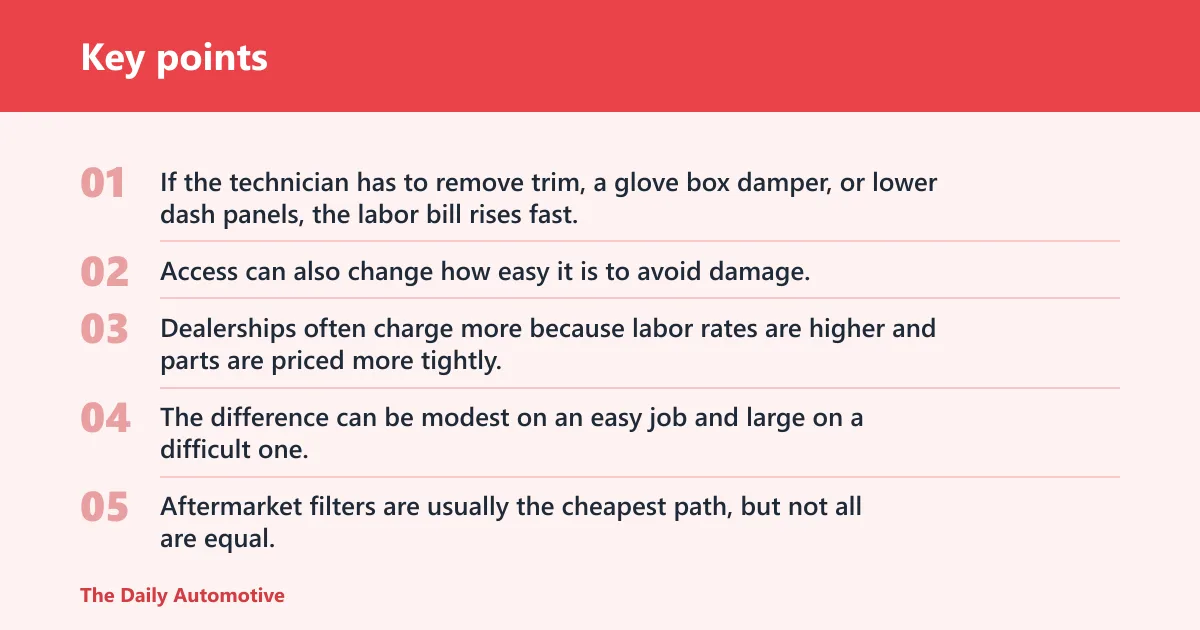
The cabin filter usually sits in the HVAC intake path, often behind the glove box, under the dash, or near the cowl at the base of the windshield. That location sets the labor time. If the technician has to remove trim, a glove box damper, or lower dash panels, the labor bill rises fast.
Access can also change how easy it is to avoid damage. Some housings have fragile clips. Others use small screws in tight spaces. That extra care adds time, and time is what you pay for.
Independent shop pricing versus dealership pricing
Dealerships often charge more because labor rates are higher and parts are priced more tightly. Independent shops are usually cheaper for the same basic swap, especially when the vehicle does not require a brand-specific filter. The difference can be modest on an easy job and large on a difficult one.
Dealership pricing becomes more noticeable when the filter is sold as an OEM-only part or when the service adviser adds inspection charges. A shop may also quote a cabin filter with a cabin air system inspection, which makes the total look less like a filter price and more like an HVAC service ticket.
OEM, aftermarket, and multi-filter setups
Aftermarket filters are usually the cheapest path, but not all are equal. Media quality, pleat count, and frame fit vary by brand. OEM filters typically cost more, but they are built to the vehicle’s exact dimensions and often fit more predictably.
Some vehicles use two filters or a special cartridge design. Those setups can double parts cost even before labor is counted. When the filter pack is multi-piece, the cost gap between DIY and shop service narrows less than owners expect.
Cabin filter cost breakdown table
This table shows the usual split between parts and labor by access type. It is a planning tool, not a quote. Exact pricing still depends on vehicle fitment, regional labor rates, and whether the shop uses OEM or aftermarket parts.
| Vehicle access type | Typical parts cost band | Typical labor time band |
|---|---|---|
| Behind glove box | $10 to $35 | 10 to 20 minutes |
| Under dash | $15 to $40 | 20 to 40 minutes |
| Cowl or engine-bay access | $15 to $50 | 30 to 60 minutes |
| Multi-filter or specialty housing | $25 to $70 | 40 to 75 minutes |
Say your sedan uses a single filter behind the glove box. A $18 aftermarket part and 15 minutes of labor may keep the shop bill near the low end. Say your SUV hides a two-piece filter under the cowl. The part price may still be modest, but labor can push the total far higher.
Can you replace it yourself?
Yes, many owners can replace a cabin air filter themselves if the housing is easy to reach and the correct part number is on hand. DIY is most attractive when the filter sits behind the glove box and the vehicle uses simple tabs or a single cover. It is less attractive when access is tight or the part fit is uncertain.
Tools and access points
Most DIY jobs need no special tools. Common items include a flashlight, a trim tool or small screwdriver, and sometimes a socket or Torx bit for trim panels. The key is knowing whether the filter is behind the glove box, under the dash, or at the cowl, because each layout changes the removal sequence.
- Confirm the fitment. Check the owner’s manual or the parts catalog by year, trim, engine, and cabin filter size. The wrong filter can bend, leak around the frame, or bind in the housing.
- Open the access panel. Lower the glove box, remove stops, or release the cover at the cowl or under-dash location. Work gently so clips do not break, since a broken retainer can turn a simple swap into a trim repair.
- Remove the old filter. Slide it out carefully and note the airflow arrow or orientation mark. A reversed filter can cut airflow and let more dust into the HVAC box.
- Install the new filter. Seat the new element in the same direction and close the housing fully. A loose edge can whistle, rattle, or let air bypass the filter.
- Recheck airflow. Turn the blower on and listen for abnormal noise while checking vent output. If airflow is still weak, the issue may be elsewhere in the HVAC system.
When DIY makes sense
DIY is usually worth it when the filter is inexpensive, the housing is obvious, and the vehicle has a straightforward access path. It can save the labor charge entirely. That matters most when a shop minimum would cost more than the part.
When a shop is the better call
A shop is the better call when access is buried, the cabin filter is part of a larger HVAC service, or the owner is unsure about the exact fitment. A pro is also the safer choice if broken clips, hidden screws, or cowl seals are part of the job. Paying labor is cheaper than replacing damaged trim.
What a clogged cabin filter feels like
A clogged cabin air filter usually shows up as weak airflow, a stale smell, or more dust entering the cabin than usual. Fogging can get worse because the HVAC system cannot move as much conditioned air across the windshield. These symptoms are clues, not proof, because other HVAC faults can feel similar.
Reduced airflow
When the filter loads up with dust and debris, the blower has to push air through a smaller opening. Vent output drops first at lower fan settings and may feel uneven from one vent to another. That is often the clearest sign the filter is overdue.
Musty odor
A musty smell can point to a dirty filter, but it can also come from moisture inside the HVAC box or evaporator case. If the smell returns soon after replacement, the filter was probably part of the problem, not the whole problem.
Fogging and dust intrusion
Fogging on the windshield can increase when airflow is weak, especially in damp weather. Excess dust on the dash or inside the cabin points to filtration trouble, though leaks around the filter housing or a poor seal can produce the same result.
A common first-timer mistake is assuming every airflow complaint means the cabin filter is bad. A stuck blend door, weak blower motor, or blocked fresh-air intake can create a similar symptom list and cost more to diagnose than the filter itself.
Do activated carbon cabin air filters cost more?
Yes. Activated carbon cabin filters usually cost more than standard filters because they add odor-absorbing media to the filter layer. The premium is often small on the parts side, but it can matter if you replace the filter often or if your vehicle uses a costly OEM cartridge.
What the premium buys you
Activated carbon media is aimed at odor control and some pollutant reduction. It can help when traffic fumes, roadside smoke, or persistent outside odors enter the cabin. It is not a cure for every smell, and it does not replace cabin cleaning or HVAC repair.
When the upgrade is worth it
The upgrade is usually worth it if you drive in heavy traffic, park near idling vehicles, or are bothered by odors from outside the car. It can also be a sensible choice if the vehicle already has easy access and the price difference is modest, since the added cost is limited mostly to the part.
When a standard filter is enough
A standard filter is usually enough if your main goal is basic dust capture and you change the filter on schedule. If the cabin stays clean, odor is not a concern, and the vehicle sees mostly normal suburban driving, the standard part is often the better value.
How often should you replace your cabin air filter?
Many manufacturers list cabin air filter replacement intervals in the roughly 12,000 to 30,000 mile range, which is often about once a year to every two years depending on the vehicle. Dusty roads, heavy traffic, pollen, smoke, and frequent idling shorten that interval. Fitment matters because the correct filter is the one made for your exact vehicle, not the cheapest one on the shelf.
Mileage and time intervals
The calendar interval matters because a filter can clog with age even if the car is driven lightly. A low-mileage vehicle that sits outside in a dusty area may still need replacement yearly. High-mileage commuters may need it sooner than the book interval.
How conditions change the interval
Harsh conditions load the filter faster. Dirt roads, wildfire smoke, construction zones, and pollen-heavy seasons all cut service life. If airflow starts dropping before the scheduled interval, replacement should move up.
Why fitment matters more than guesswork
Guessing based on appearance alone is risky. Two filters that look similar can differ in thickness, seal design, or airflow direction. The right part number prevents leaks and keeps the replacement cost from turning into a do-over.
- Check the service schedule. Use the maintenance guide for your exact model and trim. The factory interval is the best starting point because it accounts for the HVAC housing and filter size.
- Adjust for conditions. Shorten the interval if you drive in dust, smoke, or heavy urban traffic. Replace sooner if airflow drops or odors return before the next scheduled service.
- Verify the part number. Match the filter by year, model, engine, and housing type. That avoids fitment errors and keeps labor from being wasted on the wrong part.
Frequently asked questions
How much does a car cabin air filter replacement cost?
Most owners pay $20 to $70 for DIY parts and $60 to $150 at a shop. Easy-access vehicles stay near the bottom of that range, while harder layouts can move much higher. Some specialty or buried filters can reach $200 once labor is added.
Is cabin air filter replacement cheaper at a dealership or repair shop?
It is usually cheaper at an independent repair shop. Dealerships often charge more for labor and may use higher-priced OEM parts. The gap is biggest on vehicles with complicated access, where the labor time can dwarf the filter price.
How much does the cabin air filter itself cost?
A standard aftermarket cabin filter often costs $10 to $25, while OEM filters commonly run $20 to $50. Activated carbon filters usually cost more than standard media, and some vehicles with two filters or specialty housings can push parts cost higher.
Can I replace a cabin air filter myself?
Yes, if the filter is easy to reach and you have the correct part number. Behind-the-glove-box swaps are often simple, while under-dash and cowl layouts can be awkward. If access is tight or clips are fragile, paying a shop may be the safer choice.
Products related to this article
Sponsored / affiliate links. As an Amazon Associate I earn from qualifying purchases. I may earn additional commission from eligible campaigns.