Is Automotive Protection Service Worth It?
An automotive protection service makes sense only when the contract premium plus deductible is lower than one likely repair you expect before coverage ends, especially on older, high-mileage, or complex vehicles. Skip the math and you can spend hundreds or thousands on coverage that duplicates a repair fund. This guide compares break-even costs by vehicle age, mileage, and drivetrain complexity so you can decide fast.
What automotive protection service actually covers
A vehicle service contract pays for specific repairs after factory warranty coverage ends. It is not the same as a manufacturer warranty, and it is not a promise to fix every failure. The value comes from matching covered systems to the repairs your vehicle is most likely to need next.
How a vehicle service contract differs from a factory warranty
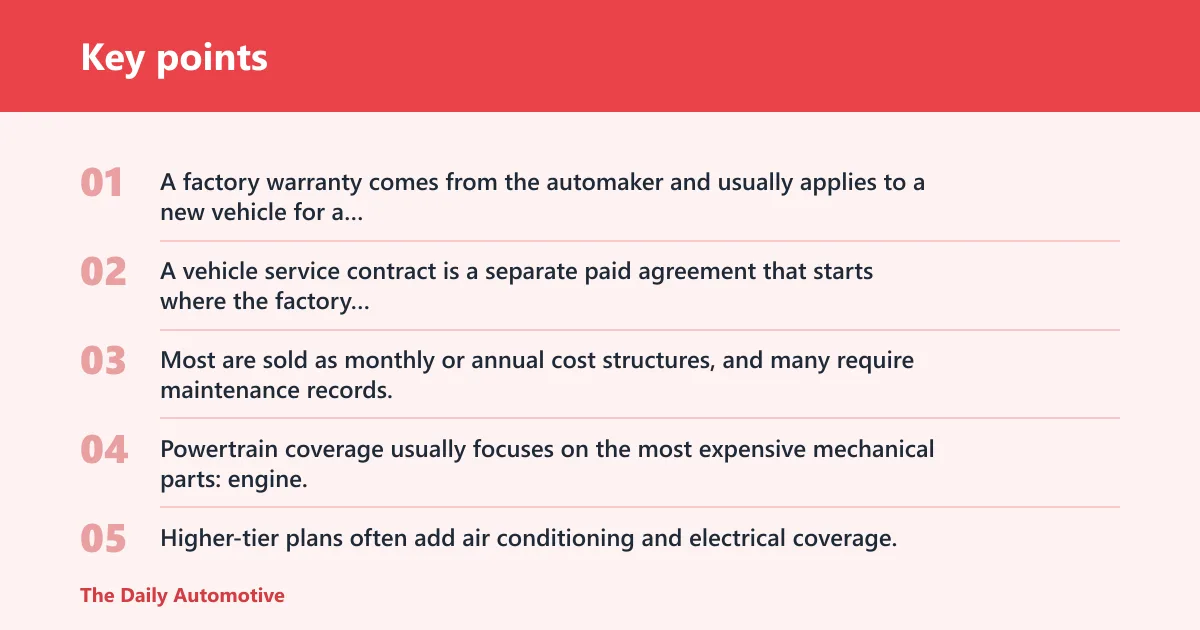
A factory warranty comes from the automaker and usually applies to a new vehicle for a set time or mileage. A vehicle service contract is a separate paid agreement that starts where the factory warranty stops, subject to its own limits, exclusions, and claim rules. Most are sold as monthly or annual cost structures, and many require maintenance records.
The main coverage buckets
Powertrain coverage usually focuses on the most expensive mechanical parts: engine, transmission, transfer case, drive axle(s), plus some gaskets and seals. Higher-tier plans often add air conditioning and electrical coverage. Exclusionary coverage is broader, because it lists what is excluded instead of listing every covered part, but parts still remain excluded.
Exclusionary contracts are often the widest option for newer vehicles that qualify. New Exclusionary is designed for vehicles from 2015 or later and under 100,000 miles. Used Stated Coverage applies to models within 10 years of the current model year and under 150,000 miles. Powertrain Protection can cover vehicles within 15 model years and with fewer than 250,000 miles.
What usually stays out of coverage
Most contracts exclude wear-and-tear, accident damage, pre-existing conditions, and many items that fail because of neglect or missed service. That matters because the parts that look cheap on paper can become expensive once labor, diagnostics, and related damage are added. A contract only helps if the failed component is actually listed or not excluded.
How the costs add up

Price alone does not answer the question. Compare the premium, the deductible per repair visit, and the repairs you are likely to face before the contract ends. A plan can look affordable until you count repeat visits, diagnostics, and smaller repairs that never reach claim level.
Monthly or annual premium structure
Some providers quote a monthly payment, others quote annual pricing, and many offer both through financing. Safeguard My Car plans start at $99 per month. That figure matters less than the total paid over the full term, because a low monthly payment can still produce a high total if the vehicle has few repair claims.
Deductibles per repair visit
Safeguard My Car lists a $100 deductible per repair visit. That deductible changes the break-even point because it adds to every covered claim. If a shop diagnostic bill and a modest repair total less than the deductible plus premium share, the contract may not help at all. If the repair is large, the deductible matters less.
How shop diagnostics and small repairs change the math
Suppose a repair shop charges about $160 to diagnose a check-engine light, then quotes about $280 to replace a sensor. If the plan still requires a $100 deductible and the contract premium for that year is higher than the repair itself, the policy has already lost ground. Small jobs are where self-insuring usually wins.
A common first-timer mistake is buying coverage for a low-risk car because the payment feels manageable. The monthly amount feels small, but the annual total plus deductible can exceed the likely repair bill on a well-maintained commuter car.
Which repairs matter most?
The biggest value usually comes from one major repair, not a stack of tiny ones. Transmission failure, engine internal damage, or an expensive electrical fault can quickly exceed what a contract costs. That is why drivetrain complexity and electronics load matter more than the sales pitch.
Engine, transmission, transfer case, and drive axle coverage
Powertrain coverage centers on the systems that are hardest to replace and most expensive to diagnose. On rear-wheel, all-wheel, or four-wheel drive vehicles, the transfer case and drive axle(s) can also be costly. If a vehicle has an unusually complex drivetrain, a broader contract can make more sense than basic powertrain-only protection.
Gaskets, seals, electrical, and air conditioning add-ons
Gaskets and seals can be part of higher-tier mechanical coverage, but not always. Electrical coverage is often where older luxury vehicles become expensive, because modules, sensors, and wiring faults are common repair drivers. Air conditioning add-ons matter in hot climates, but only if the contract actually covers the failed component and not just a few named parts.
Picture a roughly 9-year-old all-wheel-drive crossover with about 112,000 miles. If the transfer case starts making noise, that single repair can shift the value equation fast. On the other hand, a 5-year-old compact sedan with a strong service history may never come close to using the same amount of covered value.
When does it stop making financial sense?

A protection plan stops making sense when the expected repair cost, adjusted for likely claim denials and deductibles, stays below the premium you will pay before the contract ends. Low-risk commuter cars usually cross that line later than luxury, European, or high-electronics vehicles, but mileage and model year still matter.
Mileage bands and model-year eligibility
Eligibility rules often track age and odometer reading. Older vehicles are more likely to face coverage limits or weaker tier options. High-mileage vehicles are also more likely to be priced into narrower coverage because the risk of claims rises with wear, age, and prior maintenance history.
Low-risk commuter cars versus higher-risk luxury or high-mileage cars
For a simple commuter car with modest mileage and a clean history, self-insuring is often the better choice. For luxury, European, turbocharged, or electronics-heavy vehicles, the odds of a large repair can justify a contract if the coverage actually includes the costly systems. The decision is about exposure, not brand status alone.
When self-insuring can be the better choice
If you can set aside the full premium amount and keep it untouched, self-insuring often beats a contract for reliable vehicles. That is especially true when repairs are likely to be routine items, such as brakes, tires, batteries, and fluids, which are commonly excluded anyway. A contract should beat that reserve on paper before you buy it.
Automotive protection service worth worksheet
This worksheet uses simple annual math. Add the premium, expected deductibles, and any denied or excluded repairs you think are likely. Then compare that total with the repair exposure you expect over the same period. If the contract costs more than the likely covered repair, skip it.
| Scenario | Estimated annual premium | Deductible frequency | Expected covered repair costs | Uncovered items | Buy or skip |
|---|---|---|---|---|---|
| Low-risk commuter car | $1,188 | 0 to 1 visit | $0 to $900 for an occasional sensor or alternator claim | Wear items, tires, brakes, battery, alignments | Skip; self-insure usually wins |
| Average used car | $1,188 | 1 visit | $1,400 to $2,500 for a covered AC, electrical, or cooling repair | Pre-existing faults, maintenance neglect, fluids, gaskets outside plan | Buy if records are clean and coverage is broader |
| High-risk luxury or high-mileage car | $1,188 | 1 to 2 visits | $3,000 to $6,000 for transmission, control module, or drivetrain work | Suspension wear, cosmetics, corrosion, accident damage, denied claims | Buy if the contract covers the expensive systems you fear |
These figures show the logic, not a promise. A low-risk commuter car can pay more in premiums and deductibles than it ever receives back. A high-mileage luxury car can flip the math with one covered failure, especially if a transmission or electrical repair lands early in the contract term.
What can kill a claim?
Claims fail most often because the car was not maintained, the problem existed before coverage started, or the failed item falls under a contract exclusion. The cleanest-sounding plan still loses value if the provider can deny the repair after inspection or service-history review. That risk belongs in the calculation from day one.
Maintenance record requirements
Many contracts require proof of manufacturer-spec maintenance. That can mean oil changes, fluid services, and scheduled inspections recorded by date and mileage. Missing service history can raise denial risk, even when the failure seems mechanical rather than maintenance-related. Keep receipts and work orders before you buy.
Pre-existing-condition and wear-and-tear exclusions
Pre-existing-condition disputes are common when a part showed symptoms before the contract started. Wear-and-tear exclusions also matter because many expensive failures begin as gradual degradation. If the plan excludes the item category, or the provider says the failure existed beforehand, the claim can be rejected with little room for argument.
Claim conditions that can reduce payout
Some contracts require approval before repair, a qualifying shop inspection, or specific documentation from the repair order. Others cap labor rates, exclude related damage, or limit what is paid on a part-by-part basis. Those limits can turn a big repair into a partial reimbursement instead of a full fix.
Roadside and reimbursement extras
Extras can be useful, but they should not drive the whole decision. Towing, lockout service, fuel delivery, battery jump assistance, and tire assistance are convenient, yet they do not change the core question of whether the contract pays for the repairs you are most likely to need.
Towing, lockout service, fuel delivery, battery boost, and tire help
The plan includes roadside assistance, towing, lockout help, fuel delivery service, battery jump assistance, and tire assistance. Those benefits can reduce nuisance costs after a breakdown, especially if the vehicle is stranded. They are supportive features, not proof that the contract is good value on repair coverage alone.
Rental reimbursement limits and trip interruption support
Some contracts include rental reimbursement up to $30 per day for up to 11 days in some cases. The plan also offers lodging reimbursement up to $75 per day for up to three days. That can help if a covered repair strands you away from home, but the daily cap is still modest.
Why these extras should not drive the whole decision
If the repair coverage is weak, roadside perks will not rescue the math. Use the extras as a tie-breaker after the repair coverage, deductible, exclusions, and claim rules already make sense. A good contract pays for major failures first and treats convenience benefits as secondary.
Frequently asked questions
Is automotive protection service worth it?
It is worth it when the contract premium, deductible, and likely denial risk still come in below one expected repair before coverage ends. That tends to favor older, higher-mileage, or mechanically complex vehicles. For simple low-mileage cars, self-insuring often costs less over time.
Is vehicle service protection worth it?
It can be, but only if the plan covers the expensive systems you are actually worried about. Powertrain-only coverage may be too thin for a car with heavy electronics, while broader exclusionary coverage can be worthwhile for newer qualifying vehicles. Compare the quote to likely repair exposure.
Are vehicle protection plans worth it?
They are worth it when a single covered failure would cost more than the full contract plus deductible. If the vehicle is reliable, inexpensive to repair, and still eligible for warranty-like coverage, the odds often favor skipping the plan and setting aside the premium instead.
What is included in an automotive protection service contract?
Typical coverage can include powertrain parts such as the engine, transmission, transfer case, and drive axle(s), plus higher-tier electrical and air conditioning add-ons. Some plans also include roadside assistance, towing, lockout help, fuel delivery, battery jump assistance, tire assistance, rental reimbursement, and lodging support.
What repairs are typically excluded from service contracts?
Common exclusions include wear-and-tear, accident damage, pre-existing conditions, neglected maintenance, and parts not named in the contract. Tires, brakes, batteries, cosmetic damage, and routine fluids are also often excluded. Read the contract for labor caps, diagnostic rules, and parts-specific limits before signing.
What should I check before buying a vehicle service contract?
Check model-year and mileage eligibility, the exact covered systems, deductible amount, maintenance record requirements, claim approval rules, and what the contract excludes. Also confirm whether roadside assistance, rental reimbursement, and lodging support are included, because those extras vary by plan and should not be assumed.
Products related to this article
Sponsored / affiliate links. As an Amazon Associate I earn from qualifying purchases. I may earn additional commission from eligible campaigns.