Is Car Dealership Service Worth It? Cost Rules
Dealership service often makes sense when a repair is under warranty, needs factory tools or software, or the dealer quote is in the same general range as an independent shop, roughly within about 10% to 20%. Outside those cases, an independent mechanic usually makes more sense. Paying dealer rates for routine work can cost hundreds over time while the result stays the same. This guide shows when dealer service is worth it, when it is not, and how to compare quotes for the same repair.
What dealership service actually includes
Dealership service centers usually bring several things to the job: OEM-trained technicians, factory scan tools and software, access to OEM parts, and repair records that can fit the brand’s warranty process. Those tools matter on brand-specific diagnostics, software updates, and warranty-sensitive repairs. They matter less for basic maintenance.
OEM-trained technicians and factory tools
A dealer shop works from the brand’s service information, scan tools, and calibration procedures. That matters on late-model driver-assist systems, module programming, key coding, and some hybrid or EV faults. An independent shop can still do excellent work, but its diagnostic depth depends on the tools and training it has chosen to buy.
OEM parts access and warranty paperwork
Dealers can usually source genuine parts faster for current models, though not always cheaper. OEM parts are made to the vehicle maker’s spec, which can help with fitment and with warranty disputes on covered repairs. A good independent shop may offer OEM parts too, along with equivalent aftermarket parts when cost matters more than brand packaging.
Why dealer labor rates run higher
Dealer labor rates are often higher because the shop pays for brand-specific tools, training, facilities, and access to factory systems. The bill can also include diagnostic fees, shop supplies, tire disposal, hazardous-fluid disposal, and inspection add-ons. That is why a “simple” dealer visit often totals more than the first line item suggests.
Is car dealership service worth it during warranty?
During the warranty period, dealership service is worth it for repairs that could turn into a coverage dispute, for work that needs factory software or parts validation, and for jobs tied to recall or campaign records. For routine oil changes or brake pads, the dealer is optional unless the warranty booklet requires a specific process.
Required maintenance versus dealer add-ons
Manufacturer warranty coverage usually depends on following the maintenance schedule, not on buying every dealer-recommended extra. Required service can include oil changes, filter replacements, and specified fluid checks at set mileage or time intervals. Dealer upsells like throttle-body cleaning, fuel-system treatment, or extra flushes are often recommended, not required.
When dealer records matter most
Dealer service documentation matters most if a claim could hinge on whether maintenance was done on time or by the correct method. A stamped dealer invoice can make that conversation easier. Independent-shop invoices can also support a claim if they show the date, mileage, oil spec, fluid type, and work completed.
What warranty-safe service really means
Warranty-safe service means the work follows the maker’s schedule, uses approved parts or fluids where required, and leaves a paper trail. It does not mean every task must happen at a dealer. A 5,000-mile oil change at a competent independent shop can still protect coverage if it meets the schedule and specification.
Dealership service decision matrix

This matrix uses a simple dealer-worth-it score from 1 to 10. A higher score means the dealer is more likely to be worth the premium because of warranty risk, software access, or brand-specific equipment. Lower scores point you toward a competent independent shop.
| Service | Dealer worth it score | Short reason | Recommended shop type |
|---|---|---|---|
| Warranty-safe repair under factory coverage | 10/10 | Dealer paperwork and factory procedure reduce claim disputes. | Dealer service center |
| Complex diagnostics and warning lights | 9/10 | Factory scan tools and brand software can cut diagnosis time. | Dealer or specialist independent |
| High-voltage EV or hybrid work | 9/10 | High-voltage safety rules and model-specific training matter. | Dealer or EV-qualified shop |
| Brake job | 4/10 | Broad parts availability and standard procedures usually keep this simple. | Independent auto repair shop |
| Oil change | 3/10 | Routine labor rarely needs dealer pricing unless the schedule is unusual. | Independent auto repair shop |
| Fluid flushes | 4/10 | Worth checking the manual first; many are maintenance, not emergencies. | Independent auto repair shop |
| Prepaid maintenance plan | 5/10 | Good only if the covered intervals fit your mileage and term. | Depends on break-even math |
Picture a 3-year-old crossover with a check-engine light and a rough idle. If the dealer needs to trace a brand-specific sensor fault through factory data, the higher diagnostic fee can be justified. Picture the same crossover coming in for a standard oil change and cabin filter; the dealer premium is much harder to defend.
Brake jobs, oil changes, and fluid service
Brake jobs usually belong at a well-equipped independent shop once the car is out of warranty. Oil changes are the clearest low-value dealer visit unless the vehicle uses an unusual specification or the owner wants the dealer record. Fluid service sits in the middle; some models call for factory procedures, but many do not.
High-voltage EV and hybrid work
High-voltage work is a stronger dealer case because the risks are different and the parts are more specialized. Battery cooling faults, inverter issues, charging-system codes, and software updates can require tools a general shop may not have. A qualified EV specialist can still be a good option, but the shop needs the right equipment and training.
Prepaid maintenance plans
Prepaid maintenance plans are worth comparing only after you list the exact covered intervals, term or mileage cap, transferability, and exclusions. A plan can save money if you keep the car long enough to use every covered visit and if the plan price is below the total pay-as-you-go cost by a real margin. If you trade early, the math often flips.
- List the service intervals the plan covers.
- Check the mileage cap and the time cap.
- Ask whether the plan transfers to the next owner.
- Compare the plan cost with the same services paid separately.
- Use the plan only if the break-even point fits your driving pattern.
Do dealerships charge more for service?
Yes, dealerships usually charge more for service because their hourly labor rate tends to be higher and their bills often include diagnostics, shop fees, and add-on charges that independents may not charge in the same way. The bigger the repair complexity, the more those differences matter. For routine work, the gap can be hard to justify.
Labor rate, diagnostic fee, and shop charges
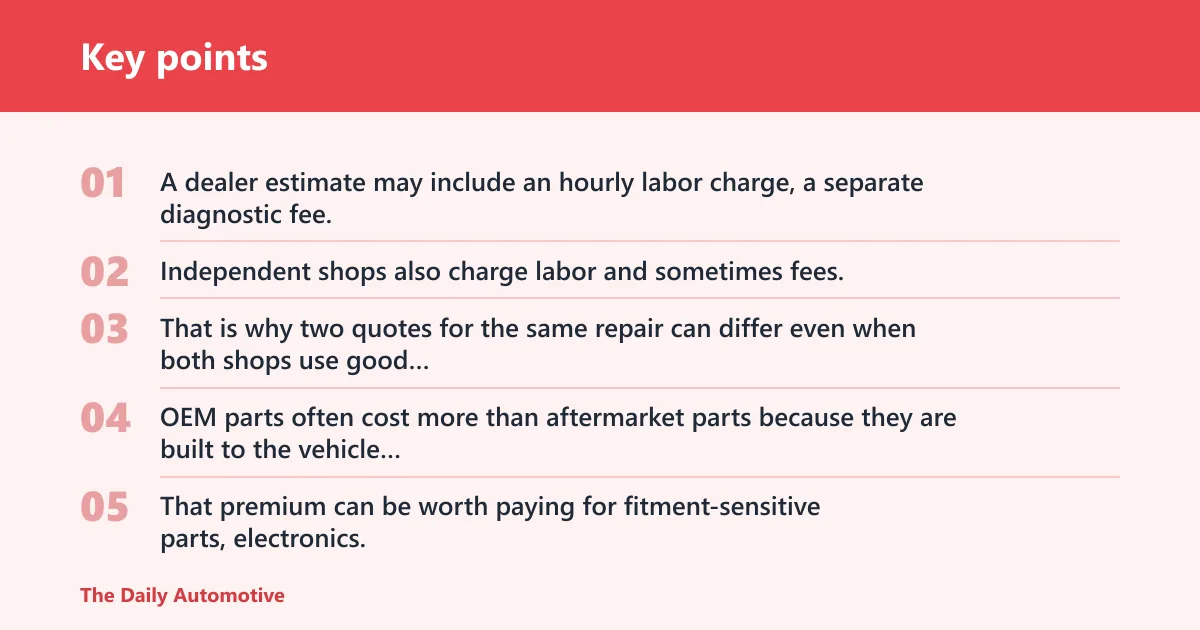
A dealer estimate may include an hourly labor charge, a separate diagnostic fee, shop supplies, and disposal fees. Independent shops also charge labor and sometimes fees, but the hourly rate is often lower. That is why two quotes for the same repair can differ even when both shops use good parts and proper procedures.
OEM parts premium versus aftermarket options
OEM parts often cost more than aftermarket parts because they are built to the vehicle maker’s specification and distributed through the brand’s supply chain. That premium can be worth paying for fitment-sensitive parts, electronics, and warranty disputes. For wear items like brake pads, filters, and many suspension parts, aftermarket options are often fine if quality is good.
How estimates can grow at the counter
A written estimate can rise once the inspection turns up extra work, such as worn tires, fluid leaks, seized hardware, or a failed sensor hidden behind the first fault. Ask the advisor to separate required repair items from recommended maintenance and from inspection findings. If the added work is not urgent, you can often decline it and revisit later.
When does an independent shop make more sense?
An independent shop makes more sense for routine maintenance after warranty, for common repairs with broad parts availability, and for owners who want lower labor rates without giving up good workmanship. It is also the better fit when you want to compare OEM and aftermarket parts before approving the job. The key is choosing a shop with the right equipment.
Routine maintenance after warranty
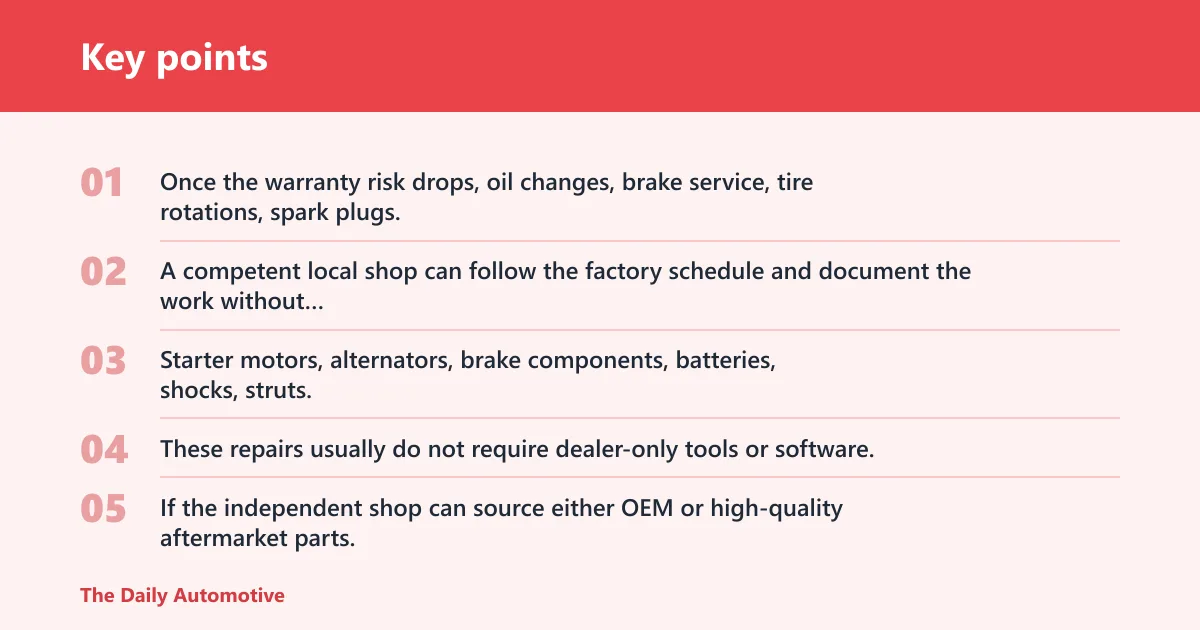
Once the warranty risk drops, oil changes, brake service, tire rotations, spark plugs, belts, and many fluid services usually move to the independent side of the ledger. A competent local shop can follow the factory schedule and document the work without dealer pricing. That saves money over years of ownership.
Common repairs with broad parts availability
Starter motors, alternators, brake components, batteries, shocks, struts, and many cooling-system parts are widely available. These repairs usually do not require dealer-only tools or software. If the independent shop can source either OEM or high-quality aftermarket parts, the dealer premium is often unnecessary.
Choosing a shop with the right equipment
Not every independent shop is the same. For late-model driver-assist systems, lane sensors, key programming, and EV service, ask whether the shop has the scan tools, calibration equipment, and training for your exact model. A general repair bay is enough for many jobs, but not for every one.
Suppose a 6-month-old sedan needs a software update and a camera calibration after a windshield replacement. The dealership is a strong choice because the procedure depends on brand software and service records. Now suppose the same sedan needs front brake pads at 42,000 miles after the warranty has ended. An independent brake specialist is usually the smarter spend.
Are service plans worth the upfront cost?
Service plans are worth the upfront cost only when the included visits match your actual mileage, the contract term fits how long you plan to keep the car, and the transfer rules do not trap value if you sell early. Many plans look good on paper and weak once the cap, exclusions, and real maintenance schedule are checked.
Covered intervals and mileage caps
Many prepaid plans cover specific visits, such as oil changes or scheduled inspections, up to a mileage cap like about 24,000 or 36,000 miles, or a time limit such as about two or three years. If you drive more than average, you may run out of coverage before the vehicle leaves your ownership. That lowers the value fast.
Transferability and contract limits
Some plans transfer to the next owner, which can help resale. Others do not. You should also check whether the plan covers only routine items or if it excludes brake pads, alignments, filters beyond basics, and fluid top-offs. The more exclusions the contract has, the closer the comparison must be to actual pay-as-you-go cost.
Break-even point versus pay-as-you-go
The break-even point is simple: add the plan price, then compare it with the same services bought one by one at today’s rates. If the total scheduled work over the term is clearly higher than the plan price, the plan may fit. If the savings are thin, pay as you go and keep flexibility.
Frequently asked questions
Is car dealership service worth it?
It is worth it for warranty-sensitive work, brand-specific diagnostics, and high-voltage EV repairs. For routine maintenance, the value is much lower unless the dealer price is close to an independent quote. The job type matters more than the badge on the service bay.
Are dealership service centers more expensive?
Usually, yes. Dealer labor rates, diagnostics, parts access, and shop fees tend to push the total higher than an independent shop. The gap is most noticeable on simple maintenance. On complex brand-specific work, the added cost can be easier to justify.
Why are dealerships so expensive for repairs?
They often charge more per hour, add diagnostic fees, and use OEM parts that cost more than aftermarket choices. Dealer facilities also carry the cost of factory training and tools. None of that means the repair is overpriced by default, but it does explain the bill.
What are the benefits of dealership service versus an independent mechanic?
The main benefits are factory scan tools, OEM parts access, warranty-compliant records, and technicians who work on that brand every day. An independent mechanic may still be the better value for brakes, oil changes, and other routine items after warranty.
When does dealership service make sense after warranty ends?
It still makes sense for complex diagnostics, software updates, safety-system calibration, and EV or hybrid high-voltage work. For routine maintenance and broad-coverage repairs, an independent shop usually offers a better value. After warranty, the dealer should earn the job, not assume it.
How do dealership service plans compare with pay-as-you-go repairs?
Service plans work best when the covered maintenance matches your mileage and the contract term. If you drive less than expected or sell early, pay-as-you-go usually wins. Compare the total plan cost with the exact services you expect to need before signing.
Products related to this article
Sponsored / affiliate links. As an Amazon Associate I earn from qualifying purchases. I may earn additional commission from eligible campaigns.