JDM ASTAR LED Headlight Bulbs Review
JDM ASTAR LED headlight bulbs are a buy only if the bulb base, depth, and chip position match your housing; if they do, they can work well, but the wrong fit often means glare, CANbus warnings, or a weak cutoff. Bad fitment can waste money and make night driving worse for you and oncoming traffic. This guide checks socket compatibility, beam pattern, error-code risk, and the housings where JDM ASTAR LEDs are most likely to perform well.
Verdict

The catch is simple: the brand’s catalog spans headlights, fog lights, reverse lights, and switchback bulbs, and those jobs do not behave the same in a car’s optics. Based on the published product details and seller profile, JDM ASTAR looks like a broad-budget catalog with over 60 products, an average rating of 4.8, 32,976 feedbacks in the last 12 months, and an average price of $23.10, but fitment still needs to be checked by socket and housing, not by the brand name alone.
Pros and cons
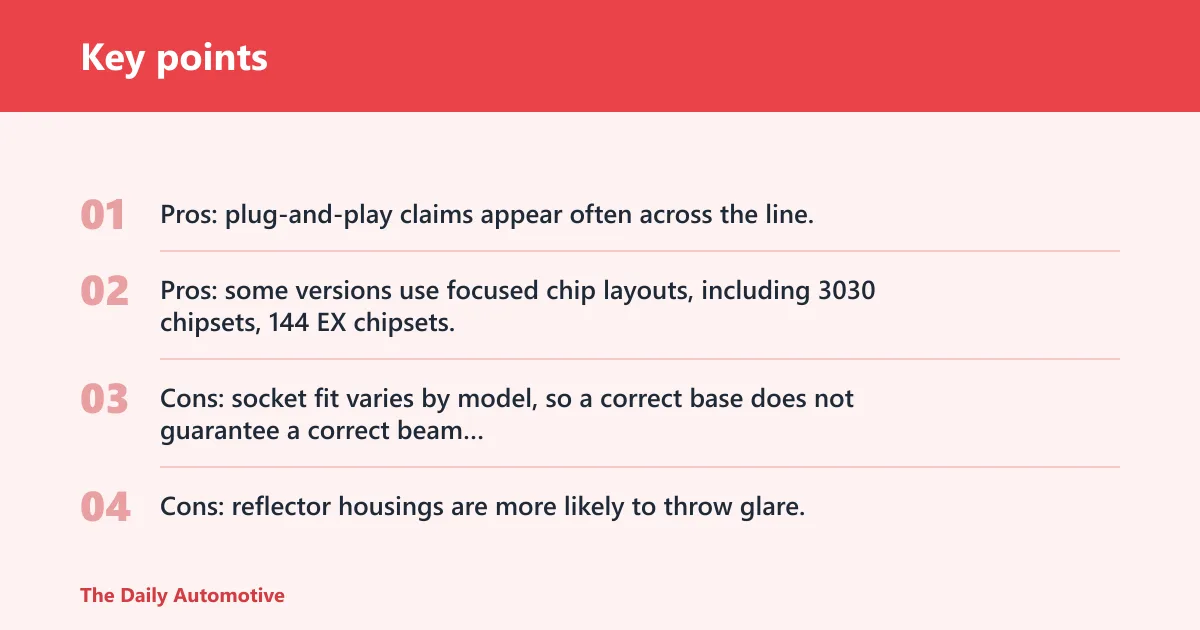
- Pros: plug-and-play claims appear often across the line; aluminum bodies and cooling fins support heat dissipation; several listings target common sockets and position-specific use.
- Pros: some versions use focused chip layouts, including 3030 chipsets, 144 EX chipsets, PX chips, AX-2835 chipsets, and 90-EX chipsets, which can matter more than raw brightness claims.
- Cons: socket fit varies by model, so a correct base does not guarantee a correct beam pattern.
- Cons: reflector housings are more likely to throw glare, and some vehicles may need resistors or a Canbus decoder.
Specs at a glance
| Item | What to check | Why it matters |
|---|---|---|
| Bulb type | Replacement LED bulb | Works only if the base and emitter position match the housing |
| Common socket families | H11, H16, 881, 3056, 3156, 3057, 3157, 7440 | Wrong socket means no install or poor retention |
| Chipset examples | 3030, 144 EX, PX, AX-2835, 90-EX | Chip layout affects output and beam focus |
| Cooling design | Aluminum body, cooling fins, passive heatsink | Helps heat dissipation in a compact shell |
| Install behavior | Plug-and-play, but vehicle-specific fitment | Some cars need resistors or a Canbus workaround |
| Output claims in the line | 50W high power, 2000 lumens, 360-degree shine | Useful only if the beam pattern stays controlled |
Who it
JDM ASTAR fits the buyer who already knows the exact socket, knows whether the car uses a projector or reflector housing, and wants a low-cost LED swap with specific beam-pattern expectations. It is a weaker match for anyone hoping for a universal brightness fix, because headlight optics decide whether the output looks clean or scattered.
Skip it if your housing has very little rear clearance, if your car is sensitive to bulb-out warnings, or if you want a near-OEM beam from a reflector housing without extra trial and error. A common first-timer mistake is buying by socket only, then discovering the new bulb hits the dust cap or throws light above the cutoff.
What works
The strongest case for JDM ASTAR is fitment-first value. The brand’s line includes socket-specific bulbs for common automotive positions, and its product pages frequently call out chip types, cooling hardware, and plug-and-play installation. That matters because beam focus, not raw output claims, decides whether the road ahead gets cleaner light or the next driver gets glare.
Projector housings are the better target. In a projector, a correctly placed LED emitter can keep the cutoff tighter and the beam more directional than the same bulb in a reflector shell. If the bulb uses a compact aluminum body with cooling fins and a passive heatsink, it is also more likely to survive in a tight rear cavity without cooking itself.
Say your car uses H11 low beams in a projector housing and the bulb depth clears the dust cap by a small margin. In that case, a focused LED with a sensible chip layout can be worth trying, because the housing already helps control the beam. The same bulb in a shallow reflector may look brighter in the driveway and worse on the road.
What does not?
The biggest drawback is inconsistency across the catalog. JDM ASTAR sells headlight, fog, reverse, and switchback bulbs under the same brand, but those products are not interchangeable in beam shape or legality. The 3030 switchback bulb, the 144 EX reverse bulb, the 90-EX 360-degree bulb, and the fog-light model rated at 50W high power all solve different problems.
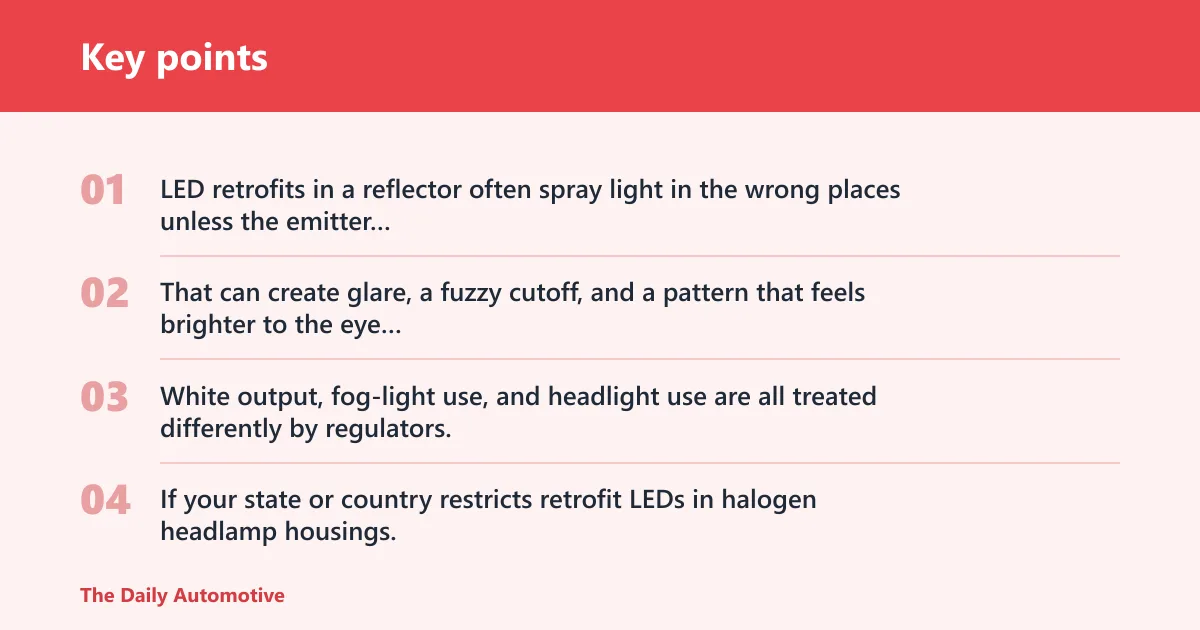
Reflector housings are the weak point. LED retrofits in a reflector often spray light in the wrong places unless the emitter sits where the halogen filament used to sit. That can create glare, a fuzzy cutoff, and a pattern that feels brighter to the eye while giving less useful reach on dark roads.
Legal use also stays local. White output, fog-light use, and headlight use are all treated differently by regulators, and color temperature alone does not make a bulb road legal. If your state or country restricts retrofit LEDs in halogen headlamp housings, the cleanest beam pattern still may not make the setup compliant.
Fitment decision table
This table separates the common JDM ASTAR bulb families by housing type, install friction, resistor risk, beam focus, and best use case. It is a decision aid, not a promise that every vehicle in that socket family will behave the same way.
| Bulb family | Typical housing type | Install friction | Canbus / resistor risk | Beam-focus strength | Best use case |
|---|---|---|---|---|---|
| H11 / H9 / H8-style LED headlight retrofits | Projector preferred; reflector higher risk | Moderate in tight housings | Medium; vehicle-specific | Better in projector housings | Low beams where cutoff control matters |
| H16 / 881-style small-base LED retrofits | Fog-light or compact front housing | Low to moderate | Low to medium | Moderate | Fog lights and compact positions |
| 3056 / 3156 / 3057 / 3157 reverse-light bulbs | Rear lamp assemblies | Low | Low to medium | Less about cutoff, more about spread | Reverse visibility |
| 7440-family position bulbs | Signal, DRL, or rear position use | Low | Medium, depending on vehicle monitoring | Low for headlight use | Position-specific lighting, not headlight use |
| 3030 chipset switchback bulb | Turn-signal / switchback application | Moderate | Medium to high | Not a headlight beam pattern part | Switchback signaling only |
| 90-EX chipset 360-degree shine bulb | Rear or auxiliary position | Low to moderate | Medium | Broad output, not a precise cutoff beam | Coverage and visibility in auxiliary roles |
Which JDM ASTAR bulb size fits my car?
Use the factory socket code first, then check the housing depth, dust-cap space, and bulb orientation. H11, H16, 881, 3056, 3156, 3057, 3157, and 7440 are not interchangeable in a practical sense, even when the tabs look close. Headlight fitment depends on the exact lamp position, not just the connector shape.
For headlights, H11 and H16-style fitments are the most relevant starting points in this catalog. For rear and auxiliary positions, 3056, 3156, 3057, 3157, and 7440 come up often, but those are not headlight replacements. The 921, 912, and T15 fitment named on one 360-degree bulb is another example of a position-specific lamp, not a headlight bulb.
- Check the owner’s manual or the old bulb base for the socket code.
- Measure rear clearance behind the headlamp or fog lamp.
- Look at whether the housing is projector or reflector.
- Check for bulb-out warnings or a CAN-bus monitored circuit.
- Confirm the bulb is meant for the position you are replacing.
Do JDM ASTAR LED bulbs need resistors or a canbus decoder?
Sometimes. If the car monitors bulb resistance closely, a low-draw LED can trigger flicker, a warning on the dash, or pulsing at startup. A resistor or Canbus decoder is most likely when the vehicle checks for halogen load, but the need varies by make, model, and lighting position.
Start with the symptom, not the accessory. Flicker usually points to communication or power regulation issues. A dashboard error points to load monitoring. Intermittent shutdown can point to heat or poor contact. If the bulb is physically tight, add-on hardware can make the rear of the lamp assembly even harder to close.
Suppose a 3157 switchback bulb flashes correctly on the bench but throws a warning once installed in the car. That suggests the vehicle expects a different electrical load, not that the bulb is bad. The fix is usually a compatible resistor or decoder, plus a recheck of polarity and grounding.
Troubleshooting checklist
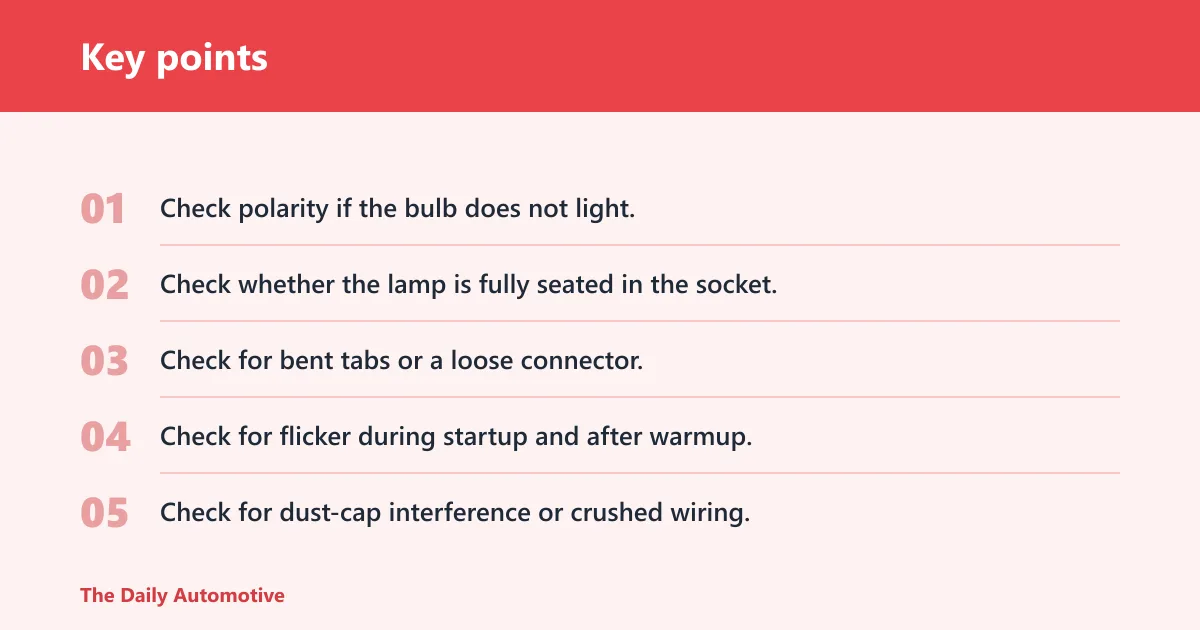
- Check polarity if the bulb does not light.
- Check whether the lamp is fully seated in the socket.
- Check for bent tabs or a loose connector.
- Check for flicker during startup and after warmup.
- Check for dust-cap interference or crushed wiring.
- Check whether the beam is aimed too high and causing glare.
- Check for moisture in the housing before blaming the bulb.
Are JDM ASTAR LED headlights too bright for road use?
They can be, if the beam pattern is wrong for the housing. Brightness alone is not the problem; uncontrolled light is. A projector housing can often manage a retrofit LED better than a reflector housing, while a reflector may scatter the same bulb into oncoming traffic or onto the hood line.
White output also does not guarantee legal use. Local rules can limit retrofit LEDs in halogen headlights, and some areas care about beam pattern as much as color. The safer rule is simple: if the cutoff gets fuzzy, the bulb is probably wrong for that housing even if the output seems strong.
Picture a compact sedan with a halogen reflector and a new LED that advertises 360-degree shine. That broad output may help in a reverse lamp, but in a headlight it can wash out the cutoff and push light where it does not belong. More output is not the same as better forward vision.
How do JDM ASTAR LED bulbs compare with halogen bulbs?
Compared with halogen, LED retrofits usually promise more visible output, lower power draw, and longer life claims. The trade-off is beam control. A halogen filament sits where the reflector or projector was designed to read it; an LED chip has to mimic that position closely or the pattern can suffer.
Halogen is still the safer baseline if you want predictable beam shape and no extra electrical surprises. LED is the better choice when the housing is compatible, the emitter placement is right, and the car does not need major workaround parts. The upgrade is about fit and focus first, brightness second.
Alternatives

SEALIGHT’s H11 option is the more obvious headlight alternative in the supplied product list because it is actually an H11 bulb. The published claims are aggressive, with 70,000LM, 6500K, and a 70,000 hour lifespan, but the same fitment cautions apply: it still needs the right housing, and a reflector can still throw glare if the beam pattern is off.
Compared with a broader JDM ASTAR catalog, this is the cleaner pick on paper for an H11 headlight buyer who wants a direct socket match. The drawback is that a high-output claim does not solve clearance, Canbus, or cutoff problems by itself, so you still need to verify depth and monitoring behavior before buying.
Should you buy it?
Buy JDM ASTAR only if you are matching the exact socket, housing type, and lamp position. That makes the brand a reasonable fitment-first option for some projectors, fog lamps, reverse lamps, and switchbacks, but not a universal headlight upgrade. For headlights, the safest path is a controlled beam pattern in a compatible housing, not the biggest lumen claim.
The line is most appealing to DIY buyers who can confirm socket size, check clearance, and tolerate some trial-and-error with resistors or Canbus hardware. If you want a one-and-done headlight swap with no glare risk, no warning lights, and no aiming work, a halogen replacement or a purpose-built projector setup is the safer route.
Frequently asked questions
Are JDM ASTAR LED headlight bulbs worth it?
They are worth it only when the housing, socket, and emitter position line up well. In that case, they can improve usable light and keep the beam controlled. If the fit is wrong, the upgrade can create glare, dash warnings, or a weak cutoff, which makes the road picture worse.
Will JDM ASTAR LED bulbs fit tight headlight housings?
Some will, some will not. Aluminum bodies, cooling fins, and passive heatsinks help with heat, but they also take space. Tight housings, shallow dust caps, and awkward wire paths are common failure points, so measure before buying and expect more friction in compact lamp assemblies.
Products related to this article
Sponsored / affiliate links. As an Amazon Associate I earn from qualifying purchases. I may earn additional commission from eligible campaigns.