AUXITO LED Interior Lights Review: Are They Worth It?
AUXITO LED interior lights are worth buying when you match bulb size, polarity, and load type. They fit best in map, dome, and trunk lights, while some vanity, courtesy, and mirror housings can create glare or trigger errors. Bad fitment can leave hot spots, flicker, warning lights, or a cabin that is harder to use at night. This review covers fitment, glare, CANbus/error risk, and which interior positions are smart swaps versus skips.
This guide is part of our Car exterior accessories guide series.
Verdict

Based on the manufacturer’s specs and published product details, this is a strong buy for simple interior upgrades, not a universal cabin fix. AUXITO advertises 300% brighter maximum visibility, plug-and-play installation, 45-day returns, and a 2-year warranty, but the real decision is whether your housing depth, socket type, and vehicle electronics suit a 6000K LED replacement.
Specs at a glance
| Spec | AUXITO 194 LED bulb |
|---|---|
| Voltage | 12V |
| Color temperature | 6000K xenon white |
| Power | 2W |
| Lighting angle | 360-degree |
| Socket fitment | 168, 175, 194, 2825, 912, 921, W5W, T10 |
| Install type | Plug-and-play |
| Error claim | Canbus error free for 99% of vehicles |
| Common uses | Map lights, dome lights, glove box lights, trunk cargo room lights |
Who it
AUXITO interior LEDs fit drivers who want brighter cabin lighting where extra output helps most: map lights, dome lights, trunk cargo areas, and glove boxes. They are also a practical pick for shoppers who want a low-cost upgrade and are willing to verify fitment before buying.
They suit daily commuters who need clearer cabin lighting, family vehicles that see frequent loading and unloading, and rideshare or delivery vehicles where passengers need to find belts, phones, or bags quickly. They are less attractive for older vehicles with sensitive body modules, or for shallow housings where a bright 6000K emitter can create hard reflections.
Pros and cons
- Pros: AUXITO advertises 300% brighter maximum visibility, 360-degree output, and plug-and-play installation.
- Pros: The 194 bulb listing covers several common interior socket sizes, which helps when the vehicle uses the T10/194 family.
- Pros: The brand offers 45-day returns and a 2-year warranty, which reduces the risk of a bad fit.
- Cons: 6000K white can feel harsh in some cabins, especially in vanity mirrors and shallow map-light housings.
- Cons: CANBUS results vary by vehicle, so error-free claims do not guarantee a clean install everywhere.
Are AUXITO LED interior lights worth it?
Yes, if you are replacing dim halogen interior bulbs in positions that benefit from a wider, whiter beam. They are most useful where you want coverage across a cabin or cargo area, not where you want a soft reading light. The value drops when the bulb sits close to a reflective lens or an exposed mirror surface.
The tradeoff is simple. AUXITO’s 6000K xenon white can make small items easier to find, but it can also expose glare and hot spots that halogens hid better. Picture a dome light above a dark cloth headliner: more output helps. Picture the same LED above a mirror vanity with a shallow lens: the same output can feel harsh.
What the upgrade does well
The strongest case for AUXITO is in map lights, dome lights, trunk cargo lights, and glove box lights. Those areas benefit from the 360-degree output and the brand’s claim of 300% brighter maximum visibility. In practice, that kind of spread is more useful in a cargo bay than in a narrow reading lamp.
Where the tradeoffs start
The tradeoffs start when the housing is shallow, the lens is clear, or the bulb points directly at the eyes. That is where 6000K white can look colder than expected and where the beam pattern can feel less comfortable at night. For vanity and sun visor lights, many buyers are better off staying selective rather than changing every bulb.
Who should pass?
Skip them if your vehicle already has sensitive lighting electronics, if you dislike cool-white cabin light, or if the housing leaves almost no room around the bulb. A common first-timer mistake is replacing a single warm courtesy bulb with a 6000K LED and then deciding the whole cabin looks too blue or too bright.
Who it fits best
Daily commuters get the most predictable value when the goal is simple visibility. A brighter dome light helps you find dropped items. A clearer trunk light helps at night. A brighter glove box light helps when reading registration papers or insurance cards.
Family vehicles and rideshares also benefit, because passengers often use map lights, rear dome lights, and cargo areas more than a single driver does. Older vehicles with sensitive electronics are the harder case. Those owners should be more cautious about CANBUS warnings, flicker, and bulb polarity than about raw brightness.
Which bulb size fits your cabin?
The T10 / 194 / 168 family covers many interior applications, but fitment still varies by trim, year, and model. Use the owner’s manual or remove the existing bulb before buying. If the bulb shape, base width, or socket style does not match, a “fits most” listing is not enough.
For AUXITO’s 194 LED bulb, the listing states compatibility with 168, 175, 194, 2825, 912, 921, W5W, and T10 sockets. That covers a lot of common map, dome, glove box, and trunk cargo lamps. It does not remove the need to verify depth and lens clearance before ordering.
Common cabin positions
- Map lights: Often T10 or 194 family bulbs, depending on trim.
- Dome lights: Common interior swap point, especially in larger cabins.
- Reading lights: Can work well, but glare rises quickly in shallow housings.
- Glove box lights: Usually a strong candidate because output matters more than color.
- Trunk cargo lights: One of the best use cases for a brighter LED.
- Vanity mirror / sun visor lights: Highest glare risk in this group.
How to verify fitment before buying
- Check the owner’s manual for the bulb code.
- Remove the existing bulb and read the base marking if it is visible.
- Compare socket family, not just shape, because 194, 168, and T10 listings overlap in marketing but not always in physical fit.
- Measure housing depth if the lens is shallow or the bulb sits close to a reflector.
- Use AUXITO’s vehicle bulb finder if you cannot confirm the match from the manual or the old bulb.
Interior light decision table
| Bulb position | Common socket size | Expected payoff | Glare risk | CANBUS risk | Strong buy? |
|---|---|---|---|---|---|
| Map light | T10 / 194 family | High for finding items and reading labels | Medium to high in shallow housings | Medium on newer cars | Yes, if lens depth is adequate |
| Dome light | 194 / 168 / festoon in some vehicles | High for overall cabin visibility | Medium | Medium | Yes, often the best first swap |
| Trunk cargo light | 194 / T10 | High in dark cargo areas | Low to medium | Low to medium | Yes |
| Glove box light | 194 / 168 / T10 | Moderate, but useful | Low | Low to medium | Yes, if the bulb runs cool enough in enclosure |
| Vanity mirror light | 194 / festoon / trim-specific | Moderate for cosmetics and grooming | High | Medium | No, unless you want a very white look |
| Courtesy / door light | T10 / 194 family | Moderate | Medium | Medium to high on some vehicles | Maybe, based on housing depth |
Do AUXITO LED bulbs flicker or throw errors?
They can. AUXITO advertises the 194 bulb as canbus error free for 99% of vehicles, but that is not the same as universal compatibility. Some cars still need a decoder or resistor, and some cabins react to polarity, load monitoring, or bulb-check routines in ways that cause flicker or warning messages.
That matters most in newer vehicles and in cars with body-control modules that watch every light circuit. If the bulb fits physically but the system sees the load as wrong, you can get strobing, a lamp-out message, or a bulb that only works after flipping it around.
CANBUS limits
The brand’s claim is strong, but vehicle electronics decide the final result. “Error free for 99% of vehicles” still leaves out a meaningful number of sensitive cars. If your vehicle is known for hyperflash, bulb-out warnings, or pulse-width modulation issues, assume you may need extra hardware.
Polarity and housing-depth issues
Non-polarity plug-and-play bulbs are convenient, but not every interior LED behaves the same in every socket. Some fixtures are so shallow that the LED sits too close to the lens, which concentrates the light into a hot spot instead of spreading it evenly. That is a fitment problem, not a brightness problem.
When a decoder or resistor helps
A decoder or resistor can help when the bulb itself is fine but the vehicle thinks the circuit is faulty. Use that approach when the symptoms are error messages, rapid flicker, or intermittent operation after a confirmed fitment. If the issue is physical clearance, a decoder will not fix it.
What works
The best results come from positions that need broad, practical light. AUXITO’s 360-degree output makes sense in a dome or trunk because the goal is coverage, not beam control. The 6000K xenon white also makes dark fabric, cargo contents, and small print easier to see than a weak yellow halogen.
The 2W draw on the 194 bulb is another useful detail because it fits the usual interior-light goal: more visibility without building unnecessary heat. That said, enclosed housings still deserve caution. Lower wattage does not automatically mean every enclosure stays happy if the LED sits too close to plastic.
Brightness and beam pattern
More output is useful when the cabin has shadows or the cargo bay is deep. A 360-degree design reduces blind spots compared with a forward-facing chip layout. That is why these bulbs make more sense in dome and trunk positions than in tiny mirror housings.
Color temperature tradeoff
6000K is bright and crisp, but it is not the warmest choice for late-night use. It can reduce perceived comfort because the light reads colder and can make reflective trim feel harsher. AUXITO’s ultra blue variant would lean even farther away from night comfort, so buyers who want a calmer cabin should stay with standard white or skip the upgrade in sensitive positions.
Say your cabin has a dim trunk lamp. Say your trunk uses a T10 bulb and the factory light leaves one side of the cargo floor dark. A 360-degree LED is a smart swap there because the lens is usually less eye-level, glare matters less, and the extra output helps you see straps, groceries, or tools quickly.
What does not?
Not every interior socket benefits from a whiter, brighter LED. Shallow vanity mirrors, exposed courtesy lamps, and some reading lights can become uncomfortable if the bulb is too intense or the lens is too clear. In those spots, the upgrade can feel more like glare than improvement.
Another drawback is the gap between fit and function. A bulb can match the socket size and still be wrong for the housing depth, heat path, or vehicle electronics. That is why “plug-and-play” should be read as “easy when the vehicle agrees,” not “works everywhere.”
When to choose a warmer bulb
Choose a warmer bulb if you want less eye strain at night or if the cabin already has bright white dash and screen lighting. A softer color works better in vanity mirrors and some front-map positions, where you want usable light without turning the cab into a daylight bulb test.
When to replace only select positions
Replacing every interior bulb at once is often unnecessary. Start with the trunk, glove box, and dome light. If those work cleanly, move to map lights only if the housing has enough depth and the color still feels comfortable at night.
A common first-timer mistake is…
A common first-timer mistake is buying a full cabin set because every bulb lists the same base family, then discovering that the vanity mirror housing is too shallow and the light is painfully bright. One variable changed: the position. The socket fit is fine. The use case is not.
Alternatives
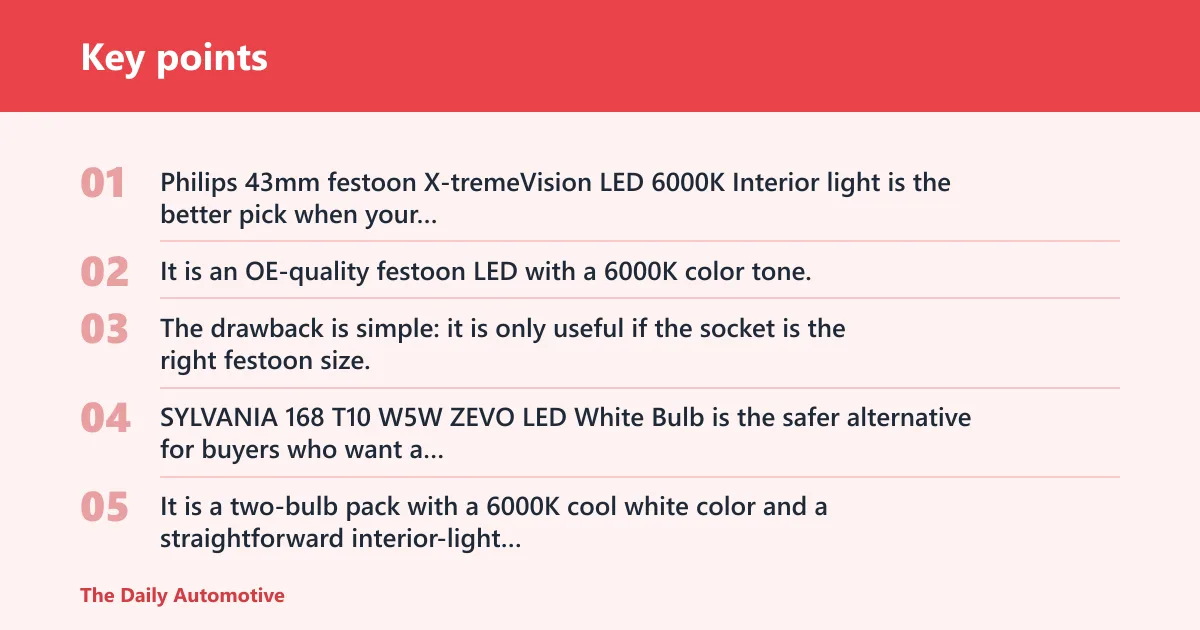

It is an OE-quality festoon LED with a 6000K color tone, so the fitment story matters more than the brand name here. The drawback is simple: it is only useful if the socket is the right festoon size, and it will not solve a T10 or wedge-bulb cabin.

SYLVANIA 168 T10 W5W ZEVO LED White Bulb is the safer alternative for buyers who want a mainstream 168/T10 option from a major lighting brand. It is a two-bulb pack with a 6000K cool white color and a straightforward interior-light use case. The drawback is cost: it is pricier than AUXITO’s 10-pack approach, and it still needs the same fitment checks for polarity, depth, and CANBUS behavior.
Should you buy it?
Buy AUXITO if you want a brighter cabin, you know your bulb code, and your target positions are map, dome, trunk, or glove box lights. Skip or narrow the order if you are dealing with vanity mirrors, very shallow housings, or a vehicle that has already shown sensitivity to LED load changes. That is the cleanest way to avoid glare and error codes.
The best buying move is selective replacement. Use AUXITO where the beam pattern helps and the electronics are forgiving. Leave alone the positions that are likely to feel harsh or trigger warnings. That approach gives you most of the upside without turning the whole cabin into a fitment puzzle.
AUXITO’s bulb finder makes that easier because it uses a year-make-model selection flow, and the site tells shoppers to use the full bulb finder if they cannot find their vehicle. That support path matters more than the marketing claim. It is what helps you avoid the wrong base, the wrong depth, or the wrong circuit type.
Frequently asked questions
Are AUXITO LED bulbs good?
They are good when you use them in the right place. Based on specs and reviews, AUXITO is strongest in simple interior positions where more light is the main goal. The brand’s 300% brightness claim, 6000K white output, and plug-and-play design make sense there, but fitment still decides the final result.
Are AUXITO LED headlights any good?
That question points to a different product category. Walmart listings show AUXITO H11 headlight bulbs with 12,000 lumens and 300% brighter claims, and another listing for 2026 Latest H11 bulbs at 30,000 lumens and 6500K cool white. For this review, the better question is whether their interior bulbs fit your cabin and electronics.
Is AUXITO good for interior lights?
Yes, especially for map lights, dome lights, glove box lights, and trunk cargo lights. The 194 LED bulb listing uses 12V, 6000K xenon white, 2W power, and a 360-degree lighting angle, which suits general cabin use. The weak spots are glare-prone housings and vehicles with picky lighting modules.
Which AUXITO bulb fits my dome light?
Start with the owner’s manual or the current bulb code. If the dome housing is a festoon style or has a shallow lens, a different bulb family may be required.
How bright are AUXITO 194 interior bulbs?
That does not mean every cabin will look the same, because housing depth, lens color, and socket position change what you actually see. The brightness is useful, but placement matters more.
Products related to this article
Sponsored / affiliate links. As an Amazon Associate I earn from qualifying purchases. I may earn additional commission from eligible campaigns.