12V Car Battery vs 24V Battery
A 12V battery fits most passenger vehicles; 24V systems are common on some trucks, buses, and heavy equipment, and you should replace a battery with the same system voltage. Buy the wrong voltage, and the vehicle may not start, the charging system may be mismatched, or electronic parts can be damaged. This guide explains how 12V and 24V systems differ, how to identify your vehicle’s setup, and what to check before buying parts.
| Decision factor | Car Battery | 24V Battery | Winner |
|---|---|---|---|
| Typical vehicle fit | Most passenger vehicles, SUVs, and smaller vehicles | Heavy-duty trucks, buses, and some off-road equipment | Car Battery |
| Starting compatibility | Matches normal 12V starting systems | Matches 24V starting systems only | Tie |
| Accessory compatibility | Fits common 12V accessories directly | May need a DC-DC converter for 12V devices | Car Battery |
| System architecture | Usually a single 12V battery or a 12V bank | Often built from two 12V batteries in series | Car Battery |
| Purchase complexity | Usually simpler to match by voltage, group size, and CCA | Requires checking battery bank layout and accessory needs | Car Battery |
| Do not use for | 24V vehicle platforms | Normal 12V passenger cars | Neither |
What voltage means in a vehicle electrical system
Voltage is the electrical pressure that pushes current through a vehicle’s wiring. Most passenger cars, SUVs, and light-duty trucks use 12 volts. 24 volts is more common in trucks, buses, and other heavy-duty platforms built for larger starting loads and more electrical gear.
That difference matters because the battery is only one part of the system. The starter motor, alternator, wiring, relays, and accessories are designed around a specific system voltage. Change the voltage without changing the rest of the architecture, and the vehicle can refuse to start or suffer electrical damage.
Voltage is not the same as capacity. Amp-hours, or Ah, describe how much charge a battery can store, while watt-hours, or Wh, describe total energy using the formula Wh = volts × Ah. That is why two battery systems can look similar on paper and still behave very differently in a vehicle.
Why 24V is common in heavy-duty platforms and 12V in passenger cars
Passenger cars are built around 12V systems because they are compact, widely available, and easier to install. Heavy-duty vehicles such as trucks and buses may require 24V systems because the platform is built for larger electrical loads and higher starting demand.
A 24V system can move the same power with less current than a 12V system. In one common example, the same 1200W load uses 50 amps at 24V instead of 100 amps at 12V. That cuts heat and can improve efficiency in larger loads, but it does not make 24V a drop-in replacement for a normal car.
What is a 12V car battery?
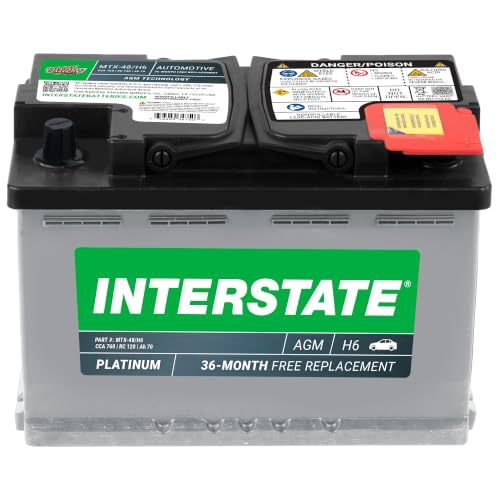
A 12V car battery is the standard battery used in most passenger vehicles. It powers engine starting and runs normal accessory loads in the vehicle’s 12V electrical system.
Retail listings for automotive batteries usually sort them by group size and voltage. That matters because the correct replacement must fit the battery tray, terminal layout, and charging system, not just the voltage number on the label.
Where 12V batteries are used
Most passenger vehicles use 12-volt batteries as the standard. They are also common in SUVs, light-duty cars, and many smaller vehicles where the electrical system is built around a single 12V battery.
That is why 12V batteries are widely available. They are also described as lightweight and compact, which makes them easier to package in a passenger vehicle than a larger multi-battery 24V setup.
What CCA and group size tell you
Cold cranking amps, or CCA, is a starting-performance number that appears on many automotive battery listings. A higher CCA rating can matter when the engine has to crank in cold weather or when the starter demands more current.
Group size tells you the physical case and terminal layout. For example, Walmart lists Group 24F at 12 volts, Group H6 / LN3 / 48 as 12 volts and 615 CCA, and Group 47 AGM as 12 volts and 680 CCA. Those details show why voltage alone is not enough.
What a 12V reading means on a multimeter
A reading around 12.4 volts means the battery has some charge, but it is not a full yes-or-no answer by itself. A resting voltage reading does not confirm that the battery fits the vehicle’s system, that the CCA is adequate, or that the terminals and group size are correct.
Suppose a car shows 12.4 volts at rest but cranks slowly. That could still point to a battery that is weak under load, undersized for the vehicle, or mismatched to the starting system. Voltage alone cannot rule those out.
What is a 24V battery system?
A 24V battery system is a vehicle electrical architecture built to supply 24 volts to the starter and connected equipment. It is common in heavy-duty trucks, buses, and some off-road equipment, but it is not a substitute for a 12V car battery in a normal passenger car.
In many vehicles, a 24V system can be built from two 12V batteries. That setup changes the system voltage, the wiring arrangement, and the accessory requirements, so you need to match the vehicle platform before buying.
Two 12V batteries in series
Two 12V batteries in series make 24V. In the cited example, two 12V 100Ah batteries in series produce 24V 100Ah. The voltage adds, but the amp-hours stay the same in series.
That is the key reason 24V battery banks are not just “bigger 12V batteries.” They are wired for a different system voltage. If the vehicle is built for 24V, that wiring is part of the design.
Where 24V systems are used
Heavy-duty vehicles such as trucks or buses may require 24-volt batteries. Some off-road equipment also uses 24V because the platform is designed for higher electrical demand and a different starting system.
24V can be more efficient for larger loads because the system can deliver the same power with less current. But that advantage only matters when the vehicle is designed for it.
Why 12V accessories need special attention
A 24V system may need DC-DC converters for 12V devices. That is the practical issue many buyers miss: phones, radios, lights, and many accessories are built for 12V, not 24V.
If the platform is 24V and the accessory is 12V, you need a converter or another approved step-down provision. Without that, the accessory can be damaged by the wrong voltage.
Car Battery vs 24V Battery decision table
Use the table below as a buying filter. It maps the vehicle class to the system voltage, starting compatibility, and the checks that matter before you purchase anything.
| Vehicle type | System voltage | Starting compatibility | Required checks |
|---|---|---|---|
| Passenger car | 12V | Use a 12V battery matched to the tray and terminals | Check group size, CCA, and terminal layout |
| Light truck | Usually 12V | Use the voltage listed for that exact model | Check group size, CCA, and whether the battery tray accepts the case size |
| Heavy-duty truck or bus | 24V | Use the platform’s 24V starting system | Check series-battery layout, system voltage, and accessory requirements |
| Off-road equipment | Often 24V, sometimes 12V | Match the machine’s electrical architecture | Check the owner manual, battery count, and accessory voltage |
| 24V-to-12V accessory setup | 24V source with 12V load | Only with a proper step-down solution | Check DC-DC converter need, accessory amperage, and wiring protection |
| Do not do this: wrong-voltage replacement | 12V battery in a 24V system, or 24V battery in a 12V system | Not compatible | Avoid no-starts, charging mismatch, and accessory damage |
How do you make 24V from two 12V batteries?
You make 24V by wiring two 12V batteries in series. Series connection adds voltage, so two 12V batteries become a 24V bank. The amp-hours stay the same in series, so the bank is not automatically larger in capacity.
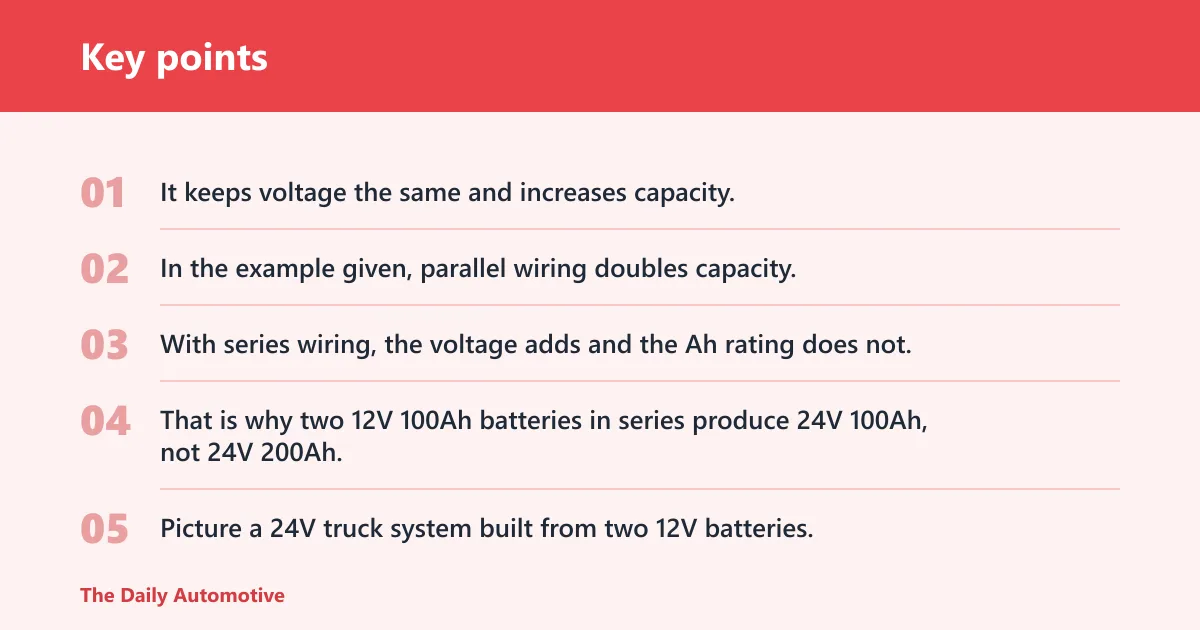
Parallel wiring does the opposite. It keeps voltage the same and increases capacity. In the example given, parallel wiring doubles capacity, which is why it is used to build larger 12V banks rather than 24V banks.
Series wiring keeps amp-hours the same
With series wiring, the voltage adds and the Ah rating does not. That is why two 12V 100Ah batteries in series produce 24V 100Ah, not 24V 200Ah.
Picture a 24V truck system built from two 12V batteries. If one battery is replaced with the wrong group or wrong voltage, the whole bank can be unbalanced. That can create starting problems and charging issues.
Parallel wiring keeps voltage the same
Parallel wiring is used when you want more capacity at the same voltage. The system stays 12V, but the available capacity increases.
That distinction matters in vehicle context. A driver trying to “make 24V” by wiring batteries in parallel will not get 24V at all. The system will stay 12V.
Why bank wiring changes the result
The final system voltage depends on how the batteries are connected, not just how many batteries you buy. The same two batteries can create a higher-voltage bank in series or a larger-capacity bank in parallel.
A common first-timer mistake is buying two 12V batteries for a 24V platform and wiring them the wrong way. The vehicle may still not start, and accessory protection can be wrong if the wiring does not match the manual.
Which checks should you make before buying?
Confirm the vehicle’s system voltage first. Then check the battery group size, terminal layout, CCA, and whether a DC-DC converter is needed for any 12V accessories. Voltage alone is not enough to choose the right part.
- Check the owner manual or the old battery label for system voltage.
- Match the battery group size and terminal layout to the tray and cables.
- Check CCA if the battery has to start an engine.
- Confirm whether the vehicle uses a 24V bank built from two 12V batteries.
- Check whether any 12V accessories need a DC-DC converter.
- Do not buy a replacement until the voltage and fitment both match.
Suppose a light truck uses a 12V starting system but the owner chooses a 24V battery because it sounds stronger. That battery will not fix a fitment mismatch, and it can create starting or charging problems if the truck was never designed for 24V.
Choose Car Battery if… / Choose 24V Battery if…
Choose Car Battery if you drive a normal passenger vehicle, SUV, or light-duty truck that uses a 12V starting system. Choose it if you need a common replacement with the right group size, terminal layout, and CCA for a typical automotive setup.
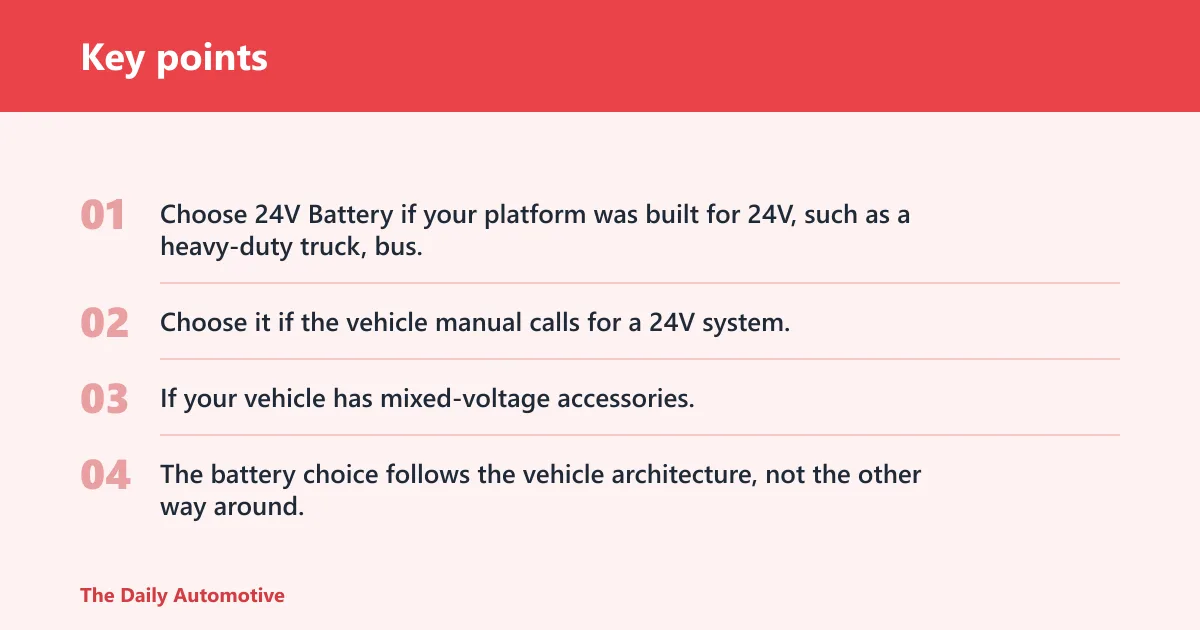
Choose 24V Battery if your platform was built for 24V, such as a heavy-duty truck, bus, or some off-road equipment. Choose it if the vehicle manual calls for a 24V system, or if the machine uses two 12V batteries in series and may also need a DC-DC converter for 12V accessories.
If your vehicle has mixed-voltage accessories, match the main system first and then check accessory protection separately. The battery choice follows the vehicle architecture, not the other way around.

Frequently asked questions
Are car batteries 12v or 24v?
Most car batteries are 12V because most passenger vehicles use a 12-volt electrical system. 24V is more common in trucks, buses, and heavy equipment. Replace the battery with the same system voltage listed by the vehicle manual or on the existing battery label.
What’s the difference between 12v and 24v?
The difference is system voltage. A 12V system is the common passenger-car setup, while a 24V system is used more often in heavy-duty platforms. Two 12V batteries in series make 24V, and 24V systems may need DC-DC converters for 12V accessories.
What is a 24v battery?
A 24V battery system is a vehicle setup built around 24 volts, common in heavy-duty trucks, buses, and some off-road equipment. It is often made from two 12V batteries in series. It is not a drop-in replacement for a 12V car battery.
Are car batteries 12v or 6v?
Most modern car batteries are 12V, not 6V. Six-volt batteries are associated with older vehicle designs, not the typical passenger car on the road today. If you are buying a replacement, check the existing label and the owner manual before ordering.
Is 12.4 volts okay for a car battery?
12.4 volts can mean the battery has some charge, but it does not prove the battery is correct for the vehicle or strong enough under load. It is only a resting reading. You still need to confirm system voltage, group size, and CCA before buying a replacement.
Products related to this article
Sponsored / affiliate links. As an Amazon Associate I earn from qualifying purchases. I may earn additional commission from eligible campaigns.