LED Light Conversion Kits for Cars: Are They Street Legal?
LED headlight conversion kits are street legal only when the bulb, housing, beam pattern, and local rules all line up; many retrofit kits are illegal in halogen reflector housings, even if the kit itself is sold as DOT-approved. Get it wrong and you risk failed inspections, traffic stops, fines, and a beam that blinds other drivers. Check the lamp type, the cutoff, the socket, and the rules where the car is registered or driven before you buy.
Factors that determine LED kit legality
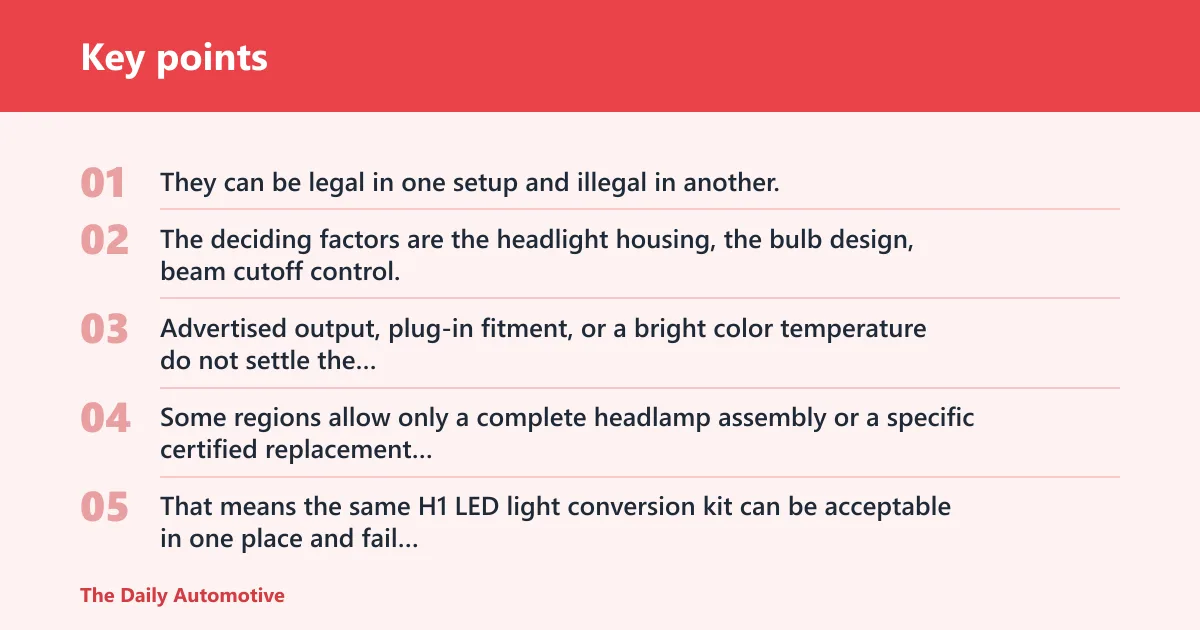

They can be legal in one setup and illegal in another. The deciding factors are the headlight housing, the bulb design, beam cutoff control, aiming, and the rules where the vehicle is registered or driven. Advertised output, plug-in fitment, or a bright color temperature do not settle the question.
Why legality changes by country and state
Lighting rules differ across jurisdictions. Some regions allow only a complete headlamp assembly or a specific certified replacement lamp, while others allow certain bulb conversions only when the beam pattern stays within the required cutoff and glare limits. That means the same H1 LED light conversion kit can be acceptable in one place and fail inspection in another.
Why bulb design alone is not the answer
A bulb base size tells you what socket it fits, not whether the beam is lawful. An aftermarket retrofit light source rated for 12V-24V may still throw light into the wrong part of a reflector housing. That is why a kit can fit physically and still be a compliance problem.
Why beam pattern and aim matter
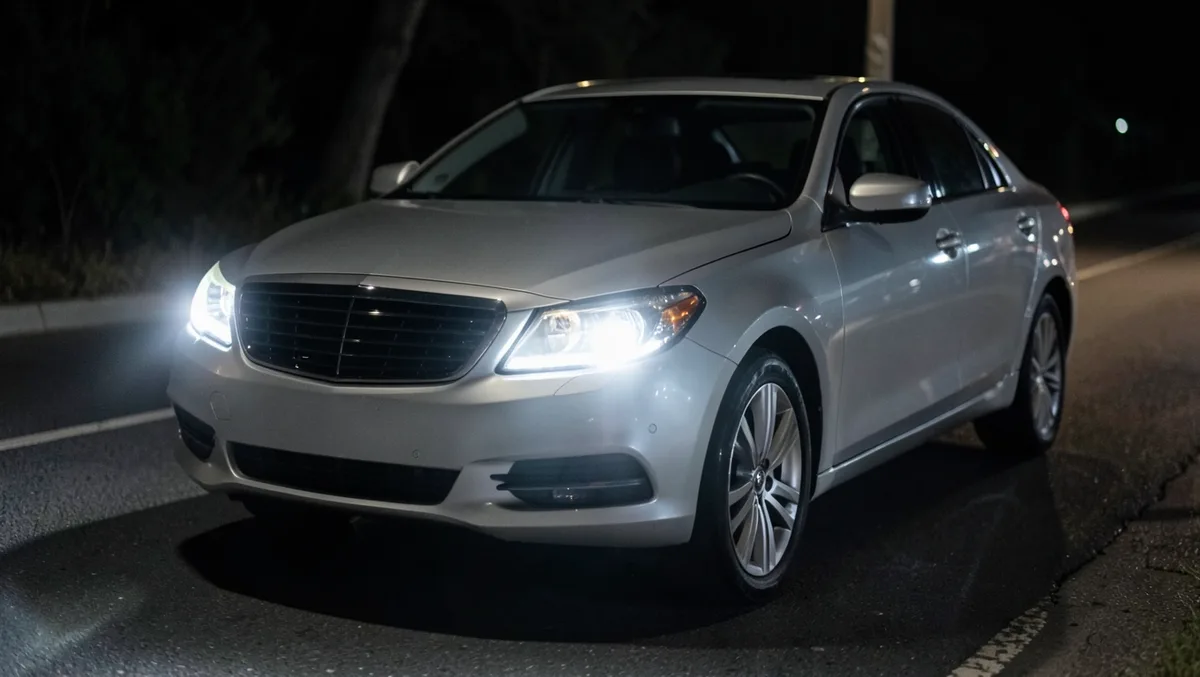
Inspectors and enforcement officers care about what the road sees. A proper cutoff keeps light on the pavement and off oncoming drivers’ eyes. If an LED source is placed in a reflector designed for halogen filament geometry, the beam often spreads too high or too wide. That is the glare risk, and it is often what makes the setup fail.
What makes a retrofit legal or illegal?
The legal line is usually drawn by how the lamp system controls light, not by the fact that it is LED. Halogen reflector retrofits are the most common problem, projector housings are more forgiving when the cutoff is preserved, and OEM projector replacements are usually the cleanest path when the vehicle was designed for that lamp family.
Halogen reflector retrofits
These are often considered the highest-risk swaps. A halogen reflector is shaped around a filament position and a specific light-emitting area. Put an LED chip in the same socket and the reflector may no longer control the beam correctly. Even a kit advertised at about 6,000LM per bulb, 11,000LM, 18,000LM, 20,000LM, or 24,000LM does not become legal just because it is bright.
Projector housings and cutoff control
Projectors can handle retrofits better because the lens and shield help control the beam. Still, the bulb has to sit in the correct focal position, and the housing must keep a sharp cutoff. If the pattern blooms above the cutoff or scatters to the sides, the retrofit can still fail a road-use check.
OEM projector replacements and housing changes
An OEM projector replacement or a full assembly swap is often the safer compliance route because the light source and optics were designed together. That does not guarantee legality everywhere, but it removes one common failure point: forcing a new light source into a reflector made for a different emitter shape.
Will LED conversion bulbs fit my car?
Fitment depends on more than the bulb base. You need the correct socket size, enough room for the heat management system, and electrical compatibility with the vehicle’s DC 12V-24V system. A bulb can be sold as compatible with 99% vehicles and still fail on a specific car because the dust cap, connector, or warning system does not cooperate.
Headlight bulb base sizes and socket match
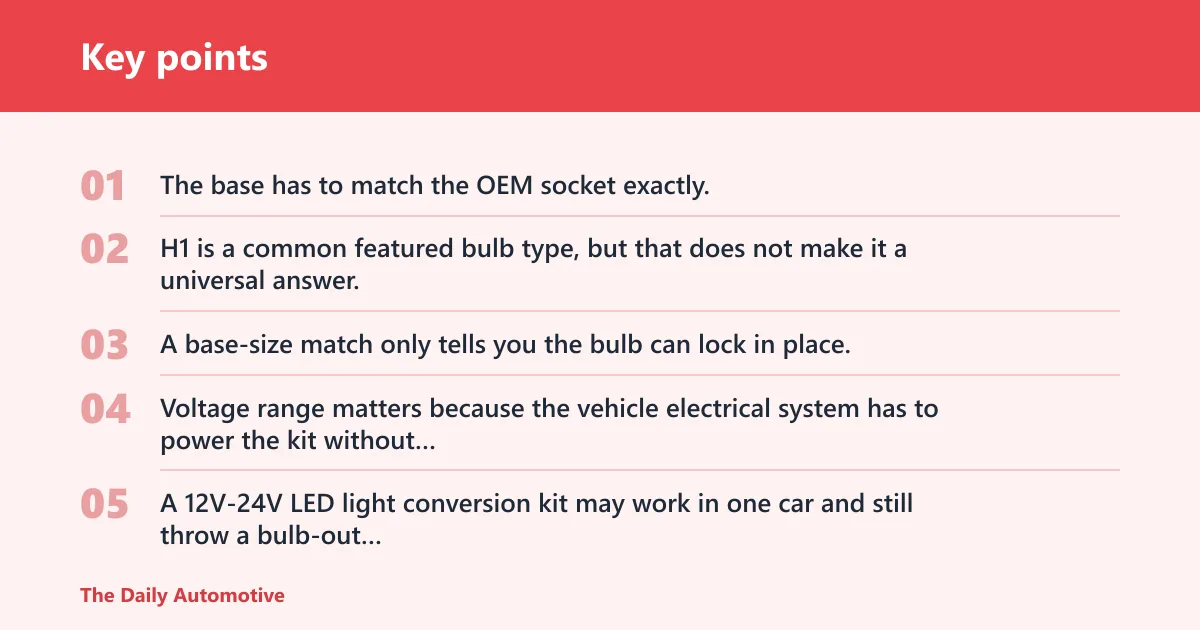
The base has to match the OEM socket exactly. H1 is a common featured bulb type, but that does not make it a universal answer. A base-size match only tells you the bulb can lock in place; it says nothing about beam focus, dust cap clearance, or whether the headlight optics were built for an LED emitter.
DC 12V-24V electrical compatibility
Voltage range matters because the vehicle electrical system has to power the kit without confusing the body control module or dash warnings. A 12V-24V LED light conversion kit may work in one car and still throw a bulb-out message in another if the load profile looks wrong to the vehicle. That is where canbus modules, decoders, or resistors enter the picture.
Dust cap clearance and cooling hardware
Many LED bulbs use a cooling fan or heat sink, plus dual heat dissipation hardware. Some add an integrated IC or intelligent temperature controller to regulate output and protect the chips. If the rear housing is too shallow, the dust cap will not fit, or the fan will be blocked. That can shorten lifespan and turn a neat-looking install into a moisture problem.
Say your car uses an H1 halogen reflector with a tight dust cap. The bulb may lock into the socket, but the rear fan sticks into the cap and the cap no longer seals. The result is not just a fitment nuisance; it can also trap heat and leave the lamp assembly exposed to moisture.
LED conversion legality checklist
Use this as a jurisdiction-neutral screening tool before you buy or install. It does not replace local law, but it will help you separate a legal-looking listing from a road-ready setup.
| Modification type | Likely legal risk | What must be verified | Common failure point |
|---|---|---|---|
| Halogen reflector retrofits | High glare risk and frequent inspection failure | Beam cutoff, hotspot placement, aim, and local approval rules for bulb retrofits | Light scatters above cutoff or into opposing lanes |
| Projector retrofits | Moderate risk if the focal point is wrong | Lens cutoff quality, emitter alignment, and whether the projector was designed for the source | Blurred cutoff or sideways spill |
| OEM projector replacements | Lower risk when the assembly matches the vehicle’s approved lamp design | OEM compatibility, certification status, and installation per the vehicle and lamp manual | Wrong assembly variant or improper aiming |
| Resistor and decoder additions | Mixed risk because they solve warnings but add heat and complexity | Whether the vehicle needs load simulation, whether extra hardware is permitted, and where it can be mounted safely | Hot components, false fixes, or continued flicker |
- Confirm the vehicle’s headlight type: reflector, projector, or OEM LED projector.
- Match the bulb base size to the exact OEM socket.
- Check whether the lamp assembly was designed for LED or halogen optics.
- Verify dust cap clearance and cooling hardware space.
- Confirm DC 12V-24V compatibility and warning-light behavior.
- Check your local inspection rules before the purchase.
Do you need a resistor or decoder?
Sometimes yes, sometimes no. A resistor or decoder is used to address bulb-out warnings, flickering, or strobing when the car’s electrical system expects a different load than the LED bulb presents. Some European vehicles need this more often, but the tradeoff is extra hardware, extra heat, and another possible failure point.
Bulb-out warnings and load detection
Modern cars often monitor current draw. If the LED bulb uses less power than the original halogen load, the car may assume the bulb has failed. A decoder or resistor can simulate the expected load and stop the warning. That does not guarantee legal compliance, but it can make the lamp function correctly on the vehicle network.
Flicker and strobing causes
Flicker can come from pulse-width modulation, poor driver compatibility, unstable voltage supply, or a module that keeps checking bulb status. If the kit has 2PCS multi-core technology chips and an integrated IC, that may help with control, but it does not rule out compatibility problems with the car’s electronics.
Tradeoffs of added hardware
Extra load hardware can run hot. It can also be awkward to mount, especially in a small headlamp cavity. If it is installed poorly, the fix can create new problems while hiding the original warning light. That is why a decoder should be treated as a compatibility tool, not a legal shortcut.
A common first-timer mistake is buying a bulb that stops the dashboard warning but still leaves the beam pattern wrong. The light may seem steady, yet the reflector still throws glare upward. That setup can pass the electronics check and fail the road-safety check.
How do brightness and color temperature affect compliance?
Brightness and color temperature affect visibility and appearance, but they do not decide legality by themselves. A kit listed at 6,000LM per bulb, 30W per bulb with a 10% tolerance, or 6,500K can still fail if the beam pattern is uncontrolled. Inspectors care about where the light goes, not only how much light comes out.
Why lumens do not equal legality
Lumens describe output, not distribution. A brighter bulb can produce more foreground light and more glare at the same time. That is why claims such as 300% brighter than original bulbs are not compliance proof. A legal headlamp has to control the beam, not merely raise the number on the box.
Why 6,500K can still fail glare checks
Color temperature affects the look of the beam and how sharp glare appears to other drivers. A 6,500K LED may look crisp, but if the cutoff is poor or the bulb sits outside the reflector’s intended focal zone, the lamp can still wash out signs or dazzle oncoming traffic. The color does not rescue a bad pattern.
What inspectors look for instead
Expect checks for beam height, cutoff shape, lamp aim, lens condition, and whether the lamp behaves like the original equipment. If the vehicle has a headlamp leveling system, that matters too. A compliant setup should look controlled, not merely bright.
Inspection readiness and glare risk
The safest pass/fail answer is simple: pass if the bulb, housing, aim, and electrical behavior all match the law and the vehicle’s lamp design; fail if the kit creates glare, warning lights, or an improper beam pattern. Daily drivers and commuters should favor the lowest-risk configuration, while off-road use should stay off public roads.
Led light conversion kits decision checklist
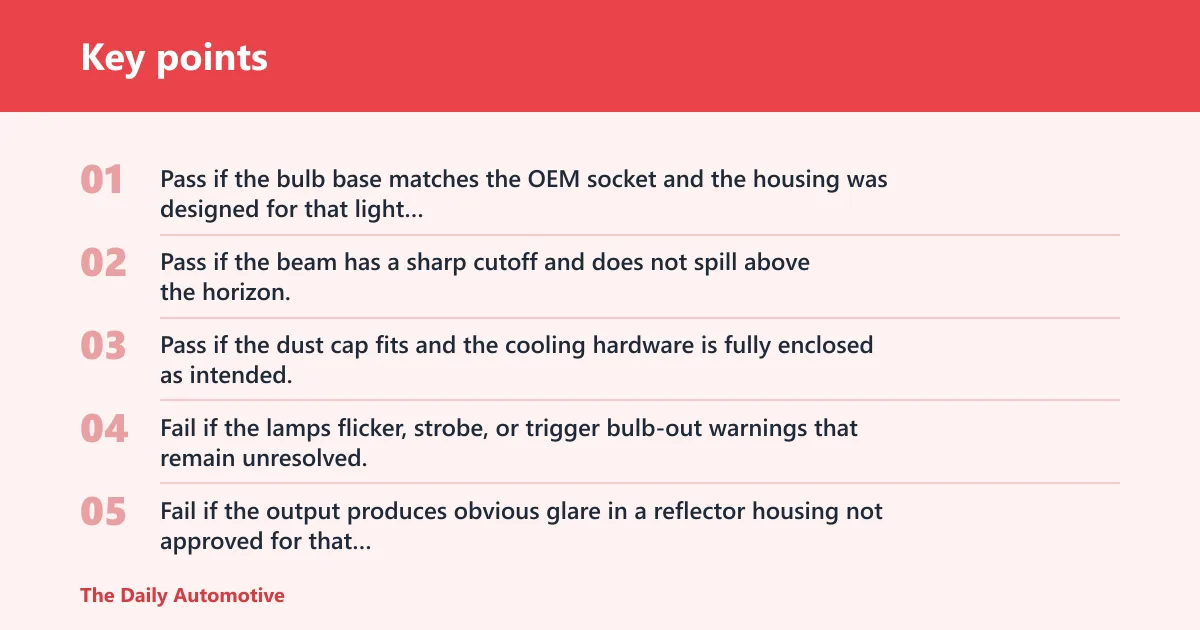
- Pass if the bulb base matches the OEM socket and the housing was designed for that light source.
- Pass if the beam has a sharp cutoff and does not spill above the horizon.
- Pass if the dust cap fits and the cooling hardware is fully enclosed as intended.
- Fail if the lamps flicker, strobe, or trigger bulb-out warnings that remain unresolved.
- Fail if the output produces obvious glare in a reflector housing not approved for that retrofit.
- Fail if local inspection rules do not permit the conversion in that vehicle class.
Common failure points before inspection
The most common problems are wrong housing type, poor aim, missing decoders where needed, and a rear bulb body that will not clear the cap. Another common issue is assuming that a 12V-24V rating means universal approval, when it only suggests compatibility with that voltage range. It does not. Electrical compatibility and road legality are separate checks.
Daily driver, commuter, and off-road use cases
For a daily driver in an inspection-heavy market, the best path is usually the most conservative one: an approved assembly or a retrofit that the local rules clearly accept. Commuters who drive at night need glare control first. Off-road users may accept a wider range of setups, but that does not carry over to public-road use.
Frequently asked questions
Are LED light conversion kits for cars street legal?
Only sometimes. Street legality depends on the headlight housing, beam pattern, vehicle fitment, and local rules. A kit can be legal in one configuration and illegal in another, especially when it is placed in a halogen reflector that was not designed for that light source.
Do LED headlight conversion kits pass inspection?
They can pass if the beam cutoff is correct, the lamps are aimed properly, and local rules allow that retrofit. They often fail when glare is visible, the housing is wrong for the bulb type, or the vehicle shows warnings and unstable lamp behavior.
Will LED conversion bulbs fit my car’s headlight housing?
Maybe, but socket fit is only part of the answer. You need the correct base size, enough room for the cooling hardware, and optics that work with the LED emitter. A 30mm x73mm bulb can still be a bad match if the dust cap or reflector geometry is wrong.
Do I need a resistor or decoder with LED headlight bulbs?
Sometimes. If your car checks lamp load and flags a bulb-out warning, a resistor or decoder may be needed to mimic the expected electrical behavior. That hardware can also help with flicker, but it adds heat and can fail if mounted badly or chosen for the wrong system.
What does compatible with 99% vehicles actually mean?
It usually means the bulb can physically fit many sockets and voltage ranges, not that it is road-legal or problem-free on every car. You still have to verify the headlight type, the beam pattern, the 12V-24V electrical match, and whether the car’s warning system accepts the load.
Are plug-in LED headlight conversion kits legal in European vehicles?
Not by default. Some European vehicles need a load resistor or LED decoder to stop warning lights, but legal use still depends on the lamp approval rules in the country and the beam pattern in the housing. A plug-in fit does not prove compliance, and glare remains a violation risk.
Products related to this article
Sponsored / affiliate links. As an Amazon Associate I earn from qualifying purchases. I may earn additional commission from eligible campaigns.