Trailer Ramps for Low Cars: Top Picks for Easy Loading
For lowered cars, choose trailer ramps with a long approach length and a low breakover angle; as a common rule of thumb, 48-inch-plus ramps suit many street-lowered cars, while very low splitters often need about 60-inch or arched ramps. Wrong ramp geometry can crack splitters, scrape exhaust, or stall the car halfway up. This guide compares trailer ramps by angle, length, width, traction, and load rating so you can match them to your car and trailer.
Top pick for most lowered cars


Best overall: a long, low-angle aluminum ramp set with top hooks and a non-slip surface. It is the safest middle ground for many lowered street cars because it balances approach angle, weather resistance, and a secure mount to the trailer. For many owners, that matters more than chasing the shortest or cheapest ramp.
The key is geometry, not marketing. A ramp can be strong and still miss the mark if the approach angle is too steep for your front lip, splitter, or exhaust.
Why this setup fits mild to moderate drop heights
Longer ramps spread the rise over more distance, which lowers the angle the front tires see at the trailer edge. That reduces the chance of the nose dropping onto the transition, especially on cars with low splitters or a long front overhang.
Aluminum is the best all-around pick for repeated loading because it is light enough to handle, resists corrosion outdoors, and is commonly sold with top hooks and traction rungs. Foam ramps are useful too, but they fit a narrower use case.
What it solves better than short ramps
Short ramps often create a sharp breakover right at the trailer lip. That is where scraping usually starts. A longer ramp also gives the tires more time to stay planted before the car reaches the deck.
Quick picks
- Best for street cars with modest front lips: 60-inch aluminum ramps with traction rungs and top hooks.
- Best for track cars that need lower angles: 67-inch or 72-inch low-profile ramps, especially if the splitter sits close to the ground.
- Best for tight storage and occasional use: EVA foam ramps, since they are lighter and easier to move.
- Best for frequent outdoor loading: 84-inch aluminum ramps with a secure attachment point and corrosion resistance.
Best for street cars with modest front lips
For a mildly lowered street car, a ramp in the 60-inch class is often the practical starting point. VEVOR’s aluminum ramps measure 60 inches long and 12 inches wide, and they carry a 6,000-pound capacity.
Best for track cars that need lower angles
If the car has a low splitter or a steep driveway-to-trailer transition, longer ramps are safer. Leinuosen’s 5-inch H ramps use a 67-inch length and a 4.3° approach angle, with 1,500 pounds per ramp and 3,000 pounds per pair.
Best for tight storage and occasional use
EVA foam ramps make sense when storage space is limited and the load is light enough for the material’s intended use. Leinuosen’s low-profile foam style is built around a lightweight, anti-wear surface with a non-slip texture, which helps when you want easy handling more than maximum durability.
Best for frequent outdoor loading
For regular loading outdoors, aluminum stays the more durable choice. BestEquip’s aluminum ramps measure 84 by 14 inches and are rated at 6,000 pounds total. That long length helps when the trailer sits high or the car sits very low.
What trailer ramps are best for lowered cars?
For lowered cars, the best trailer ramps are low-profile ramps with a long approach length, secure attachment, and a surface that resists tire slip. Foam works well for lighter, lower-risk loading, while aluminum is the better choice for repeated use, outdoor storage, and heavier cars. Very low builds may need extendable or arched systems.
Foam ramps for lighter, lower-risk loading
EVA foam ramps are attractive because they are light, easy to position, and forgiving to handle. Their anti-wear and non-slip surfaces help reduce tire slip, and the softer build is useful when the car is light and the trailer angle is mild.
They are not the right answer for every case. If the car is heavier, the loading angle is steep, or the ramps will see frequent use, aluminum gives better long-term durability.
Aluminum ramps for repeated use and weather exposure
Aluminum ramps are the safer buy for most owners who load often. They resist corrosion, commonly include top hooks, and usually use slip-resistant rungs that improve traction as the tires climb. That makes them a strong fit for enclosed and open car haulers.
Extendable systems for very low builds
Detachable or extendable ramp systems are worth considering when the car is extremely low or storage space is tight. They let you add length only when needed, which can turn a borderline setup into a usable one without forcing you to store very long one-piece ramps.
How long should trailer ramps be for a low car?
Longer ramps reduce approach angle, and that matters more than ramp height alone. The right length depends on trailer deck height, front lip clearance, and wheelbase. A 46-inch ramp may work for mild loading, but low splitters and taller decks usually need 60 inches, 67 inches, 72 inches, or more.
Why longer ramps lower approach angle
The longer the ramp, the more gradually the tire climbs. That lowers the chance that the splitter or front valance will strike the trailer lip during the transition. A small change in angle can matter a lot on a very low car.
How wheelbase and trailer deck height change the answer
Deck height sets the vertical rise the ramp must overcome. Wheelbase matters because a long wheelbase can help the chassis clear the breakover, while a short wheelbase or long front overhang can make the front end drag sooner. Front lip height and exhaust position matter just as much.
Say your car sits 5 inches from the ground at the front lip and the trailer deck is also low, with a mild loading angle target around 4.3°. A 67-inch ramp is in the right zone because that length and angle pair with Leinuosen’s 5-inch H ramp geometry.
When 46, 60, 67, 72, and 84 inches stop being enough
A 46-inch ramp can be fine for modest drops, but it is short for many lowered cars. A 60-inch ramp is better, though still not enough for every low splitter. A 67-inch ramp lowers the angle further, and 72-inch ramps are the next step for tougher clearance situations. An 84-inch ramp helps with higher decks, but it still may not be enough for a very low build that needs a truly shallow angle.
What ramp angle is safe for a low car?
There is no single safe angle for every low car. Lower is better, but the real limit depends on front lip height, splitter shape, wheelbase, and where the exhaust hangs. Competitor examples around 4.3°, 5.5°, and 9.05° show the spread: the lower the angle, the less scraping risk you usually face.
How to think about 4.3°, 5.5°, and 9.05° examples
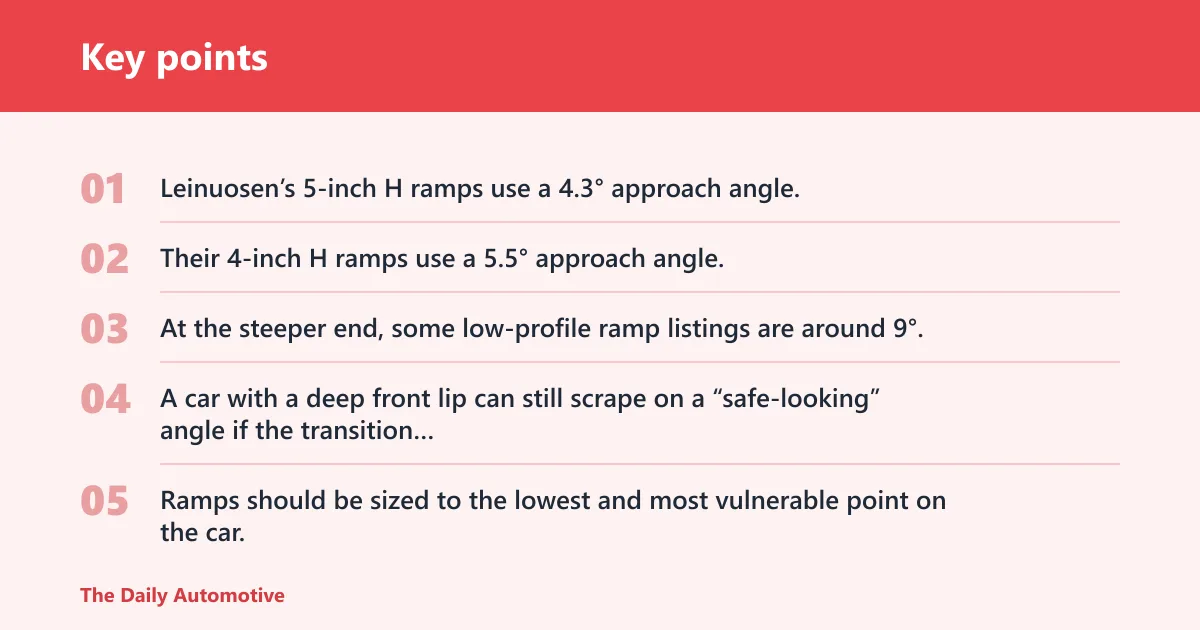
Leinuosen’s 5-inch H ramps use a 4.3° approach angle. Their 4-inch H ramps use a 5.5° approach angle. At the steeper end, some low-profile ramp listings are around 9°, which can be too aggressive for very low splitters or long-front cars.
A lower angle does not erase risk by itself. It just reduces it. A car with a deep front lip can still scrape on a “safe-looking” angle if the transition point is abrupt.
Why front lip, splitter, and exhaust clearance matter more than a single angle number
Ramps should be sized to the lowest and most vulnerable point on the car, not just the bumper height. Splitters and exhaust tips can sit lower than the nose centerline, and either one can catch during the first few inches of the climb.
A common first-timer mistake is checking the bumper and forgetting the splitter edge. That is usually where the damage starts.
How to spot a transition point that will scrape
Look at the trailer lip, not just the ramp deck. If the ramp end does not sit securely in the slot or it creates a sharp step, the car can bottom out at the seam even if the ramp itself is long enough. A beavertail-style or hook-secured end helps smooth that transition.
Ramp selection matrix
This matrix ties the decision to the car’s actual clearance risk. It uses front lip height, trailer deck height, wheelbase, and loading risk to point you toward the minimum ramp length, target angle range, material type, and attachment feature that make sense.
| Scenario | Front lip height | Trailer deck height | Wheelbase | Loading risk | Minimum ramp length | Target angle range | Material type | Must-have attachment feature |
|---|---|---|---|---|---|---|---|---|
| Street car with mild lowering | Moderate | Low to moderate | Average | Low to moderate | 60 inches | About 5.5° or lower | Aluminum or EVA foam | Top hook or slot-fit end |
| Track car with a low splitter | Low | Moderate | Average to long | Moderate | 67 inches | About 4.3° to 5.5° | Aluminum | Top hook plus non-slip rungs |
| Widebody or long-overhang car | Low | Moderate to high | Long | Moderate to high | 72 inches | About 4.3° | Aluminum | Beavertail-style or hooked attachment |
| Very low race build | Very low | Higher deck or sharp transition | Short to average | High | 84 inches or extendable system | As low as practical | Aluminum or high-density structural foam core | Secure attachment plus slot compatibility |
That matrix is the practical shortcut. If the car is still scraping at the trailer lip, move up a length class before changing anything else.
Start with the car’s lowest point, then work outward to the trailer. Check splitter height, front overhang, tire width, trailer lip clearance, and the amount of space you have for storage. Only then compare ramp length, angle, material, and attachment style.
- Measure the lowest front point. Splitter, lip, or exhaust tip should drive the decision.
- Check trailer deck height and lip shape. A sharper transition needs more ramp length.
- Match the ramp end to the trailer slot dimensions. Snug fit matters for alignment and safe loading.
- Pick a load rating that fits the vehicle and use case. The rating should cover the axle load and loading conditions, not just a headline number.
- Choose traction and attachment features. Non-slip rungs, top hooks, or a beavertail-style end reduce movement.
- Test the approach slowly before full ascent. A spotter can watch the front lip and call out any contact risk.
Do not skip the security check. Straps or hooks help keep the ramp from shifting as the tires climb, especially if the surface is wet or the trailer deck has a slick finish.
Suppose a very low car loads fine on dry concrete but spins a front tire on a wet ramp surface. That is a traction problem, not a length problem, and a non-slip surface or rung design becomes the first fix.
Flex matters too. A heavier car can make a lightweight ramp bow or move at the lip. That is why total capacity should be part of the decision, not the only one.
Frequently asked questions
Are foam trailer ramps better than aluminum for low cars?
Foam ramps are better when you want light handling, compact storage, and a non-slip surface for lower-risk loading. Aluminum is better for repeated use, outdoor exposure, and higher capacity. For many owners, aluminum is the more durable long-term choice, while foam is the easier occasional-use option.
How much weight should trailer ramps for low cars hold?
Check the rated capacity and make sure it fits the loading setup. Examples in this category include 1,500 pounds per ramp, 3,000 pounds per pair, 6,000 pounds total, and 6,500 pounds per pair. Do not rely on the number alone; ramp geometry and fit still matter.
Do I need straps or hooks on trailer ramps?
Yes, security features help. Top hooks or beavertail-style attachments reduce shifting during loading and make the ramp sit more securely against the trailer. That matters most when the trailer lip is slick, the car is heavy, or the angle is steep enough to push the ramp forward.
Products related to this article
Sponsored / affiliate links. As an Amazon Associate I earn from qualifying purchases. I may earn additional commission from eligible campaigns.