Tire Rotation Cost / Price / How Much
A tire rotation usually costs about $20 to $50 at an independent shop, about $40 to $80 at a dealership, and can sometimes be free with certain tire purchases or maintenance plans. Skipping rotation can cut tire life short and leave one edge wearing faster than the others, which can cost far more than the service. This guide breaks down what different shops charge, what that price usually includes, and when you should expect rotation at no extra charge.
Tire rotation cost matrix
| Shop type | Typical price range | What’s included | What’s usually excluded | Who gets free rotation |
|---|---|---|---|---|
| Dealership | $40 to $80 | Rotation, basic tire pressure check, torque check, visual inspection | Balancing, alignment, oil changes, brake inspection unless bundled | Some buyers with service plans or tire packages |
| Independent shop | $20 to $50 | Bare rotation, pressure check, torque check | Balancing and alignment are usually extra | Some repeat customers, loyalty programs, or package deals |
| Quick-lube | About $40 | Rotation with other maintenance checks depending on the location | Balancing and alignment | Customers with bundled maintenance visits |
| Big-box retailer | Varies by market and tire package | Often rotation tied to a tire installation or service plan | Alignment, unless separately sold | Customers who bought tires and installation there |
| Discount Tire | $10 to $20 per tire; about $15 per tire in many locations | Rotation, and free lifetime rotation if tires were purchased there; complimentary puncture repair | Alignment and most extra service work | Anyone who bought tires there under the retailer’s program |
| Costco | Included with tire installation package | Rotation, balancing, nitrogen tire inflation, flat repairs for the life of the tire | Alignment and unrelated maintenance | Members who buy the tires and installation package there |
| Couponed chain pricing | About $9.99 with coupon; about $25 regular price | Rotation at the advertised service level | Extras may cost more if not part of the coupon | Customers using the coupon offer |
What tire rotation costs overall
A standard tire rotation often lands in the $24 to $120 range, depending on the shop, the vehicle, and what the invoice includes. A bare rotation can be closer to $20 to $80 per set, while a package with balancing or other checks pushes the total higher. Some retailers fold the service into a tire purchase.
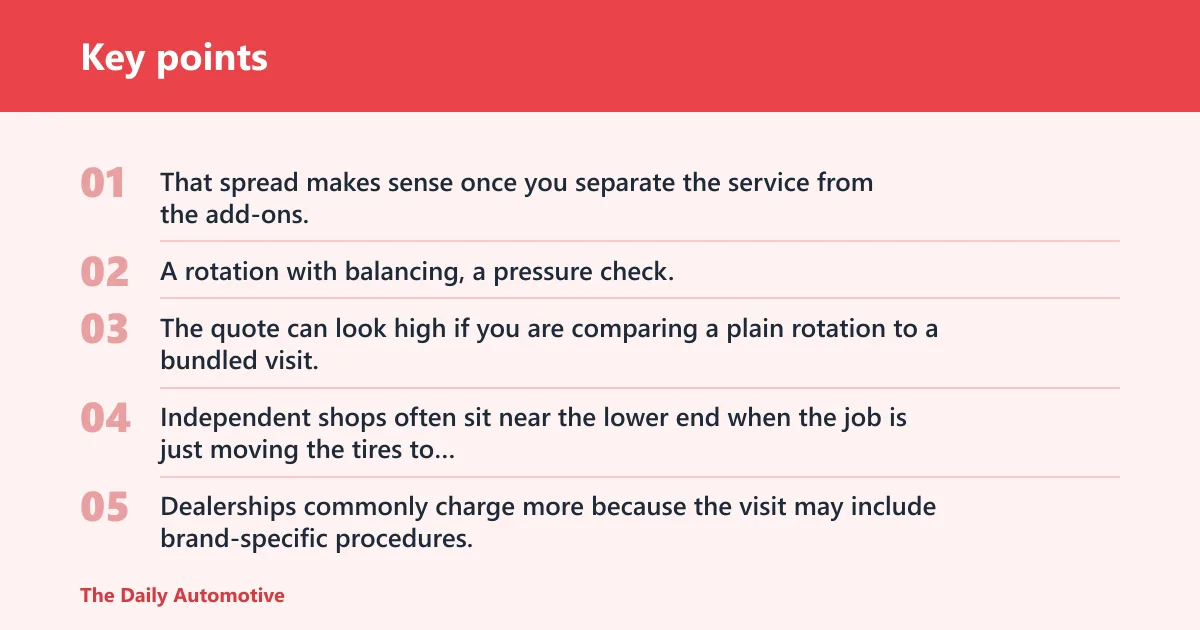
That spread makes sense once you separate the service from the add-ons. A rotation alone is one line item. A rotation with balancing, a pressure check, or a multipoint inspection is a different package. The quote can look high if you are comparing a plain rotation to a bundled visit.
Typical price range by service type
Independent shops often sit near the lower end when the job is just moving the tires to new wheel positions. Dealerships commonly charge more because the visit may include brand-specific procedures, documentation, or a broader inspection. Chain stores may price the same work differently by region.
Firestone is a clear example of the gap between coupon pricing and regular pricing. A coupon rotation price can be $9.99, while the regular price is about $25. Jiffy Lube’s usual tire rotation cost is about $40.
What changes the quote
Vehicle setup matters. Front-wheel drive, rear-wheel drive, all-wheel drive, directional tires, and uniform-size tires do not always use the same pattern or the same labor time. A staggered setup can also change the quote because the tires cannot simply be crossed from one axle to the other in the usual way.
Say your sedan uses uniform-size tires and the shop can do a rearward cross pattern in one visit. That job is usually simpler than a five-wheel rotation on a vehicle with a full-size spare, so the invoice may be lower. The labor difference is real even when the service sounds similar.
When free rotation is part of the deal
Free rotation is most common when you bought the tires from the same retailer or signed up for a tire package. Discount Tire offers free lifetime rotation if tires were purchased there. Costco tire installation includes rotation, balancing, nitrogen tire inflation, and flat repairs for the life of the tire, and tire purchase includes installation at no charge.
That does not mean every tire store gives away the service. The free offer usually depends on where you bought the tires, whether you kept the paperwork, and whether the car still qualifies under the retailer’s program. Check the terms before you assume the service is free.
How often should you rotate tires?
Most mechanics recommend rotating tires every 5,000 to 8,000 miles, which often works out to about every six to 12 months. Owner’s manual guidance comes first, though, because the right interval and pattern can change by vehicle make and model. Some warranties may also require regular rotation and proof.
Mileage and time intervals
The simplest rule is to match rotation with regular maintenance visits. Many owners do it at oil-change intervals, but that only works if the mileage lines up with the manufacturer’s schedule. If you drive fewer miles, the calendar still matters.
A common first-timer mistake is waiting until one tire is clearly worn before scheduling the service. By then, the wear pattern may already be set. Rotation works best as prevention, not repair.
Why the owner’s manual matters
Some cars use a pattern that is different from the generic advice found online. Directional tires often need a side-to-side style only, and certain all-wheel-drive systems can be sensitive to tread-depth differences. The manual should control the interval and the pattern if it differs from the shop’s default.
Warranty timing and recordkeeping
F1 tire warranties may require rotation. If that applies to your tires, keep the invoice and note the mileage. A dated receipt is often the easiest proof if a warranty claim comes up later.
Why tire rotation prices vary so much?
Prices vary because shops sell different service packages, not because the tires themselves change. The quote may reflect labor, local market rates, shop policy, wheel layout, and whether the visit includes extras like balancing or a tire pressure reset. Vehicle type can add time, especially on cars with special layouts.
Drivetrain and tire layout
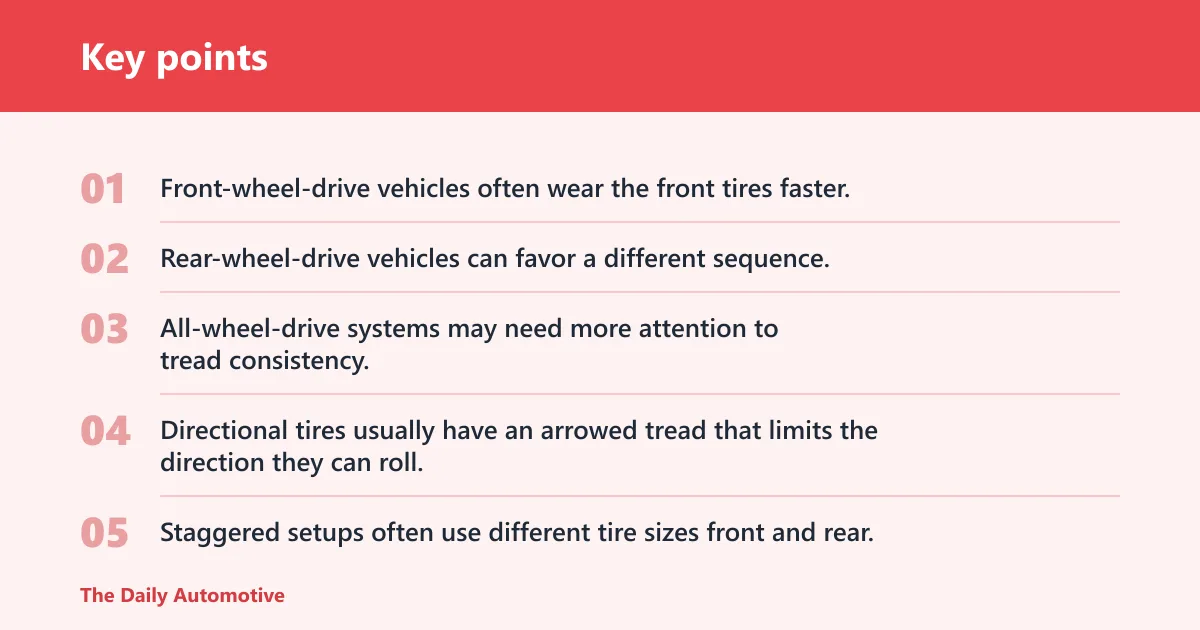
Front-wheel-drive vehicles often wear the front tires faster, so the pattern aims to move the front tires to different positions before wear gets out of balance. Rear-wheel-drive vehicles can favor a different sequence. All-wheel-drive systems may need more attention to tread consistency, which can affect both the method and the price.
Directional, staggered, and five-tire setups
Directional tires usually have an arrowed tread that limits the direction they can roll. Staggered setups often use different tire sizes front and rear, which narrows the rotation options. A five-tire rotation with a full-size spare takes more time because the spare enters the cycle.
Picture a crossover with directional tires on all four corners and a full-size spare. The shop cannot use the same cross pattern it would use on a small sedan with non-directional tires. That difference affects labor, and labor affects price.
Labor, local market, and shop policy
Local wage levels and rent show up in the service price. So does store policy. One location may include a pressure check and torque check in the base price, while another bills those items as part of a tire-care package. That is why a quote can look normal in one zip code and high in another.
What is included in the price?
A fair rotation invoice should usually list the tire positions changed, a tire pressure check, a torque check, and a visual inspection. Some shops also note tread depth or recommend an alignment if the wear pattern looks uneven. If the invoice is vague, ask for the line items before you pay.
Pressure check, torque check, and visual inspection
The pressure check confirms that each tire is set to the vehicle’s recommended level after the move. The torque check verifies that the lug nuts are tightened to spec. The visual inspection can catch cuts, bulges, nail damage, or one tire wearing much faster than the others.
Balancing, alignment, and other extras
Balancing usually is not part of a bare rotation unless the shop spells it out. Alignment is a separate service. Oil changes and brake inspection may be bundled into a dealer or chain package, but they are not standard parts of the tire rotation itself.
That matters because a low headline price can become a much larger ticket if the quote adds balancing and alignment by default. Ask whether the estimate is for rotation only or for a bundled visit that includes extra work.
What to confirm before you pay
- Confirm the exact rotation pattern the shop will use.
- Ask whether the price includes pressure checks and torque checks.
- Ask whether balancing or alignment is extra.
- Confirm whether the quote changes for directional, staggered, or five-tire setups.
- Ask whether your tire purchase already includes free rotation.
How rotation patterns affect service
The pattern matters because it changes how much labor the service takes and whether the shop can use a generic sequence at all. The vehicle manual may override a shop’s default pattern, especially on directional tires or mixed-size setups. The goal is even wear, not just moving rubber around.
Rearward cross and forward cross
Rearward cross and forward cross are common patterns on vehicles with uniform-size tires. On many front-wheel-drive cars, the rear tires move forward on the same side while the front tires cross to the rear, though the exact plan can vary by manual. Rear-wheel-drive cars may use the opposite direction.
X-pattern and side-to-side rotation
X-pattern rotation moves each tire diagonally to a new position. Side-to-side rotation is more common with directional tires because those tires must keep their rolling direction. The manual decides whether either pattern is suitable.
Five-tire rotation for vehicles with a full-size spare
A five-tire rotation brings the spare into the cycle so all five tires share wear more evenly. That can be a smart choice when the spare is full-size and intended for road use. It also takes longer than a four-tire rotation, which can push the price up.
Is tire rotation free anywhere?

Yes, but usually only under specific terms. Tire rotation can be free if you bought the tires from the retailer, signed up for a tire package, or are using a coupon or lifetime program that includes the service. Free does not mean universal, and it does not mean the same thing at every shop.
Free lifetime rotation programs
Discount Tire offers free lifetime rotation if tires were purchased there. It also offers about $15 per tire for tire rotation in many locations, with regional pricing differences. That is why the invoice may vary from store to store even within the same chain.
It includes rotation, balancing, nitrogen tire inflation, and flat repairs for the life of the tire. Tire purchase includes installation at no charge, which can make the up-front price look higher while lowering the long-term service cost.
Discount pricing versus regular pricing
Coupon pricing is useful when you want a lower one-time cost, but it should not be mistaken for the normal rate. Firestone’s coupon price is $9.99, while the regular price is about $25. That is a real difference, and it is the kind of difference shoppers should compare before booking.
Suppose you see a low coupon at a chain store and a higher quote at a dealership. The lower price may cover only rotation, while the dealership price may include a pressure check, torque check, and a more detailed inspection. Compare the package, not just the headline number.
Frequently asked questions
How much is tire rotation cost?
For a standard service, tire rotation cost often falls between $24 and $120 depending on the shop and what is included. Independent shops tend to be lower, dealerships higher, and bundled tire programs can be free. Always compare rotation-only pricing with packages that add balancing or inspections.
How much for a tire rotation
How much for a tire rotation depends on where you go and what your vehicle needs. A bare rotation can be around $20 to $80 per set, while chain pricing may land near $40 or more. If the shop includes balancing or other checks, expect the quote to rise.
What is the average price of a tire rotation?
The average price of a tire rotation is not one fixed national number. A practical way to shop is to expect about $20 to $50 at an independent shop, about $40 to $80 at a dealership, and less if the service is part of a tire purchase or coupon offer.
What does a typical tire rotation cost at Costco or Discount Tire?
At Discount Tire, tire rotation will cost $10 to $20 per tire, and free lifetime rotation is available if the tires were purchased there. Costco tire installation includes rotation and balancing, plus nitrogen tire inflation and flat repairs for the life of the tire, so the price is often bundled into the installation package.
How often should you rotate your tires?
The exact interval can change with drivetrain, tire type, and vehicle design. If your tires have a warranty, keep records because rotation may be required.
Does tire rotation usually include balancing or alignment?
Usually no. A basic rotation often includes a tire pressure check, torque check, and visual inspection, but balancing and alignment are commonly separate charges. Some shops bundle those services, which is why the quote can look much higher than a bare rotation price.
Is tire rotation worth paying for or doing it yourself?
For many owners, paying for rotation is worth it because the service is fast, documented, and less likely to be done with mistakes. DIY can save money, but only if you have level ground, jack stands, and the correct tools. Never rely on a jack alone under a vehicle.
Products related to this article
Sponsored / affiliate links. As an Amazon Associate I earn from qualifying purchases. I may earn additional commission from eligible campaigns.