We Tested Nitrous Oxide System for Cars: Top 3 Picks
For most EFI street builds, the safest buy is the kit that matches your fueling, controller support, and future horsepower goal, not the biggest number on the box. Choose wrong, and you can end up with poor spray quality, unsafe fuel delivery, and a kit that costs more to tune than it saves. This guide ranks three kits by install simplicity, tuning margin, and upgrade path, with fitment notes and overall setup cost considered.
Quick picks


- Best overall: Nitrous Express Proton Plus — 35-150 HP range, 10 lb bottle, universal EFI fitment.
- Best EFI upgrade path: Nitrous Express ML2000 MainLine EFI — EFI-ready, 50-150 WHP range, fits non-TBI EFI vehicles from 1985 onward.
- Best carbureted match: NOS 05001 Powershot, smooth power delivery for Holley 4-barrel setups.
Nitrous kit buyer matrix
| Kit | Install difficulty | Fitment breadth | Tuning margin | Included hardware | Total setup cost |
|---|---|---|---|---|---|
| Nitrous Express Proton Plus | 2/5 | 5/5 | 4/5 | 4/5 | Moderate |
| Nitrous Express ML2000 MainLine EFI | 3/5 | 4/5 | 5/5 | 4/5 | Moderate to high |
| NOS 05001 Powershot | 3/5 | 3/5 | 3/5 | 3/5 | Moderate |
The score above weighs real buyer friction, not peak shot size. A kit that fits more cars, needs fewer add-ons, and leaves room for safe tuning belongs ahead of a bigger shot that asks for extra hardware on day one.
What is the best nitrous oxide system for cars?
The best nitrous oxide system for most EFI buyers is the Nitrous Express Proton Plus because it balances fitment breadth, a 35-150 HP range, and a 10 lb bottle without turning the install into a parts hunt. It wins on the parts most people actually pay for: fit, setup time, and room to grow.
Why the Proton Plus ranks first
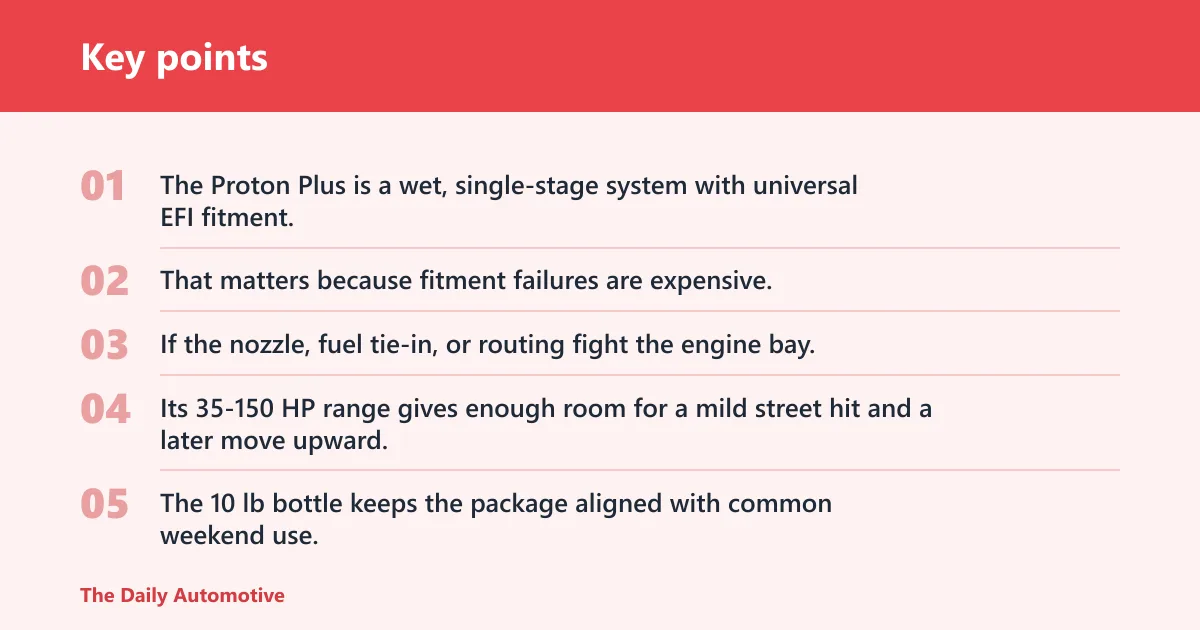
The Proton Plus is a wet, single-stage system with universal EFI fitment, so it is easier to place into more builds than a narrow chassis-specific package. That matters because fitment failures are expensive. If the nozzle, fuel tie-in, or routing fight the engine bay, the “cheap” kit turns into a longer install with more add-ons.
Its 35-150 HP range gives enough room for a mild street hit and a later move upward. The 10 lb bottle keeps the package aligned with common weekend use, while still demanding the usual extras: bottle heater, purge, and tuning support if you want the system to behave consistently.
A common first-timer mistake is chasing the biggest number on the box, then finding that the fuel system needs more headroom than expected. A 75-shot with the right fuel pressure and timing retard can be the smarter buy than a larger setup that needs more parts before it is safe to arm.
Where it does not win
The Proton Plus is not the cleanest choice for a carbureted Holley build, and it is not the most purpose-built option if you want a sharply defined EFI-only upgrade path. If your car is clearly in the ML2000’s lane, that kit earns a look for its EFI focus and 50-150 WHP band.
Nitrous express Proton Plus
The Proton Plus fits universal EFI applications and gives a broad 35-150 HP spread, which makes it the most flexible of the three picks for mixed street use. It suits buyers who want one kit that can start modestly and still leave room for a later step-up without replacing the whole system.
What comes in the kit
Expect the core wet-system pieces: nitrous delivery hardware, fuel-side integration parts, solenoids, lines, fittings, and the 10 lb bottle. The real question is not whether the box has metal parts. It is whether the kit includes enough of the right hardware to avoid a separate shopping list.
Hidden costs still matter. A bottle heater helps hold pressure in a usable range. A purge kit clears trapped gas. A window switch controls when the kit can hit. Tuning support matters if the car is already near the safe limit on pump fuel.
Who it fits best
Choose the Proton Plus if you want a broad-coverage EFI kit, prefer a wet system, and care more about a sane install than the biggest possible number. It is a practical fit for street cars that need straightforward hardware and enough range to avoid becoming obsolete quickly.
Suppose your EFI car already has a healthy fuel system and you want a 50-shot now with room to step up later. The Proton Plus makes more sense than a kit built around a narrow shot window, because you are buying headroom you can actually use.
Nitrous express ML2000 mainLine EFI
It is aimed at non-TBI EFI vehicles from 1985 onward, so it is the pick for buyers who know their platform already lives in that lane.
Why it suits non-TBI EFI cars from 1985 onward
This kit makes the most sense when your car already has EFI architecture that can support nitrous fuel strategy and control logic. Because it is EFI-ready, it is better aligned with builders who want the kit to plug into an EFI plan rather than forcing a universal solution into a tightly packaged engine bay.
The WHP label also matters. WHP is not the same as crank horsepower, so compare like with like when you are sizing the shot. A 50-150 WHP kit can be a stronger performance decision than a plain HP figure if the rest of the combination is built around wheel power targets.
Setup notes for first-time EFI buyers
The ML2000 is the one to choose when you already expect to handle tuning support. That can include checking fuel pressure, setting the correct plug heat range, and planning timing retard before the system ever sees full spray. EFI does not remove the need for safe jetting.
Say your 1990s EFI car already has adequate fuel pump capacity but no nitrous hardware yet. The ML2000 is attractive because it stays inside the EFI world and offers a wider power window than a one-size-fits-all entry kit, even if it asks for a bit more tuning discipline.
NOS 05001 Powershot
The NOS 05001 Powershot earns its place for carbureted buyers, especially Holley 4-barrel setups that want smooth power delivery and on-demand use. It is the best carb match here because it fits a straightforward carburetor build instead of forcing the car to adapt to EFI-style assumptions.
Why Holley 4-barrel users care
A carb setup can be the better buy when the vehicle already has the right fuel and intake architecture for it. The Powershot’s smooth power delivery matters because hit quality is part of what makes nitrous feel controllable, especially when the driver wants a predictable pull instead of a spiky surge.
That does not make it the most flexible kit in the group. It is a more focused choice, and the fitment logic is narrower than the Proton Plus or ML2000. For a carb car, though, that narrower fit can be an advantage if it reduces the number of adapters and compromises.
When it is the better buy
Choose the Powershot when the car is carbureted, the goal is clean on-demand performance, and the build already favors Holley 4-barrel hardware. It is less of a universal answer and more of a right-tool-for-the-job pick.
Should I choose a wet or dry nitrous kit?
Choose wet if you want nitrous and fuel added together, smoother power delivery, and better atomization. Choose dry if you want simpler installation and are confident your fuel system or ECU can supply the extra fuel safely. The right answer depends on power goal, fuel headroom, and how much tuning burden you want.
Wet nitrous system
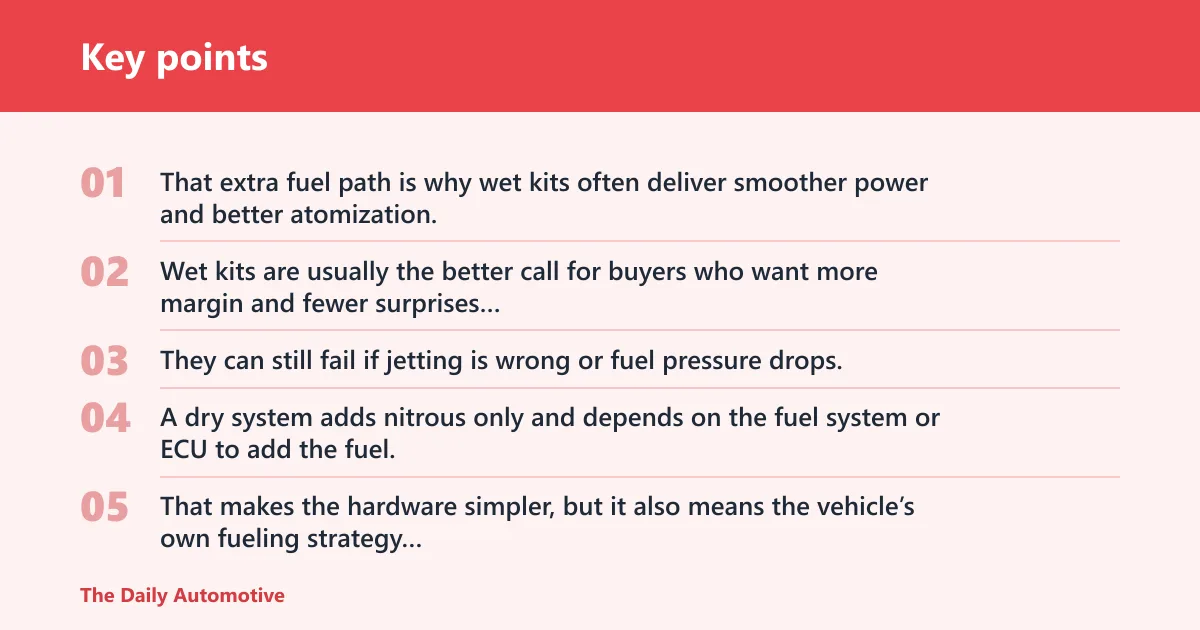
A wet system adds nitrous and fuel together. That extra fuel path is why wet kits often deliver smoother power and better atomization, especially when the engine needs the mixture controlled at the kit level rather than relying entirely on the vehicle’s existing fuel delivery strategy.
Wet kits are usually the better call for buyers who want more margin and fewer surprises from the fuel side. They can still fail if jetting is wrong or fuel pressure drops, but they generally give you a cleaner framework for a street car or a track car that will see repeated use.
Dry nitrous system
A dry system adds nitrous only and depends on the fuel system or ECU to add the fuel. That makes the hardware simpler, but it also means the vehicle’s own fueling strategy has to be ready for the extra demand. Simpler is not the same as safer.
Dry kits fit some street cars well, especially when the engine management is prepared for it. They are less appealing if the fuel system is already near its limit or if you are new to nitrous and want the hardware to carry more of the load.
Which setup fits your build?
Street cars usually benefit from wet systems when fitment is straightforward and the builder wants a broader safety margin. Strip cars can lean either way, but they often reward the setup that matches existing fuel strategy and controller support. Beginner builds should lean wet unless the platform is clearly set up for dry operation.
How do you choose a nitrous kit?
Choose the kit that matches your fuel system, chassis, and power goal before you think about peak shot size. Then budget for the parts that do not always come in the box: bottle heater, purge kit, window switch, and tuning support. Finally, confirm fuel pressure, timing retard, and plug heat range.
Fitment first, then shot size
Universal fitment sounds convenient, but chassis and engine family matter more than marketing language. EFI cars, carbureted cars, and late-model throttle-body setups do not all ask for the same hardware. A good kit is the one that fits the platform without forcing you into a pile of adapters.
Hidden ownership costs
The kit price is only the opening number. A bottle heater keeps pressure in range, and a purge kit clears vapor before the hit. A window switch keeps the spray off at the wrong RPM. Tuning support can cost more than expected if the engine needs safe jetting changes after installation.
Check these costs before you buy:
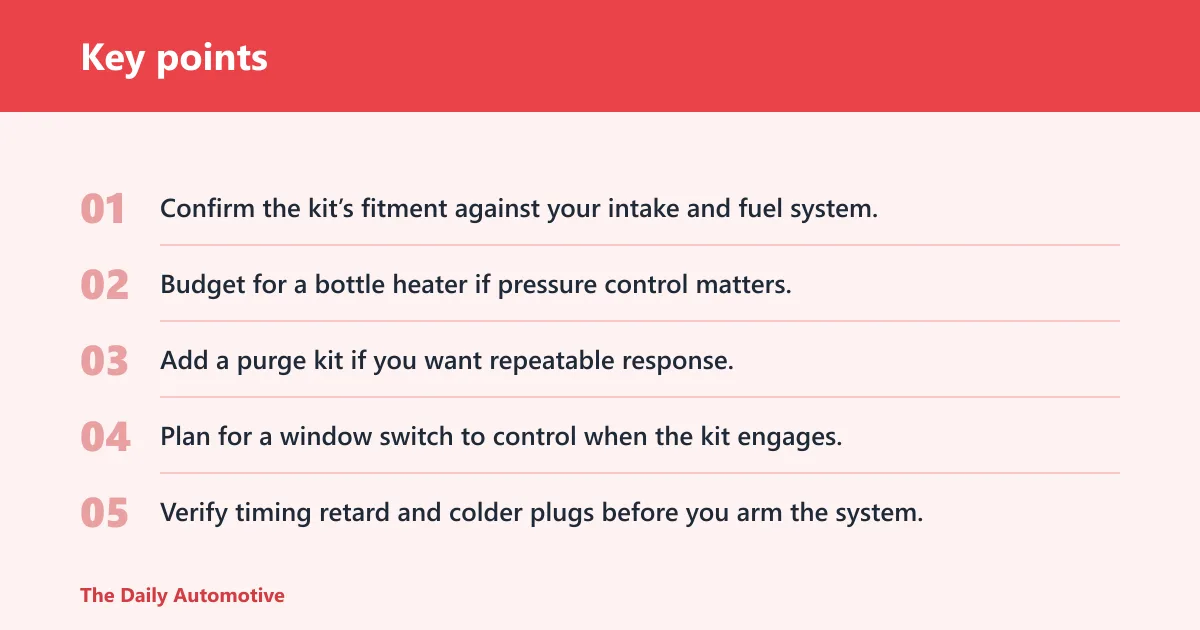
- Confirm the kit’s fitment against your intake and fuel system.
- Budget for a bottle heater if pressure control matters.
- Add a purge kit if you want repeatable response.
- Plan for a window switch to control when the kit engages.
- Verify timing retard and colder plugs before you arm the system.
Failure modes to plan
Lean-out happens when the engine gets more nitrous than fuel. Timing retard matters because added cylinder pressure can punish an unchanged ignition map. Bottle pressure issues change how the kit hits, which is why heater control and consistent fill level are part of the real setup, not extras for enthusiasts only.
Picture a street car that gets a 75-shot but keeps its stock plugs and untouched timing. The first pull may feel fine, then the mixture and spark margin disappear under load. That is how a simple kit turns into a repair bill. The safer move is to prepare the engine first, then arm the nitrous.
What parts come in a complete nitrous kit?
A complete nitrous kit usually includes the bottle, solenoids, lines, fittings, nozzle or plate hardware, brackets, and the control pieces needed to meter spray. The exact contents vary by wet or dry design, but the buyer should expect the core delivery parts, not just a bottle and a few jets.
That said, “complete” does not mean “fully ready.” You may still need a bottle heater, purge kit, window switch, and tuning support before the car is actually ready to use. The best package is the one that gets you closest to safe operation with the fewest surprise add-ons.
Frequently asked questions
Which nitrous kit is safest for a beginner?
A beginner is usually safest with a wet kit that matches the vehicle’s existing fuel strategy and leaves room for conservative jetting. The Proton Plus is the strongest all-around starter in this group because it covers many EFI applications, while still giving you the hardware and range to keep the setup modest.
Will a nitrous kit work on my EFI car?
Yes, if the kit is built for your EFI layout and your fuel system can support the added demand. The Proton Plus has universal EFI fitment, and the ML2000 is EFI-ready for non-TBI EFI vehicles from 1985 onward. Fitment, fuel pressure, and tuning support matter more than the label on the box.
How much horsepower does a nitrous kit add?
The answer depends on the kit and jetting. In this group, the Proton Plus is listed at a 35-150 HP range, the ML2000 targets 50-150 WHP, and the Cold Fusion Universal Dry Kit is adjustable from 50 to 125 HP, though it is not one of the three ranked picks. Match the shot to the engine’s fuel and ignition margin.
Do I need tuning before using a nitrous kit?
Yes, at least basic tuning prep. Verify fuel pressure, consider colder plugs, and plan timing retard before use. Nitrous does not forgive a lazy tune. Even a modest shot can go lean or become spark-sensitive if the fuel system, plug range, or ignition timing are left unchanged.
Products related to this article
Sponsored / affiliate links. As an Amazon Associate I earn from qualifying purchases. I may earn additional commission from eligible campaigns.