Best Hose Clamps for Cars: Worm Gear vs. Spring Type
A hose clamp seals a hose onto its fitting so coolant, fuel, or vacuum lines don’t leak under pressure.
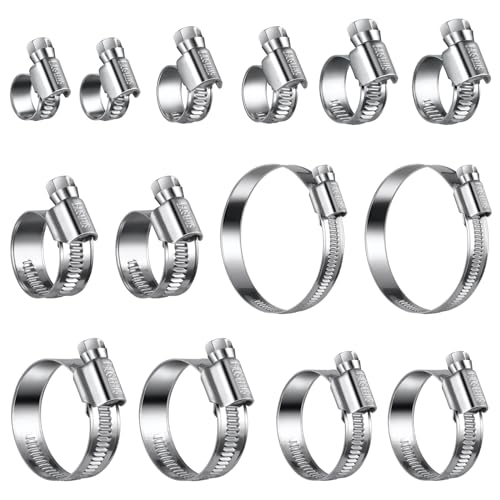
Worm gear clamps use a screw-and-band design that grips tight on fuel and vacuum lines, while spring clamps hold constant tension through the heat cycles of a cooling system – which is why factories use them there. Below are three well-reviewed clamp kits, followed by which type to buy for which job.
Worm Gear vs. Spring Hose Clamps: Which Should You Buy?
The two clamp styles aren’t interchangeable for every job. A worm gear clamp uses a screw that turns a threaded band, so you can dial in the exact tension by hand – that makes it the better pick for fuel lines, vacuum hoses, and any repair where you need to fine-tune the fit. The tradeoff is that overtightening one can bite into a soft rubber hose and cut it, so stop turning once the clamp stops moving freely by hand.
A spring clamp is a single band of tempered steel that squeezes with constant force. As a hose heats up and expands, the spring expands with it instead of loosening off the way a worm gear clamp can – that’s why automakers use spring-style clamps on many factory coolant and radiator hoses. If you’re replacing a clamp on your car’s cooling system, matching the original spring-clamp design matters more than picking whichever kit is cheapest. For the coolant side of the job, see our car coolant flush guide for how these clamps fit into the bigger picture.
Steelsoft Non-Slip Worm Gear Hose Clamp Assortment Kit
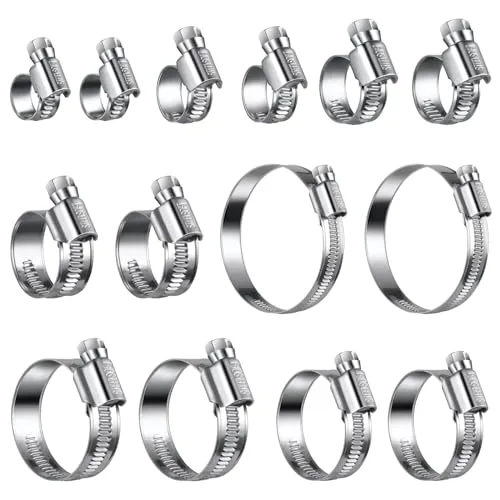
This 14-piece kit covers the size range most DIY repairs actually need – 5/16″ to 2 3/4″ (8-70mm) – with a HEX-head screw you can tighten using a standard 5/16″ nut driver or socket instead of a flat screwdriver, which makes it easier to get consistent torque without slipping. The bands are stainless steel, so they hold up to engine-bay heat and road salt without rusting the way a plain zinc-plated clamp will after a couple of winters.
Pros:
- Stainless steel construction resists corrosion in the engine bay and outdoors.
- Covers 5/16″ to 2 3/4″ (8-70mm), enough range for most fuel, coolant, and vacuum hose jobs.
- HEX-head screw takes a nut driver or socket for a firmer, less slip-prone grip than a flathead screw.
Cons:
- Overkill if you only need one or two clamps for a single small job.
- Costs more per clamp than a basic non-stainless kit.
Because the band is stainless rather than the more common zinc-plated steel, this kit is the one to reach for on any hose that sits in a wet or salted area – a coolant hose near the wheel well, a washer-fluid line, or anything exposed under the car. Just remember a worm gear clamp can cut into a soft hose if you keep cranking past the point where it stops moving freely: snug is enough, don’t force it.
Check the current price on Amazon.
Dianrui 42-Piece Stainless Steel 304 Hose Clamp Kit
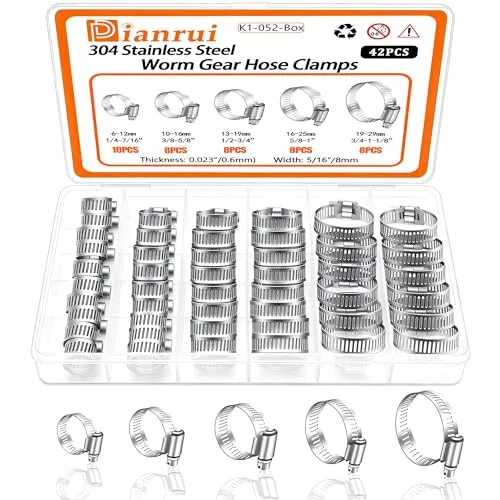
This is the kit to buy if you want more clamps than sizes – 42 pieces split across five sizes from 1/4″ to 1-1/8″ (6-29mm), which covers most vacuum lines, small coolant hoses, and fuel line splices on a typical car. The plastic organizer case keeps each size sorted, so you’re not digging through a loose bag to find the right one mid-repair.
Pros:
- Stainless steel 304 construction resists rust and corrosion.
- 42-piece assortment across five sizes covers most small-diameter hose jobs.
- Worm gear design allows precise, adjustable tightening.
- Comes in a labeled case instead of a loose bag.
Cons:
- Tops out at 1-1/8″, so it won’t fit larger radiator or intake hoses.
- Needs a flathead screwdriver, not a nut driver, to tighten.
Because it stays in the smaller 1/4″-1-1/8″ range, this kit is better suited to vacuum lines, PCV hoses, and small fuel lines than to a car’s main radiator hose, which usually runs 1.5″ or larger. Pair it with the Steelsoft kit above if you need both size ranges covered.
Check the current price on Amazon.
Eoppen 72-Piece Spring Hose Clamp Assortment (Low-Pressure Lines)
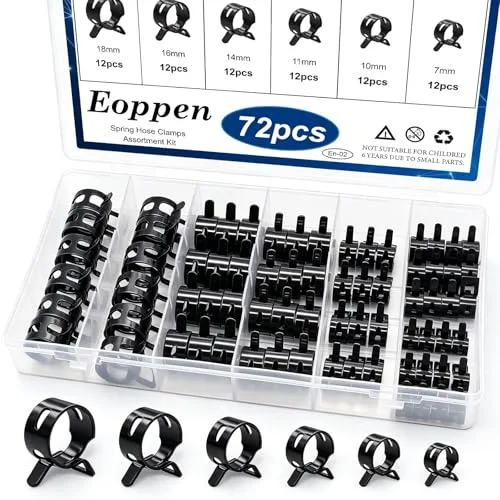
These are constant-tension spring clamps, not worm gear clamps, so a squeeze-and-release tab does the work instead of a screw – squeeze the tabs with pliers, slide the clamp on, and let go. The spring keeps pressing evenly as the hose flexes and heats up, which makes them a close match for the factory-style clamps found on many silicone vacuum lines and small fuel hoses, in six sizes from 7mm to 18mm.
Pros:
- Constant spring tension holds without loosening as the hose heats and cools.
- No tool needed to tighten – squeeze, slide, release.
- Six sizes (7-18mm) cover most vacuum and small fuel lines.
- Lightweight and low-profile compared to a worm gear band.
Cons:
- Rated for low-pressure lines only – not a substitute for a radiator or high-pressure coolant hose clamp.
- Plastic tabs are less rugged than an all-metal worm gear clamp.
Use these on vacuum lines, PCV hoses, and small fuel or silicone lines where the original equipment used a spring-style clamp – not on a main coolant or radiator hose, where a pressure-rated worm gear or OEM spring clamp is the safer choice.
Check the current price on Amazon.
Frequently Asked Questions
What Is a Hose Clamp Used For?
A hose clamp squeezes a hose tight against a fitting – a radiator neck, a fuel line nipple, a vacuum port – so the connection doesn’t leak or blow off under pressure or vibration. Cars use them on coolant, fuel, vacuum, and washer-fluid lines.
How Do I Choose the Right Hose Clamp Size?
Measure the hose’s outer diameter with the fitting already pushed on, then pick a clamp whose adjustable range covers that number with room to tighten further. A clamp sized right at the edge of its range won’t seal as well as one with some tightening left.
Are Stainless Steel Hose Clamps Durable?
Yes. Stainless steel resists rust, road salt, and engine-bay heat far better than the zinc-plated steel used in cheaper clamps, which is why stainless is the standard choice for anything exposed to moisture or the elements.
Can Hose Clamps Be Reused?
Usually, as long as the band isn’t stretched, cracked, or rounded out at the screw threads. If a worm gear clamp’s threads are stripped or a spring clamp has lost its tension, replace it rather than reuse it – a weak clamp is how a slow leak turns into a blown hose.
What Are Worm Gear Hose Clamps?
A worm gear clamp uses a screw that turns against a slotted metal band, tightening the loop around the hose. Turning the screw lets you dial in the exact tension by hand, which is why they’re the most common clamp for aftermarket fuel line, vacuum hose, and general repair work.
Should I Use a Worm Gear or Spring Clamp on My Car?
Use a worm gear clamp for fuel lines, vacuum hoses, and repairs where you need to fine-tune the tension by hand. Use a spring clamp, or match the factory clamp style, on coolant and radiator hoses, where constant tension through heat cycles matters more than adjustability.
Conclusion
For most fuel line, vacuum hose, and general repair jobs, a stainless steel worm gear kit like the Steelsoft or Dianrui assortment gives you the adjustable range and corrosion resistance to handle whatever size hose you’re working on. If you’re servicing a low-pressure vacuum or silicone line that originally used a spring clamp, the Eoppen kit matches that constant-tension design instead.
Whichever type you pick, match it to the job: worm gear for fuel and vacuum lines you’ll adjust by hand, spring-style for lines that need constant tension through heat cycles. And if the hose itself is cracked or swollen rather than just the clamp, see our guide to choosing the right silicone and rubber hose for your car before you clamp a new one on.
Products related to this article
Sponsored / affiliate links. As an Amazon Associate I earn from qualifying purchases. I may earn additional commission from eligible campaigns.