Phone Battery Drain When Car Is Off Podcast
It can be confusing when your phone seems to be taking power from your car even when the engine isn’t running, especially if you’re just trying to enjoy a podcast. Many people wonder about why do phones drain car battery when listening to podcasts when car is off. This might seem like a tricky issue, but it’s actually quite simple once you understand how things work.
We’ll break it down easily, step by step, so you can fix it. Get ready to learn how to keep your car battery safe.
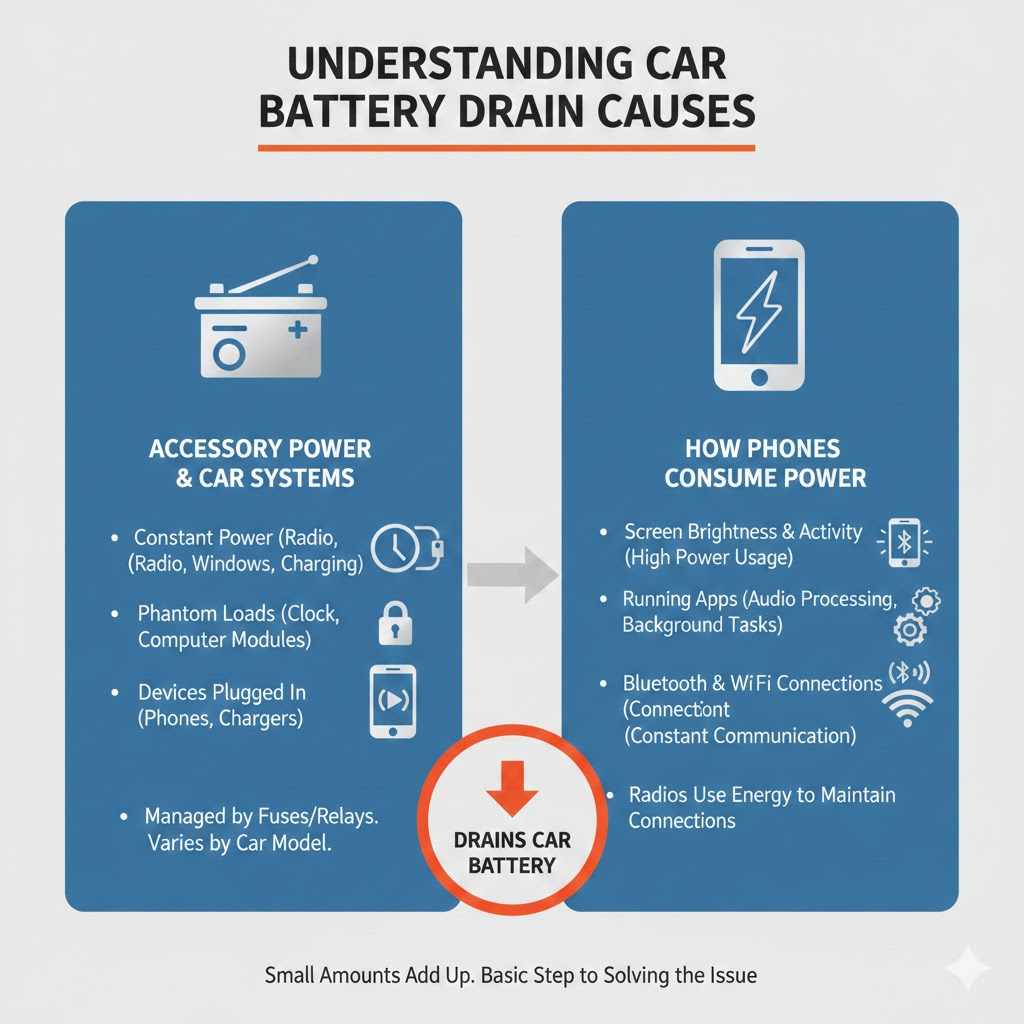
Understanding Car Battery Drain Causes
This section looks at the main reasons your car battery might be losing power unexpectedly. We’ll cover how different parts of your car can use up energy even when the engine is off. This helps explain why simply listening to your phone can sometimes be a problem.
Understanding these basics is the first step to solving the issue.
Accessory Power and Car Systems
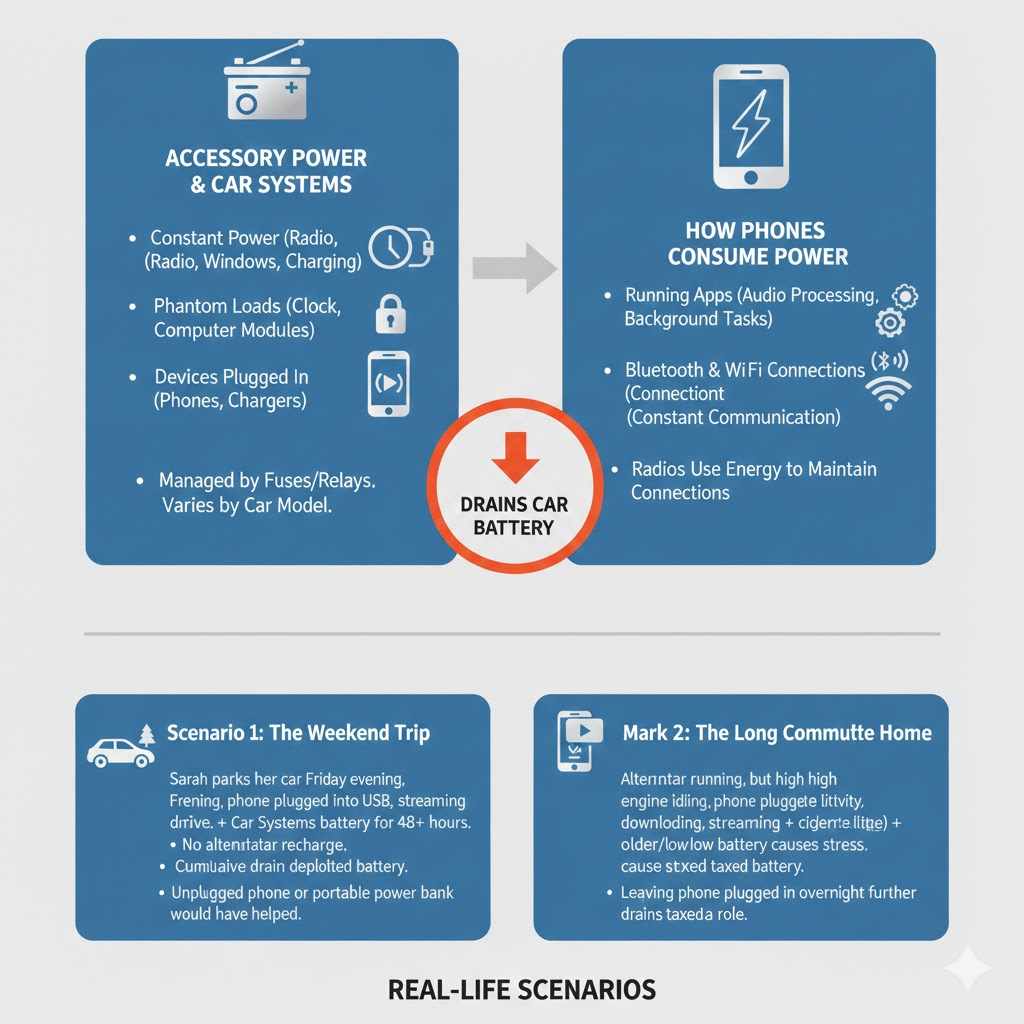
Cars have systems designed to provide power even when the engine is off. This is often called “accessory power” or “constant power.” It’s what lets you listen to the radio, use the power windows, or even charge your phone using a car charger. Manufacturers design this so you can use certain features without needing the engine running, which is convenient.
However, this constant power source means that any device plugged into it can draw electricity. Even small amounts of power used by various car components can add up over time. This includes things like the car’s clock, alarm system, and the computer modules that manage different functions.
When you add a phone charging and running a podcast app, that’s another drain on the battery.
The accessory power is typically controlled by a fuse or a relay. When the car is off, this circuit remains active, allowing devices connected to it to receive power. The amount of power drawn by accessory systems can vary greatly depending on the car’s make and model.
Some cars have more sophisticated power management systems than others.
- Accessory power allows you to use car features like the radio and power outlets when the engine is off. This is useful for comfort and convenience.This feature is a deliberate design choice by car manufacturers. It ensures that drivers can enjoy amenities such as listening to music or using their phones without needing to keep the engine running, which would waste fuel and increase emissions. The power is routed through specific circuits, often managed by fuses, that remain active even when the ignition is turned off.
- Even when the engine is off, many car systems continue to use a small amount of power. These are often called “phantom loads.”These phantom loads are necessary for the car to maintain certain settings or be ready for immediate use. For example, the car’s internal computer systems might need a small amount of power to store memory, such as radio presets or learned driving habits. The security system also requires continuous power to monitor for potential threats.
Other components like door locks and internal lights can also contribute to this drain.
- Connecting devices like phones through car chargers or directly into USB ports means they also start using this accessory power.When you plug your smartphone into a car’s USB port or a cigarette lighter adapter, you are directly tapping into the car’s accessory power circuit. Your phone then begins to draw power to charge its battery and to run any active applications, like a podcast app. This combined draw from your phone and the car’s own systems can deplete the battery faster than you might expect.
How Phones Consume Power
Your smartphone is a powerful device, and running applications like podcasts requires a significant amount of energy. This energy consumption is a key factor in why phones can drain car batteries.
Screen Brightness and Activity
The screen on your phone is one of its biggest power consumers. When you’re listening to a podcast, the screen might stay on, especially if you’re adjusting settings or just looking at it. Even if it’s dimmed, it still uses energy.
The brighter the screen, the more power it uses. If you’re in a dark car and the screen is bright, it’s working harder. Also, if you’re interacting with the phone a lot – skipping tracks, checking notifications, or browsing – this activity further increases power draw.
Some phones have features that keep the screen active to show notifications or time. While useful, these features also contribute to battery drain. Turning off features like “always-on display” can help reduce this.
- The phone’s display is a major power hog. Keeping it bright or active for long periods uses a lot of battery.The light-emitting diodes (LEDs) or liquid crystal display (LCD) panels that form your phone’s screen require electricity to illuminate and display images. The more pixels that are lit up and the brighter the light emitted, the more power is consumed. This is why watching videos or playing games, which often involve bright, dynamic screens, drain batteries much faster than simple audio playback.
- Running apps, especially those that are actively processing audio or data, continuously uses power.Even when you’re just listening to a podcast, the phone’s processor is working. It needs to decode the audio stream, manage the playback, and possibly download new episodes or update information in the background. This ongoing processing, though less demanding than graphics-intensive tasks, still consumes a steady amount of energy from the battery.
- Background processes and network activity also contribute to power drain.Your smartphone is always doing things in the background. It checks for emails, social media updates, app notifications, and system updates. If your phone is connected to Wi-Fi or cellular data, it’s constantly communicating with nearby networks to maintain these connections and receive information, which adds to the overall power usage.
Bluetooth and Wi-Fi Connections
When you connect your phone to your car’s audio system via Bluetooth, or even just keep Wi-Fi and Bluetooth on, these radios are constantly active. They use power to search for devices, maintain connections, and transmit data.
Bluetooth, in particular, is designed for short-range communication and requires power to operate its radio frequency transmitter and receiver. This is how your phone sends the podcast audio to your car speakers. Even when idle, these radios consume a small but persistent amount of power.
Wi-Fi also consumes power when it’s active, scanning for networks or maintaining a connection. If you have Wi-Fi turned on and are searching for a signal, or if it’s connected to a weak signal, it can use more power.
- Bluetooth and Wi-Fi radios on your phone use energy to communicate wirelessly.These wireless technologies are essential for many smartphone functions, but they do require a power supply to operate. The phone’s internal components that manage Bluetooth and Wi-Fi signals continuously draw a small current. This is to keep the radios powered up and ready to establish or maintain connections with other devices or networks.
- Maintaining these connections even when not actively streaming requires the phone to stay powered on and searching.When your phone is paired with your car via Bluetooth, it needs to maintain that connection. This involves periodic “handshakes” and signal checks to ensure the link remains stable. Similarly, if Wi-Fi is enabled and searching for networks, it uses power in that scanning process.
This constant background activity contributes to the overall drain.
- This means even if you’re just listening to audio, the wireless communication is still active and consuming power.The act of streaming audio over Bluetooth doesn’t just involve sending sound waves. It requires the phone’s Bluetooth radio to be actively transmitting data packets. This consistent data flow, managed by the phone’s processor, contributes to the power draw.
Even when the audio is paused or the app is in the background, the Bluetooth connection might remain active.
Why This Drains the Car Battery
This section explains how the power consumption of your phone, combined with your car’s accessory power, leads to a drained car battery. It details the mechanics of the drain and why it happens over time.
The Accessory Power Circuit
Cars have different power circuits. One is for the engine and essential functions (always on when the engine runs). Another is the accessory power circuit, which is often powered directly from the battery and can draw power even when the car is off.
This is usually controlled by the ignition switch. When the key is out or the engine is off, this circuit is still “hot” or live.
When you plug your phone into a car charger connected to an accessory power outlet, you are essentially creating a direct line from the car battery to your phone. The car’s charger adapter converts the car’s 12-volt supply to the 5-volt supply your phone needs. However, this conversion and the phone’s charging circuitry still draw power from the car’s 12-volt system.
The amount of current drawn is usually small, but it is continuous as long as the phone is connected and the accessory circuit is live. This is why parking for extended periods with a phone plugged in can be problematic. The car battery has a finite capacity.
- The car battery powers not only the engine starter but also various electronic systems.The car battery’s primary role is to provide the immense surge of power needed to crank the engine and start it. However, it also serves as a reservoir for many other electrical components. These include interior lights, the car’s computer (ECU), the radio, power windows, and security systems.
These systems draw power from the battery when the engine is not running.
- When your car is off, the battery still needs to power its own internal electronics and any connected devices.Even when the engine is dormant, components like the anti-theft alarm, the car’s clock, and memory for radio presets require a constant trickle of power. This is often referred to as “standby power” or “parasitic drain.” When you add a phone charging, this parasitic drain increases.
- Your phone, while charging and running an app like a podcast player, adds its own power demand to this system.The charger adapter itself is not 100% efficient; some energy is lost as heat during the voltage conversion. Your phone then uses power for its processor, screen, and wireless radios. This combined draw from the car’s own systems and your phone can slowly deplete the car battery, especially if left connected for many hours or days.
Cumulative Power Draw
The drain from your phone isn’t always noticeable immediately. It’s a cumulative process. Small amounts of power are drawn continuously.
Over time, these small draws add up, eventually reducing the battery’s charge.
A car battery typically has a capacity measured in amp-hours (Ah). This indicates how much current it can deliver over a certain period. If a phone charger and the phone itself draw, for example, 0.5 amps continuously, that’s 12 amp-hours drawn in 24 hours.
A typical car battery might be 50-70 Ah. While not all of this is available for accessories, it shows how quickly capacity can be reduced.
Factors like the age and health of the car battery also play a role. An older battery holds less charge than a new one. Extreme temperatures can also affect battery performance, making it more susceptible to drain.
- Small power draws over long periods can significantly drain a car battery.Imagine a leaky faucet. Each drip is tiny, but over hours and days, it can fill a bucket. Similarly, the constant, low-level power draw from your phone charger and the car’s electronics works like those drips.
The battery’s reserve is slowly depleted, and if it’s not replenished by the engine running, it can reach a point where there isn’t enough power to start the car.
- The longer the phone is connected and the car is left unused, the greater the impact on the battery.If you park your car for a weekend with your phone plugged in, that’s 48 hours of continuous power draw. Even a small draw of 0.2 amps over 48 hours accounts for nearly 10 amp-hours of lost battery capacity. This can be a substantial amount for a battery that may already be working harder to start the car.
- This cumulative drain is often unnoticed until the battery is too low to start the car.You might not notice any difference in your car’s performance for days or even weeks. The battery has a reserve, and it’s designed to handle some basic parasitic loads. However, as the battery’s charge level drops, the voltage can fall below the threshold needed by the starter motor, leading to a no-start situation.
This is when the cumulative effect becomes apparent.
When the Car is Off
The critical point is that when the car is off, the alternator is not running. The alternator is the component in your car that recharges the battery while the engine is running. Without the alternator producing power, the battery is only being drained, not replenished.
So, even if the combined draw is small, it’s a one-way street for power. The battery’s charge is constantly decreasing. If this happens for a prolonged period, especially with a phone plugged in and running a power-hungry app, the battery can become too depleted to start the car.
This is why it’s crucial to be mindful of what’s connected to your car’s accessory power when the engine is off. Podcasts are great, but not at the expense of being stranded.
- Without the engine running, the alternator is inactive and cannot recharge the car battery.The alternator is driven by the engine’s crankshaft via a belt. When the engine is off, this belt is not moving, and therefore the alternator is not generating electricity. Its sole purpose is to produce power to run the car’s electrical systems and simultaneously recharge the battery while the engine is in operation.
- This means any power drawn from the battery is a net loss of energy.When the alternator is offline, the car battery is the sole source of electrical power for any active systems. This includes the car’s own electronics and any accessories plugged into it. Any ampere-hours consumed by these devices are directly removed from the battery’s total capacity, leading to a gradual discharge.
- Leaving a phone charging for extended periods while the car is off can lead to a completely discharged battery.If you were to leave your phone plugged in and charging overnight or for several days with the car off, the combined draw could easily exceed the battery’s ability to sustain itself. This is particularly true if the battery is older or the weather is cold, as these conditions reduce battery efficiency and capacity.
Solutions and Best Practices
Now that we understand why this happens, let’s look at practical ways to prevent your car battery from draining. These solutions are simple and effective for most drivers.
Disconnect When Not in Use
The most straightforward solution is to simply unplug your phone charger or disconnect your phone from the car’s USB port when you are finished listening to podcasts or when you leave the car for an extended period. This directly cuts off the power draw from your phone.
Even if your phone is not actively charging, it might still draw a small amount of power if it’s connected through a charger that’s plugged into an accessory outlet. So, it’s a good habit to remove the charger from the outlet.
If you frequently use your phone in the car, consider keeping a separate portable power bank. This allows you to charge your phone without relying on the car’s battery, especially when the car is off.
- Always unplug your phone charger from the car’s power outlet when you are done using it.This simple action breaks the electrical circuit between the car battery and your phone. Without the charger connected to the accessory port, no power can flow to your phone. This is the most effective way to prevent your phone from contributing to battery drain.
- Disconnect your phone from the USB port if it’s connected for charging or audio.Even USB ports can draw power when the car is off. If your phone is plugged into a USB port for charging or to play audio through the car’s system, it’s best to unplug the USB cable. This ensures no unwanted power consumption.
- Make it a habit to disconnect before you leave your car unattended for long periods.Developing this routine will save you from potential battery issues. Train yourself to perform this quick check every time you park your car, especially if you plan to leave it for more than a few hours.
Utilize a Portable Power Bank
A portable power bank, also known as a portable charger or battery pack, is an excellent alternative. You can charge the power bank at home using a wall outlet. Then, use the power bank to charge your phone in the car, without drawing any power from the car’s battery.
This method is particularly useful for long drives or when you know you’ll be parked for a while. It ensures your phone stays charged without any risk to your car’s starting power.
Modern power banks come in various sizes and capacities, so you can choose one that suits your needs. Some are small enough to fit in your pocket, while others can charge your phone multiple times.
- Charge a portable power bank at home and use it to charge your phone in the car.This strategy allows you to keep your phone powered up independently of your car’s electrical system. You recharge the power bank overnight, and then use it to top up your phone’s battery throughout the day or during your commute, preventing any drain on your car battery.
- This eliminates the need to keep your phone plugged into the car’s accessory socket or USB port.By using a separate power source, you bypass the car’s accessory power entirely. This means your phone’s charging process will not impact your car’s battery reserve, ensuring you always have enough power to start your engine.
- Power banks are convenient for travel and offer a reliable backup power source.These devices are designed for portability and are a great companion for anyone who relies heavily on their smartphone. They are not just for cars; you can use them on planes, trains, or anywhere you need a power boost on the go, making them a versatile gadget.
Check Your Car’s Power Settings
Some modern cars have intelligent power management systems. These systems can automatically cut power to accessory outlets after a certain period or when the battery voltage drops too low. This is a safety feature designed to prevent total battery depletion.
Consult your car’s owner’s manual to see if it has such features and how they are configured. If your car doesn’t have this built-in, you might consider aftermarket solutions that can monitor and manage accessory power.
Understanding your car’s electrical setup is key. If you’re unsure, a mechanic can advise you on the best course of action for your specific vehicle.
- Some car models automatically shut off power to accessory outlets after a set time.Manufacturers are increasingly incorporating features to prevent battery drain. This might mean that after a certain duration of inactivity (e.g., 30 minutes to a few hours), the car’s system will disconnect power to the cigarette lighter or USB ports. This is a smart way to avoid accidental discharge.
- Your car’s manual may detail how to manage accessory power or if it has an auto-shutoff feature.The owner’s manual is a valuable resource for understanding your vehicle’s specific electrical features. Look for sections related to power outlets, battery management, or accessory power. It will often explain how these systems work and if they are user-configurable.
- If your car lacks this feature, consider a battery guardian or voltage-sensing relay.For older vehicles or those without intelligent power management, an external device can be installed. A battery guardian or voltage-sensing relay can monitor the car battery’s voltage and automatically disconnect power to accessories if the voltage falls below a safe level, protecting the battery from deep discharge.
Listen to Podcasts Before Driving or After Arriving
A simple behavioral change can also solve the problem. Instead of listening to podcasts while parked with the car off, save them for when you are driving or have arrived at your destination.
When the engine is running, the alternator is actively recharging the battery, so listening to podcasts then poses no risk. You can also enjoy them using headphones after you’ve parked and turned off the car. This way, your phone’s power source is independent of your car’s battery.
This practice helps extend the life of your car battery and ensures you always have enough power to start your vehicle. It’s a practical adjustment that requires minimal effort.
- Listen to podcasts while the car engine is running and the alternator is recharging the battery.When your engine is on, the alternator generates electricity. This electricity powers your car’s systems and simultaneously replenishes the charge in your car battery. Therefore, using your phone to listen to podcasts during a drive is a safe and effective way to enjoy your audio content without draining your battery.
- Use headphones to listen to podcasts after you have parked and turned off the car.This is a great alternative that completely isolates your phone’s power usage from your car’s battery. By using headphones, your phone draws power only from its own internal battery, which can then be recharged later without affecting your car’s ability to start.
- This approach ensures your car battery is always ready to start your engine.By adopting these habits, you remove the risk of accidentally discharging your car battery. Your battery will remain at its optimal charge level, ensuring that your car starts reliably every time you need it, regardless of how long you spend listening to audio content.
Understanding Your Car’s Battery Health
Sometimes, the issue might be less about the phone and more about the car’s battery itself. An old or weak battery might struggle to hold a charge, making it more susceptible to drain from any connected device.
Battery Age and Condition
Car batteries typically last between 3 to 5 years. After this period, their capacity to hold a charge diminishes significantly. If your car battery is older than this, it might be the primary reason for rapid drain.
You can have your car battery tested at most auto parts stores for free. They can tell you its condition and whether it needs to be replaced. A healthy battery is crucial for the overall reliability of your vehicle.
A battery in poor condition can also lead to other electrical issues in your car. It’s wise to regularly check its health.
- Car batteries have a limited lifespan, typically 3-5 years.The chemical reactions that occur within a car battery are not infinite. Over time, the lead plates corrode, and the electrolyte can degrade. This wear and tear means that as a battery ages, its ability to store and deliver electrical energy decreases, making it more prone to failing.
- An older or failing battery may not be able to sustain even minimal parasitic drains.A brand-new battery has a significant reserve capacity. However, an aging battery might only have 50-70% of its original capacity. If this reduced capacity is further drained by a phone charger and the car’s own electronics, it can quickly drop below the minimum voltage required to start the engine.
- Regular battery testing can identify potential issues before they leave you stranded.Most auto service centers and battery retailers offer complimentary battery testing. This involves applying a load to the battery and measuring its output. This simple test can reveal if your battery is weak, nearing the end of its life, or if there’s an issue with the charging system, allowing for proactive replacement.
Parasitic Drain Testing
A “parasitic drain” is the term for electrical current that is drawn from the battery when the ignition is off and all accessories are supposed to be off. A small amount is normal (for the clock, alarm, etc.), but excessive parasitic drain can quickly kill a battery.
If you suspect a significant drain beyond what your phone is causing, a mechanic can perform a parasitic draw test. This involves using a multimeter to measure the current flowing out of the battery when the car is off. By systematically pulling fuses, they can identify which circuit is drawing too much power.
This type of testing can help pinpoint issues with faulty components or wiring that might be draining your battery, unrelated to phone usage.
- Parasitic drain refers to power consumption when the car is off and all systems are supposedly inactive.It’s normal for a car to draw a small amount of current when parked to maintain things like the car’s clock, radio presets, and the anti-theft system. This is called quiescent current or standby current. However, excessive draw indicates a problem.
- A multimeter can be used to measure this draw and identify faulty circuits.This diagnostic process involves disconnecting the battery’s negative terminal and placing a multimeter in series with it. The meter will display the current being drawn. If this reading is higher than the manufacturer’s specification, fuses are pulled one by one until the draw drops to normal levels, revealing the faulty circuit.
- Excessive parasitic drain can deplete the battery even without a phone plugged in.A malfunctioning electronic control unit (ECU), a stuck relay, or a short circuit in a component can cause a substantial current leak. This drain can be significant enough to kill a healthy car battery within a day or two, independent of any phone usage.
Real-Life Scenarios
Let’s look at a couple of common situations to make this clearer.
Scenario 1: The Weekend Trip
Sarah often listens to podcasts on her drive to her weekend cabin. She usually leaves her phone plugged into the car’s USB port to charge. After a full Friday commute and then leaving the car parked for the entire weekend without driving it, she returns on Sunday evening to find her car won’t start.
This happened because her phone continued to draw power from the car battery for over 48 hours. During this time, the car’s own systems were also drawing a small amount of power. Without the alternator recharging the battery, the cumulative drain was enough to deplete it significantly, preventing the engine from starting.
If Sarah had unplugged her phone charger before leaving the car, or used a portable power bank, her battery would likely have had enough charge to start the car.
Scenario 2: The Long Commute Home
Mark has a long commute home and always listens to podcasts. He often keeps his phone plugged into the cigarette lighter adapter to keep his battery topped up. One evening, he gets stuck in traffic for an extra hour, and his phone is actively downloading new podcast episodes while streaming audio.
Even though he’s in his car, the engine is idling, and the alternator is running, so this is usually fine. However, if the car battery is older or if Mark had recently driven a very short distance and not allowed the alternator to fully recharge it, the continuous high draw from the phone (downloading and streaming) could have contributed to a slightly lower battery charge than usual by the time he reached home. If he then parked the car and left the phone plugged in overnight, this could put further stress on an already taxed battery.
This highlights how the phone’s activity level and the car’s charging status both play a role.
Frequently Asked Questions
Question: Will my phone drain my car battery if it’s not charging but just connected via Bluetooth?
Answer: While Bluetooth itself uses a small amount of power to maintain a connection, it’s generally not enough to drain your car battery significantly on its own. The main drain comes from charging or if the phone is actively using data and processing power.
Question: How long can I listen to podcasts with the car off before my battery drains?
Answer: This varies greatly depending on your phone’s battery, your car’s accessory power draw, and your car battery’s health. It could be a few hours or much longer, but it’s risky to test the limits.
Question: Can my car’s USB port drain the battery even if my phone isn’t actively charging?
Answer: Yes, the USB port and the car’s internal circuitry connected to it can draw a small amount of power even when the phone is not charging, especially if the car’s accessory power remains active.
Question: Is it bad for my phone’s battery to be plugged into the car charger for long periods?
Answer: Modern phones have smart charging to prevent overcharging, so it’s generally safe for the phone’s battery. However, it still draws power from your car’s battery, which is the primary concern here.
Question: If my car battery drains, will it affect my phone?
Answer: A fully drained car battery usually won’t directly damage your phone, but it will prevent your car from starting. If the car battery is completely dead, any connected phone will stop receiving power.
Summary
When your car is off, listening to podcasts with your phone plugged in can drain your car battery because the accessory power remains active. Your phone, while charging and running apps, adds to this constant power draw. By unplugging your charger or using a portable power bank, you prevent this drain.