Private Sale vs Dealer Sale: Which Pays More in Net?
Sell privately only if the higher price clears the real costs: repairs, cleaning, ads, time, loan payoff, and risk. If the gap is relatively small, the dealer offer often ends up ahead once you factor in the other costs and convenience. Miss those costs and you can lose money while spending days or weeks on calls, no-shows, and title or payoff problems. This guide breaks down net proceeds, friction, and the situations where a dealer trade-in can beat a stronger private-party offer.
This guide is part of our Car buying, financing, and selling guide series.
Private sale vs dealer sale: the real trade-off
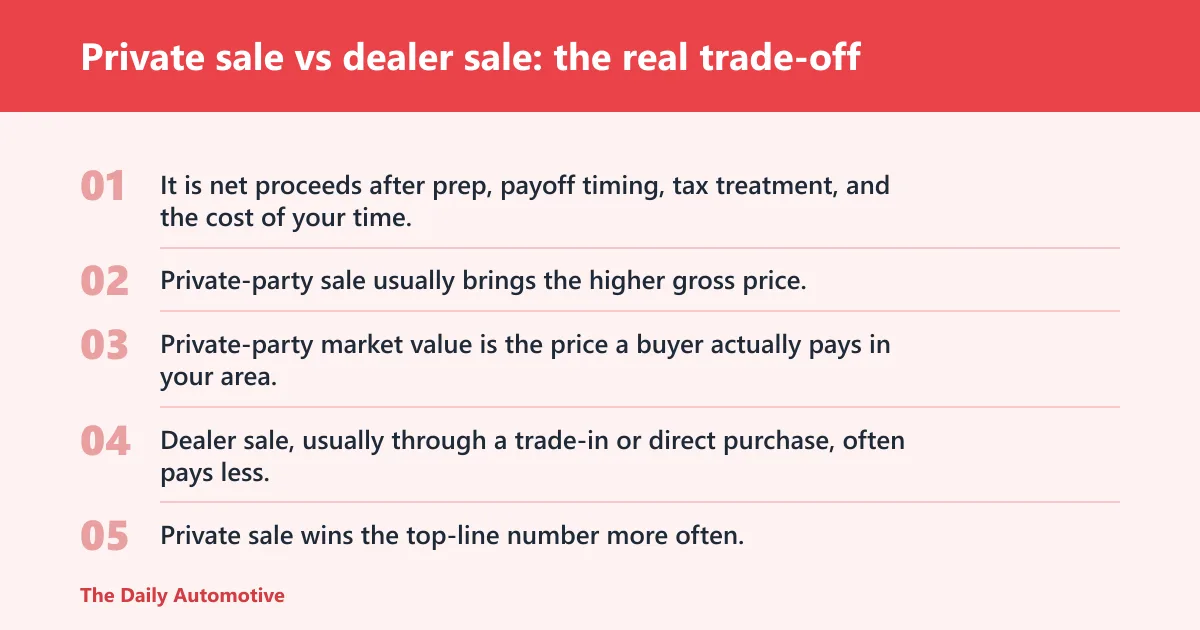


The real choice is not sticker price. It is net proceeds after prep, payoff timing, tax treatment, and the cost of your time. Private-party sale usually brings the higher gross price, but dealer sale is often faster, simpler, and less exposed to payment or title trouble.
Private-party market value is the price a buyer actually pays in your area, not the hopeful number in the ad. Dealer sale, usually through a trade-in or direct purchase, often pays less, but the dealer handles more of the paperwork and may reduce sales tax on the next car in some states.
| Decision factor | Private Sale | Dealer Sale | Winner |
|---|---|---|---|
| Gross sale price | Usually higher if the car is clean, titled, and easy to buy | Usually lower, with trade-in value often below private-party market value | Private Sale |
| Time to complete | Longer: ads, calls, meetups, negotiation, payment checks, title transfer | Faster: one visit, one offer, dealer handles much of the paperwork | Dealer Sale |
| Payment and fraud risk | Higher risk if the buyer uses bad funds or delays payment | Lower risk because the dealer is a business and payment is simpler | Dealer Sale |
| Sales tax impact on replacement car | Usually no trade-in tax credit | May reduce taxable amount in many states | Dealer Sale |
| Paperwork burden | You handle title transfer, bill of sale, odometer disclosure, and local rules | Dealer handles most paperwork, though you still need to review it | Dealer Sale |
Gross price is only the starting point
Private sale wins the top-line number more often, but that number is not money in hand until the buyer pays and the title clears. A dealer offer can look smaller and still leave more in your pocket once you subtract prep, repair, and time costs.
That is why private sale vs dealer sale should be treated as a net-proceeds calculation. If the private offer is only a little higher, the trade-in or dealer purchase can be the cleaner result.
Time and hassle are part of the price
Private-party sale requires buyer negotiation, ads, calls, meetups, and sometimes several no-shows. Dealer sale is quicker because the dealer manages the process and can often close things the same day.
For many sellers, that speed matters more than a few hundred dollars. It also matters when a replacement vehicle is already lined up and the clock is running on registration, insurance, or a loan payoff deadline.
Risk changes the math
Private sales carry payment-verification risk, title-transfer risk, and the possibility that a buyer disappears after inspecting the car. Dealers reduce that friction because they are set up to process transactions and paperwork as part of their business.
That does not mean every dealer deal is perfect. It means the seller is less exposed to fraud, bounced funds, and last-minute renegotiation after the test drive.
Net proceeds worksheet: what each option actually leaves you

The right comparison is not “private price versus dealer offer.” It is expected price minus all the costs tied to each path. Once you include cleaning, minor repairs, listing time, lien payoff timing, and sales tax on the next car, the gap often shrinks fast.
Below is a simple worksheet using a hypothetical car. The point is the structure, not the exact numbers.
| Line item | Private Sale | Dealer Sale |
|---|---|---|
| Expected sale price / trade-in offer | $10,800 | $9,800 |
| Prep spend: cleaning, photos, ad costs | -$150 | -$0 |
| Minor repairs and reconditioning | -$600 | -$200 |
| Time to sell and stale-listing drag | -$300 | -$0 |
| Lien payoff timing / extra interest risk | -$120 | -$0 |
| Replacement-car sales tax effect | $0 | +$500 |
| Estimated net result | $9,630 | $10,100 |
Prep spend is real money
Private sellers often need a deep clean, a detail, new photos, and a few small fixes just to get the car to market. Those costs are easy to ignore because they happen before the sale, but they still reduce the net result.
Dealer sales usually skip most of that work. A rough car or one with visible wear often gets the same basic offer whether or not the seller spent time making it photo-ready.
Time has a price
Waiting for a private buyer can cost more than people expect. The longer the listing sits, the more likely the seller gets lower offers, spends time answering messages, or drops the price to move the car.
That stale-listing drag is hard to see in advance, but it is common. A dealer offer that is a little lower on day one can beat a private sale that takes two weekends and three price cuts.
Lien timing can change the outcome
If the car has a loan, the payoff does not always line up neatly with a private sale. The lender must be paid, the release of lien must clear, and the title cannot always move instantly.
Dealers often handle payoff coordination more cleanly. With a private buyer, the seller has to make sure the loan is settled and the buyer knows when the title can be transferred.
Tax treatment can move the finish line
In many states, trading in a vehicle reduces the taxable amount of the replacement car. That sales tax advantage can narrow or even erase the gap between dealer and private sale on the seller’s real wallet impact.
State rules vary, so this needs a local check. Still, the tax credit is one of the most common reasons a dealer trade-in beats a slightly better private offer.
How much more can a private sale pay?
A private sale can pay more, but the gap is often smaller than sellers expect once asking price becomes actual selling price. The real number is the final cash you keep after prep, repairs, time, payoff, and tax effects, not the first ad response.
Why asking price is not the number that matters
Private-party market value starts with local listings, but those listings are asking prices. The true comparison should use actual selling prices in your area, because many cars never sell for the top number shown online.
Condition, mileage, maintenance history, accident history, and location all shift the number. A clean car in a high-demand area may sell close to asking; a tired car in a weak market may not.
How to compare local listings without fooling yourself
Use cars that match your own vehicle closely. Compare trim, mileage band, title status, and visible condition, then assume your selling price lands below the best examples unless your car is unusually clean.
- Find 5 to 10 local listings for the same model and trim.
- Ignore the highest outliers and the wrecked bargain listings.
- Use the likely sale band, not the top asking price.
- Subtract the costs of prep, minor fixes, and your time.
- Compare that result with the dealer’s out-the-door trade-in number.
What does a dealer sale cost you in price and fees?
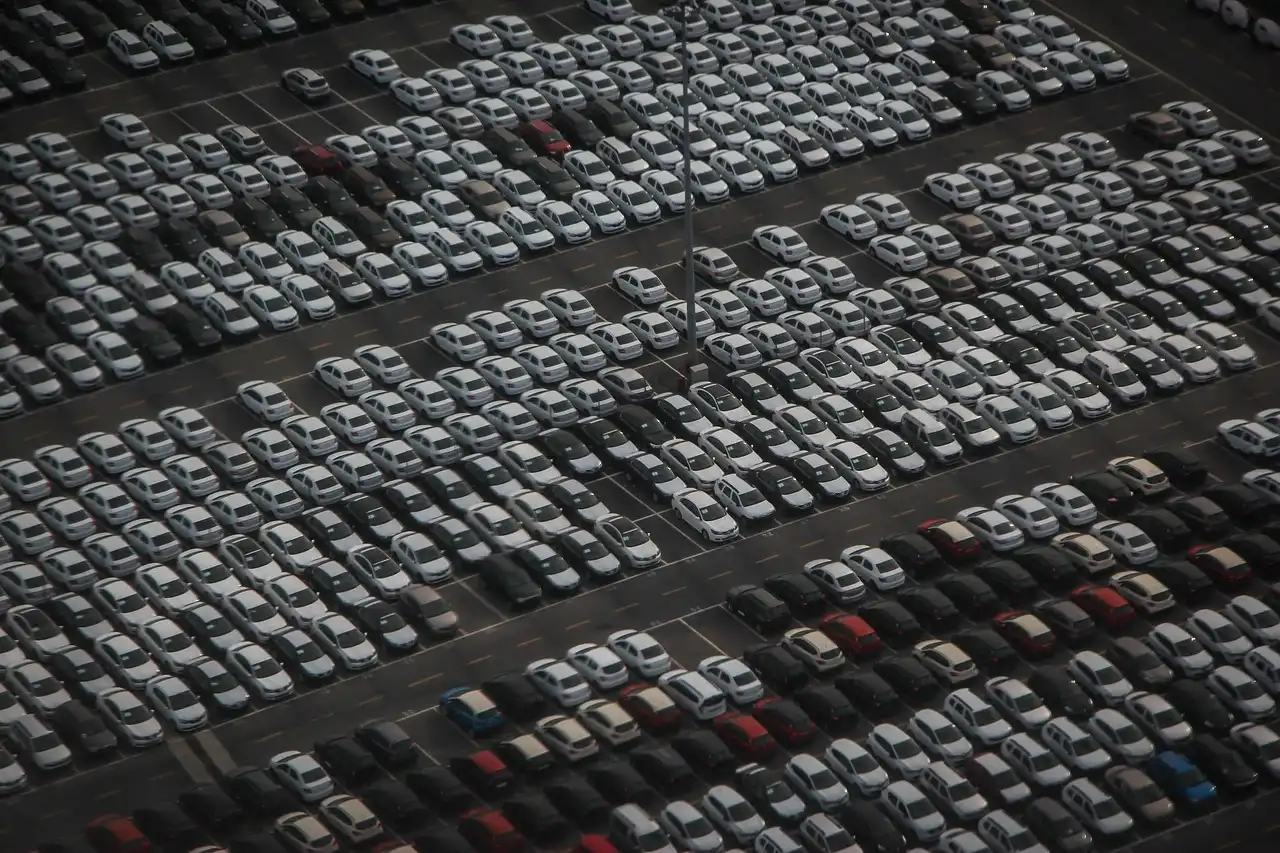
Dealer offers usually come in lower because the dealer has to resell the car, inspect it, recondition it, and take on inventory risk. Trade-in value is often lower than private-party value, but it can carry a tax credit when you buy the next vehicle.
How trade-in value is set
A trade-in value depends on condition, mileage, age, body damage, mechanical issues, and market demand. Dealers also discount for cars that are hard to retail quickly, such as high-mileage vehicles or niche trims with weak buyer interest.
That means a dealer may be less impressed by a spotless asking ad than a private buyer would be. Dealers price in the work they must do after the car arrives.
When the tax credit narrows the gap
If the state taxes only the difference between the new-car price and the trade-in, the dealer sale can become surprisingly competitive. The tax savings can offset part of the lower offer immediately.
This is one reason a lower dealer number can still be the better net deal. The seller must compare the true after-tax result, not the headline offer alone.
What paperwork and title steps are different?
Private sales usually require more seller effort. You need the title, a bill of sale, odometer disclosure where required, and any state-specific forms, while the buyer and seller both need to get the ownership transfer right.
Title transfer and lien release on a private sale
The vehicle title shows legal ownership, and lien status matters if a loan still exists. If there is a lien, the seller must coordinate the payoff and release of lien before the title can transfer cleanly.
Dealer paperwork is simpler for the seller because the dealer often handles much of the transfer. Still, the seller should verify exactly how the payoff, title, and sale amount will be processed.
Bill of sale details that should not be skipped
A bill of sale should include the sale date, buyer and seller details, purchase price, VIN, and odometer disclosure if the state requires it. It is a paper trail that helps prove what changed hands and when.
Skipping these basics creates avoidable disputes. If the buyer later questions the price, mileage, or transfer timing, the bill of sale is the cleaner record.
Dealer paperwork handling and what still needs review
Dealers do more of the paperwork, but that does not mean the seller can ignore it. The payoff amount, trade allowance, and title transfer language still need a careful read before signing.
The seller should also confirm whether the dealer is paying off a loan directly or applying the trade value against a replacement vehicle. Those are different transactions with different timing.
Is a private sale safer if you still owe money on the car?
Not automatically. If there is a lien, a dealer sale is often simpler because the dealer can coordinate payoff and paperwork in one place. A private sale can work, but it requires tighter control over funds, title release, and timing.
Why meeting at a bank reduces payment risk
For a private sale, meeting at the buyer’s bank or the seller’s bank is a practical fraud check. It makes cashier’s checks, bank transfers, and immediate verification easier than handling money in a parking lot.
That is especially important when the seller still owes money. Funds need to cover the lien first, and the seller cannot afford a payment that later fails.
Cashier’s check, bank transfer, and fraud checks
A cashier’s check is not risk-free, and a bank transfer should be confirmed before the keys leave the seller’s hand. Escrow or an in-branch transfer can reduce mistakes when the amount is large.
Private sellers should verify the payment method with the issuing bank before signing over the title. If the payment cannot be confirmed, the car should not leave.
Choose Private Sale if… / Choose Dealer Sale if…
Pick private sale when the car is clean, the title is simple, and the likely price premium survives real-world costs. Pick dealer sale when speed, certainty, tax treatment, or lien handling matters more than squeezing out the last few hundred dollars.
Choose private sale if…
Choose private sale if the car is paid off or the lien payoff is easy to coordinate, the vehicle condition is strong, and local listings show a real price gap. It also fits sellers who can wait for the right buyer and are willing to handle negotiation, title transfer, and payment verification.
It works best when the car is easy to explain and easy to inspect. Clean service records and a straightforward history help.
Choose dealer sale if…
Choose dealer sale if you need speed, if the car has mechanical issues or body damage, or if the private market is likely to stall. It also makes sense for financed cars, sellers with limited time, and anyone who wants the dealer to handle most of the paperwork.
If you are buying another vehicle, check the sales-tax effect first. The tax credit can make a lower dealer number look better on the final worksheet.
Best fit by seller type
Urgent sellers usually do better with a dealer. High-mileage cars and cars with visible wear often do better there too, because the private market discounts them heavily but still demands more seller effort.
Private-party sale is stronger for well-kept, paid-off cars with broad buyer appeal. Dealer sale is stronger when the process, not the headline number, is the main problem.
Frequently asked questions
Is it better to sell my car privately or to a dealer?
Private sale is usually better on gross price, but dealer sale can win on net proceeds once you count prep, risk, and sales tax on a replacement car. If the private offer is only modestly higher, the dealer route often leaves more usable money and far less hassle.
How much more money can I get from a private sale vs a dealer sale?
It varies by vehicle and local demand. The gap can look meaningful on paper, but it often shrinks after cleaning, minor repairs, ad costs, time, and lien payoff timing. Compare final net proceeds, not the first number you hear.
What fees or risks come with selling privately?
Private sellers may pay for detailing, listing ads, minor repairs, and extra time. The bigger risks are bad payment, title mistakes, buyer no-shows, and last-minute renegotiation. A careful payment check and a complete bill of sale reduce those problems.
How fast can I sell to a dealer compared with a private buyer?
A dealer sale is usually much faster because the dealer can inspect the car, make an offer, and complete the paperwork in one visit. A private sale can take days or weeks depending on demand, condition, price, and how quickly a serious buyer appears.
Do I need different paperwork for a private sale vs dealer sale?
Yes. Private sales usually require the title, bill of sale, odometer disclosure, and state-specific transfer forms, plus lien release if needed. Dealers handle more of the paperwork, but the seller should still review the payoff amount, title handling, and final transaction details.
Which option is safer if I still owe money on the car?
Dealer sale is usually safer when a lien exists because the dealer can coordinate payoff and title handling. A private sale can still work, but the seller should verify funds at a bank, confirm the payoff process, and make sure the lien release will be issued properly.
Products related to this article
Sponsored / affiliate links. As an Amazon Associate I earn from qualifying purchases. I may earn additional commission from eligible campaigns.