3 Best Paint Protection Films for Cars (2026): Based on Specs
For DIY car paint protection, the best scratch protection film depends on the panel you are covering: use thicker, self-healing film for high-impact edges, a wider film for long runs, and a pre-cut kit for small spots. Pick the wrong film, and you waste money, leave edges exposed, or trap dirt under a poor install. This guide compares three true scratch protection films by use case, with the best pick for small high-impact spots, longer DIY coverage, and tougher self-healing protection.
Best scratch protection film for cars
XPEL Clear Paint Protection Film Roll is the top pick for exposed panels because its self-healing polyurethane top coat helps hide light swirls and minor scuffs, while the 6-inch by 60-inch format is practical for edges, corners, and narrow strips.
Quick comparison
| Product | Badge | Best for | Price | ||
|---|---|---|---|---|---|
 |
VViViD 3M Clear Paint Protection Vinyl Film 4 Inch WideVViViD | Our pick | 4" x 60" · clear · PPF film | $17.98
Price as of 25 Oct 2026
|
View |
 |
XPEL Clear Paint Protection Film Roll, 6" x 60",XPEL | Also great | 6" x 60" · clear · self-healing PPF | $19.13
Price as of 25 Oct 2026
|
View |
 |
Lumen Clear Vinyl Wrap Paint Protection Film (PPF) For CarsLUMEN PROFESSIONAL FILMS | Also great | 60" x 50′ · clear · hybrid protective film | $299.99
Price as of 25 Oct 2026
|
View |
 |
Avery Paint Protection Film | Gloss Supreme Defense SeriesINSTAWRAPS | Also great | $1.49
Price as of 25 Oct 2026
|
View |
The main trade-off is simple: wider and thicker film helps on larger exposed panels, while narrower rolls make spot work cheaper and easier to handle. Match the film poorly, and you get waste, edge lift, or a seam that should have stayed off the car.
How we chose
This comparison focuses on film type, thickness, and roll size first. That is what decides whether a panel gets covered cleanly or turns into an off-cut puzzle.
We also weighed install difficulty for DIY buyers, because a film that looks good on paper can be awkward on a mirror cap or rocker panel. Finally, we separated true paint protection film from masking film, since those are not the same job.
Three details matter most here: urethane or polyurethane PPF, the actual thickness listed in the product details, and whether the roll size fits the part you want to cover. The Consumer’s Guide notes that 8 mil is the point where chip protection moves beyond simple scuff guarding, while thinner than 6 mil is only scuff guard territory.
Scratch film fitment matrix
This matrix maps the three picks to common DIY jobs. It is aimed at fitment, not brand hype, so the goal is to match panel size and install difficulty to the roll you can actually use.
| Area | Best pick | Recommended roll width/length | Thickness | Install difficulty | Likely waste |
|---|---|---|---|---|---|
| Hood leading edge | XPEL Clear Paint Protection Film Roll | 6 in x 60 in | 6 mil class | Medium | 15% to 25% |
| Bumper corners | 3M Scotchgard Clear Paint Protection Bulk Film | 48-inch roll, cut-to-size panel sections | 8 mil | Medium to hard | 20% to 35% |
| Mirror caps | XPEL Clear Paint Protection Film Roll | 6 in x 60 in | 6 mil class | Medium | 25% to 40% |
| Door cups | 3M Clear Paint Protection Bulk Film Roll | 6 in x 25 in | 6 mil | Easy | 10% to 20% |
| Rocker panels | 3M Scotchgard Clear Paint Protection Bulk Film | 48-inch roll, long cut sections | 8 mil | Hard | 25% to 40% |
| Short touch-up strips | 3M Clear Paint Protection Bulk Film Roll | 6 in x 25 in | 6 mil | Easy | 5% to 15% |
Say your door cups only need a narrow patch where rings and keys brush the paint. A 6-inch by 25-inch roll fits that job better than a broad sheet, because the install stays short and the leftover scrap stays small.
Suppose a bumper corner needs wraparound coverage and the film must bend around compound curves. A thicker 8-mil sheet can help, but the extra stiffness can increase contour mismatch if the installer stretches too far.
3M Scotchgard Clear Paint Protection Bulk Film: best for thicker DIY coverage
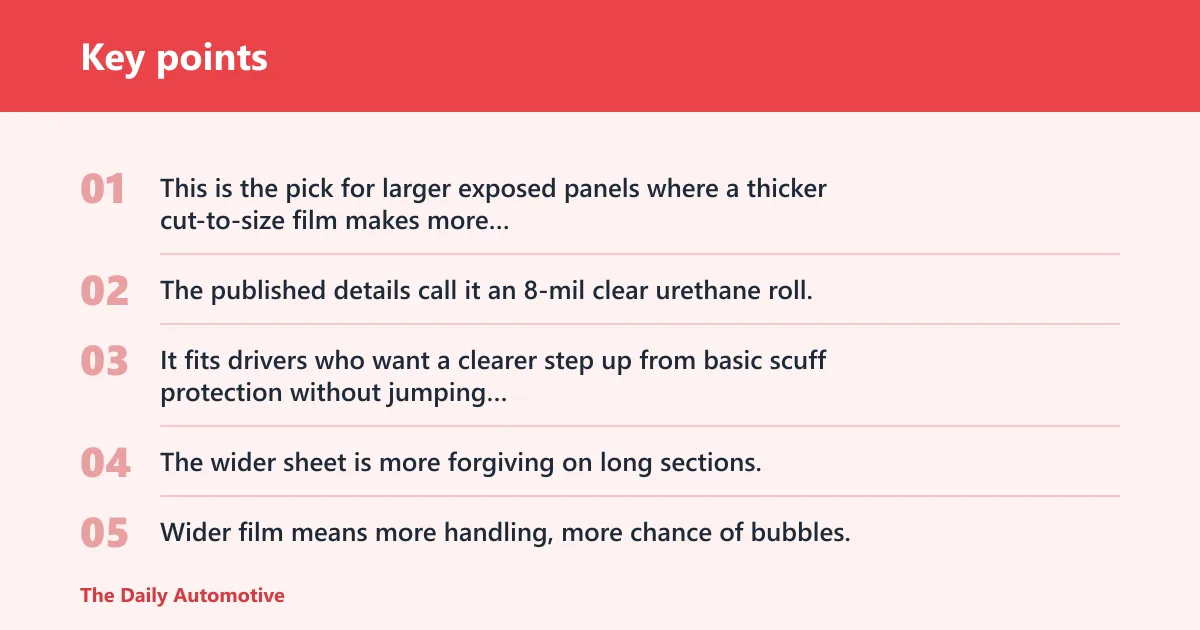
This is the pick for larger exposed panels where a thicker cut-to-size film makes more sense than a narrow spot roll. The published details call it an 8-mil clear urethane roll, and the 48-inch length gives more room to cut hood edges, rocker sections, and wider bumper pieces.
It fits drivers who want a clearer step up from basic scuff protection without jumping straight into a full pro install. The wider sheet is more forgiving on long sections, and the transparent top coat keeps the finish visually quiet once installed.
The drawback is install effort. Wider film means more handling, more chance of bubbles, and more waste if the panel has sharp curves or a tight recess. On complex shapes, the extra thickness can make edge control harder than with a smaller roll.
Why the 8-mil build matters
The 8-mil thickness lines up with the kind of protection buyers expect when they want more than a scuff guard. The Consumer’s Guide separates chip protection from lighter film by that threshold, so this product sits on the more protective side of the divide.
That does not mean it stops dents or deep keyed scratches. It can help absorb small impacts, scratches, and road debris, but hard contact can still reach the paint underneath.
Where the 48-inch roll makes sense
The 48-inch format matters on panels that need wide cut pieces or mirrored cuts for left and right sides. It is a better fit for rocker panel sections, bumper corners, and larger hood-edge strips than a short narrow roll.
It is less efficient for tiny spots. If you are only covering door cups or a mirror cap, a big sheet can create more scrap than protection.
Install notes and waste to expect
Plan on careful prep, slip solution, and a squeegee pass that works from the center out. Dust or leftover polish under the film will show up as bubbles or haze, and edge handling matters because lifted corners collect dirt.
Waste is usually higher than with a narrow roll because the sheet must be trimmed to the body line. On curved bumper corners, expect extra off-cuts from contour mismatch and test fitting.
3M Clear Paint Protection Bulk Film Roll: best for budget spot protection
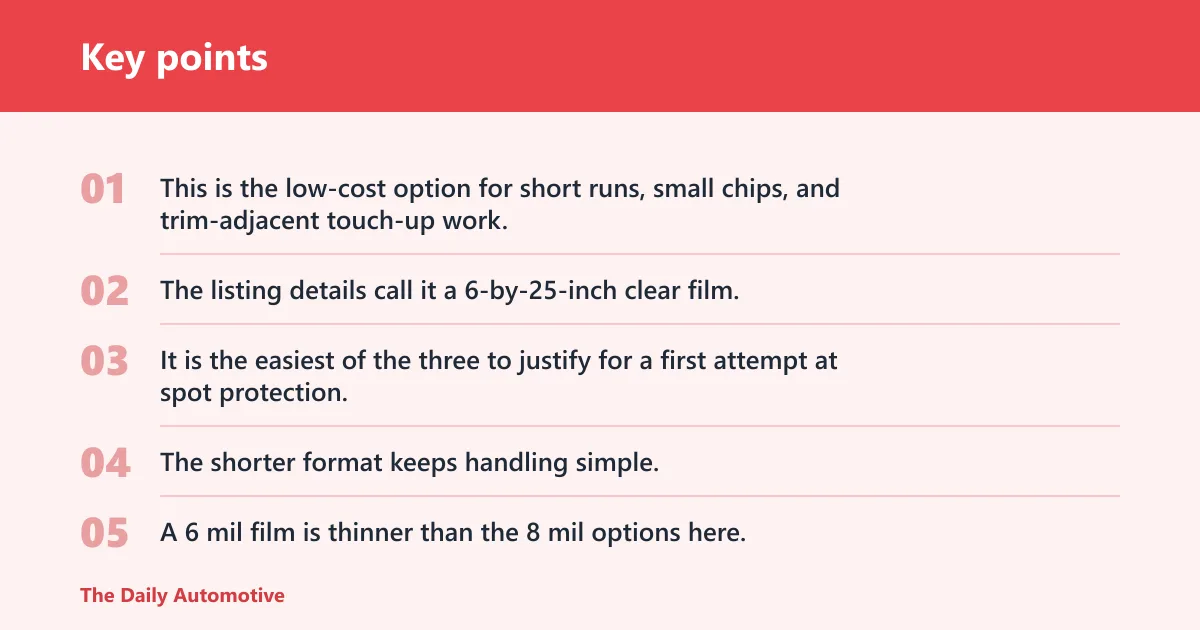
This is the low-cost option for short runs, small chips, and trim-adjacent touch-up work. The listing details call it a 6-by-25-inch clear film, which makes it a practical choice for door cups, short hood-edge strips, and other small jobs where coverage length matters more than broad panel reach.
It is the easiest of the three to justify for a first attempt at spot protection. The shorter format keeps handling simple, and the smaller footprint makes it easier to place, slide, and squeegee without chasing the film across a large panel.
The trade-off is protection depth. A 6 mil film is thinner than the 8 mil options here, so it fits lighter jobs better than high-impact panels. It is also not the right answer if you want broader self-healing performance or more confidence against repeated abrasion.
Why 6 mil fits smaller jobs
Six mil works best where the panel is small and the exposure is limited. The Consumer’s Guide says thinner than 6 mil is only a scuff guard, which is why this product sits near the bottom end of true paint protection film coverage.
That makes it useful for spot protection, not for claiming broad impact resistance. The thinner build is easier to maneuver, but it should not be treated like a heavier bumper wrap.
Best use on narrow panels and trim-adjacent areas
Door cups are the cleanest use case. Short strips on hood edges and small leading sections also fit the format well, especially if the panel only needs protection in a narrow contact zone.
It is less attractive for rocker panels or wide bumper sections. The small roll size increases seam risk and can force awkward joins that show up after installation.
Limits on coverage and protection depth
Do not expect this roll to solve every scratch problem. It can help with common paint wear, but it will not stop deep gouges, hard impacts, or poorly aimed key scratches.
Because the roll is short, planning matters. Measure the panel before cutting, because a bad cut can leave you without enough length for a second try.
XPEL Clear Paint Protection Film Roll: best for self-healing protection
This is the strongest fit for buyers who care about daily wear on high-contact panels. The product details describe it as polyurethane, and the listing says it protects against chips, scratches, dings, and road debris. Its self-healing top coat is the feature that sets it apart from the simpler 6 mil spot film.
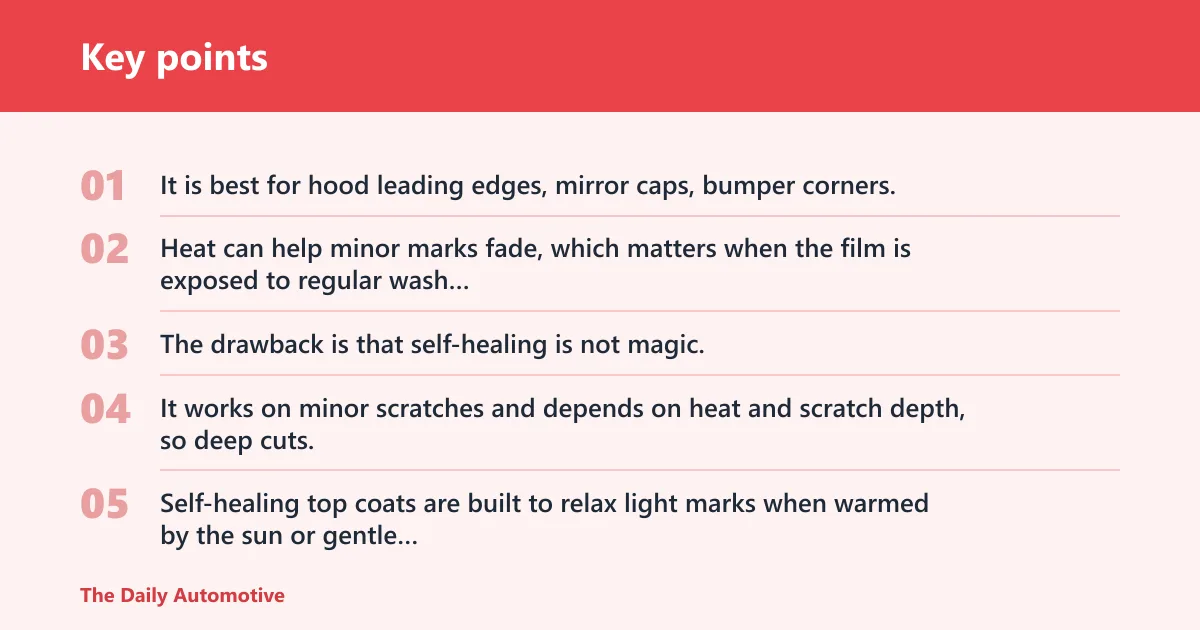
It is best for hood leading edges, mirror caps, bumper corners, and other places that collect fine swirls and light scuffs. Heat can help minor marks fade, which matters when the film is exposed to regular wash contact or brushing from road grit.
The drawback is that self-healing is not magic. It works on minor scratches and depends on heat and scratch depth, so deep cuts, sharp edges, and bad prep still show through or lift at the margins.
How the self-healing top coat changes daily wear
Self-healing top coats are built to relax light marks when warmed by the sun or gentle heat. That helps reduce the look of faint swirls and small scratches that would otherwise stay visible on a clear finish.
It does not mean every mark disappears. Deeper scratches can remain, and performance depends on temperature, the finish, and how hard the damage cuts into the film.
Best panels for a tougher finish
This is the better choice for surfaces that get touched often or take repeated debris hits. Mirror caps, front bumper corners, and hood fronts are the usual candidates because they see a mix of abrasion and visual wear.
A common first-timer mistake is using a narrow, non-healing film on a panel that gets cleaned often. The result is a clear film that shows wash marks faster than expected.
What to expect from heat-activated scratch recovery
Minor marks may fade after heat exposure, but the recovery is gradual and limited to light damage. That is useful for everyday use, not for fixing a rough install or a deep scrape.
Good prep still matters. Even a self-healing film will not hide trapped dust, and poor edge work can create lift that no top coat can fix.
Which one should you buy?
Buy the 8-mil 3M Scotchgard Clear Paint Protection Bulk Film if you want thicker coverage on exposed panels and you are willing to spend more time trimming to fit. It is the better choice for larger hood sections, rocker panels, and bumper corners where material thickness matters more than easy handling.
Buy the 6 mil 3M Clear Paint Protection Bulk Film Roll if you need the lowest-cost small-spot solution. It makes the most sense for door cups, short touch-up strips, and other tight areas where a short roll is enough and you do not need heavier protection.
Buy XPEL Clear Paint Protection Film Roll if you want self-healing performance for higher-contact areas. It is the best fit when light scratches, wash marks, and road wear are the main concern and you want a polyurethane film that is built for that job.
Choose by panel first, not by brand name. A rock-hit bumper corner needs a different film than a tiny door cup, and a long rocker strip needs more usable length than a small roll can give. If the panel is wide and exposed, move up. If the area is tiny, keep the roll small.
If the goal is only to mask a paint area during another repair, that is masking film territory, not PPF. True paint protection film is meant to stay on the car and protect the surface long term. Masking film is temporary by design and should not be treated as the same product.
Choose XPEL clear paint protection film roll if…
Choose XPEL if the panel sees frequent contact, especially on mirror caps, bumper corners, and hood leading edges. Choose it if you want self-healing behavior for light scratches and a polyurethane film aimed at chips, scratches, dings, and road debris.
Choose the 3M Scotchgard film instead if you need more panel width and a thicker 8-mil build for a larger section. Choose the 3M 6-by-25 roll if your work is limited to small spots, short strips, or tight areas where waste has to stay low.
Frequently asked questions
What is the best scratch protection film for cars?
The best scratch protection film depends on the panel and the amount of contact it gets. For higher-impact areas, XPEL is the best fit here because its self-healing polyurethane top coat suits light wear. For larger DIY coverage, the 8-mil 3M Scotchgard roll makes more sense.
Is 6 mil or 8 mil paint protection film better?
Eight mil is better when you want more chip protection and a sturdier feel on exposed panels. Six mil is better for budget spot work and smaller parts. The Consumer’s Guide draws the line by saying thinner than 6 mil is only scuff guard, so thickness matters for real protection.
Can paint protection film stop rock chips and scratches?
It can reduce damage from chips, scratches, and road debris, but it cannot guarantee total protection. Thick PPF helps absorb small impacts, yet deep gouges, sharp keys, and strong hits can still mark the paint. Think of it as a shield, not armor.
What’s the easiest PPF to install on a car at home?
The easiest option at home is usually the smallest roll that still fits the panel. The 3M Clear Paint Protection Bulk Film Roll is simplest for small spots and short strips. Prepped panels, slip solution, a squeegee, and careful edge work matter more than brand name.
How much film do I need for a hood edge or door cups?
A hood edge usually needs a longer strip than a door cup, so the 6-inch by 60-inch XPEL roll is the safer choice for that job. Door cups usually need only a small section, so the 6-by-25-inch 3M roll often leaves less waste.
Does self-healing PPF really remove minor scratches?
Yes, but only for minor marks and only under the right heat conditions. Self-healing top coats can reduce light swirls and fine scratches, especially on a gloss finish. Deep scratches, hard cuts, and edge damage are outside what self-healing can fix.
What is the difference between PPF and masking film?
PPF is meant to stay on painted surfaces and protect them from chips and scratches over time. Masking film is temporary and is used for covering during work, not for long-term paint protection. Mixing them up leads to the wrong material on the wrong job.
Products related to this article
Sponsored / affiliate links. As an Amazon Associate I earn from qualifying purchases. I may earn additional commission from eligible campaigns.