3 Best Protective Coatings for Cars (2026): We Compared
Choose ceramic spray coating if you want the best balance of easy application, strong water beading, and solid day-to-day protection; pick graphene ceramic coating only if you are willing to spend more time on prep and cure for longer claimed intervals, and use SiO2-focused spray formulas for the quickest low-risk application. Bad prep or a rushed cure can wipe out the advantage fast.
Quick comparison
| Product | Badge | Best for | Price | ||
|---|---|---|---|---|---|
 |
Turtle Wax Hybrid Solutions Ceramic Spray Wax Coating, 16Turtle Wax | Our pick | 16 oz · Ceramic Spray · High Shine | $14.39
Price as of 25 Oct 2026
|
View |
 |
Meguiar’s G200916EU Ultimate Quik Spray Wax 473ml, for aMeguiar’s | Budget pick | 473 ml · Spray Wax · High Gloss | $24.96
Price as of 25 Oct 2026
|
View |
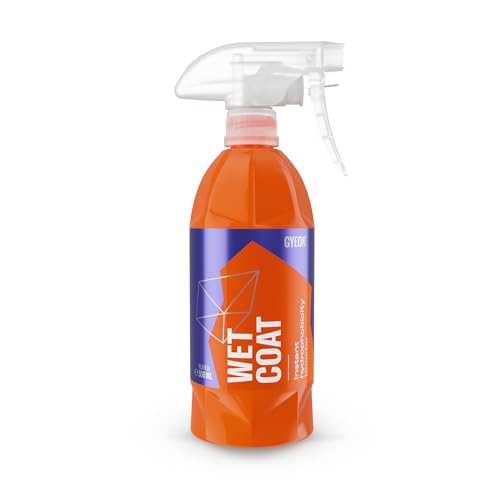 |
GYEON Wet Coat Spray-On Rinse Off Hydrophobic Gloss CoatingGyeon | Also great | 500 ml · Rinse-Off · Hydrophobic Gloss | $24.99
Price as of 25 Oct 2026
|
View |
The trade-off is plain: spray products ask less of you, while longer-claim coatings usually need more prep and tighter cure conditions. For a garage-kept weekend car, the easier spray often makes more sense. For a daily driver parked outside, longer-interval coatings matter more if you can handle the extra work.
How we chose
This comparison looks at prep time, cure burden, durability claim versus maintenance cadence, surface compatibility, and finish quality. It also separates marketing language from the work a home detailer actually has to do, because a coating that sounds stronger on paper can still be the harder choice in a driveway.
We also weighed how each product fits real DIY use: spray-on wipe-off convenience, kit-based prep, humidity sensitivity, and the surfaces each formula is commonly sold to cover. That matters more than a headline hardness claim if the coating is hard to spread evenly or needs a controlled cure window.
Turtle Wax Hybrid Solutions Ceramic Spray: best for easy DIY use
This is the best fit if you want a ceramic spray that keeps prep light and the application routine simple. Turtle Wax Hybrid Solutions Ceramic Spray Coating is a ceramic spray, and Mechanic Insider says it can last up to 6 months, which puts it in the “easy refresh” category rather than the long-haul class.
Its strongest appeal is the work it does not ask for. A spray-and-wipe product usually needs a clean, dry finish, but it does not bring the same cure strain as a kit that needs longer bonding time. Turtle Wax is also described as safe for glass, wheels, and trim, so it suits owners who want one bottle to handle paint and several exterior surfaces.
The ceiling is the trade-off. Six months is useful, but it is not a long-interval solution for a daily driver that lives outdoors and takes heavy contamination. If the paint is neglected or the panel is already rough, the spray can still bead water well and look glossy, but it will not make up for poor prep.
Why it works for low-effort protection
Spray ceramic formulas are popular because they pair hydrophobic behavior with low effort. In plain use, that means water beads more tightly, dirt releases more easily, and drying usually takes less towel work after a wash.
Turtle Wax also fits the common “refresh after wash” routine. That matters for owners who want visible gloss and UV protection without a full coating day. It is a better match for regular maintenance than for a once-and-forget strategy.
Meguiar’s Ultimate Ceramic Coating Kit: best for beginners
This is the better pick if you want a more structured kit-based approach and do not mind a longer application session. Meguiar’s Ultimate Ceramic Coating Kit is positioned as a kit, not a spray, and Theautozenith lists it as best for beginners, which usually points to guided prep rather than a purely spray-and-wipe routine.
Meguiar’s is also described by Mechanic Insider as a long-lasting ceramic kit. That makes it the middle ground here: more involved than a spray, but more approachable than many hard-coating products with strict prep and cure demands. For a DIY owner who wants stronger protection than a quick topper, that balance matters.
The honest drawback is time. Kit-based application usually means more surface prep, more care around panel coverage, and more room for user error than a spray. If you rush the process, you can end up with uneven coverage or a finish that does not look as clean as the label suggests.
Why a kit can make sense
SiO2, or silicon dioxide, is one of the common building blocks in ceramic formulas, and products built around that chemistry are often chosen for gloss, surface protection, and a hydrophobic barrier. Meguiar’s fits the category of a more deliberate application that can pay off in better-looking paint when the prep is done well.
For a beginner, the upside is control. A kit can be slower, but it can also be easier to place correctly on a panel-by-panel basis if the instructions are followed closely. The downside is that the cure window matters more than with a quick spray.
GYEON Wet Coat: best for fast maintenance
This is the fastest option in the group if the goal is quick hydrophobic protection right after a wash. GYEON Wet Coat is a spray-on rinse-off product, so it is built around speed rather than a long install process, and that makes it attractive for owners who want gloss without a long detailing session.
Its main strength is maintenance cadence. It works well as a booster for existing ceramic protection and can be used on paint, wheels, and glass, which makes it a practical maintenance product for exterior touch-ups. The finish can look clean and slick, and the rinse-off format keeps the work simple.
The drawback is that it is not the same as a longer-term coating. Spray-on rinse-off products are usually about convenience and maintenance support, not maximum durability. If your goal is the longest protection interval from a single application, this is the wrong category.
Where rinse-off products fit
Wet Coat-style formulas are useful when you wash often and want to restore beading fast. They are less compelling if you want one application to carry most of the load for months at a time.
That makes them a smart add-on for a coated car, but a less complete answer for a neglected finish or a driver looking for the lowest reapplication cadence.
Which coating is easiest to apply at home?
For most DIY owners, the easiest at-home option is the ceramic spray coating. Spray-on wipe-off formulas usually need less prep, less cure control, and less risk than a kit-based coating, while rinse-off products are fast but are generally more limited as a primary protection layer. The easiest product is not always the most durable one.
Where mistakes happen
Common failure cases are straightforward. High humidity can slow drying and leave a smeared look, uneven curing can create patchy water behavior, and streaking often shows up when too much product is used or the panel is not fully clean.
Say your black sedan sits outside after a quick wash and the panels are still warm at noon. A spray coating can flash unevenly on that surface, and the result may be streaks that are visible in sunlight until the residue is corrected.
Suppose a garage-kept coupe gets a careful prep but the owner applies a kit coating on a damp day. The finish may still look glossy, but the cure can be less consistent, which usually means the claimed durability is harder to realize in practice.
Best first-step choice
If this is your first coating, start with the spray. It gives you the highest margin for error and the shortest learning curve. If you want more longevity and are willing to spend more time on prep, the kit makes sense next.
How the three coatings compare
The biggest difference is not gloss. All three can improve shine and water behavior. The difference is ownership burden: how long prep takes, how carefully the cure must be managed, and how often you will be back on the paint with another application.
| Criteria | Turtle Wax Hybrid Solutions Ceramic Spray | Meguiar’s Ultimate Ceramic Coating Kit | GYEON Wet Coat |
|---|---|---|---|
| Prep time | Low | Medium to high | Low |
| Cure burden | Low | Medium to high | Low to medium |
| Durability claim in practical terms | Up to 6 months | Long-lasting ceramic kit | Maintenance booster, not a long-term base coat |
| Water-beading strength | Strong | Strong when applied correctly | Very strong immediately after use |
| Surface versatility | Paint, glass, wheels, trim | Mainly paint, depending on prep and instructions | Paint, wheels, glass |
| Best-fit owner profile | Easy DIY user | Beginner who wants a kit | Frequent washer who wants fast upkeep |
Prep time and surface prep
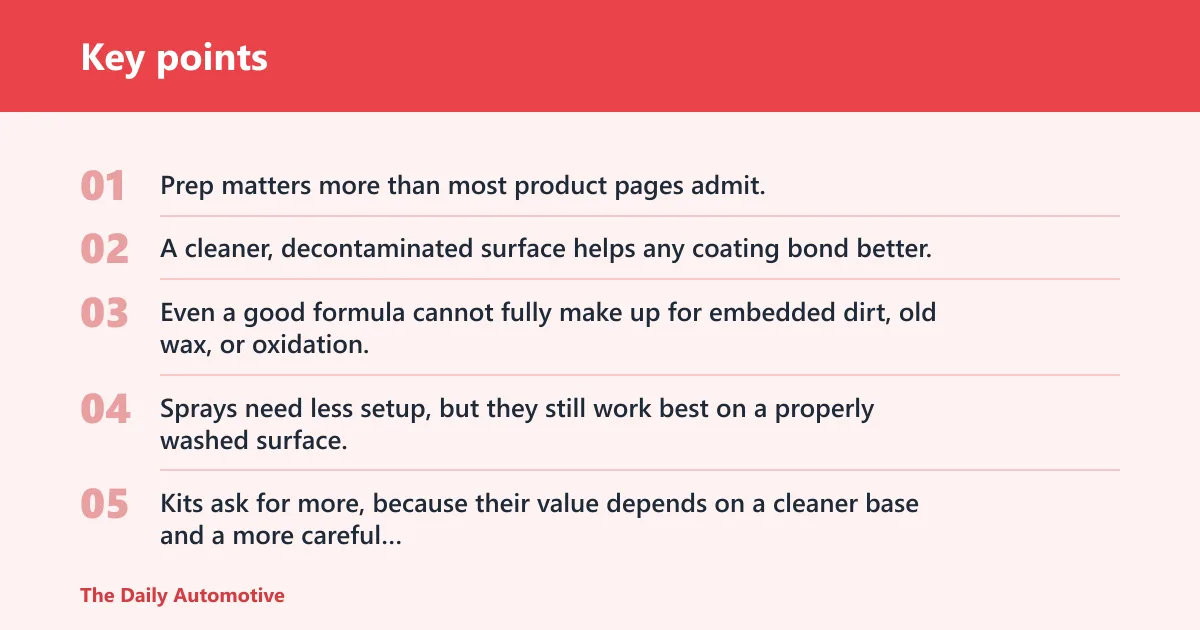
Prep matters more than most product pages admit. A cleaner, decontaminated surface helps any coating bond better, and neglected paint usually reduces the payoff. Even a good formula cannot fully make up for embedded dirt, old wax, or oxidation.
Sprays need less setup, but they still work best on a properly washed surface. Kits ask for more, because their value depends on a cleaner base and a more careful install. That is why the prep burden is a real ownership cost, not a minor detail.
Cure time and humidity sensitivity
Drying and curing are where longer-claim coatings can become less convenient. Heat, moisture, and poor ventilation can change how evenly the product sets. That is one reason a quick spray can feel more reliable for a home user, even if a kit promises longer protection.
The practical takeaway is simple: if you cannot control your workspace, choose the product that is least sensitive to the environment. That usually favors spray formats over more demanding coatings.
Durability claim versus maintenance cadence
A “long-lasting” coating is only useful if you can actually keep it on the car. If a product promises more protection but needs longer prep, tighter cure control, and a more careful wash routine, the real-world burden rises with the claim.
For garage-kept weekend cars, that burden is easier to absorb. For daily drivers parked outdoors, maintenance cadence matters more because road film, rain, and sunlight shorten the easy life of any coating.
Which one should you buy?
Use the car and your tolerance for prep to decide. Garage-kept weekend cars do well with a spray or a kit, depending on whether the owner values easy refreshes or longer intervals. Daily drivers parked outdoors usually benefit from the strongest protection they can apply correctly, but only if they are willing to manage the prep and cure step.
| Scenario | Best pick | Why |
|---|---|---|
| Garage-kept weekend car | Turtle Wax Hybrid Solutions Ceramic Spray | Easy application, strong gloss, and enough durability for light-use mileage |
| Daily driver parked outdoors | Meguiar’s Ultimate Ceramic Coating Kit | Better fit when you want longer protection and are willing to spend time on prep |
| Low-maintenance owner | GYEON Wet Coat | Fastest upkeep after washing, with minimal application burden |
| Want the least reapplication without professional installation | Meguiar’s Ultimate Ceramic Coating Kit | More involved up front, but the right DIY choice if durability matters more than speed |
Choose Turtle Wax if you want the simplest all-around ownership experience and do not need the longest interval. Choose Meguiar’s if you are willing to trade time for a more durable coating process. Choose GYEON if your main goal is quick maintenance after routine washing, not a one-and-done protectant.
Choose Turtle Wax if… / Choose Meguiar’s if… / Choose GYEON if…
Choose Turtle Wax if you want a spray-and-wipe routine, you value compatibility with glass, wheels, and trim, and you are comfortable reapplying every few months. It is also the safest call for owners who want visible hydrophobic action without a long install session.
Choose Meguiar’s if you want a more deliberate ceramic process, you are chasing longer upkeep intervals, and you can give the car proper prep and cure time. It makes the most sense when protection matters more than convenience.
Choose GYEON if you already wash regularly, want quick gloss and beading, and need a rinse-off product that supports the rest of your detailing routine. It is not the strongest long-term stand-alone answer, but it is the fastest maintenance choice.
Protective coating versus wax
Compared with traditional wax, these coatings are generally chosen for better hydrophobic behavior, better UV resistance, and longer protection intervals. Wax still has a place when speed and simplicity matter, but it usually needs more frequent reapplication and does not match a good ceramic-style finish for sustained water beading.
The difference is not only shine. Coatings are usually preferred when the owner wants easier drying, more dirt repellency, and less frequent refresh work. Wax remains a simple option, but it is the weaker long-term play for most modern daily drivers.
Frequently asked questions
What is the best protective coating for cars?
The best overall choice for most DIY owners is a ceramic spray coating because it balances easy application, strong gloss, and solid water beading with lower ownership burden. If you want the longest claimed interval and can handle more prep, a kit-based ceramic coating is the better fit. The right answer depends on how much time you want to spend on the install.
Is ceramic spray better than graphene coating?
Not always. Ceramic spray is usually easier and more forgiving, while graphene ceramic coatings often come with bigger durability and hardness claims plus more cure-time demands. If your priority is convenience, ceramic spray wins. If your priority is the longest claimed protection and you can manage the prep, graphene can make sense.
How long does a ceramic car coating last?
It depends on the formula, prep quality, wash routine, and parking conditions. In this comparison, Turtle Wax is associated with up to 6 months, while a kit like Meguiar’s is positioned as a long-lasting ceramic option. Outdoor parking and neglected paint usually shorten real-world results.
Which car coating is easiest to apply at home?
The easiest at-home choice is the ceramic spray. Spray-on wipe-off products have the lowest prep burden and the smallest cure risk, which makes them easier for first-time users. Rinse-off products are also simple, but they work more as maintenance boosters than as the main protection layer.
Can I use a protective coating on glass, wheels, and trim?
Yes, some coatings are built for more than paint. Turtle Wax is described as safe for glass, wheels, and trim, and GYEON Wet Coat can also be used on paint, wheels, and glass. Always check the product instructions, since surface compatibility can vary by formula and application method.
What coating gives the best water beading?
Strong beading is a common feature of ceramic-style formulas, but the best immediate beading often comes from fresh spray applications and maintenance boosters. Turtle Wax is described as giving extreme water beading, while GYEON Wet Coat is built around hydrophobic performance. The catch is that beading quality depends on both application and condition of the surface.
Products related to this article
Sponsored / affiliate links. As an Amazon Associate I earn from qualifying purchases. I may earn additional commission from eligible campaigns.