Lead Acid vs Lithium Car Battery
For most cars, Lead Acid is the safer replacement; choose Lithium Car Battery only if the battery type, charging system, and low-temperature specifications all match the car. Expect less cranking reserve in some cold conditions. A poor match can cause slow starts, charging faults, or early battery wear. This guide compares starting performance, charging fit, cold-weather behavior, and total ownership cost.
| Decision factor | Lead Acid | Lithium Car Battery | Winner |
|---|---|---|---|
| Upfront cost | Lower upfront cost | Higher upfront cost | Lead Acid |
| Weight | Heavier construction | About one-third as much | Lithium Car Battery |
| Cold-weather starting | Usually steadier cold cranking | Sensitive to cold temperatures | Lead Acid |
| Cycle life | 500 to 1200 cycles | 2000 to 3000 cycles | Lithium Car Battery |
| Storage behavior | Best kept at 95 to 100 percent when not in use | Prefers 70 to 80 percent at rest | Tie |
| Retrofit fit | Matches most factory charging systems | May need BMS checks and charger changes | Lead Acid |
Lead acid vs lithium at a glance
These chemistries solve different car problems. Lead Acid fits the standard 12V starting role with the least trouble, while Lithium Car Battery can pay off in weight-sensitive builds, storage use, and higher cycle life if the car’s charging setup is compatible.
Starter-battery duty is the key difference
A car starter battery has to deliver a short, strong burst, then accept recharge from the alternator almost immediately. That is where fit matters more than marketing claims. Lead Acid has more forgiving compatibility in ordinary passenger cars, while Lithium Car Battery can demand tighter control of charge voltage and temperature.
Side-by-side tradeoffs for cost, weight, charging, and cold weather
Lead acid batteries have been used for more than 150 years, so vehicle charging systems are built around that chemistry. Lithium batteries cost more up front than lead acid, weigh about one-third as much, and can provide higher power and higher output voltage than lead acid batteries. Cold weather still tilts the field back toward Lead Acid for most daily drivers.
What changes in real car starting?
Real starting use is brief and repetitive. The battery must crank the engine, support electronics during the start, and then recover quickly from the alternator. A battery that looks fine on a shelf can still be a poor match if it cannot tolerate the car’s charging profile or cold starts.
Cranking power and short bursts of demand
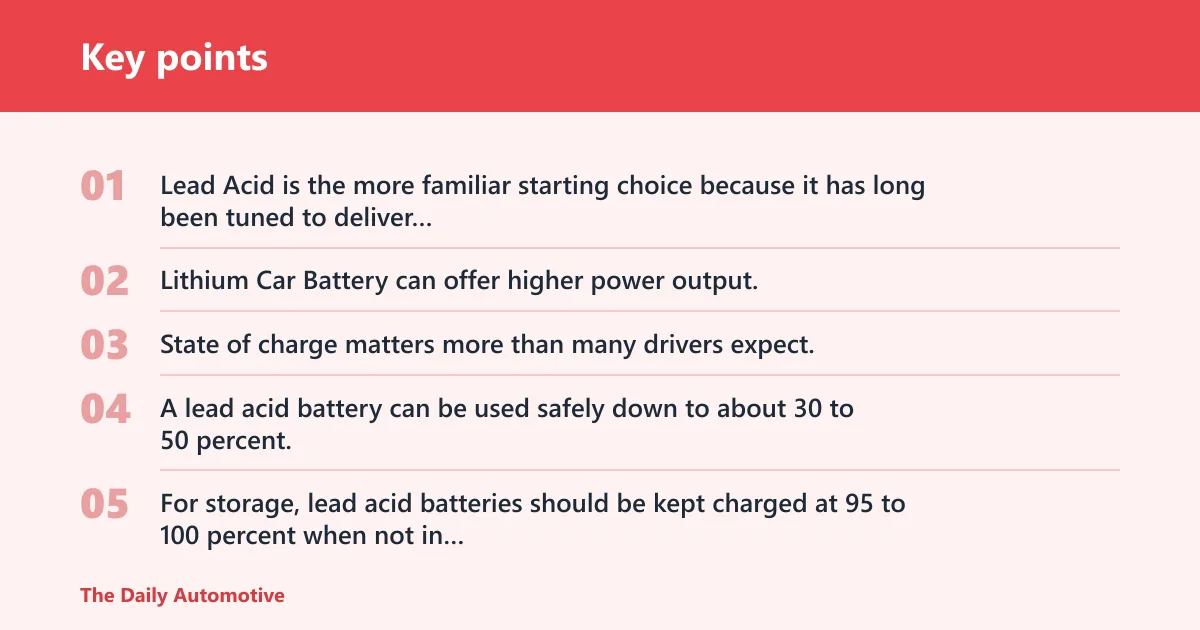
Lead Acid is the more familiar starting choice because it has long been tuned to deliver short bursts and recover under alternator charge. Lithium Car Battery can offer higher power output, but that only helps if the vehicle’s charge control, low-temperature behavior, and starting demand are in range.
State of charge and how low you should go
State of charge matters more than many drivers expect. A lead acid battery can be used safely down to about 30 to 50 percent, while a lithium battery can be run to 20 percent safely. For storage, lead acid batteries should be kept charged at 95 to 100 percent when not in use, while lithium batteries prefer to sit at 70 to 80 percent.
That difference changes how you should think about parked vehicles. A car that sits for weeks with parasitic draw can punish a lead acid battery if it is left partially discharged. A lithium unit may tolerate a deeper usable range, but only if the car’s charging and protection system is designed for it.
Accessory loads when the engine is off
Engine-off loads are where state of charge drops fast. Dashcams, parking monitors, audio amplifiers, and infotainment memory all draw from the same 12V supply. For those loads, the key question is not only capacity; it is whether the battery chemistry and vehicle electronics can support repeated partial discharge without early failure.
Car battery decision matrix
| Scenario | Best pick | Expected tradeoff |
|---|---|---|
| Short-trip commuter | Lead Acid | More tolerant of repeated partial recharge from brief drives |
| Long-storage vehicle | Lithium Car Battery | Lower self-stress when stored at 70 to 80 percent, but only if the vehicle and charger match |
| Cold-weather daily driver | Lead Acid | Better starting confidence in low temperatures |
| High-electronics or audio load | Lithium Car Battery | Higher power output helps, but BMS and alternator compatibility become critical |
| Budget replacement | Lead Acid | Lower upfront cost and easiest fit with factory charging |
Short-trip commuters usually do better with Lead Acid because the alternator gets less time to refill the battery after each start. Long-storage vehicles can favor Lithium Car Battery if the vehicle is set up for it and the battery can sit at the right storage charge. Budget replacements still point to Lead Acid when you want the simplest swap.
Say your sedan gets about a 7-minute commute each way and spends the rest of the day parked. That pattern keeps the battery in a shallow charge cycle and often favors Lead Acid. Now change only one variable: the same car sits in a garage for three weeks at a time. Storage behavior becomes the bigger issue, and Lithium Car Battery may fit better if the charging setup is compatible.
How do charging and alternators compare?
The alternator is not a generic battery charger. It is part of the vehicle’s electrical system, and it must match the battery chemistry the car expects. If the charging profile and battery type disagree, the result can be slow recovery, fault codes, or shortened service life.
Why alternator output must match battery chemistry
An alternator charges the battery while driving and supports accessory loads at the same time. Lead Acid accepts the factory setup in most cars because those systems were built around it. Lithium Car Battery may need tighter voltage control and a cleaner match between the alternator, vehicle electronics, and the battery’s protection circuitry.
Battery management circuitry and protection limits
Lithium packs usually rely on battery management circuitry for overcharge and undercharge protection, and that circuitry also shapes charge-rate compatibility. That helps protect the cells, but it can create retrofit limits. A battery that is safe on paper can still be wrong for a specific car if the BMS does not like the alternator’s output pattern.
When a retrofit charger or charger setting change is needed
Retrofitting lithium may require a different charger or a different charging mode, especially for cars that are stored for long periods or charged off-vehicle. A lead-acid charger is often not the right choice for a lithium battery unless the manufacturer says it is compatible. Check the battery manual and the vehicle manual before changing chemistry.
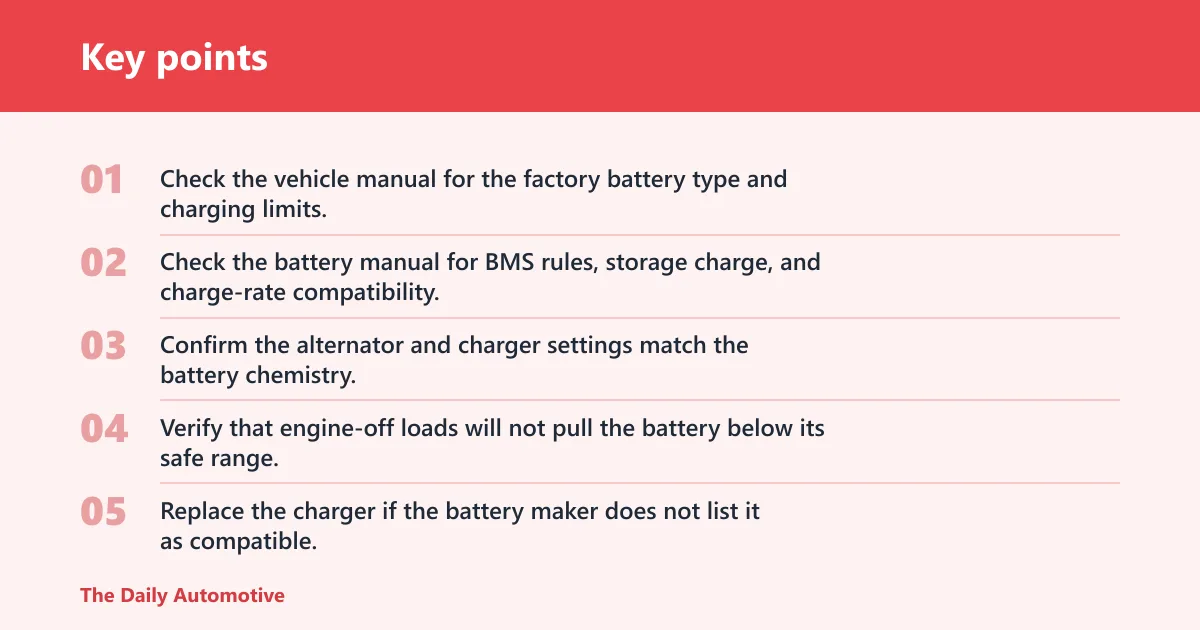
- Check the vehicle manual for the factory battery type and charging limits.
- Check the battery manual for BMS rules, storage charge, and charge-rate compatibility.
- Confirm the alternator and charger settings match the battery chemistry.
- Verify that engine-off loads will not pull the battery below its safe range.
- Replace the charger if the battery maker does not list it as compatible.
How do cold temperatures and short trips compare?
Cold weather hurts lithium performance more than lead acid performance. That matters because starting is hardest when the engine is cold and the battery is cold. Short trips add another problem: the battery may not get enough time to recover from the start event, especially in winter.
Cold-weather starting reliability
Lead Acid usually has the edge in cold starts because it is the more established 12V starter chemistry. Lithium Car Battery is lighter and can deliver strong output, but it is more sensitive to cold temperatures. In cold weather, that sensitivity can show up as slower cranking or reduced usable output when the car first wakes up.
Cold-temperature charging limits for lithium
Low-temperature charging is a key failure mode for lithium retrofits. If the battery management circuitry blocks charge below its safe temperature window, the alternator may not refill the battery the way the vehicle expects. That can matter after a short winter drive, when the battery needs recharge but cannot accept it normally.
Short-trip driving and recovery from partial charge
Short trips are rough on any starter battery, but especially on one that needs a precise charging profile. Lead Acid can still be the better fit because it matches the factory system and tolerates that usage pattern better. Lithium Car Battery may recover faster under the right conditions, yet it depends more heavily on matched electronics.
What is the 3-year cost difference?
Upfront price is only part of the bill. The real comparison includes replacement frequency, storage behavior, and whether you need charger changes to keep the battery healthy. Lithium batteries cost more up front than lead acid, but their longer cycle life can offset that in the right duty cycle.
| Cost item | Lead Acid | Lithium Car Battery | Cost note |
|---|---|---|---|
| Purchase price | Lower upfront cost | Higher upfront cost | Lead Acid wins on entry price |
| Replacement frequency | More likely to need earlier replacement if cycled often or left undercharged | Longer service window when used within spec | Lithium Car Battery can win over time |
| Charger compatibility | Usually matches standard charging gear | May need a different charger or setting | Lead Acid is cheaper to support |
| Storage maintenance | Should be kept at 95 to 100 percent when not in use | Prefers 70 to 80 percent at rest | Tie, but the maintenance target differs |
Cycle life helps explain the ownership gap. Lead-acid batteries typically deliver 500 to 1200 cycles, while many lithium batteries can reach 2000 to 3000 cycles. That does not mean lithium is automatically cheaper over three years; it means the result depends on how often the battery is cycled and whether the car can charge it correctly.
A common first-timer mistake is assuming the higher cycle count means an easy swap. Picture a stop-start hatchback with a factory alternator and a battery that sits under the hood in winter. If the lithium battery lacks the right charge control, the car may still start less reliably than the cheaper Lead Acid replacement.
Can you replace lead acid with lithium?
Sometimes, yes. But a straight swap is not the same as a safe swap. The battery has to match the vehicle’s charging profile, electrical loads, and low-temperature behavior. If the battery management circuitry and alternator output do not agree with the battery chemistry, replacement can create more problems than it solves.
BMS compatibility and vehicle electronics
Battery management circuitry matters because it governs charge limits and protects the cells from overcharge and undercharge. Many lithium units depend on that control to stay within safe operating limits. If the car’s electronics expect lead-acid behavior, a lithium retrofit can confuse the charging system unless the battery maker says it is approved for that vehicle pattern.
When parallel pairing is a bad idea
Putting Lead Acid and Lithium Car Battery units in parallel is usually a poor idea unless the manufacturer specifically allows it. Different storage charge targets, charge acceptance, and protection limits can make one battery fight the other. Mixed chemistry banks are especially risky in starter systems that depend on quick alternator recovery.
What to verify in the owner and battery manuals
Follow the vehicle and battery manuals first. Check chemistry approval, charging limits, cold-start behavior, and whether the car uses start-stop logic or battery monitoring that expects a certain type. If the manuals do not approve the swap, keep the original chemistry.
Lead Acid vs Lithium Car Battery which is better
Lead Acid is the better fit for most ordinary cars, especially if you want the safest match for the factory alternator, the lowest upfront cost, and the best odds in cold weather. Lithium Car Battery is the better pick when weight, storage use, or cycle life matters more than plug-and-play compatibility.
Choose Lead Acid if budget and OEM fit matter most
Choose Lead Acid if the car is a daily driver, the weather gets cold, or the battery must work with an unmodified charging system. It is also the safer bet for short-trip commuting and budget replacement work. If you want the least retrofit risk, start here.
Choose Lithium Car Battery if weight, cycle life, or storage use matters more
Choose Lithium Car Battery if you have verified BMS compatibility, the charging system matches the chemistry, and the car’s use case rewards lighter weight or longer cycle life. It makes more sense for some stored vehicles, audio-heavy builds, and specialized applications than for a plain commuter.


Frequently asked questions
Lead acid vs lithium ion battery price: is lithium worth it?
Lithium can be worth it when longer cycle life, lighter weight, or long storage behavior matters more than the price at checkout. For a normal commuter car, Lead Acid usually makes more financial sense because it costs less up front and is more likely to fit the factory charging system without changes.
How long does a lead acid battery last compared with lithium?
That cycle gap is real, but it only pays off if the vehicle’s charging system and temperature range let the lithium battery work within spec for the full service period.
Is a lithium car battery safer than lead acid?
Safety depends on fit and handling, not chemistry alone. Lead-acid batteries contain hazardous lead, and no level of lead in the blood is safe. Lithium batteries need battery management circuitry to prevent overcharge and undercharge. In the car, the safer choice is the one that matches the vehicle manual.
What is the weight difference between lead acid and lithium batteries?
Lithium batteries weigh about one-third as much as lead acid. That matters in racing, off-road, or weight-sensitive builds, but the savings do not help if the battery cannot survive the car’s charging profile or cold-start demand. Weight is a benefit, not a replacement plan by itself.
How do cold temperatures affect lead acid vs lithium car batteries?
Cold temperatures hurt lithium performance more sharply. Lead Acid usually starts more predictably in winter and is the safer choice for cold climates or parked vehicles that must fire up after a freeze. Lithium can work well in the right car, but its cold-temperature sensitivity needs to be part of the decision.
Can you put lead acid and lithium batteries in parallel?
Usually no, unless both battery makers say the combination is allowed. Mixed chemistry batteries can disagree on storage charge, charge rate, and protection limits, which can shorten life or create charging faults. For a starter system, keep the battery bank in one approved chemistry unless the design specifically calls for a hybrid setup.
Products related to this article
Sponsored / affiliate links. As an Amazon Associate I earn from qualifying purchases. I may earn additional commission from eligible campaigns.