Best Car Polishing Tools for Flawless Detailing Results
For most DIY detailers, the best polishing system is a dual-action polisher with foam cutting, polishing, and finishing pads plus a medium-cut compound; choose a rotary only for severe defects and experienced hands. Pick the wrong setup, and you can waste hours, leave haze or swirls, or burn through clear coat. This guide compares polishing machines, pads, and compounds by paint condition and skill level so you can choose the right setup.
Quick comparison
| Product | Badge | Best for | Price | ||
|---|---|---|---|---|---|
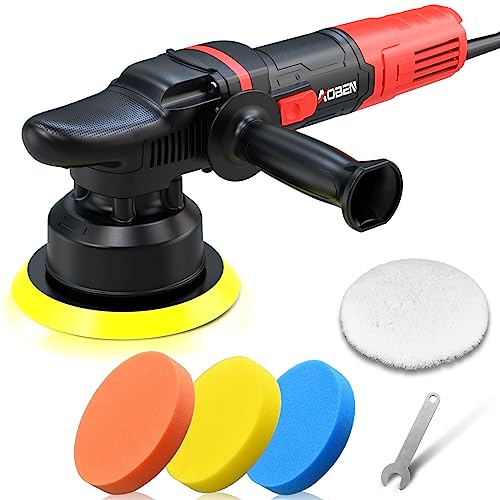 |
AOBEN Car Buffer Polisher,6 inch Dual ActionAOBEN | Our pick | 6-inch · Dual-Action · 6-Speed Kit | $49.99
Price as of 19 Oct 2026
|
View |
 |
RUPES BigFoot LHR15 Mark V Random Orbital Polisher – ToolRUPES | Upgrade pick | 15mm · RUPES · Random Orbital | $552.00
Price as of 19 Oct 2026
|
View |
 |
Meguiar’s Mirror Glaze Bundle, Polishing Compound KitMeguiar’s | Pair with it | Compound Kit · Ultra-Cut · Gloss Polish | $27.94
Price as of 19 Oct 2026
|
View |
This comparison is built around paint condition, not brand hype. For most people, start with a dual-action machine, matched pads, and a compound that fits the defect level.
How we chose
Selection rests on four checks: matching pad cut to paint hardness, confirming pad and backing plate compatibility, balancing correction speed against finish quality, and tracking consumable cost per corrected panel. Beginner-friendly systems are separated from advanced correction tools because the safest setup is not always the fastest one.
We also looked at common failure points. Pad hopping, holograms, micromarring, and heat buildup matter more than raw speed when you are trying to finish a panel cleanly.
Polishing tool matrix
| Paint condition | Defect severity | Skill level | Best tool | Pad and product combo | Stop at polishing or move to compounding? | Budget level |
|---|---|---|---|---|---|---|
| Soft clear coat | Light swirls, haze | Beginner | Dual-action polisher | Finishing foam pad + finishing polish | Stop at polishing unless defects remain after inspection | Low to medium |
| Medium clear coat | Moderate swirls, water spotting, light oxidation | Beginner to intermediate | Dual-action polisher | Polishing foam pad + medium-cut compound, then finishing foam pad + polish | Move to compounding if one polishing pass does not reduce defects | Medium |
| Hard clear coat | Heavier swirls, moderate scratches | Intermediate | Dual-action polisher or rotary buffer | Cutting foam or microfiber pad + compound, then polishing foam pad + finishing polish | Compound first if polishing alone leaves visible defects | Medium to high |
| Very hard clear coat | Deep swirls, heavier marring | Experienced | Rotary buffer | Microfiber cutting pad or aggressive foam + compound, then DA finishing step | Compounding is usually required before any final polish | High |
| Soft clear coat | Micro-marring after compounding | Beginner to intermediate | Dual-action polisher | Finishing foam pad + low-cut finishing polish | Stop at polishing if the panel is defect-free after panel wipe | Low to medium |
AOBEN Car Buffer Polisher: best for budget dual-action use
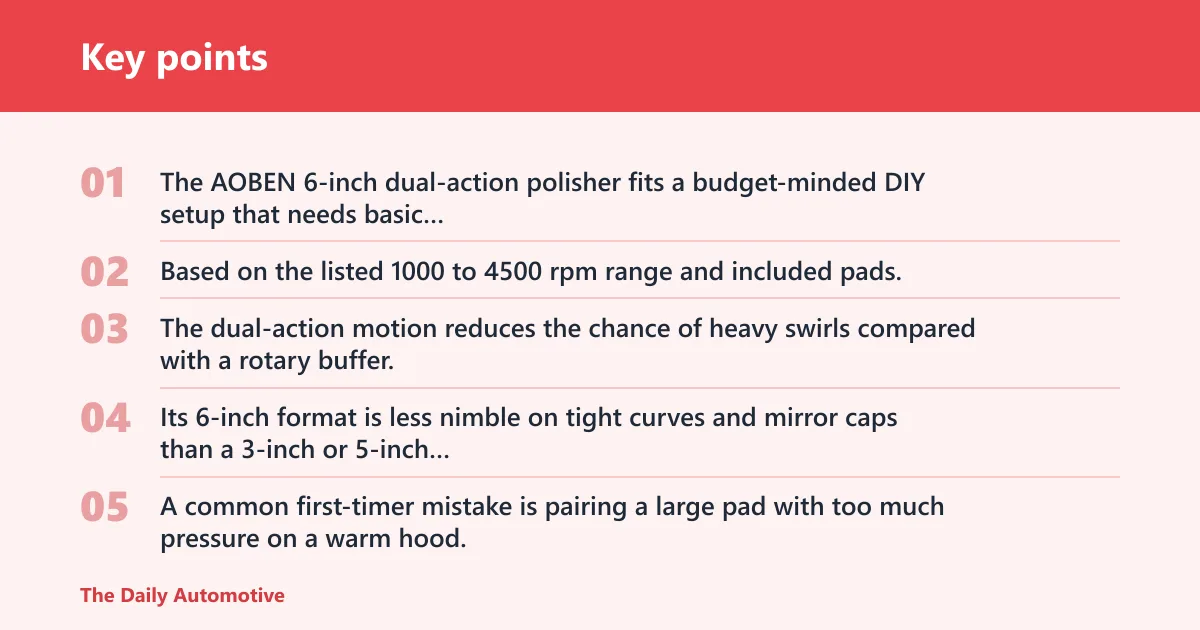
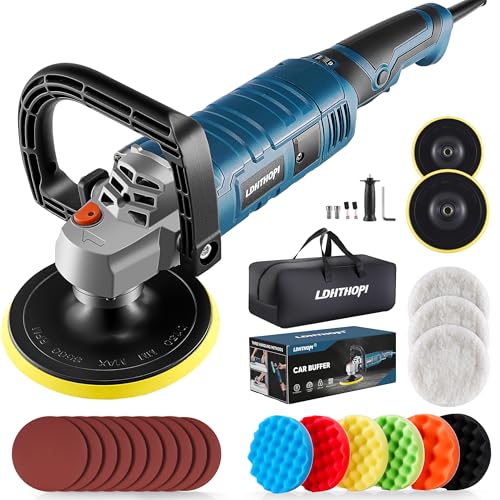
The AOBEN 6-inch dual-action polisher fits a budget-minded DIY setup that needs basic swirl removal, light correction, and wax application. Based on the listed 1000 to 4500 rpm range and included pads, it makes sense for someone who wants one machine for several light-detail tasks.
The dual-action motion reduces the chance of heavy swirls compared with a rotary buffer, and the variable speed control helps you spread product at low speed before increasing correction speed. Its 6-inch format is less nimble on tight curves and mirror caps than a 3-inch or 5-inch machine.
A common first-timer mistake is pairing a large pad with too much pressure on a warm hood. That can slow pad rotation, add heat, and leave uneven correction. A safer approach is to test a small section, clean the pad often, and stop once inspection shows the defect is actually gone.
RUPES BigFoot LHR15 Mark V: best for refined correction
The RUPES BigFoot LHR15 Mark V suits detailers who want a premium random orbital polisher for controlled correction and finishing. Based on the published features, the reduced vibration, anti-spinning ring, and ventilation support smoother operation during longer correction sessions.
This is the kind of machine that makes sense when paint is medium to hard and you need repeatable results without rushing into a rotary buffer. The 15mm orbit gives more correction than many short-throw machines while staying within the safer dual-action category.
The drawback is cost. It is also tool-only, so you still need the right backing plate, pads, and compounds. If you buy it for occasional light swirl removal, the price can be hard to justify compared with a less expensive dual-action machine.
Meguiar’s Mirror Glaze Bundle: best for compound-and-polish kits
Meguiar’s Mirror Glaze Bundle is the strongest match for users who need a compound and finishing polish in one kit. The listed Ultra-Cut Compound targets moderate to heavy defects, while the Ultra-Finishing step helps remove the micro-marring that often follows a stronger cut.
This is useful when you are working on paint that needs more than a single polish pass. The compound is the better choice when swirls or sanding marks remain after a light step, and the finishing product helps bring back gloss before final inspection.
The drawback is that this is a product kit, not a machine. You still need the correct pad and polisher, and the stronger compound can haze softer paint if you jump straight to an aggressive pad or high machine speed.
Dual-action polisher: best for beginners
A dual-action polisher is the safest all-purpose choice for most users because its random orbital motion lowers the chance of burning the clear coat and makes it easier to finish without obvious holograms. It is the best starting point for swirl removal, light oxidation, and final refinement.
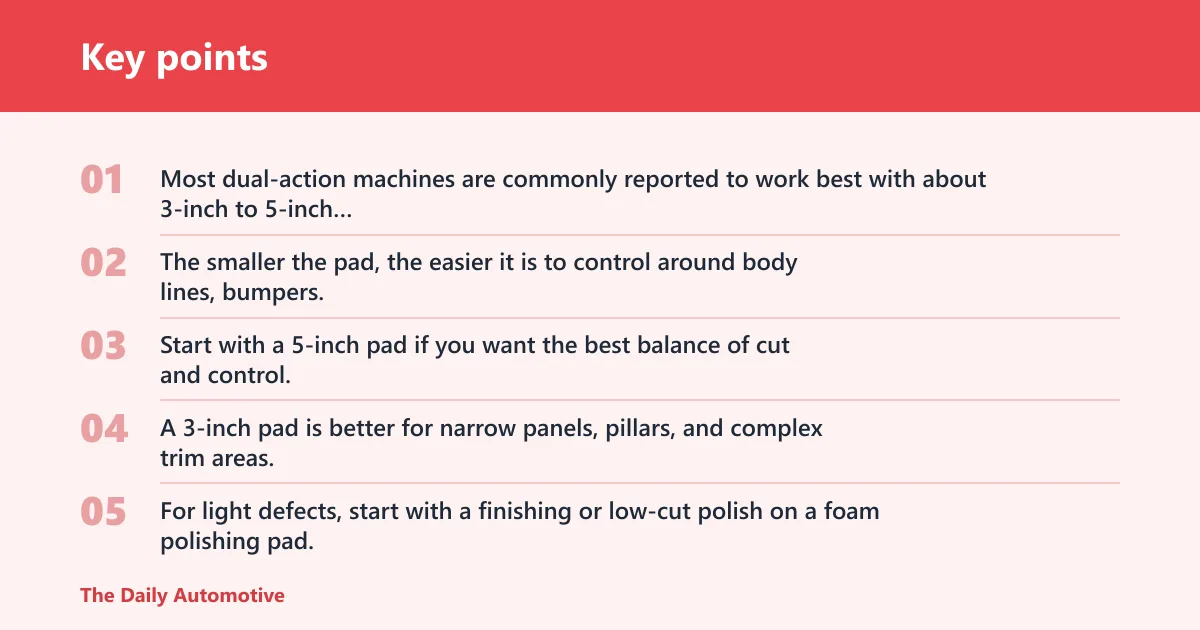
Most dual-action machines are commonly reported to work best with about 3-inch to 5-inch pads, though 6-inch setups are also common on larger budget units. The smaller the pad, the easier it is to control around body lines, bumpers, and tight curves.
What pad size should you start with?
Start with a 5-inch pad if you want the best balance of cut and control. A 3-inch pad is better for narrow panels, pillars, and complex trim areas, while a 6-inch pad covers larger flats faster but is less precise on curved surfaces.
Which compound and polish pair works best?
For light defects, start with a finishing or low-cut polish on a foam polishing pad. For moderate swirls, move to a medium-cut compound first, then refine with a finishing polish after panel wipe confirms the correction.
What speed settings should you use?
Use the lower speed range to spread product, then step up for correction, and drop back down for finishing passes. A variable speed control matters because too little speed limits cut, while too much speed can add heat, pad chatter, or extra haze.
Rotary buffer: best for fast correction
A rotary buffer uses direct-drive rotation, so it cuts faster than a dual-action machine but also raises the risk of burn-through, holograms, and heat buildup. It belongs in the hands of experienced users who can read paint response and manage pad angle carefully.
It fits best in the middle of a correction workflow when the surface has heavier defects and a dual-action machine is too slow. Many professionals still finish with a dual-action polisher afterward, because the rotary can leave marks that need refinement.
How do you reduce holograms and heat risk?
Keep the pad flat, work small sections, and avoid lingering on sharp body lines. Clean the pad often, reduce speed as the panel heats up, and inspect after each pass with a panel wipe. If the surface starts to haze or smear, stop and step down to a milder setup.
Which users should skip a rotary?
Beginners should skip it, and so should anyone working on thin paint, repainted panels of unknown thickness, or soft clear coat that already marks easily. The faster correction rate is useful only when the operator can control pressure, pad choice, and heat.
Foam pads: best for controlled finishing
Foam polishing pads are the most versatile accessory for a correction kit because they come in cutting, polishing, and finishing versions. Pad firmness and cell structure change how much bite the pad has, and color coding varies by brand, so the label alone should not decide the job.
A firmer pad with a more open structure usually cuts more, while a softer finishing pad helps reduce micro-marring and bring out gloss. That matters because a pad that is too aggressive can leave haze on soft paint even if the compound is mild.
How does pad firmness change cut and finish?
Firm pads transfer more machine action to the paint and often correct faster. Softer pads conform better to shape and usually leave a cleaner finish, but they remove defects more slowly. On hard clear coat, a firmer pad often saves time; on soft paint, it can create unnecessary haze.
Why should you not trust color coding alone?
There is no universal foam-pad color standard. One brand’s yellow cutting pad may be another brand’s polishing pad. Check the manufacturer’s pad description, not the color, before pairing it with a compound or polish.
Microfiber cutting pad: best for heavier defects
A microfiber cutting pad removes defects faster than most foam pads when paired with compound, which makes it useful on heavier swirls, oxidation, and some sanding marks. It is not the right choice for finishing polish, and it can haze softer clear coat if you push it too far.
This type of pad is useful when a foam cutting pad is too slow but a rotary buffer is more machine than you need. The tradeoff is finish quality, because microfiber systems often need a second step with foam and polish to clear the remaining haze.
When does microfiber beat foam?
Choose microfiber when the paint is medium to hard and the defects are too deep for a polishing pad alone. It usually wins on correction rate, especially if you are trying to reduce heavier marring in fewer passes.
How do you avoid haze on soft clear coat?
Use lower pressure, shorter section passes, and inspect often. If microfiber leaves a dull finish on softer paint, stop there and switch to a foam polishing pad with a finishing polish. A panel wipe helps show whether the haze is from residue or actual micro-marring.
Which one should you buy?
If your paint has light swirls and you want the safest path, buy a dual-action polisher, a 5-inch backing plate, a finishing pad, a polishing pad, and a medium-cut compound. That setup covers most DIY correction work without forcing you into a rotary buffer.
If your paint is medium hardness with moderate defects, start with a dual-action machine and add a foam cutting pad plus a compound, then finish with a polishing pad and low-cut polish. If the panel still looks dull after panel wipe, step up to a more aggressive pad before reaching for a rotary.
For hard clear coat and deeper marring, a dual-action polisher can still work, but a microfiber cutting pad and compound will save time. If you already know how to manage heat and pad angle, a rotary buffer can speed the first correction stage, though it should not be your default purchase.
On a tight budget, a basic dual-action kit with a few foam pads is the smarter buy than a powerful machine with no consumables. Pads wear out, compounds run out, and a matched setup often corrects more panels per dollar than a machine with no accessories.
Say your sedan has faint swirls on the hood and roof. A 5-inch dual-action polisher, a polishing foam pad, and a medium-cut compound may be enough, with a finishing polish only if inspection under bright light still shows micro-marring.
Suppose a black coupe has deeper dealer-installed wash marks and hard clear coat. A microfiber cutting pad with compound can remove defects faster, but a second foam-finishing step is usually needed to clear the haze before final inspection.
Remember the hidden costs. A pad that loads up quickly can slow correction and force more cleaning. A cheaper setup can become expensive if you need three extra pads to finish one car cleanly.
Frequently asked questions
What are the best car polishing tools for a flawless finish?
For most people, the best setup is a dual-action polisher with 3-inch to 5-inch pads, a few foam pad types, a medium-cut compound, and a finishing polish. That combination covers light swirls through moderate defects while keeping the risk of burn-through and holograms lower than a rotary buffer.
Should I use a dual-action polisher or a rotary buffer?
Use a dual-action polisher unless you need faster correction on heavier defects and already know how to manage heat and pad angle. A rotary buffer is faster, but it is less forgiving. For most DIY work, dual-action motion gives a better blend of safety and finish quality.
What pads and compounds should I use for swirl marks?
For light swirls, start with a polishing foam pad and a medium or finishing polish. For deeper swirls, move to a cutting pad with a compound, then refine with a softer foam pad and finishing polish. If the paint is soft, jump straight to the least aggressive combo that actually corrects the mark.
How do I choose the right pad size for my car?
Choose 3-inch pads for tight spaces and complex curves, 5-inch pads for the best all-around control, and 6-inch pads for faster coverage on large flat panels. The backing plate must match the pad size, and the hook-and-loop interface needs to hold the pad firmly during rotation.
Can a beginner polish a car without burning the paint?
Yes, if the beginner uses a dual-action polisher, works on cool panels, starts with the least aggressive pad and polish, and checks results with a panel wipe. The main hazards are too much pressure, too much speed, and staying too long on sharp edges or body lines.
What speed setting should I use on a car polisher?
Use a lower speed to spread product and a higher speed for correction, then slow down again for finishing. Exact numbers vary by machine, but the rule stays the same: enough speed to cut, not so much that the pad hops, overheats, or leaves extra haze.
What accessories do I need with a car polishing tool?
At minimum, you need a compatible backing plate, several pads, a compound or polish matched to the paint condition, and a panel wipe or paint prep spray for inspection. Useful extras include microfiber towels, pad-cleaning brushes, and masking tape for trim and sharp edges.
Products related to this article
Sponsored / affiliate links. As an Amazon Associate I earn from qualifying purchases. I may earn additional commission from eligible campaigns.