Best Sprayers for Car Paint (2026): We Compared
The ANEST IWATA LPH400 is often a strong choice for car-paint finish quality, because its 1.4 mm automotive setup is aimed at smooth basecoat and clearcoat work without the air hunger that can hurt panel finish quality.
Quick comparison
| Product | Badge | Best for | Price | ||
|---|---|---|---|---|---|
 |
Graco Magnum X5 Airless Paint Sprayer, Interior & ExteriorGraco | Our pick | 3000 PSI · Adjustable pressure · 1–5 gal bucket spray | $339.00
Price as of 23 Oct 2026
|
View |
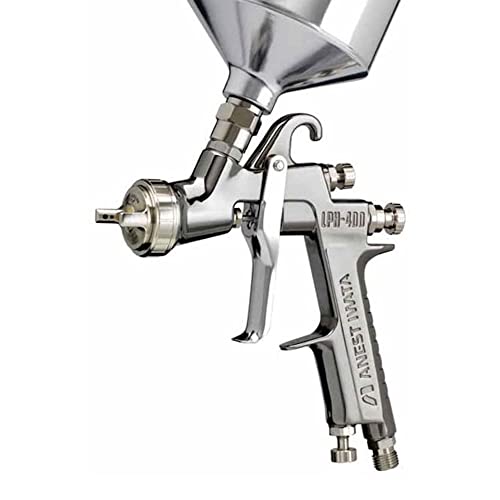 |
ANEST IWATA LPH400 LPH-400-144LV 1.4 mm LPH400LV Spray GunANEST IWATA | Also great | 1.4 mm tip · HVLP gravity feed · Automotive-rated | $629.97
Price as of 23 Oct 2026
|
View |
Use this table to match your compressor and project before you buy. Car paint is less forgiving than wall paint, and the wrong air demand or tip size shows up fast as pulsing, dry spray, or orange peel.
How we chose
The three most important filters are compressor fit, nozzle size, and coating type. A good car paint sprayer has to match the air supply, the material thickness, and the job you plan to spray.
We also weighed setup and ownership cost. Extra cups, spare tip sets, regulators, filters, and cleaning supplies can make a cheap gun less cheap once you add the pieces needed for real automotive use.
Finally, we looked at whether the gun should be dedicated to primer or used for everything. Separation matters, because primer contamination can ruin a topcoat session and add a full cleanup cycle.
Sprayer matrix
| Compressor CFM | Project type | Paint viscosity | Sprayer category |
|---|---|---|---|
| Below 8 CFM | Touch-up, small parts, spot repairs | Thin basecoat or thin clear | LVLP with small-tip setup |
| 8 to 10 CFM | Single panel, mirrors, fenders | Basecoat and clearcoat | Lightweight HVLP or low-air automotive gun |
| 9.5 CFM | Finish-focused basecoat and clearcoat | Thin automotive coatings | Premium gravity-feed HVLP |
| 10.9 to 12 CFM | Flexible use across primer, base, and clear | Thin to medium materials | Multi-tip gravity-feed gun |
| 12 CFM and above | Primer-heavy and repeated spraying | Primer, high-build surfacer | Dedicated primer gun or two-gun kit |
Project type versus nozzle size
| Project type | Recommended nozzle | Why it fits |
|---|---|---|
| Basecoat | 1.3 mm to 1.4 mm | Thin materials atomize better through smaller openings. |
| Clearcoat | 1.3 mm to 1.4 mm | Helps lay down a smoother wet film without excess waste. |
| Primer | 1.7 mm to 1.8 mm | Thicker coatings need more material flow. |
| High-build surfacer | 1.7 mm to 1.8 mm | Reduces the chance of starving the fan pattern. |
Paint viscosity versus tip choice
| Paint type | Tip range | What happens if the tip is too small |
|---|---|---|
| Thin basecoat | 1.3 mm to 1.4 mm | Dry spray and poor coverage. |
| Clearcoat | 1.3 mm to 1.4 mm | Rough texture and uneven wetness. |
| Primer | 1.7 mm to 1.8 mm | Heavy material flow gets choked off. |
| High-build surfacer | 1.7 mm to 1.8 mm | Spray pattern can pulse and break up. |
If your compressor can only keep up with a low-air gun, watch the end of a long pass. A smaller compressor that cannot hold output steady will often pulse, and that shows up as dry spray or orange peel before the panel is finished.
If you want to prime a door and then switch to clearcoat, one gun can do it. You will need more cleanup, and the chance of primer residue is higher unless you strip the fluid path very carefully between materials.
ANEST IWATA LPH400: best for finish quality
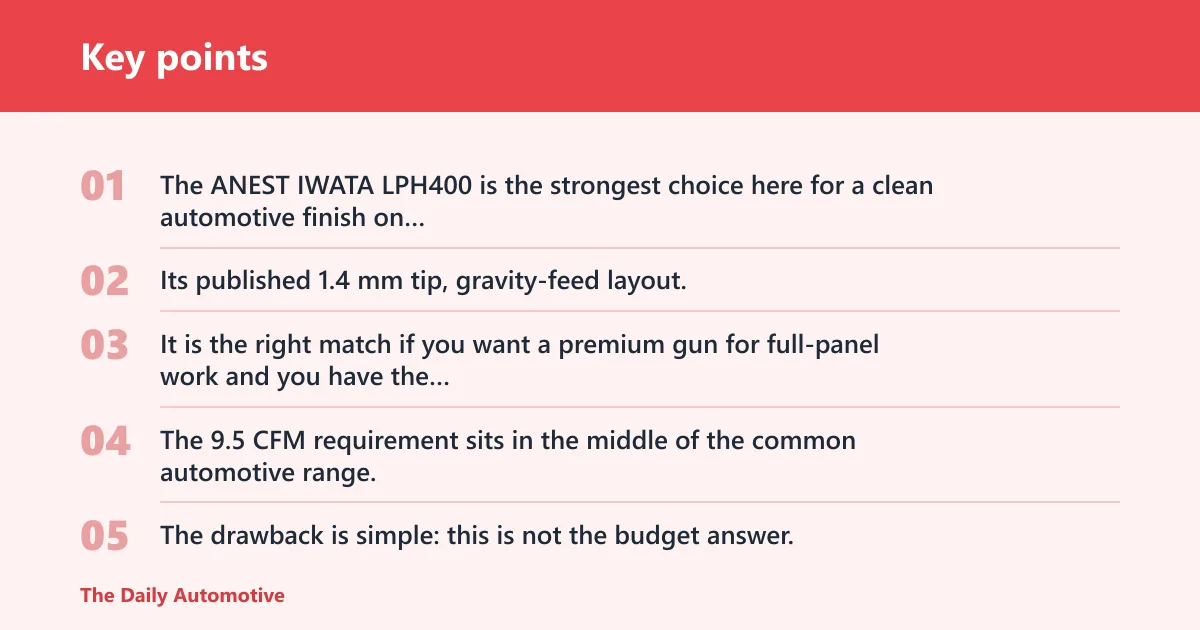
The ANEST IWATA LPH400 is the strongest choice here for a clean automotive finish on basecoat and clearcoat. Its published 1.4 mm tip, gravity-feed layout, and automotive-rated design fit the common finish-first job where atomization and control matter more than brute material flow.
It is the right match if you want a premium gun for full-panel work and you have the compressor to support it. The 9.5 CFM requirement sits in the middle of the common automotive range, and the 0.86 lbs weight is a real plus for long passes and tight body positions.
The drawback is simple: this is not the budget answer, and it is not the best dedicated primer gun. If you plan to spray thick surfacer often, a larger tip or a separate primer setup makes more sense.
What to budget for beyond the gun
| Hidden cost | Why it matters | Buy it now? |
|---|---|---|
| Extra cup | Useful if you switch colors or clear between stages. | Often yes, if you spray multiple materials. |
| Spare tip set | Lets you stay in the 1.3 mm to 1.4 mm range for base and clear. | Yes, for flexibility. |
| Regulator | Helps you hold a stable supply at the gun. | Yes. |
| Filters and water separator | Reduces moisture and contamination in the air line. | Yes. |
| Cleaning supplies | Solvent, brushes, and seals keep the gun usable between jobs. | Yes. |
Graco Magnum X5: best for spraying large areas outside automotive finishing
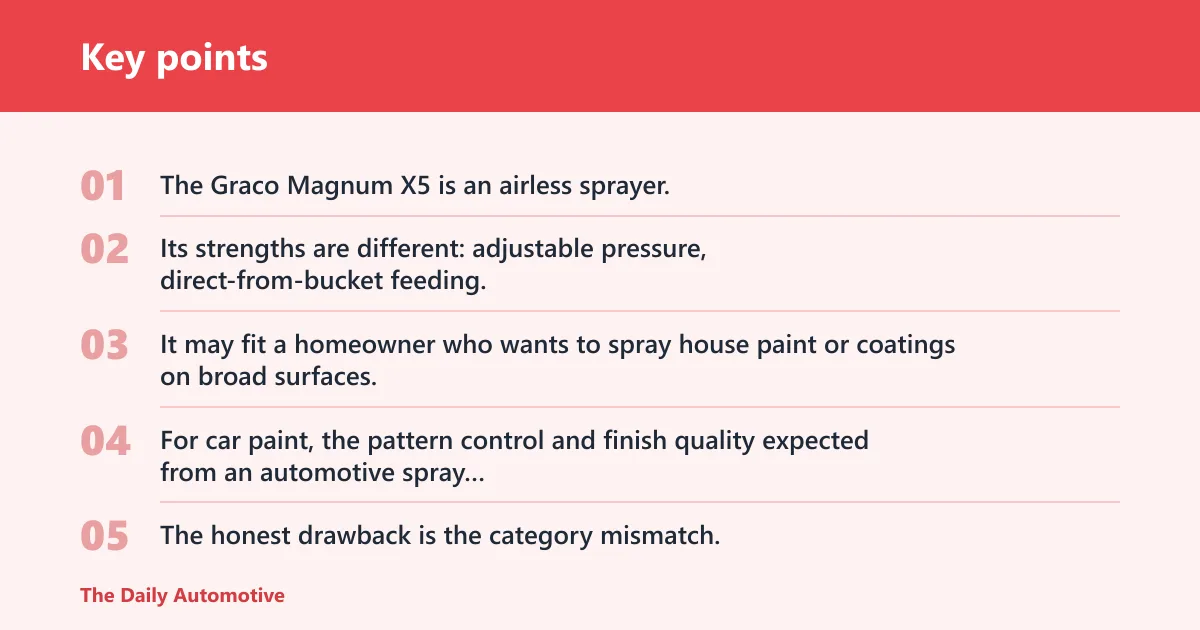
The Graco Magnum X5 is an airless sprayer, so it is not the right pick for fine automotive basecoat or clearcoat work. Its strengths are different: adjustable pressure, direct-from-bucket feeding, and long hose support for larger exterior jobs.
It may fit a homeowner who wants to spray house paint or coatings on broad surfaces, but that is not the same as atomizing car finish. For car paint, the pattern control and finish quality expected from an automotive spray gun are not what this unit is built to deliver.
The honest drawback is the category mismatch. If your goal is a car panel, a bumper, or a full respray, this is the wrong tool.
What to budget for beyond the gun: hidden cost Why it matters
| Hidden cost | Why it matters | Buy it now? |
|---|---|---|
| Appropriate hose setup | Needed to reach distance with stable flow. | Usually yes. |
| Pressure accessories | Needed to control spray output accurately. | Yes. |
| Cleaning materials | Airless systems still need thorough flushing. | Yes. |
Which one should you buy?
If you want the best automotive finish, buy the ANEST IWATA LPH400. It is the stronger choice for basecoat and clearcoat, and its 1.4 mm setup lines up with the common finish range for thin coatings.
If you only need a sprayer for large non-automotive surfaces, the Graco Magnum X5 belongs in a different conversation. It is not a substitute for a true car paint gun.
For compressor fit, start with your available CFM, not the box art. A gun that wants 9.5 CFM can work well on a properly sized compressor; a gun that draws more air than the compressor can supply will pulse and push you toward dry spray or orange peel.
For project fit, decide whether you want one gun for everything or separate tools for primer and finish. A dedicated primer gun saves cleanup time and helps keep thick material out of a topcoat path.
For a beginner, the simplest path is a gravity-feed gun with a 1.3 mm to 1.4 mm tip for base and clear, plus a separate plan for primer. Gravity feed is the common automotive format because it gives better control and reduces paint waste.
Frequently asked questions
What’s the best paint sprayer for cars?
The best paint sprayer for cars is usually a gravity-feed HVLP gun with a 1.3 mm to 1.4 mm tip for basecoat and clearcoat. For a finish-first choice, the ANEST IWATA LPH400 is the strongest pick in this comparison because it is tuned for automotive coatings and steady atomization.
What are the best paint sprayers for automotive work?
The best automotive sprayers are the ones matched to the job: a low-air gun for small compressors, a premium HVLP gun for cleaner full-panel finishes, and a dedicated primer setup if you spray surfacer often. One gun can do a lot, but tip size and air demand still have to match the coating.
Should I choose HVLP or LVLP for car painting?
Choose HVLP if you have enough compressor output and want high transfer efficiency with less overspray. Choose LVLP if your compressor is smaller and cannot support a higher-air gun consistently. HVLP guns typically consume 6 to 12 CFM at operating pressure, so compressor fit is the deciding factor.
What nozzle size is best for base coat and clear coat?
For basecoat and clearcoat, the usual target is 1.3 mm to 1.4 mm. Thin materials work best in that range. If the tip is too large, you can flood the surface; if it is too small, you are more likely to get dry spray and poor atomization.
How much CFM do I need for an automotive paint sprayer?
A common automotive demand range is about 8 to 13 CFM, and HVLP guns are often reported to use roughly 6 to 12 CFM at operating pressure. The key is to match the gun to the compressor, because an undersized compressor can cause pulsing spray, dry spray, and orange peel.
Can I use one gun for primer, base coat, and clear coat?
You can, but it is not the cleanest setup. Primer usually wants a 1.7 mm to 1.8 mm opening, while basecoat and clearcoat usually want 1.3 mm to 1.4 mm. Using one gun for all three means more cleanup, more crossover risk, and more tip changes.
Products related to this article
Sponsored / affiliate links. As an Amazon Associate I earn from qualifying purchases. I may earn additional commission from eligible campaigns.