3 Best Steam Cleaners for Cars (2026): Based on Specs and Reviews
The best steam cleaner for cars for most owners is a balanced canister, because it handles vents, seat rails, door pockets, and carpets without forcing you to stop for a refill every few minutes. A compact handheld still makes sense for quick spot jobs, and a larger canister is the better call for SUVs or repeated full details.
The strongest all-around pick here is the McCulloch MC1375 style canister: enough tank for real interior work, enough control for mixed surfaces, and better endurance than a handheld without jumping to the bulk of a pro unit.
Quick comparison
| Product | Badge | Best for | Price | ||
|---|---|---|---|---|---|
 |
Mecmic Steam Cleaner for Home – 1600ML Water Tank 15smecmic | Our pick | 1600ML · 2500W · Portable Steamer | $63.99
Price as of 23 Oct 2026
|
View |
 |
BLACK+DECKER Steam Mop, Floor and Handheld Steamer,BLACK+DECKER | Also great | Handheld/Floor · 6 Attachments · Multi-Purpose | $134.99
Price as of 23 Oct 2026
|
View |
 |
Kärcher Steam Cleaner SC 3 EasyFix, 40 Sec Heat-up,Kärcher | Upgrade pick | SC 3 EasyFix · 40 Sec Heat-up · Power Steamer | $249.99
Price as of 23 Oct 2026
|
View |
Handhelds move easily around tight spaces, while canisters keep steaming longer and reach deeper into the cabin before you need to pause. That split matters most once you move past cupholders and into seat tracks, vents, and headliners.
For a full interior, the machine that keeps steaming without constant pause usually saves more time than the one with the smallest footprint.
📊 Bissell Steam Shot OmniReach weighs 2.8 lb. Source: Best Car Steam Cleaners for 2026, Tested.
How we chose
This comparison focuses on four things that matter in a car: heat-up time, usable tank size, hose and tool reach, and the controls that keep steam from being too aggressive on leather, plastics, and touch surfaces. It also weighs failure points that are easy to miss, like short hoses, loose fittings, and slow heat recovery after a refill.
The models were compared by published specs and buyer feedback, not by raw accessory count alone. Attachments matter only when they match a car surface you actually clean.
That means a crevice tool for seat rails and vents, a detail nozzle for seams, an upholstery brush for fabric, and a triangular brush for broader panels and floor mats. A canister with the wrong tools can still be awkward.
Steam cleaner comparison matrix
Which Steam Cleaner Fits Your Car?
| Criteria | Handheld spot cleaner | Balanced canister | Larger-vehicle canister |
|---|---|---|---|
| Heat-up time | Fast, about 3 min 26 sec on the Bissell Steam Shot OmniReach | About 8 minutes on the McCulloch MC1375 | Fast enough for repeated sessions, but bulkier to stage |
| Tank size | 10 oz | 48 oz | 64 oz on the MC1385 |
| Runtime | Short, best for brief tasks | Long enough for a full sedan interior | Up to 2 hours on the MC1385 |
| Hose reach | Limited reach; body stays in your hand | Better reach for consoles, rails, and footwells | Best for larger cabins and repeated repositioning |
| Accessory relevance | Best with a detail nozzle and small brush | Strong match for crevice, upholstery, and extension tools | Most useful when you use all-purpose detailing tools across a large cabin |
| Safety controls | Simple control, but less margin for error on delicate surfaces | Variable steam control helps on plastics and trim | More control matters because longer jobs increase exposure risk |
| Portability | Highest | Middle ground | Lowest |
| Best interior zones | Cupholders, vents, buttons, seams | Seat rails, carpets, door panels, console seams | Full cabins, cargo areas, second and third rows |
| Ideal vehicle size | Small cars and quick touch-ups | Sedans, hatchbacks, small crossovers | Midsize SUVs, three-row vehicles, multi-car households |
| Common failure case | Small tank runs dry before the cabin is done | Short hose or heat recovery stall slows the job | Bulk and setup time outweigh the benefit on small cars |
Bissell Steam Shot OmniReach: best for spot cleaning
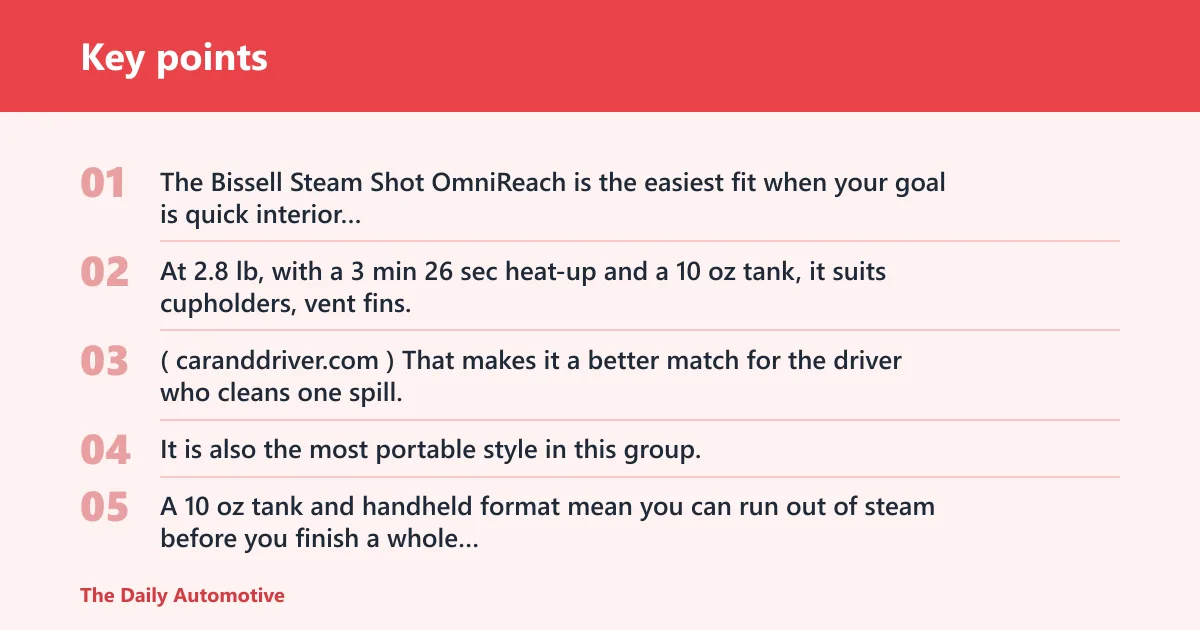
The Bissell Steam Shot OmniReach is the easiest fit when your goal is quick interior cleanup, not a full-detail session. At 2.8 lb, with a 3 min 26 sec heat-up and a 10 oz tank, it suits cupholders, vent fins, steering-wheel buttons, and other small zones that need short bursts of steam. (Caranddriver)
That makes it a better match for the driver who cleans one spill, one seam, or one sticky touch point at a time. It is also the most portable style in this group, which matters when you want to move fast and keep the machine close.
The honest drawback is capacity. A 10 oz tank and handheld format mean you can run out of steam before you finish a whole cabin, and Bissell recalled the Steam Shot in July 2024 for burning hazards, so surface caution matters.
Where the handheld format works best
Use a handheld for isolated jobs: a coffee ring in a cupholder, residue in a door-pull pocket, or grime around a shifter bezel. It is also useful when you want to target one zone without dragging a hose across the cabin.
Suppose you are cleaning a compact sedan after a child’s snack spill. A handheld can reach the cupholders and nearby trim quickly, but it is the wrong tool if the job expands to seat rails, floor mats, and rear-door pockets.
Limits on tank size and runtime
Small tanks keep the machine light, but they also force more pauses. That matters because a car interior is not one flat surface; it is a chain of small zones, and every refill breaks your rhythm.
If you often clean more than a few touch points at once, a handheld becomes a spot tool rather than a true interior-detailing machine.
McCulloch MC1375: best balanced canister
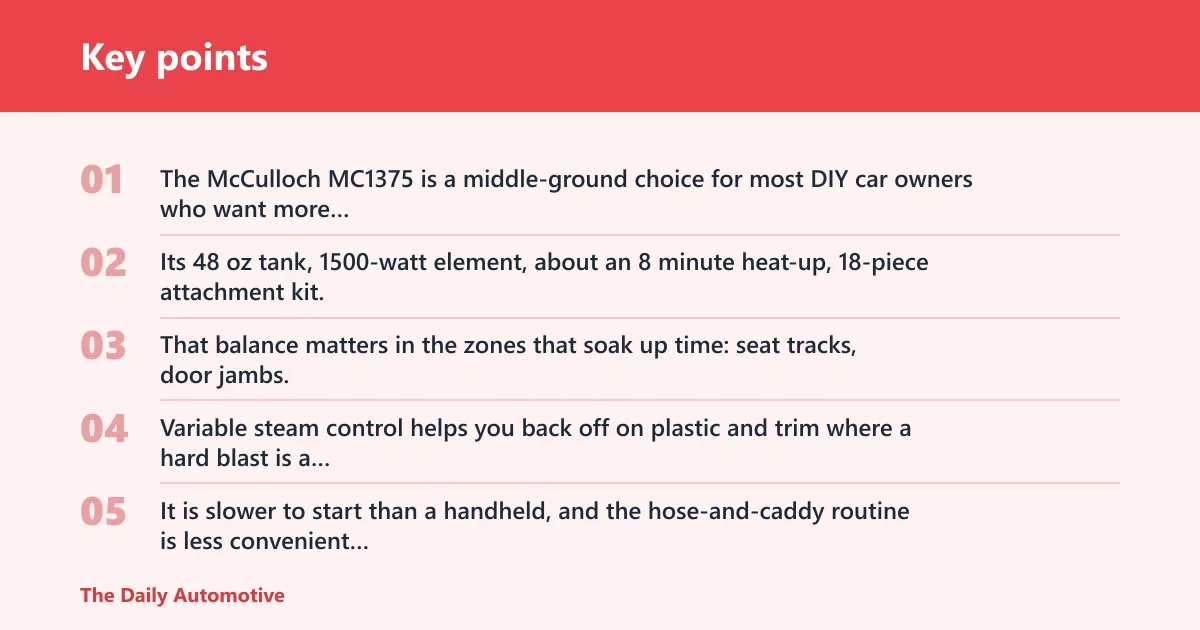
The McCulloch MC1375 is a middle-ground choice for most DIY car owners who want more endurance than a handheld without moving into oversized, pro-level equipment. Its 48 oz tank, 1500-watt element, about an 8 minute heat-up, 18-piece attachment kit, and variable steam control make it a balanced format for full cabin work.
That balance matters in the zones that soak up time: seat tracks, door jambs, center-console seams, pedals, and fabric edges. Variable steam control helps you back off on plastic and trim where a hard blast is a poor idea.
The drawback is simple. It is slower to start than a handheld, and the hose-and-caddy routine is less convenient if all you want is one quick cleanup.
Why the 48 oz tank matters
A larger tank changes the job because it lets you keep moving through the cabin instead of pausing every few minutes. For a sedan or small crossover, that usually means fewer stops between the front seats, rear bench, and cargo sill.
The 18-piece attachment kit also helps only if the right tools are included in the right length and shape. On cars, the most useful pieces are the crevice tool, detail nozzle, upholstery brush, and extension hose or wand.
Best interior zones for this setup
This format works well where the cabin has mixed materials close together. Think vents beside soft-touch trim, or carpet beside plastic seat bases.
It is especially useful for door panels, console seams, and lower dash areas where a handheld can feel cramped and a larger pro unit is more machine than you need.
McCulloch MC1385: best for larger vehicles
The McCulloch MC1385 makes sense when the vehicle is big enough that refill breaks become a problem. With a 64 oz tank, up to about 2 hours of runtime, and 23 accessories, it is a stronger pick for repeated full details, third rows, and long cabin sessions.
The benefit is endurance. That matters if you clean multiple cars, manage an SUV-heavy household, or prefer to finish the interior in one pass instead of splitting the work across days.
The drawback is size and setup burden. A machine built for endurance is not the nicest choice for a quick console wipe, and a large tool set can be overkill for a small car.
Why the bigger tank changes the job
A 64 oz tank reduces the chance that heat recovery or refill time interrupts your workflow in the middle of a seat, carpet, or cargo-area pass. For larger vehicles, that is a real advantage because the cabin has more surface area and more seams to cover.
The MC1385 is most sensible when the interior is large enough that runtime matters more than portability.
When the accessory kit helps most
Extra accessories help when they fill specific gaps: a triangular brush for broader fabric surfaces, a crevice tool for rails and vents, and an extension hose or wand for deeper reach. More parts are not automatically better.
They matter most on vehicles with long footwells, third-row seats, or cargo areas where a short tool feels restrictive.
Dupray Neat Steam Cleaner: best for pro-level endurance
The Dupray Neat sits in the pro-detailing lane because of its stainless steel boiler, steam up to about 275°F, a 1.6L fill, and up to about 120 minutes of runtime. That combination is aimed at long sessions, repeated use, and users who want more endurance than a basic household unit.
Its strength is staying productive over time. That is a better fit for detailing work than a machine that looks capable but runs out of steam halfway through the cabin.
The drawback is that pro-leaning endurance does not solve every car-specific problem by itself. You still need the right hose reach and the right attachments, and the machine can be more than a casual weekend user needs.
Why pro-level endurance matters
Long runtime helps when the interior is not one quick cleanup. It helps on neglected carpets, pet hair zones, and heavily used family vehicles where one pass rarely finishes the job.
It also reduces the chance that you stop mid-job and lose momentum while the steam recovers.
Wagner Spraytech AutoRight: best fast-start car-focused option
The Wagner Spraytech AutoRight is built around speed and car-friendly use. Its 1.5L tank, 15-second heat-up, 12 accessories, and 45-minute runtime make it one of the quickest-starting options in this field, and the car focus is the main reason to consider it.
That fast start is useful for sudden messes, quick turnarounds, or a garage routine where you want steam almost immediately. It is a clean fit for routine maintenance work.
The drawback is that 45 minutes is enough for many cars, but not all SUV or multi-car jobs. If your interior work tends to stretch long, the tank size can still become a limit.
Where the fast-start design helps
This style is valuable when you want fast access to vents, cupholders, and plastics without waiting around. It is also a strong choice for people who clean in short sessions instead of carving out an afternoon.
The accessory set is best when it includes the small tools that actually touch car surfaces: a detail nozzle, crevice tool, and upholstery brush.
Gautye steam cleaner: best fast-heating budget-style option
The Gautye steam cleaner is worth a look if quick start matters and you want more control than a bare-bones handheld. Its 3-level steam control, 1.69-quart tank, 1700W heating element, and 15-second heat-up give it a strong speed-and-control pitch for the price-minded buyer.
That combination makes it a practical pick for a small car or for owners who clean in short bursts and want to avoid waiting for the machine to warm up.
The drawback is that budget-style machines can vary more in fittings and hose feel, so loose connections and awkward tool fit are the kinds of problems to watch for before you commit.
Fast heat does not fix every problem
Fast heat is helpful, but it does not make a short hose longer or a weak fitting tighter. Those are the details that decide whether a machine is pleasant to use inside a car.
If the tools do not reach the rear footwells or the hose pulls loose mid-clean, the headline heat number stops mattering.
Choose the best tool for the job
The right answer depends on how you clean, not on one big spec. Choose a handheld if you want a fast spot cleaner. Choose a balanced canister if you want one machine that can handle most of a sedan or small crossover. Choose the biggest tank only when the interior size or your cleaning frequency makes endurance worth the extra bulk.
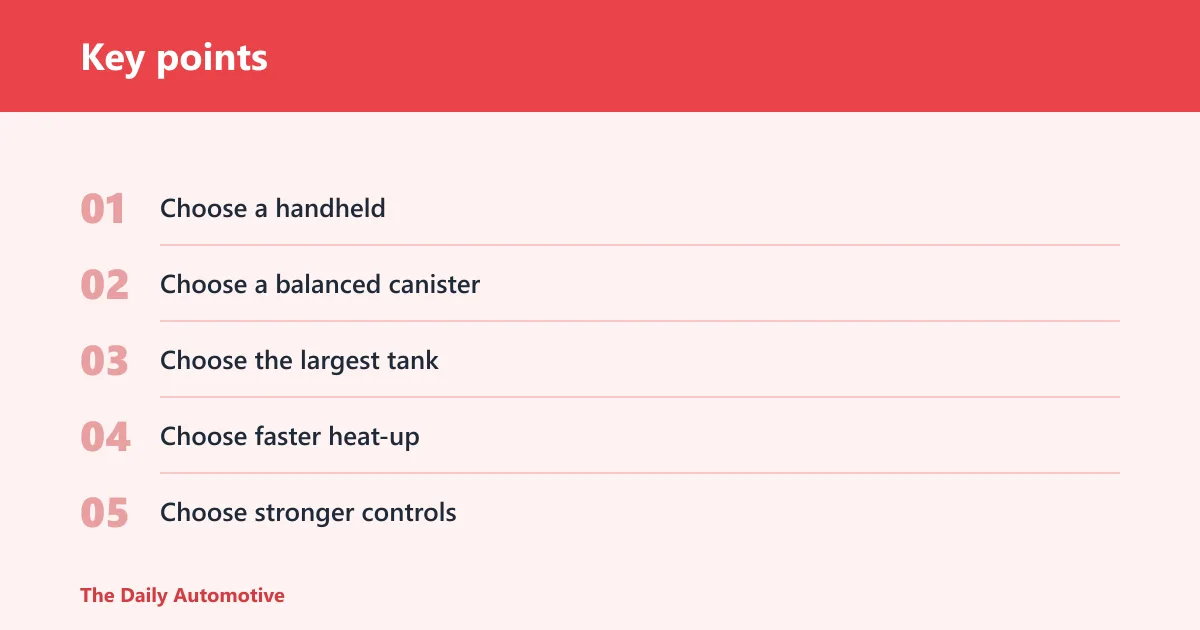
- Choose a handheld if you clean small messes often, mainly hit cupholders and vents, and want something light enough to grab without setup fatigue.
- Choose a balanced canister if you clean one vehicle at a time and want enough runtime for door panels, seat rails, floor mats, and console seams.
- Choose the largest tank if you detail SUVs, carry passengers often, or work on more than one car in a session.
- Choose faster heat-up if you do short cleanups and hate waiting; the tradeoff is usually smaller capacity or less overall endurance.
- Choose stronger controls if you have leather, glossy plastics, or screens nearby, because you need to reduce output where the surface is delicate.
Choose a handheld if your messes are isolated and the goal is speed. Choose a canister if your interior jobs often spread past one zone.
For a one-car household with a compact sedan, the balanced canister is usually the best compromise. For a multi-car household with an SUV in the mix, the larger tank starts to make more sense.
Choose a handheld if you clean small messes often
Pick the compact format if you mostly deal with crumbs, drink residue, and sticky touch points. It is the best match for quick spot work in small cars, especially when you do not want to pull out a hose and several attachments.
A common first-timer mistake is buying a canister for a job that only needs a detail nozzle and a few short steam bursts.
Choose a canister if you detail full interiors
Choose a canister when the job includes seats, carpets, vents, and door panels in the same session. The larger tank and better reach usually beat the convenience of a handheld once the work gets broader.
That is where the MC1375 style machine earns its place.
Choose the largest tank if you work on SUVs or multiple cars
If you clean three-row vehicles or multiple interiors in one day, runtime matters more than size. The MC1385 and Dupray-style endurance are useful because they reduce mid-job stops and make large cabins easier to finish cleanly.
For frequent use, short refill cycles become the bottleneck more often than steam strength.
Choose faster heat-up if you need quick turnaround
If the machine will be used for quick resets, fast heat-up is valuable. The Wagner AutoRight and Gautye style setups are the better fit for that pattern because they cut down the wait before cleaning starts.
That said, fast startup is not the same as high endurance. A speed-first machine can still be the wrong one for a long detail.
Which attachments matter most for car detailing?
The most useful car attachments are the ones that match narrow spaces and mixed materials. A detail nozzle targets seams and concentrated grime, a crevice tool reaches seat rails and console gaps, an upholstery brush works on fabric, an extension hose or wand improves reach, and a triangular brush covers broader flat or softly curved surfaces.
Those tools matter more than a long generic accessory list because cars have small, awkward zones. A kit that skips reach or precision will slow you down.
- Detail nozzle: best for stitching, seams, and grime packed into tight edges.
- Crevice tool: best for seat rails, between-console gaps, and narrow trim channels.
- Upholstery brush: best for cloth seats, carpet, and fabric floor areas.
- Extension hose/wand: best when you need reach without moving the whole machine constantly.
- Triangular brush: best for broader interior surfaces where a small nozzle would be slow.
Choose the attachment by surface
Use the detail nozzle on seams and controls. Use the upholstery brush on fabric and mats. Use the crevice tool when dirt sits in a narrow gap, such as a rail channel or a vent edge.
For plastics and screens, less is more. Steam should be controlled, brief, and kept away from sensitive electronics and adhesive-backed areas.
Can a steam cleaner damage leather, plastic, or infotainment screens?
Yes. Steam can damage or stress leather, soft plastics, coatings, and infotainment screens if you hold it too close, use too much heat, or let moisture sit in one spot. The safer approach is short bursts, controlled distance, and a low setting when the machine offers one.
Leather trim needs restraint because heat and moisture can dry or mark finishes. Plastic can warp or haze if it gets too hot. Screens and touch panels are the most delicate of the three, so they should get the least direct exposure.
Do not aim steam directly at vents, screen edges, or stitched seams for long periods. A quick pass followed by wiping is safer than soaking the area with heat.
Do steam cleaners actually remove odors from car interiors?
Steam can help with odors when the smell comes from surface grime, spills, or embedded residue in fabric and carpet. It is less effective on odors that come from mold, HVAC contamination, or soaked padding, where the problem sits deeper than the visible surface.
That means steam can reduce smell, but it is not a complete odor cure. If the source is still present, the odor can return.
For odor work, steam is one step in a larger cleanup. Drying, vacuuming, and source removal matter just as much, sometimes more.
What tank size is best for cleaning a full car interior?
For a full interior, a tank in the midrange is usually the best starting point. A small handheld tank is fine for spot work, but a 48 oz canister is far more practical for a sedan or crossover, and a 64 oz tank is better once you move into larger vehicles or repeated sessions.
Tank size affects how often you stop, not just how much water you hold. More capacity usually means better continuity, which matters on seat rails, floor mats, and door panels.
How long should a car steam cleaner heat up before use?
Heat-up time should be short enough that you will actually use the machine for the quick jobs it was meant to handle. The Bissell handheld reaches ready time in 3 min 26 sec, the McCulloch MC1375 takes about 8 minutes, and the Wagner AutoRight heats in 15 seconds.
A faster start helps on small jobs. A slower start is acceptable when the machine gives you a larger tank and better endurance in return.
How do I choose a steam cleaner for a small car versus an SUV?
For a small car, portability and heat-up matter more than sheer runtime, because the interior is easier to cover in one pass. For an SUV, tank size and hose reach matter more, because the cabin is bigger, the seating area is spread out, and the job can stall if the machine needs repeated refills.
The practical rule is simple: small car, small machine; SUV, larger tank and better reach. If you clean both, pick the middle-ground canister first.
Frequently asked questions
What is the best steam cleaner for cars for the money?
The best value is usually the machine that covers the most common interior jobs without forcing a compromise on tank size or control. For many buyers, that means a balanced canister rather than the cheapest handheld, because it handles more of the cabin in one session.
Is a handheld or canister steam cleaner better for car detailing?
A handheld is better for quick spot cleaning and small touch points. A canister is better for full detailing because it usually has more runtime, better reach, and more useful control across seats, carpets, and door panels.
Products related to this article
Sponsored / affiliate links. As an Amazon Associate I earn from qualifying purchases. I may earn additional commission from eligible campaigns.
 1.8L Handheld Steam Cleaner for Home & Car with 18 Accessories, 80-Min Runtime, Portable Steamer for Cleaning, 10S-Heat Up, 221℉/ 4Bar High Pressure Steam, 6 Steam Levels, Handle & Unit Dual Controls
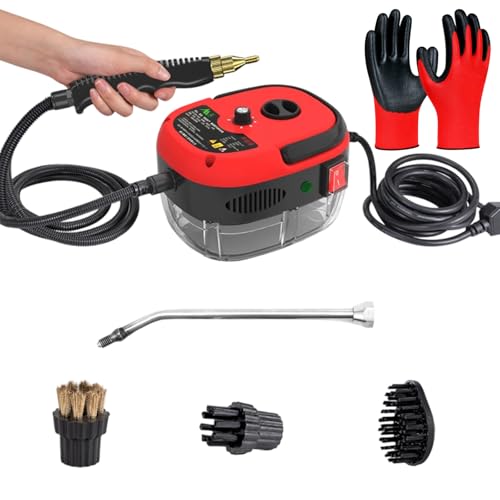 2026 New Portable Handheld Steam Cleaner, 2500w Handheld High-Temperature Pressurized Steam Cleaner, Multi Purpose Cleaner for Car Engine Furniture, Kitchen, Bathroom (Mechanical Red)