Extractor Vacuum for Car: 3 Top Picks for Deep Cleaning
Choose an extractor vacuum for car detailing by job: spot stains call for a compact portable unit, full-interior detailing needs strong suction and larger solution tanks, and mobile work favors a lighter machine with long hose reach. Pick the wrong one and you waste time, leave moisture behind, or buy power you will not use. This guide ranks three top picks by cleaning depth, portability, and compatibility so you can match the machine to your actual detailing scenario.
Quick picks for car detailing
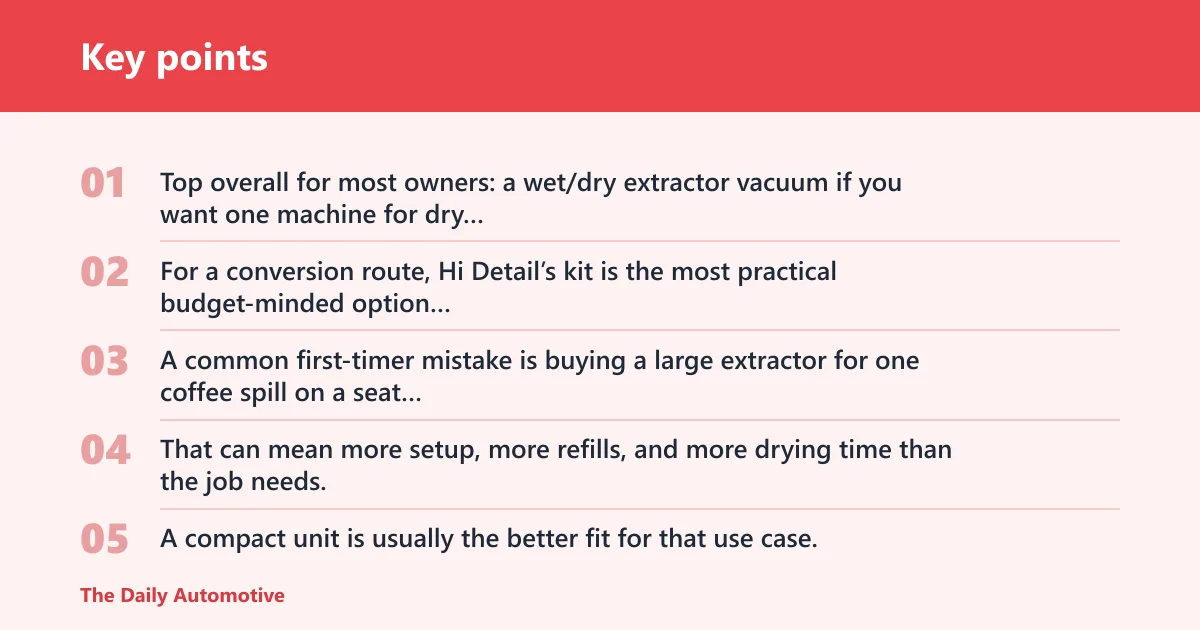


Top overall for most owners: a wet/dry extractor vacuum if you want one machine for dry vacuuming, wet pickup, and extraction across seats, carpets, and mats. For a conversion route, Hi Detail’s kit is the most practical budget-minded option because it turns a standard shop vacuum into a carpet and upholstery extractor.
| Cleaning need | Best pick | Why it fits | Key listing detail |
|---|---|---|---|
| Spot stains | Portable spot extractor | Small footprint, quick setup, easier storage | Aqua Pro Vac is positioned as a portable carpet cleaner extractor |
| Full interior | Wet/dry extractor vacuum | Handles dry vacuuming, wet pickup, and extraction in one unit | EXTRAFEIN is listed with 5.5 HP and a 6-gallon capacity |
| Mobile detailing | Shop vac extractor kit | Retrofits a machine you already own and travels well | Hi Detail’s kit converts a standard shop vacuum into a carpet and upholstery extractor |
A common first-timer mistake is buying a large extractor for one coffee spill on a seat cushion. That can mean more setup, more refills, and more drying time than the job needs. A compact unit is usually the better fit for that use case.
Shop vac extractor kit
Hi Detail’s kit is the conversion choice here. It turns a standard wet/dry vacuum into a carpet and upholstery extractor, which makes sense if you already own a capable shop vac and want spray-and-suction cleaning without replacing the machine.
What it is and how it converts a wet/dry vacuum
The basic idea is simple: the kit adds upholstery extraction hardware to a wet/dry vacuum, so you can spray solution, agitate the fabric, and pull moisture back out. That matters for car upholstery cleaning on seats, carpets, mats, and door panels, where embedded dirt often stays in the fibers after plain vacuuming.
Hi Detail’s kit includes a wand and hose, and the brand positions it for universal adapter compatibility. That combination is the main appeal. It lets you retrofit an existing vacuum instead of buying a dedicated extractor from scratch.
Best-fit use cases
This is the better option for budget DIY users and mobile detailers who already carry a shop vac to jobs. It also fits occasional deep-clean work when you do not need a heated machine or a dedicated spot extractor.
Suppose a 2-seat coupe has one muddy driver-side mat and a stained bolster. A conversion kit can handle that without taking up much storage space, as long as your vacuum and hose sizes match the kit.
Compatibility and adapter notes
Universal adapters matter because hose diameters vary across brands. In practice, that means the kit is most useful when it fits multiple hose sizes and vacuum brands without a lot of extra parts. Tool-free or easy installation also matters, especially if you are moving between jobs.
Still, conversion kits are not always the right answer. If the hose fit is awkward, if the wand seals poorly, or if you need shampoo capability for tougher grime, a dedicated extractor can make more sense than forcing a retrofit.
Wet/dry extractor vacuum
The best all-around pick for many car owners is a wet/dry extractor vacuum. It combines dry vacuuming, wet pickup, and extraction, so you can pre-vacuum debris, clean upholstery, and manage spills with one unit. That versatility is useful for carpets, mats, and seats.
Why 3-in-1 cleaning matters
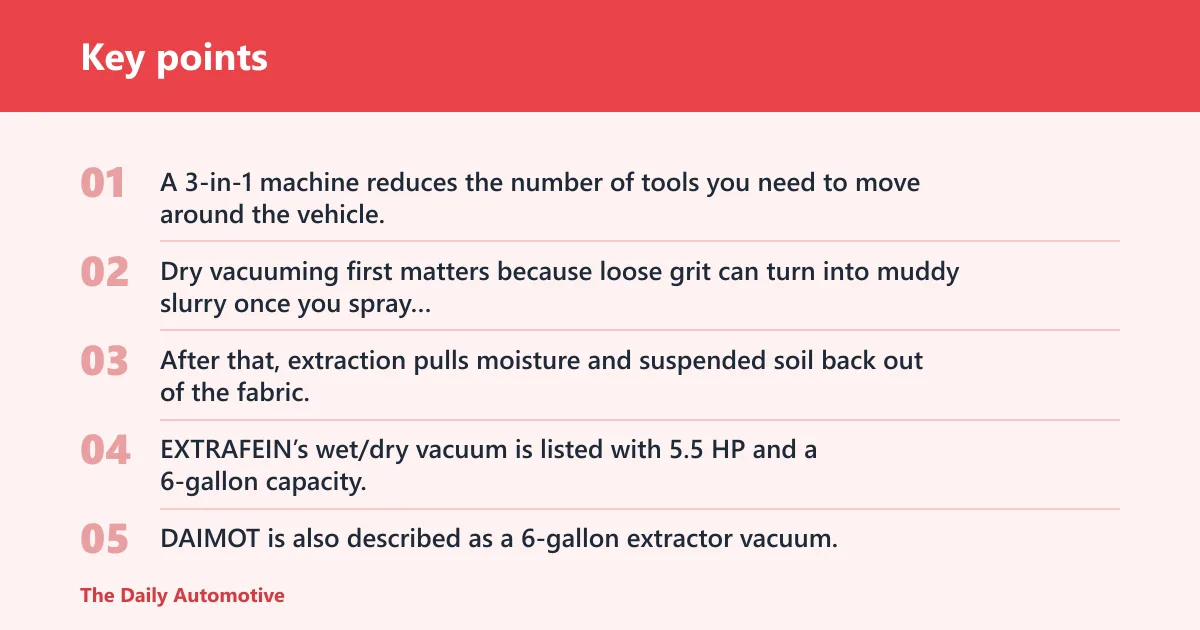
A 3-in-1 machine reduces the number of tools you need to move around the vehicle. Dry vacuuming first matters because loose grit can turn into muddy slurry once you spray solution. After that, extraction pulls moisture and suspended soil back out of the fabric.
EXTRAFEIN’s wet/dry vacuum is listed with 5.5 HP and a 6-gallon capacity, which is the kind of format many buyers look for when they want one machine for more than one job. DAIMOT is also described as a 6-gallon extractor vacuum, and the DAIMOT model on Cardetailflow is listed with a 6-gallon body and 5.5 peak HP.
What to check in the listing
If a listing does not clearly state tank size, suction, or whether the unit supports shampoo or chemical injection, check the manufacturer’s page before you buy. That matters more than headline marketing. A machine that looks powerful can still be inconvenient if the tank is too small for a full cabin.
For interior work, larger tanks cut refill stops. That saves time on full-seat cleaning, especially if you are working through multiple carpets or doing a full interior detail.
Seats, carpets, and mats
This type of machine fits the common car upholstery cleaning workflow: pre-vacuum, spray solution, agitate, extract, and then let the surfaces dry. It is a good match for cloth seats, carpeted floors, and rubber-backed mats where you want better soil removal than a standard vacuum can provide.
Watch for over-wetting. If you saturate foam padding, dry time stretches out and odors can linger. Strong suction helps pull moisture out, but the user still needs to keep the spray controlled and make enough dry passes to move water back out.
Heated extractor
Choose a heated extractor when you are dealing with tougher upholstery grime and want better stain release. Heat can help loosen coffee residue, body oils, and older spills. The tradeoff is higher cost and more complexity, so it makes the most sense for professional or frequent deep-clean use.
Why heat helps stain release
Heat can improve how fast cleaning solution breaks down soils in fabric. That does not mean every seat needs it. For light touch-ups, a standard extractor is usually enough. For set-in stains on upholstery, though, heat can shorten the amount of agitation needed.
The Mytee S-300H Tempo Heated Extractor is described as compact and heated. It also says the Mytee S300-H Tempo Heated Spotter has a 1-gallon capacity. That smaller format is aimed at spot work rather than a long, all-cabin extraction session.
When the extra cost makes sense
A heated machine is a better fit if you clean interiors often, handle pet stains, or work on cars with heavily soiled cloth seats. It is also more relevant when you need a deeper clean without having to repeat passes over and over.
Picture a sedan with coffee spills on the passenger seat and a lingering odor in the center section of the carpet. Heat can help break the stain faster, but the operator still needs to avoid saturating the cushion.
Professional-use tradeoffs
Heated extractors usually bring more plumbing, more controls, and more maintenance points than a simpler portable extractor. That extra complexity is acceptable if you clean vehicles regularly. It is harder to justify for a once-in-a-while owner who mainly wants a few spot cleanups each year.
Extractor vacuum decision matrix
Use this table to match the machine to the job. The biggest difference is not the brand name. It is how tank size, portability, and adapter needs change the way you actually clean a car interior.
| Job | Tank size | Power | Portability | Adapter needs | Drying risk | Best product type |
|---|---|---|---|---|---|---|
| Spot stains | Small tank, about 1 gallon to 48 oz class | Moderate suction is usually enough | Very high | Usually low if the unit is self-contained | Lower if you use less solution and make dry passes | Portable spot extractor |
| Full interior | 6-gallon class is common for longer sessions | Higher suction helps on seats and carpets | Moderate | Helpful if you are retrofitting a shop vac | Moderate to high if you over-saturate fabric | Wet/dry extractor vacuum |
| Mobile detailing | Mid-size tank is easier to carry | Enough for upholstery extraction, but not oversized | Very high | Often important for hose and brand fit | Moderate, depending on spray control | Shop vac extractor kit or compact portable extractor |
How do you choose the right extractor?
The right extractor depends on how often you clean, how much of the cabin you plan to do at once, and whether you already own a wet/dry vacuum. For spot work, go compact. For full interiors, look for larger capacity and stronger suction. For mobile work, prioritize weight, hose reach, and fast setup.
Tank size and refill frequency
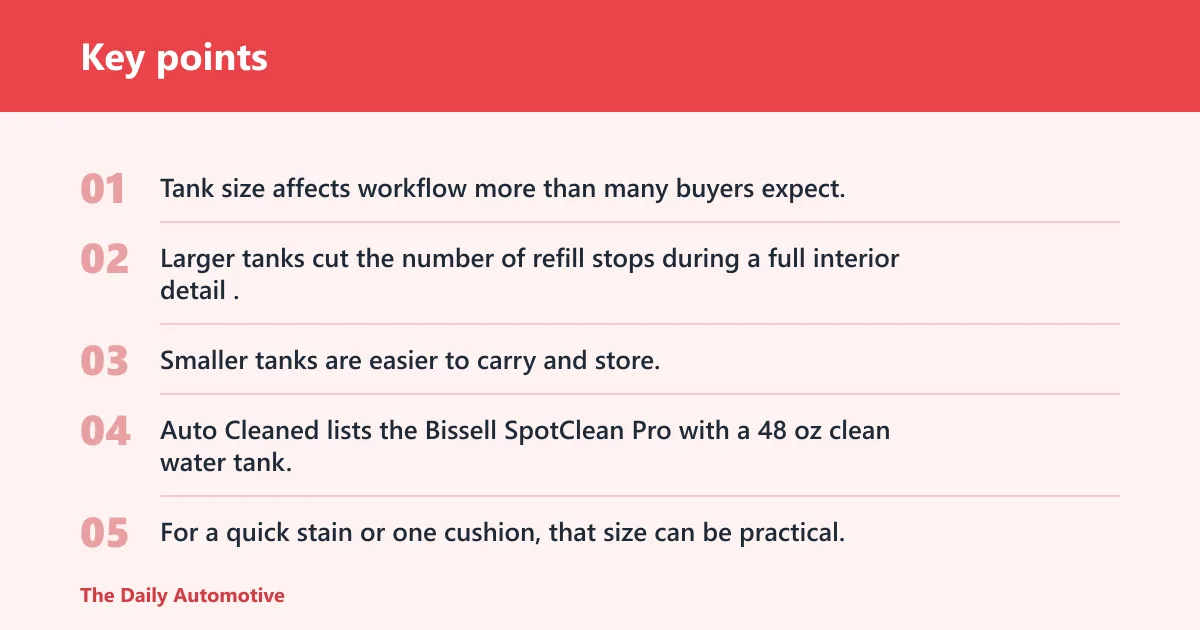
Tank size affects workflow more than many buyers expect. Larger tanks cut the number of refill stops during a full interior detail. Smaller tanks are easier to carry and store, but they can slow you down if you are working on multiple seats, carpets, and mats in one session.
Auto Cleaned lists the Bissell SpotClean Pro with a 48 oz clean water tank, which illustrates the compact end of the spectrum. For a quick stain or one cushion, that size can be practical. For a full SUV interior, it is more limited.
Portability and storage
Mobile detailers should lean toward compact or portable units. A lighter machine is easier to move from trunk to driveway to garage and takes up less space between jobs. That matters as much as raw power when the machine has to travel every day.
Aqua Pro Vac is positioned as a portable carpet cleaner extractor, and that is the kind of format that fits fast deployment. The tradeoff is that a smaller tank often means more refills on larger jobs.
Upholstery shampoo capability
Some machines include a dedicated shampoo tank or a compatible kit that adds chemical injection. That helps on heavier grime and stained fabric, but it is not always included in a conversion kit. If you need it, check the manufacturer’s listing for your model before you buy.
Shampoo capability matters most when the stain is older, oily, or spread across several fabric surfaces. For simple spot cleanup, plain extraction may be enough.
Viewing windows, wands, and hose fit
A viewing-window extraction wand helps you see soil removal as you work. That makes it easier to judge whether another pass is needed. Some models use a clear head with a brass valve, while others use stainless-steel wand variants for portable extractors or truck-mount setups.
Happy Tree’s kit uses universal adapters and a clear extraction head, which is a useful combination for users who want to see the cleaning path and avoid buying a new machine just to match one hose size.
For upholstery cleaning, look for a wand that feels controllable around seat bolsters and door panels. The attachment should spray evenly and recover moisture without flooding seams. If a kit forces awkward hose angles, the time savings disappear fast.
Can a shop vac become an extractor?
Yes, a shop vac can become an extractor if you use the right conversion kit, wand, hose, and adapters. That is often the most economical path for someone who already owns a wet/dry vacuum and wants extraction for seats, carpets, and mats without buying a new unit.
Universal adapters and hose diameters
Universal adapters are the key to making the conversion work. They fit multiple hose diameters and vacuum brands, which reduces the chance that you will have to replace the whole machine just to match a tool. Tool-free installation is even better, but fit matters most.
Hi Detail’s kit is specifically described as converting a standard shop vacuum into a carpet and upholstery extractor, and Happy Tree’s kit is described with universal adapters and a clear extraction head. Those are the features that make retrofitting practical.
When retrofitting makes more sense than buying new
Retrofitting makes sense when you already own a capable wet/dry vacuum, do occasional details, or want a mobile setup with fewer dedicated tools. It is especially appealing if you only need upholstery extraction a few times per month.
If you clean interiors regularly, however, a dedicated extractor may be the better purchase. It is usually simpler to set up, easier to use consistently, and less dependent on adapter compatibility.
Where conversion kits fall short
Conversion kits can fall short when the job requires shampoo capability, a clear workflow, or repeated deep cleans on a large vehicle. They also depend on the quality of the base vacuum. If that vacuum is awkward to maneuver or underpowered for wet pickup, the kit cannot fix that.
They are also the wrong choice when you want the fastest possible setup for a mobile appointment. In that case, a compact portable extractor is often the smoother option.
Frequently asked questions
What is the best extractor vacuum for car detailing?
The best extractor vacuum depends on the job. For most full-interior work, a wet/dry extractor vacuum is the most flexible choice because it handles dry vacuuming, wet pickup, and extraction. For spot stains, a compact portable extractor is easier to store and faster to deploy. For budget retrofits, a shop vac extractor kit makes sense.
Do I need a heated extractor for car seats?
Not always. A heated extractor is more useful for deeper upholstery cleaning, older stains, and professional use. For routine seat cleaning or light spill cleanup, a standard extractor is usually enough. Heat adds cost and complexity, so it pays off most when you clean interiors often.
Can a shop vac be turned into an extractor?
Yes. A conversion kit can turn a standard wet/dry vacuum into an upholstery extractor. Look for a kit with a wand, hose, and universal adapter compatibility so it fits your vacuum and hose diameter. If the fit is poor or you need shampoo capability, a dedicated extractor may be the better option.
What size tank is best for car detailing?
For spot work, a small tank is easier to carry and store. For full-interior cleaning, a 6-gallon class unit is often more practical because it cuts refill stops. Bigger tanks help on larger jobs, but they add weight and can be clumsy for mobile detailing.
Which extractor is best for pet stains and coffee spills?
Pet stains and coffee spills usually call for a deeper-cleaning setup, especially if the stain has set in. A heated extractor can help with stain release, while a wet/dry extractor vacuum gives you the suction and capacity needed for longer cleaning passes. For a single fresh spill, a compact spot extractor can be enough.
What attachments should an extractor vacuum include for upholstery?
Look for a wand, hose, and a head that sprays and recovers solution evenly. A viewing window is useful because it lets you monitor soil removal as you work. Universal adapters matter too, especially if you are connecting to a shop vac or mixing hose sizes across brands.
Products related to this article
Sponsored / affiliate links. As an Amazon Associate I earn from qualifying purchases. I may earn additional commission from eligible campaigns.
 Polishing Cleaner, Deep Cleaning Car Polish Spray, Multipurpose Car Interior Polishing Cleaner, Waterless Car Interior Detailer Spray, for Automotive Rubber, Leather& More(3)
 Car Vacuum Cleaner, Portable Handheld Mini Vacuum Cleaner, Portable Car Vacuum Cleaner with Inflator Function Light, Small Vacuum for Car, RV, Boats, Travel, DC12V 120W