Best Car Window Sunshades (2 Real Picks Compared)
Choose a custom-fit windshield sunshade if you park in direct sun for hours. Choose a quick-use universal or side-window shade if you want faster setup, easier storage, and grab-and-go use. Using the wrong style leaves the cabin hotter, puts more heat on upholstery and electronics, and makes child seats and steering wheels harder to touch. This guide compares two real sunshade options on fit, heat control, storage, and family use so you can pick by parking pattern, not price alone.
Window sunshade comparison matrix


| Buying dimension | Covercraft UVS100 | EcoNour windshield sunshade |
|---|---|---|
| Heat blockage | High; custom-fit windshield coverage with rigid foam-core construction | High for a universal shade; reflective silver coating and 240T polyester help with heat rejection |
| Gap coverage | Tighter edge coverage because it is vehicle-specific | More likely to leave edge gaps because fit varies by windshield shape |
| Daily install time | Fast once sized for the vehicle, but alignment matters | Very fast; pop-open folding style is easy to place and remove |
| Storage bulk | Folds into a flatter shape; storage bag included | Compact when folded, with lower day-to-day bulk than many rigid custom shades |
| Fit risk | Low if matched to the correct vehicle pattern | Moderate; windshield shape can affect edge contact and coverage |
| Long-term durability | Strong case for long service life; rigid foam-core build | Good for a budget shade, but lighter construction usually means more wear tolerance concerns over time |
| Kid and family usefulness | Best for front cabin heat control; less focused on side windows | Useful for quick front-window coverage; side-window protection still needs a separate product |
| Vehicle-transferability | Low; custom cut ties it to one exact vehicle pattern | Higher; easier to move between vehicles if windshields are similar |
That table shows the main split. Covercraft UVS100 fits best when the vehicle stays outdoors and needs a tight windshield seal. EcoNour is the simpler pick for drivers who want lower cost, faster setup, and a shade that can move between cars without much fuss.
Which car window sunshade actually blocks the most heat?
A custom-fit windshield shade usually blocks more usable heat because it covers more of the glass edge to edge. The gap at the perimeter matters more than the fabric spec in many cases. If sunlight slips around the edge, through a mirror cutout, or past a curved windshield corner, the cabin still heats up.
Why custom cut edges usually win
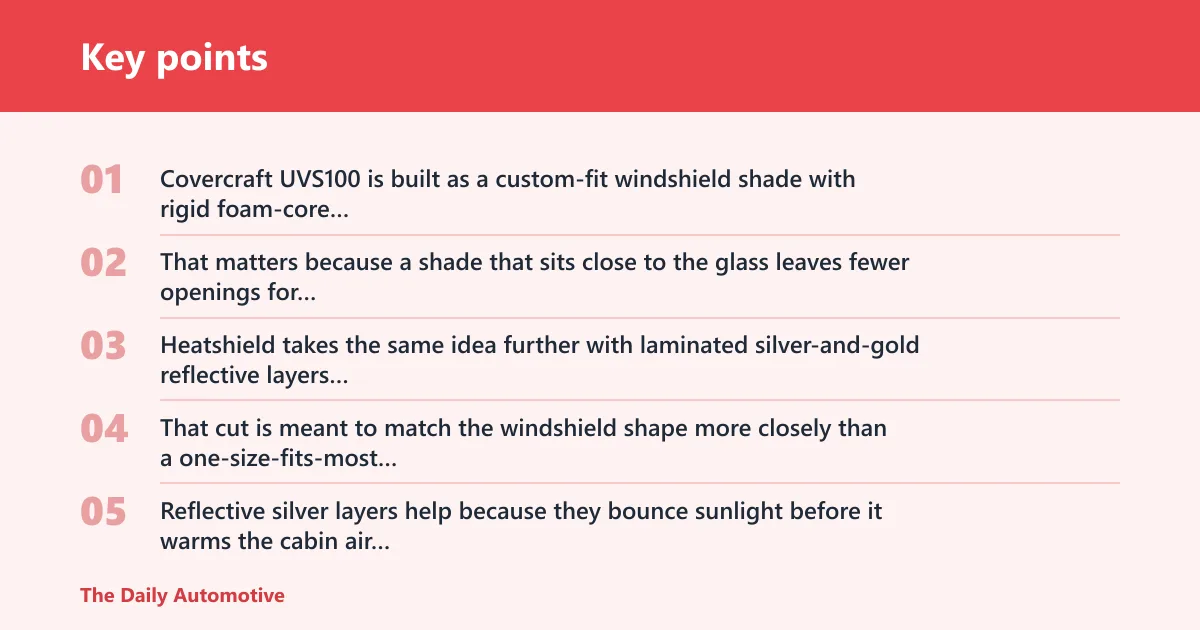
Covercraft UVS100 is built as a custom-fit windshield shade with rigid foam-core construction and a storage bag included. That matters because a shade that sits close to the glass leaves fewer openings for direct sun to reach the dashboard, steering wheel, or center stack.
Heatshield takes the same idea further with laminated silver-and-gold reflective layers and a VIN-specific cut pattern. That cut is meant to match the windshield shape more closely than a one-size-fits-most panel, which helps on vehicles with unusual rake or wider mirror housings.
Where reflective layers matter most
Reflective silver layers help because they bounce sunlight before it warms the cabin air and interior surfaces. The best result comes when the reflective face covers most of the windshield, with no wide daylight strip at the edges.
EcoNour uses 240T polyester with a reflective silver coating, plus an overlapping design. That overlap can improve coverage compared with a simple flat sheet, especially when the windshield is not boxy and the shade needs more reach.
Say your sedan has a broad windshield and a mirror housing that interrupts the top center edge. A universal shade may leave small open corners that still heat the dash. A custom-cut shade narrows that opening, and that is where the difference shows up.
Which one is easier to live with daily?
The easiest shade to live with is usually the one you will place and remove every time. Universal and pop-open styles are quicker to deploy, but custom-fit shades can still work well if you keep the same vehicle and follow a steady parking routine.
Install and fold-down time
EcoNour’s pop-open folding format favors speed. You open it, position it, and let it spring into shape. That works for drivers who move in and out of lots several times a day or do not want a multi-step setup before every stop.
This sunshade is described as using a tri-panel folding design, which is still simple but less grab-and-go than a spring frame. Heatshield uses roll-up storage, which some drivers like for packing flat, though it is not as quick to open as a pop-open frame.
Storage size and cabin clutter
Storage matters more than most buyers expect. A shade that is awkward in the door pocket or too bulky for the trunk gets left at home, and then the heat protection never happens.
Covercraft includes a storage bag, which helps keep a custom shade organized when it is not in use. EcoNour’s compact folded form has a lower storage burden, which can help in smaller cabins or in vehicles already loaded with work bags, child gear, or groceries.
Mirror interference and curl memory
Curved glass and mirror housings create fit problems during daily use. A shade can press against the rearview mirror, bow away from the glass, or leave a bright strip of sunlight at one corner. Universal shades are more likely to show that mismatch.
Suppose a crossover has a steeply curved windshield and a wide sensor housing. A pop-open shade may take seconds to install, but the edges can float away from the glass. A custom pattern usually cuts that problem down, even if placement takes a little more care.
How umbrella-style frames compare with folding shades
Umbrella-style windshield sunshades store compactly and open quickly because of the spring-loaded frame. They appeal to drivers who want one motion in and one motion out. The catch is fit. Sedan-focused limits are common, and curved glass can make the frame sit unevenly.
Folding shades are less polished but usually easier to adapt across body styles. For a straightforward commuter car, umbrella-style convenience can be worth it. For a vehicle with a deep dash, sensors, or strong windshield curvature, a shaped folding shade is often the safer bet.
Will it fit your windshield and side windows?
Fit is the whole decision. A custom windshield shade is built around a specific vehicle pattern, while a universal shade relies on a size range and generic geometry. Side-window shades add another layer: they must sit flat on clean glass to cling well and stay put.
Custom-fit VIN matching versus universal sizing
Heatshield Custom Windshield Shade is custom cut to a VIN-specific windshield pattern, which is the most direct way to improve edge contact. Covercraft UVS100 is also vehicle-specific and aimed at maximum heat and UV protection. Those are the safer choices when exact fit matters more than speed.
Universal shades are cheaper and easier to share among vehicles, but they depend on the windshield being close to the shape the maker expected. If the top corners pull away from the glass, the shade still works, but heat can slip through the gaps.
Curved glass and edge gaps
Curved glass is where universal shades fail most often. The shade can seem close in the middle while leaving daylight at the A-pillar edges, near the mirror stem, or along the top corners. That does not make it useless, but it lowers the practical benefit.
Reflective material helps most when it stays aligned with the glass. A loose edge creates a hot stripe, even if the center panel looks solid. The more curved the windshield, the more a custom cut matters.
Static-cling side window fit on clean glass
Kinder Fluff Car Window Shade uses a static-cling side window design with two transparency levels and lab-certified 99.79% UVA block. It comes in a 4-pack, which fits rear-seat passengers better than a front-only windshield shade.
Static cling avoids suction cups, so there is no cup hardware to fail in heat. The trade-off is that it works best on clean glass. Dust, humidity, and residue can weaken the cling and make the panel slide or peel at the edges.
When the Kinder Fluff 4-pack helps more than a windshield shade
For kids, the side window often matters more than the windshield. A rear seat faces low-angle sun during afternoon driving, and a front shade does nothing for that. A 4-pack helps when you want coverage on both rear doors or on more than one vehicle with child seats.
That said, side-window shades are not a substitute for a windshield shade. They solve a different problem. Use them together when you want comfort for the whole family, not only the dashboard.
Choose Covercraft UVS100 if…
Choose Covercraft UVS100 if your vehicle parks outside every day and you want tighter windshield coverage with less edge leakage. Choose it if you prefer a rigid foam-core build, want a shade that folds flat into a storage bag, and plan to keep the same vehicle long enough to benefit from a custom pattern.
It also makes sense if your windshield shape is awkward for universal sizing. That includes vehicles with strong curves, larger mirror housings, or sensor-heavy glass where a generic shade tends to leave gaps.
Choose EcoNour if…
Choose EcoNour if you want fast deployment, lower cost, and easy transfer between vehicles. Its 240T polyester construction, reflective silver coating, overlapping design, and compact pop-open folding make it a practical everyday shade when speed matters more than perfect edge coverage.
It is the better fit when you can accept some gap risk on a curved windshield and want a shade that is simple to store, simple to grab, and simple to replace if your vehicle situation changes.
Frequently asked questions
Are custom-fit sunshades worth the extra money?
They are worth it when the vehicle sits in direct sun often, especially for commuters with long parking stretches or owners who keep a car for years. The higher price buys better edge contact, less fit guesswork, and fewer missed spots around mirrors, curves, and sensor housings.
Do universal sunshades leave gaps around the windshield?
They often do, especially on curved glass or on vehicles with unusual windshield shapes. A universal shade can still cut cabin heat, but the fit is more variable. If you see daylight at the corners or near the mirror area, that is the gap showing up in use.
Which sunshade is easiest to install and store every day?
EcoNour is the easier daily pick because its pop-open folding format is quick to place and remove. It also stores compactly. A custom-fit shade takes a little more care to align and usually uses more cabin space, even when folded or bagged.
What sunshade works best for side windows with kids?
Kinder Fluff’s static-cling side window design is the stronger family option here. The 4-pack format covers more than one rear window, it avoids suction cups, and it is meant for clean glass. That makes it useful for child seats, afternoon rides, and multi-passenger rear seating.
How do I stop a sunshade from slipping on curved glass?
Start with the right size and the right shape. Clean the glass first, then seat the shade so the top edge and corners are fully in contact. If the windshield curve is pronounced, a custom-fit shade usually holds better than a universal one. On side windows, clean glass matters even more for static-cling hold.
Products related to this article
Sponsored / affiliate links. As an Amazon Associate I earn from qualifying purchases. I may earn additional commission from eligible campaigns.