Car Floor Mats Price: What You Should Pay for Better Fit
Car floor mat price makes sense only next to fit and coverage: expect about $25-$60 for decent universal sets, $80-$250 for custom-fit sets, plus shipping and duty in import markets. Buy on sticker price alone and you can end up with mats that slide, leave carpet exposed, or cost much more after freight and taxes. This guide breaks down price drivers, material tradeoffs, and total landed cost in the U.S., Pakistan, Kenya, India, Bangladesh, Nigeria, and the Philippines.
This guide is part of our Car accessories guide series.
How much do car floor mats cost?
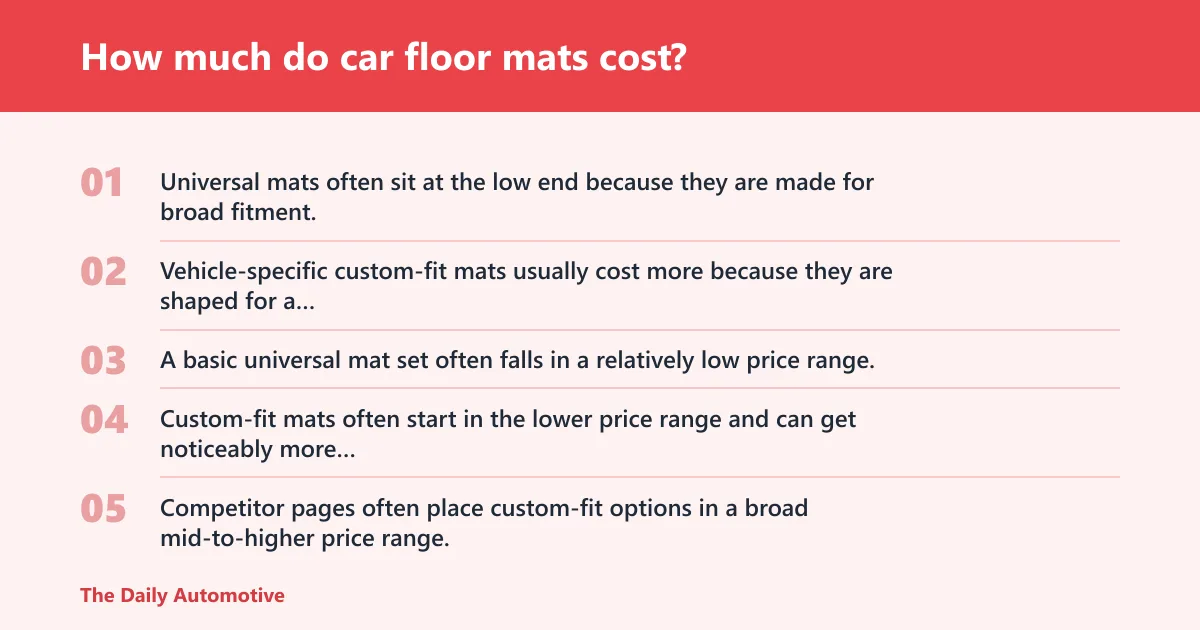


Universal mats often sit at the low end because they are made for broad fitment, not a specific vehicle. Vehicle-specific custom-fit mats usually cost more because they are shaped for a year/make/model and often cover more of the footwell, which raises tooling, packaging, and retail price.
What price buys universal mats versus custom-fit mats
A basic universal mat set often falls in a relatively low price range. Custom-fit mats often start in the lower price range and can get noticeably more expensive when the set includes deeper coverage, rear rows, cargo liners, or more complex molding. Competitor pages often place custom-fit options in a broad mid-to-higher price range.
Typical price bands for front-row-only, full-set, and cargo add-ons
Front-row-only mats are the cheapest way into a brand’s catalog. Full sets cost more because they add rear coverage and more molded material. Cargo mats and seatback mats are usually separate add-ons, so the total order can jump even when the floor mats themselves look affordable.
Why vehicle-specific fit usually costs more
A mat shaped for a specific cabin has to account for pedal placement, footwell depth, dead pedals, hump shapes, and retention points. That extra shaping is why a custom set costs more than a flat universal rectangle. A tight fit also cuts the chance of sliding and edge curling.
📊 Lasfit prices some Honda CR-V mats between $75.00 and $219.00. Source: Lasfit Custom Car Floor Mats with better Coverage than OEM,….
What actually drives car floor mat pricing?
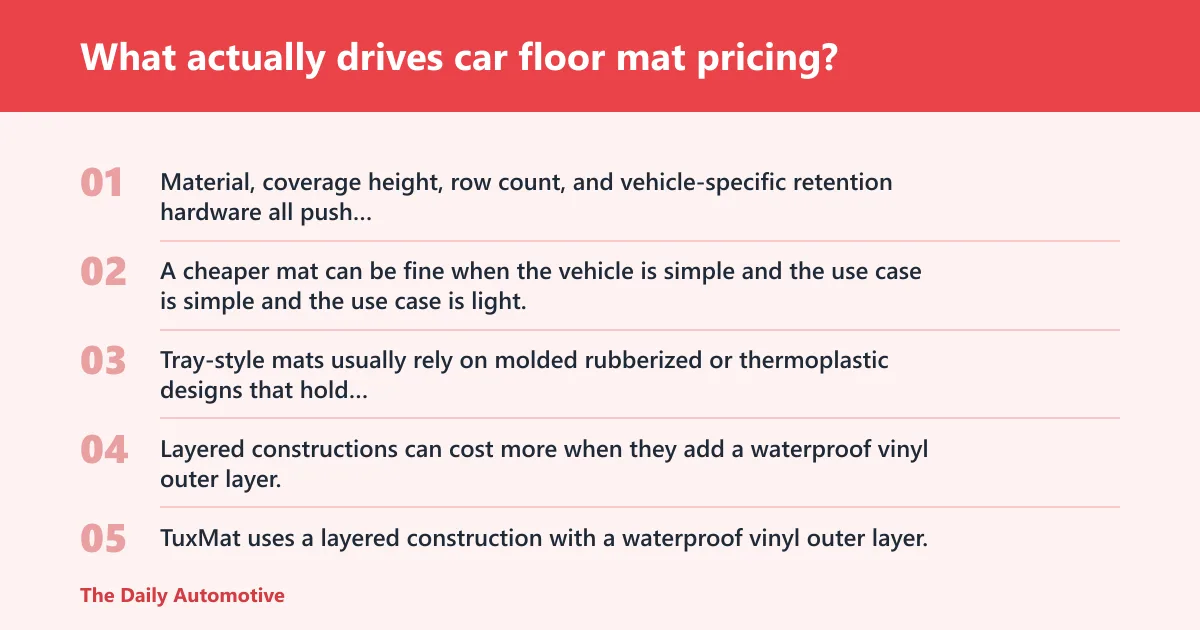
Price depends on more than brand name. Material, coverage height, row count, and vehicle-specific retention hardware all push the number up or down. A cheaper mat can be fine when the vehicle is simple and the use case is light, but price often rises when the mat has to do more work.
Material type: tray-style rubberized mats versus layered vinyl construction
Tray-style mats usually rely on molded rubberized or thermoplastic designs that hold shape and catch spills. Layered constructions can cost more when they add a waterproof vinyl outer layer, extra backing, or stitched layers that shape the sidewalls. TuxMat uses a layered construction with a waterproof vinyl outer layer.
Coverage depth, sidewall height, and spill containment
Higher sidewalls and fuller coverage use more material and more shaping steps. That matters in snow, mud, and family-haul duty. TuxMat’s coverage extends to sidewalls, which helps explain why it sits at a higher price position than simpler mats with shallow trays.
Vehicle complexity, retention clips, and OEM anchor compatibility
OEM footings and anchor points matter because they help keep the mat in place. If a mat must match multiple clip layouts or odd-shaped floor pans, installation can get harder and manufacturing cost can rise. A secure fit is not only about comfort; it is also about retention and repeatable installation.

Are custom-fit mats worth the extra money?
Custom-fit mats make the most sense when your car has a precise footwell shape, factory anchor points, or a use case that involves wet shoes, kids, pets, or long commutes. A cheap loose mat can look like a bargain, then slide around, expose carpet, or need replacement far sooner.
When year/make/model fit matters most
Year/make/model fit matters when the cabin has tight contours, unusual floor humps, or specific anchor locations. Lasfit lists a Toyota 4Runner range from $75.00 to $279.00, a Jeep Grand Cherokee L range from $109.99 to $259.00, and some Honda CR-V mats between $75.00 and $219.00. Those spreads show how vehicle complexity affects pricing.
Why poor fit can raise the real cost of a cheap mat
A mat that shifts under your heel can wear faster and can be annoying to reset every week. A common first-timer mistake is buying the cheapest mat for a vehicle with deep footwells, then replacing it after it curls at the edges or misses the dead pedal area.
When a budget universal mat is enough
If the car is leased, sees low mileage, or mostly runs in dry weather, a budget universal mat can be the smarter buy. The goal is to protect carpet without overspending on deeper containment or complex rear coverage you may not need during a short ownership window.
Price decoder: what you should expect to pay
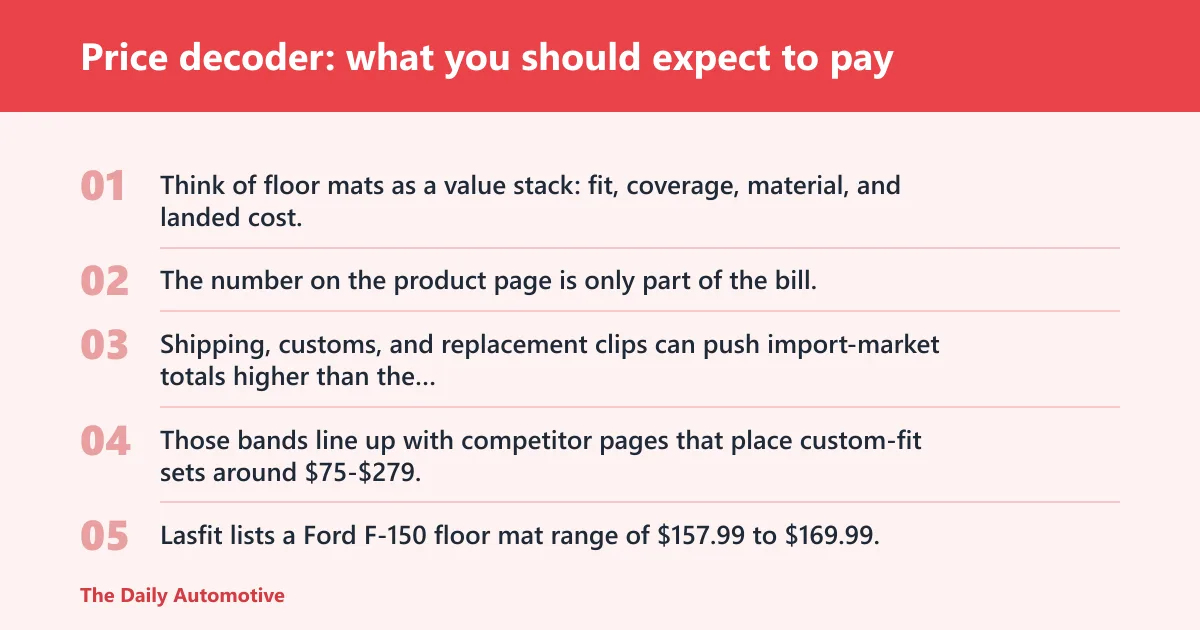
Think of floor mats as a value stack: fit, coverage, material, and landed cost. The number on the product page is only part of the bill. Shipping, customs, and replacement clips can push import-market totals higher than the sticker price suggests.
| Mat type | Coverage level | Material / build | Front-row-only | Full-set | Cargo-mat bundle |
|---|---|---|---|---|---|
| Universal | Low to moderate | Flat rubber or carpet | $25-$40 | $35-$60 | $50-$90 |
| Semi-custom | Moderate | Molded rubberized or basic layered | $45-$80 | $70-$140 | $95-$170 |
| Custom-fit budget | Moderate to high | Vehicle-specific molded plastic or layered vinyl | $75-$120 | $100-$199 | $130-$230 |
| Custom-fit premium | High | Deep tray, layered vinyl, fuller sidewalls | $120-$180 | $180-$279 | $220-$350 |
| Imported purchase | Any | Any of the above | Add shipping, customs, VAT or sales tax, and possible replacement clips or anchors; landed cost can move a mid-range set into premium territory | ||
Those bands line up with competitor pages that place custom-fit sets around $75-$279. Lasfit lists a Ford F-150 floor mat range of $157.99 to $169.99, one RAV4 set between $119.00 and $199.00, and some Honda CR-V mats between $75.00 and $219.00. The same brand can price different vehicles very differently.
Front-row-only versus full-cabin versus cargo-mat bundle costs
Front-row-only pricing is attractive, but it can hide the real total if you later add rear mats and a cargo liner. Seatback mats, where offered, are usually another line item. If you want full coverage, compare bundle pricing against piecemeal ordering before checkout.
Landed-cost examples for import markets
In Pakistan, Kenya, India, Bangladesh, Nigeria, and the Philippines, landed cost often matters more than sticker price. A $120 mat set can become a much larger purchase after international shipping, customs duty, and local taxes. Replacement anchors or clips can also carry extra freight if they are not bundled.
How do premium brands justify higher prices?
Higher-priced mats usually buy you more vehicle-specific shaping, more coverage, and a more involved material stack. WeatherTech FloorLiner is listed at $230. WeatherTech says the FloorLiner uses High-Density Tri-Extruded material and that production and testing are done in the U.S. (caranddriver.com)
WeatherTech FloorLiner and the $230 price point
The FloorLiner sits squarely in premium territory because it is a rigid tray-style design with a vehicle-specific shape. That price is not only about branding. It also reflects molded construction, fit precision, and the kind of coverage many buyers expect from a top-tier set.
What changes with WeatherTech FloorLiner HP
WeatherTech FloorLiner HP is described as softer and more flexible. That can make installation and removal easier, while still keeping a premium position. It is also described as improving cleanability compared with the standard FloorLiner, which matters if you remove mats often.
Why TuxMat costs more than many mid-tier mats
TuxMat uses layered construction, a waterproof vinyl outer layer, and fuller sidewall coverage. Those details add material and shaping steps. Car and Driver named TuxMat its premium pick in a test of five custom-fitted floor mats in long-term test cars.
By contrast, Car and Driver named Smartliner its budget pick and included Husky Weatherbeater as a mid-tier comparison point. That mix is useful because it shows the market ladder: budget, mid-tier, and premium options are often separated by coverage depth more than by basic function.
Which floor mats are easiest to clean?
Tray-style mats with smooth molded surfaces are usually easier to wipe off than layered or heavily textured designs. Cleanability improves when dirt stays on top instead of working into seams. If you deal with mud, snow, or spilled drinks, cleanup time can be worth paying for.
Tray-style surfaces versus layered surfaces
Rigid tray mats usually need a shake-out and a rinse. Layered mats can catch more debris along seams, but they may also cover more of the footwell and sidewalls. Choose the surface you will actually clean, not the one that looks simplest in a product photo.
How coverage shape affects cleanup time
Full sidewall coverage can trap more grime in corners, but it can also stop grime from spreading onto carpet. Picture a rainy week with three kids and a cargo area full of sports bags: the mat that keeps slush in the liner is often easier to manage than the one that lets it reach carpet.
What should you check before buying car floor mats?
Check fitment first, then retention hardware, then the row count you actually need. A mat that matches the wrong trim or skips the OEM anchor layout may fit poorly even if the catalog says it fits the vehicle. The cheapest safe buy is the one that installs securely.
- Confirm year, make, model, and trim.
- Check whether the set covers front rows only or the full cabin.
- Look for compatibility with OEM footings or anchor points.
- Confirm whether clips, hooks, or anchors are included.
- Check cargo and seatback options if you haul gear often.
- Add shipping, duty, and tax before comparing the final price.
Do custom-fit mats cost more than universal mats?
Yes. Custom-fit mats usually cost more because they are built for a specific vehicle and often cover more of the floor area. The price gap buys better fitment, more secure retention, and fewer exposed edges than most one-size-fits-all mats can manage.
What is the difference between floor mats and cargo mats?
Floor mats cover the passenger footwells. Cargo mats cover the rear load area, and seatback mats protect the backs of folded seats or third-row surfaces when offered. Cargo and seatback pieces are usually sold as separate add-ons, so they raise total purchase cost.
Frequently asked questions
How much do car floor mats cost?
Basic universal sets often cost about $25-$60. Custom-fit sets commonly run $75-$250 or more, especially when they include deeper coverage or brand-specific molding. Shipping, customs, and taxes can lift that total in import markets.
What is a fair price for custom car floor mats?
A fair price depends on fit and coverage. Many custom-fit sets sit around $80-$200 for the main cabin, while premium sets can move higher. If the vehicle has complex footwells or you want cargo coverage, a higher number can still be reasonable.
Are WeatherTech-style mats worth the extra money?
They can be, if you want molded fit, secure retention, and easier cleanup from a tray-style design. WeatherTech FloorLiner is listed at $230, so the value question is whether that fit and coverage are worth more than a mid-tier alternative for your vehicle.
What makes premium floor mats more expensive?
Premium mats usually cost more because they use more material, deeper sidewalls, more vehicle-specific molding, and better retention compatibility. TuxMat’s layered construction and sidewall coverage are examples of features that add cost beyond a basic flat mat.
How much should I budget for front and rear floor mats?
For a custom-fit front and rear set, a practical budget is often $100-$200 for mid-tier products and $180-$279 for premium sets. Add more if you want a cargo mat or seatback protection, especially in vehicles with three rows.
Why do some floor mats cost $75 and others over $250?
The gap usually comes from fit complexity, coverage height, material stack, and included rows or add-ons. A $75 mat may be a simpler budget custom-fit option, while a $250-plus set may cover more area, fit more tightly, and include better retention hardware.
Products related to this article
Sponsored / affiliate links. As an Amazon Associate I earn from qualifying purchases. I may earn additional commission from eligible campaigns.