Top-Rated Car Air Purifiers for a Fresh and Clean Ride
The best car air purifier depends on the problem: pick a HEPA-first model for smoke and dust, an activated-carbon model for odors and VOCs, and a plug-and-forget unit if convenience matters most. Pick the wrong one, and you keep breathing stale cabin air while paying for a device that misses the source. This guide ranks top-rated compact car air purifiers by smoke removal, allergy control, VOC reduction, and easy daily use.
Top pick for most drivers

Philips GoPure GP5212 is the best all-around pick for daily commuting because it combines PM2.5 sensing, a rated CADR of 16 m3/hour, and a stated ability to refresh a standard sedan or SUV in under 10 minutes. That mix beats a simple odor filter for drivers who want automatic response to changing cabin air.
It is also the most useful choice when you want the purifier to react without constant attention. The PM2.5 sensor supports auto-adjusted fan control, which matters in stop-and-go traffic, tunnel driving, and other polluted-city situations where cabin air changes fast.
Why this model leads the list
The GP5212 fits the broadest use case because it addresses particles and reacts to them. A purifier can have strong filtration on paper and still disappoint if it is too slow for the cabin it sits in. CADR matters here because a compact sedan and a larger SUV do not move the same air volume.
Philips also uses a HESA layer to target gaseous chemicals and odors, so it is not limited to particle capture alone. That makes it better balanced than a model built around HEPA only.
Best use case and cabin fit
Choose it if you want one unit for daily commuting, mixed urban pollution, and a cabin that changes from morning to evening use. It is a stronger fit for small to midsize cabins than for very large vehicles with stubborn HVAC odor problems.
Quick picks by need
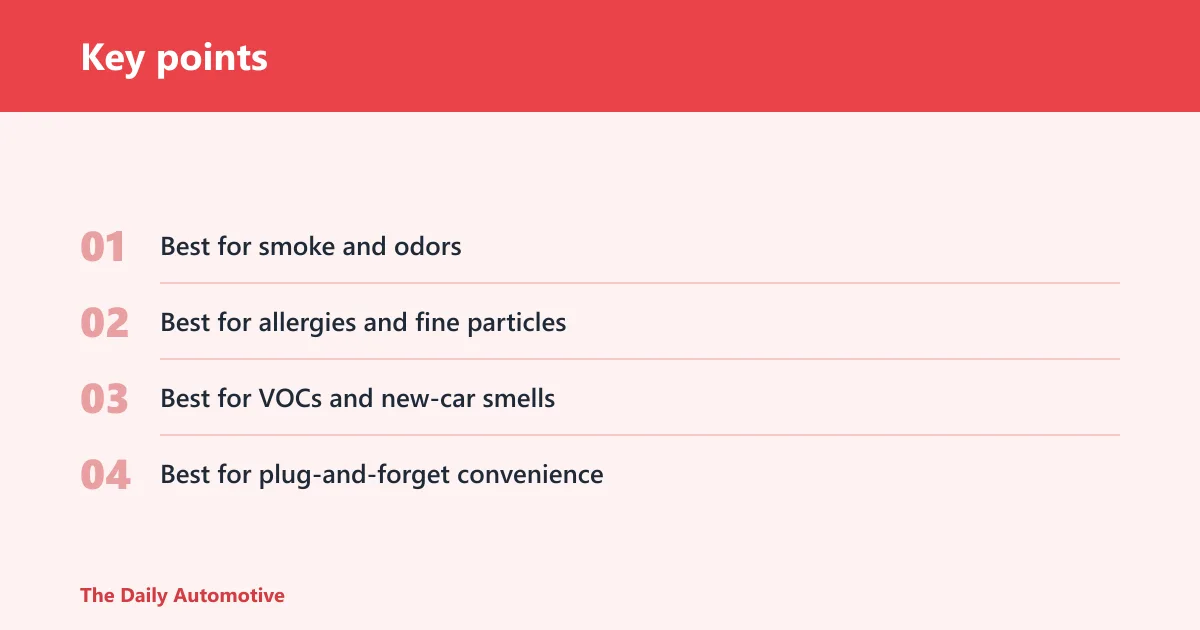
- Best for smoke and odors: PureZone Mini, for its two-stage filtration with activated carbon and True HEPA.
- Best for allergies and fine particles: Philips GoPure GP5212, for PM2.5 sensing plus measurable airflow spec.
- Best for VOCs and new-car smells: LUFTRUM, for its four-stage filtration and gaseous pollutant focus.
- Best for plug-and-forget convenience: Megashopcart car air purifier, for USB power and low-noise operation.
PureZone Mini
PureZone Mini is the easiest cordless option to place in a cup holder, console, or dash space. Its two-stage filtration combines activated carbon and True HEPA, and the HEPA layer is claimed at 99.97% efficiency. It also offers up to 12 hours of cordless use on a single charge.
That runtime makes it a better fit for short trips, rentals, rideshare shifts, or drivers who do not want another cable across the cabin. The trade-off is simple: cordless convenience helps, but battery runtime will always be finite.
LUFTRUM
LUFTRUM is the strongest choice here for buyers focused on gaseous pollutants and stronger airflow claims. It claims a four-stage filtration system, removal of harmful substances down to 0.1 microns, and fan speed up to 5300 RPM while using about 4W.
That makes it relevant for new-car smells, exhaust drift, and mixed odor problems. It still needs sensible expectations: a compact purifier can help with cabin air, but it will not cure a leaking HVAC system or eliminate severe, soaked-in smoke odor by itself.
Megashopcart car air purifier
Megashopcart is the convenience-first pick. It is USB-powered, says it removes odors, dust, smoke, and allergens, and emphasizes low-noise and energy-efficient performance. That profile suits drivers who want a simple, always-ready unit more than advanced sensing or battery portability.
USB power also cuts down on charging chores. If you want a device that can stay connected to a vehicle port and fade into the background, this is the most straightforward option in the group.
Which purifier is best for smoke and odors?
For smoke and odors, the best choice is usually a purifier with activated carbon plus HEPA, not HEPA alone. Carbon helps trap odor-causing gases and smoke smells, while HEPA handles fine particles from smoke, dust, and ash. PureZone Mini appears to be one of the closest matches for smoke and odors in this group.
What filtration works best on smoke
Smoke creates two problems at once: particles and smell. True HEPA captures fine particles such as dust, pollen, smoke, and dander, while activated carbon targets the odor side. A purifier that skips carbon may catch particles yet still leave the cabin smelling stale.
That is why multi-stage cabin filtration is a better buy than a single-layer filter when smoke is the main complaint. If the odor has soaked into seats, headliner, or the HVAC path, though, a compact purifier can only do so much.
When activated carbon matters most
Activated carbon matters most when the cabin problem is smell, exhaust drift, or lingering cigarette odor. It is also the layer most likely to help when you want a fresher cabin after parking near traffic or after carrying smelly gear. It will not erase heavy, long-standing odor by itself.
Suppose your car smells fine at startup but turns stale after idling in traffic. In that case, a carbon-heavy unit can help with the in-cabin air you breathe, while the HVAC system still needs clean filters and proper maintenance.
Is a HEPA car air purifier worth it for allergies?
Yes, a HEPA car air purifier is worth it for allergies if the cabin problem is pollen, dust, pet dander, or other fine particles. True HEPA is the right filtration type for those particles, but the purifier still needs enough airflow for the cabin size it is meant to handle.
What True HEPA can capture
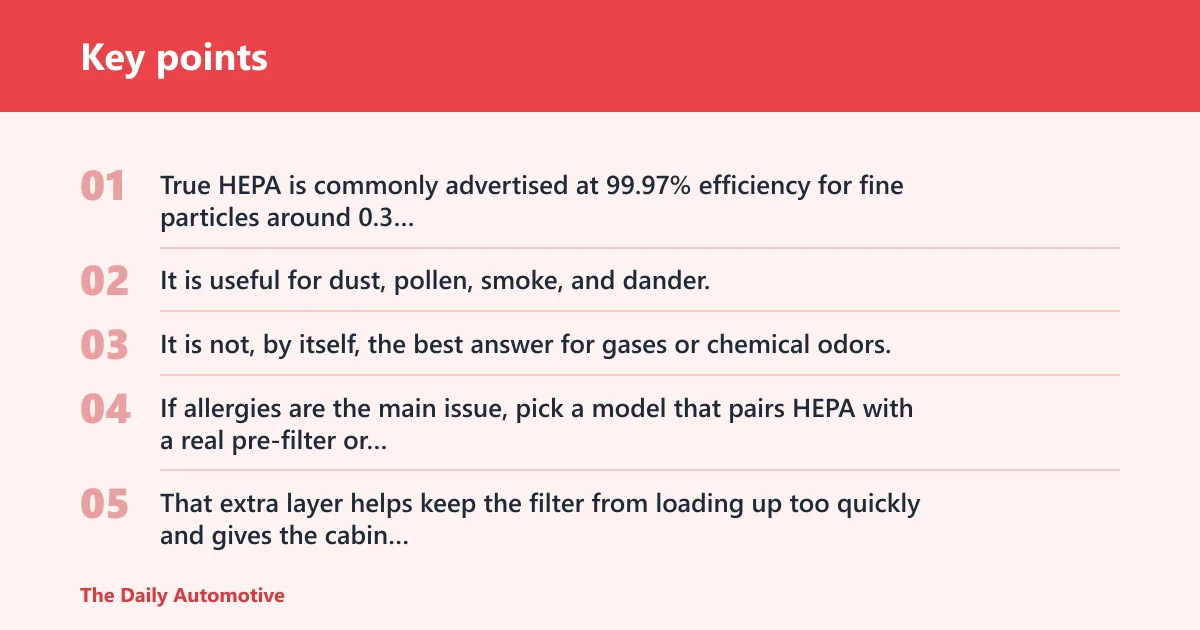
True HEPA is commonly advertised at 99.97% efficiency for fine particles around 0.3 microns, which is why it matters for allergy control. It is useful for dust, pollen, smoke, and dander. It is not, by itself, the best answer for gases or chemical odors.
If allergies are the main issue, pick a model that pairs HEPA with a real pre-filter or carbon layer. That extra layer helps keep the filter from loading up too quickly and gives the cabin air system a better chance at sustained performance.
What cabin size means for pollen control
Cabin size matters because a purifier that fits on a dash can still be too small for a larger SUV if its airflow is modest. CADR helps you compare output against the space you need to clean. The GP5212 is easier to justify for mixed cabin sizes because its CADR is stated at 16 m3/hour.
A common first-timer mistake is buying for filter type alone and ignoring air delivery. A HEPA unit that is undersized for the cabin will still leave pollen floating longer than a model with better airflow and placement.
Can a car air purifier remove VOCs and formaldehyde?
Yes, some can help with VOCs and formaldehyde, but only if they include the right gas-focused layer. HEPA alone does not remove gases well. Look for activated carbon, HESA-style layers, or other selective absorption media when the goal is new-car smell, adhesives, upholstery off-gassing, or urban chemical odors.
What gaseous pollutant layers do
Gas-focused layers are built to deal with molecules, not particles. That is why Philips uses a HESA layer in the GP5212 for gaseous chemicals and odors. Carbon is still valuable, but in cabins with fresh materials or repeated chemical exposure, a specialized layer can add useful coverage.
Even then, do not expect miracles. Persistent VOC odors from trim, mats, or lingering spills may need source cleanup, not just filtration. A purifier can reduce what circulates through the air; it cannot fix a material that keeps off-gassing heavily.
When selective absorption or HESA layers help
These layers help most in new-car conditions, urban traffic, and vehicles that pick up exhaust odor quickly. They are a strong match for drivers who notice chemical smell more than visible dust. If the cabin air problem is mostly pollen or lint, HEPA matters more.
Start with the air problem, then check airflow, power, and upkeep. A good cabin purifier should match the vehicle size, fit the mounting space, and be quiet enough that you will actually leave it on. Convenience matters only if the purifier can do the job without becoming a burden.
Cabin size and CADR
CADR is the clearest way to compare how quickly a purifier can move clean air through a cabin. A sedan and an SUV do not need the same output, even if both have a dash-mounted unit. Philips gives a CADR of 16 m3/hour and says it can refresh a standard sedan or SUV in under 10 minutes.
Placement matters too. Cup holders and dashboards are compact spaces, but a purifier blocked by a seatback or tucked under a vent loses effectiveness. Pick a location with clear intake and outlet space.
Power method: USB-C, USB, or cordless
USB-powered models are easiest to live with for daily driving because they draw from the vehicle and skip recharge planning. Cordless designs are better when portability matters, such as rentals, rideshare use, or road trips. PureZone Mini offers up to 12 hours of cordless use on a single charge.
The trade-off is runtime. Cordless units bring cleaner placement and fewer wires, but they require charging. Plug-in models reduce that chore, though they are tied to the vehicle’s power source.
Noise, placement, and auto on/off
Low-noise operation matters because cabin noise is close to your ears, especially in small cars. A purifier that is loud on higher settings is less likely to stay on. Megashopcart specifically emphasizes low-noise performance, which suits drivers who want a background device rather than a noticeable fan.
Auto on/off with ignition is also useful for daily drivers. It reduces manual handling and keeps the unit from draining power while parked. For a commute car, that kind of convenience often matters as much as raw filtration.
Filter replacement and ownership cost
Replacement filters are part of the real cost of ownership. A purifier with an easy-to-source filter and simple change process is easier to keep in service than one that needs frequent, expensive, or hard-to-find parts. That is especially true if you use the unit every day.
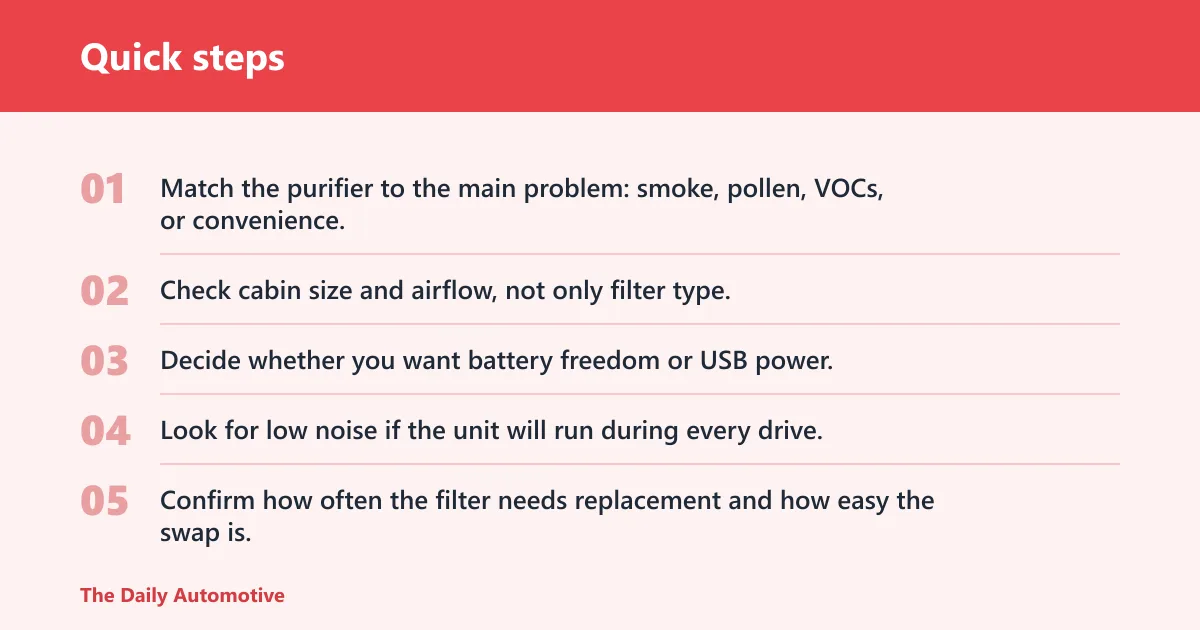
- Match the purifier to the main problem: smoke, pollen, VOCs, or convenience.
- Check cabin size and airflow, not only filter type.
- Decide whether you want battery freedom or USB power.
- Look for low noise if the unit will run during every drive.
- Confirm how often the filter needs replacement and how easy the swap is.
- Use the purifier as support, not as a fix for HVAC faults or heavy contamination.
Say your compact sedan picks up road dust and pollen every morning. A HEPA-first model with enough airflow and easy placement will help more than a strong-smelling freshener hanging from the mirror.
Car air purifier decision matrix
| Recommended purifier | Best use case | Cabin size fit | Pollutant type handled best | Power method | Expected maintenance burden | Likely trade-offs |
|---|---|---|---|---|---|---|
| PureZone Mini | Smoke and odors in short to moderate trips | Small cabins, cup holder or console placement | Particles plus odor with activated carbon and True HEPA | Cordless battery-powered | Moderate; battery charging plus filter replacement | Runtime is limited to up to 12 hours of cordless use on a single charge |
| Philips GoPure GP5212 | Allergy control and daily commuting | Sedan and SUV use where airflow matters | Fine particles, pollen, smoke, and gases via HESA layer | Vehicle-powered with auto-adjusted fan use case | Moderate; filter upkeep and placement checks | Better balanced than battery units, but still needs enough cabin space for airflow |
| LUFTRUM | VOCs, new-car smells, and stronger air movement | Best in compact to midsize cabins | Gaseous substances and fine particles down to 0.1 microns | Plug-in use implied by 4W operation | Moderate to higher; multi-stage filtration to maintain | Fan strength can help, but higher speed may be more noticeable in a small cabin |
| Megashopcart car air purifier | Plug-and-forget convenience for daily driving | Small spaces near USB access | Odors, dust, smoke, and allergens | USB-powered | Lower day-to-day effort; filter changes still apply | Simple and convenient, but less specialized for sensor-driven automation |
Frequently asked questions
Which car air purifier is best for smoke and odors?
PureZone Mini is the best fit here because it pairs activated carbon with True HEPA, which gives you both odor control and fine-particle capture. That combination matters more than a plain HEPA unit when smoke smell is the main complaint. It is especially practical for short trips and small cabins.
Do car air purifiers work better than car air fresheners?
Yes, when the problem is pollution rather than scent masking. Air fresheners only add fragrance, while a purifier can reduce particles and some odors in the cabin air. That said, a purifier will not fix soaked-in smoke, a dirty HVAC system, or a cabin that needs deep cleaning.
What size purifier fits in a cup holder or dashboard space?
Compact, cordless units are the easiest fit for cup holders and dashboards. PureZone Mini is the clearest example here because portability is part of its appeal. Fit still depends on vent clearance, cable routing, and whether the intake can breathe without being blocked by trim or seats.
Should I choose a cordless or USB-powered car air purifier?
Choose cordless if you need portability and wire-free placement, such as in rentals or rideshare work. Choose USB-powered if you want lower hassle and regular daily use. Cordless units trade convenience for charging needs, while USB models usually win on plug-and-forget practicality.
How often do car air purifier filters need replacing?
Replacement intervals vary by model, cabin pollution, and usage time. The safer approach is to follow the manufacturer’s schedule and shorten it if you drive in heavy traffic, smoke, or dusty conditions. If airflow drops or odor control weakens, the filter may be due sooner.
What features matter most in a car air purifier for daily driving?
For daily driving, the most useful features are the right filtration mix, enough CADR for the cabin, low noise, easy power, and simple filter replacement. PM2.5 sensing is valuable for city commuters, while auto on/off helps drivers who want the purifier to disappear into the routine.
Products related to this article
Sponsored / affiliate links. As an Amazon Associate I earn from qualifying purchases. I may earn additional commission from eligible campaigns.
 Tressify Portable Car Air Freshener, Usb Rechargeable Odor Eliminator, Compact Purifier For Home And Office, Whisper-Quiet Function
 Car Air Compressor Digital Tire Inflator with Auto Stop – Portable Air Compressor w/LED Light, 4 Pressure Units (PSI/BAR/KPA/kg/cm²), 8ft Cord & Needles for Cars, Bikes, Balls