WeatherTech Door Seal Kit Review: Is It Worth It?
WeatherTech Door Seal Kit is worth it if your doors freeze shut because the factory seal is weak, cracked, or missing. It is less useful on a healthy OEM seal. In the right case, it can cut drafts, wind noise, and some water intrusion. It will not fix every winter door problem, and it is a poor substitute for damaged factory weatherstripping.
What the kit is and how it works
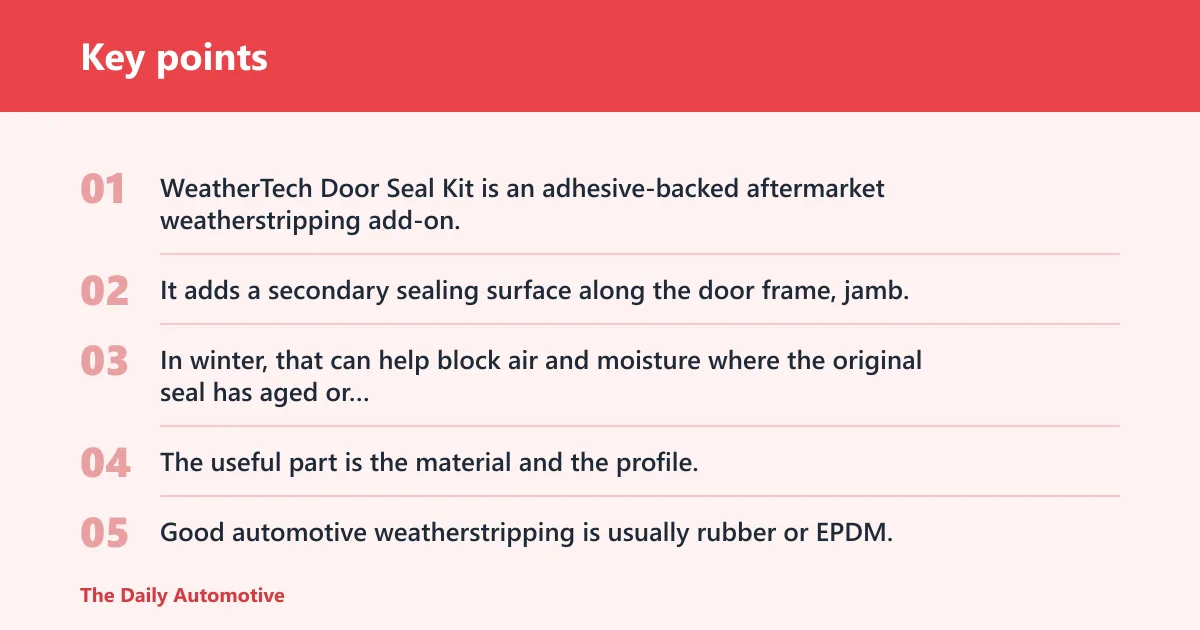

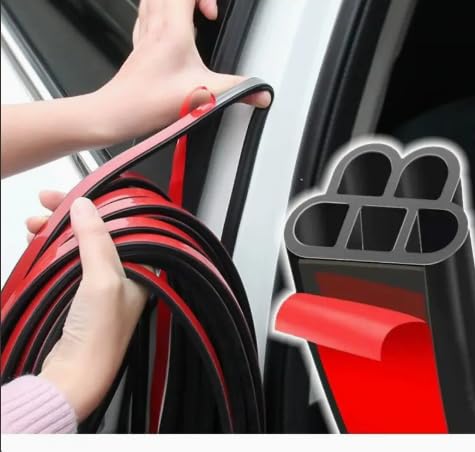
WeatherTech Door Seal Kit is an adhesive-backed aftermarket weatherstripping add-on. It adds a secondary sealing surface along the door frame, jamb, or another compatible edge, so the door can compress against a taller, fresher seal. In winter, that can help block air and moisture where the original seal has aged or flattened.
Adhesive-backed seal design
The useful part is the material and the profile. Good automotive weatherstripping is usually rubber or EPDM, a material commonly chosen for compression set resistance, cold flexibility, and resistance to UV and ozone. Those traits matter when temperatures drop, because a seal that hardens or shrinks loses contact pressure and lets air and water creep in.
Fitment and door-geometry limits
This type of kit depends on the door frame, jamb shape, and pinch points lining up well enough for the seal to sit flat. Curved sections are where problems begin. If the strip lifts there, or if it sits too tall at a hinge pocket or striker area, the door may bind or the adhesive may let go sooner than expected.
How winter compression affects sealing
A seal can look fine and still stop sealing when the rubber has taken a compression set. That is common on older cars, high-mileage daily drivers, and vehicles that see repeated freeze-thaw cycles. The added strip helps most when the old seal is still present but no longer presses evenly along the full perimeter.
Does WeatherTech Door Seal Kit actually keep doors from freezing shut?
Sometimes, but not reliably by itself. It can help if the freeze comes from moisture getting into a weak perimeter seal and then turning to ice along the door edge. It is far less helpful if ice forms around the latch area, striker, or upper frame where the added strip does not change the actual freeze point.
Ice at the door perimeter
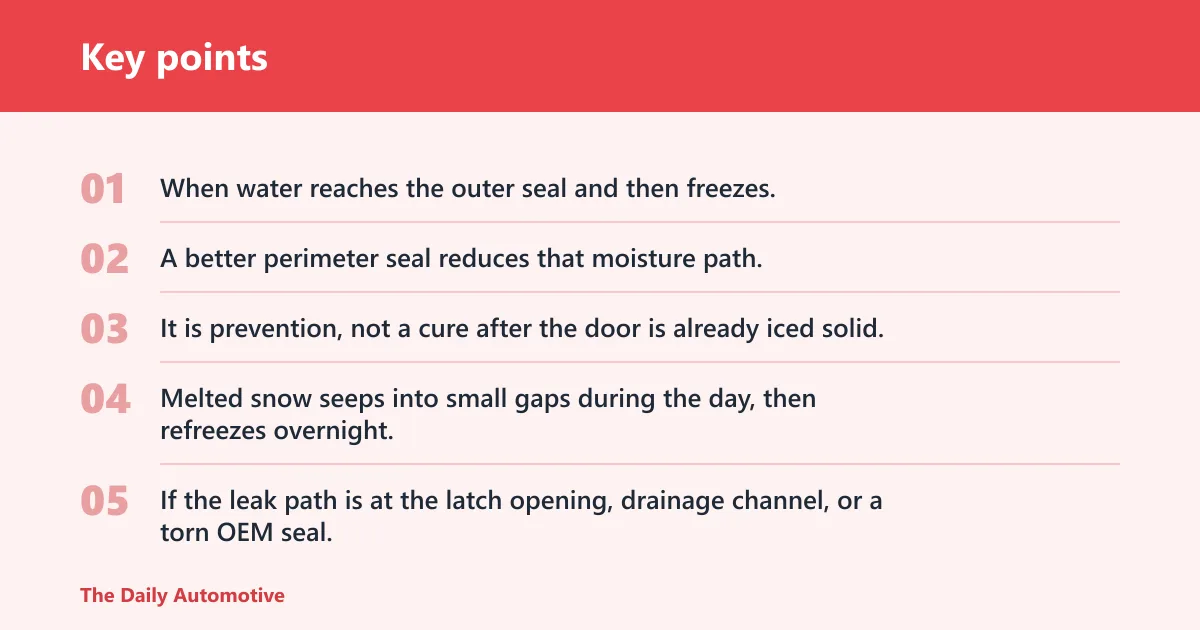
When water reaches the outer seal and then freezes, the door can stick to the body or feel glued at one corner. A better perimeter seal reduces that moisture path. That is the winter-specific value here. It is prevention, not a cure after the door is already iced solid.
Moisture, latch area, and freeze-thaw cycles
Freeze-thaw cycles are hard on vehicles. Melted snow seeps into small gaps during the day, then refreezes overnight. If the leak path is at the latch opening, drainage channel, or a torn OEM seal, an added strip may reduce the problem but not remove it. Silicone spray or de-icer may help temporarily, but they do not replace the seal.
Garage parking versus outdoor parking
Garage parking can reduce ice formation around the door perimeter, so the added seal may have less winter work to do. Outdoor parking in hard freeze-thaw weather is the tougher case. In that situation, the kit is more likely to help if the factory seal is tired, but it still will not prevent every frozen-door event.
How much does WeatherTech Door Seal Kit cost?
The price matters because this is a prevention part, not a repair part. If your original seal is intact, the value is mostly in quieter doors, fewer drafts, and less water entry. If the OEM seal is already damaged, that money may be better spent on factory-fit weatherseal replacement, especially on a newer vehicle.
Cost versus the repair that may be needed
WeatherTech’s value is highest when you need a targeted add-on and the factory seal still has life left. It is weaker value when the seal is torn, permanently flattened, or missing a section. In those cases, paying for a second strip can end up being a temporary fix on top of an unresolved problem.
Which vehicles does WeatherTech Door Seal Kit fit?
Fitment varies by vehicle and door geometry. Some applications are vehicle-specific, while others are more universal in concept, which means you still need to check the manufacturer’s listing for your model. The key question is whether the strip can follow the frame cleanly without interfering with trim, jambs, latch points, or the door’s closing force.
Compatibility with frames, jambs, and pinch points
Door frames with tight corners, folded seams, or crowded pinch points can make adhesive-backed sealing harder to place. A strip that looks fine on a flat run may fail where the frame curves sharply. That is why fitment is more than a model-year question. It is also a door-shape question.
Is installation difficult for the WeatherTech Door Seal Kit?
Installation is usually straightforward if the surface is clean and the fit is sensible. The work is more about prep than tools. Clean the mounting area, trim carefully, and press the seal firmly along its full length. The common failure points are dirty paint, oily residue, and rushed placement on curved sections.
- Clean the mounting surface with isopropyl alcohol and a microfiber cloth.
- Dry the area fully before sticking anything down.
- Test-fit the strip along the door frame or jamb first.
- Trim the ends with scissors or a utility knife as needed.
- Press the seal into place with firm hand pressure or a roller.
- Check corners, bends, and pinch points for lift or bunching.
Where poor adhesion usually happens
Adhesive fails most often where the paint has wax, road film, or moisture on it. Cold weather can make that worse if the strip is applied to a chilled surface without proper prep. If the strip lifts at one corner early on, that weak point can grow each time the door opens and closes.
Door seal decision matrix
This matrix separates winter value from general sealing value. A common mistake is buying an add-on seal for a car that mainly needs OEM weatherseal replacement. The better choice depends on seal condition, parking exposure, and how severe the freeze-thaw cycle is where the vehicle sits.
| Scenario | Expected benefit | Install difficulty | Failure risk | Better alternative |
|---|---|---|---|---|
| Newer daily driver | Moderate if the factory seal is weak at one section; helps drafts and minor water intrusion | Low to moderate | Moderate if the fit is curved or the surface prep is poor | Leave the OEM seal alone unless you can point to a specific leak path |
| Older high-mileage car | High if the original seal has flattened, hardened, or shrunk | Moderate | Moderate to high because old frames often have uneven wear | OEM weatherseal replacement if the factory seal is torn or missing sections |
| Outdoor-parked vehicle in hard freeze-thaw weather | Moderate for drafts and edge moisture; limited for latch-area icing | Moderate to difficult if the frame is complex | High if the adhesive sees repeated moisture, salt, and flexing | OEM seal replacement plus a check for door alignment and drainage issues |
Pros and cons
The kit makes the most sense when your winter complaint is perimeter leakage, not structural door damage. It is less convincing when the underlying problem is worn factory rubber or a door that already needs real repair.
Pros
- Can reduce drafts when the original seal has lost shape.
- Can help with some wind noise and light water intrusion.
- Uses a simple adhesive-backed installation process.
- May improve winter sealing without replacing the full OEM seal.
Cons
- Will not fix a torn, missing, or badly damaged factory seal.
- Can fail on dirty surfaces or tight curved sections.
- May not stop frozen doors if ice forms at the latch area.
- Can create closing-force issues if the profile is too thick for the frame.
When OEM weatherseal is the better buy
OEM weatherseal is the smarter fix when the factory geometry has failed, not just the surface finish. If the original seal is cracked, torn, shrunken, or missing, the factory part usually solves the shape problem better than an add-on strip. That is especially true on newer vehicles where the seal still has the correct fit available.
Damaged factory seal cases
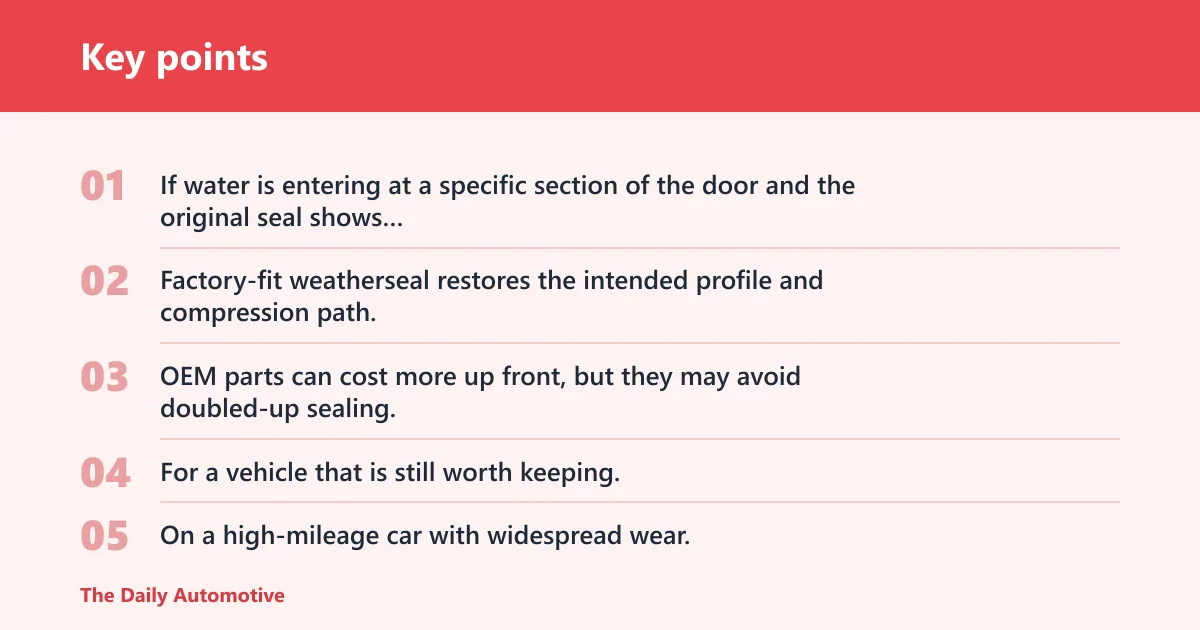
If water is entering at a specific section of the door and the original seal shows visible wear there, an adhesive add-on is a workaround. It is not the cleanest fix. Factory-fit weatherseal restores the intended profile and compression path, which often matters more than adding another layer.
Cost versus replacement value
OEM parts can cost more up front, but they may avoid doubled-up sealing, poor door closure, and recurring adhesion issues. For a vehicle that is still worth keeping, the right factory seal can be the better long-term spend. On a high-mileage car with widespread wear, that call deserves more attention than the price sticker alone.
Say your sedan has a front door that freezes at the top rear corner after overnight outdoor parking. If the original seal is flattened there, an add-on strip may reduce the gap. If the lower latch area is the real source of the ice, the kit will not solve the root cause.
Suppose your SUV has a 12-year-old factory seal that still looks intact but leaves a light whistle at highway speed. A properly placed kit may quiet that. If the rubber is cracked through in several spots, OEM replacement is the cleaner answer.
Who it’s for
This suits drivers with a mostly healthy door seal who want a winter-focused upgrade for drafts, minor leaks, or mild freezing at the perimeter. It does not suit owners who already have torn OEM weatherstripping, serious water entry, or a door that needs alignment work before any extra seal will help.
Frequently asked questions
Will a door seal kit fix wind noise and water leaks?
It can reduce both when the noise or leak is coming from a weak perimeter seal. It will not fix a torn OEM seal, a misaligned door, or water entering from another body opening. Think of it as a sealing aid, not a complete body repair.
What are the downsides of adding an aftermarket door seal kit?
The main downsides are fitment limits, adhesion problems, and the chance of making the door harder to close if the profile is too thick. It can also hide a real factory-seal problem for a while instead of fixing it. In heavy freeze-thaw weather, that tradeoff matters even more.
Products related to this article
Sponsored / affiliate links. As an Amazon Associate I earn from qualifying purchases. I may earn additional commission from eligible campaigns.