Cat Windshield Snow Cover Review: Fit and Security
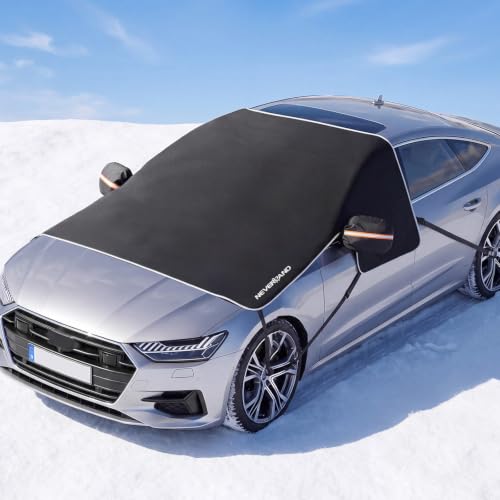
The CAT windshield snow cover is worth buying if your vehicle has a fairly standard windshield and enough room for the mirror straps. On oversized trucks, tall SUVs, or cars with unusual mirror placement, measure first and buy only if the listed coverage matches your glass. A poor fit can mean wind lift, ice at the edges, or a cover that slides off overnight. This review covers fit, hold, coverage, and wet-weather practicality across common vehicle shapes.
Verdict
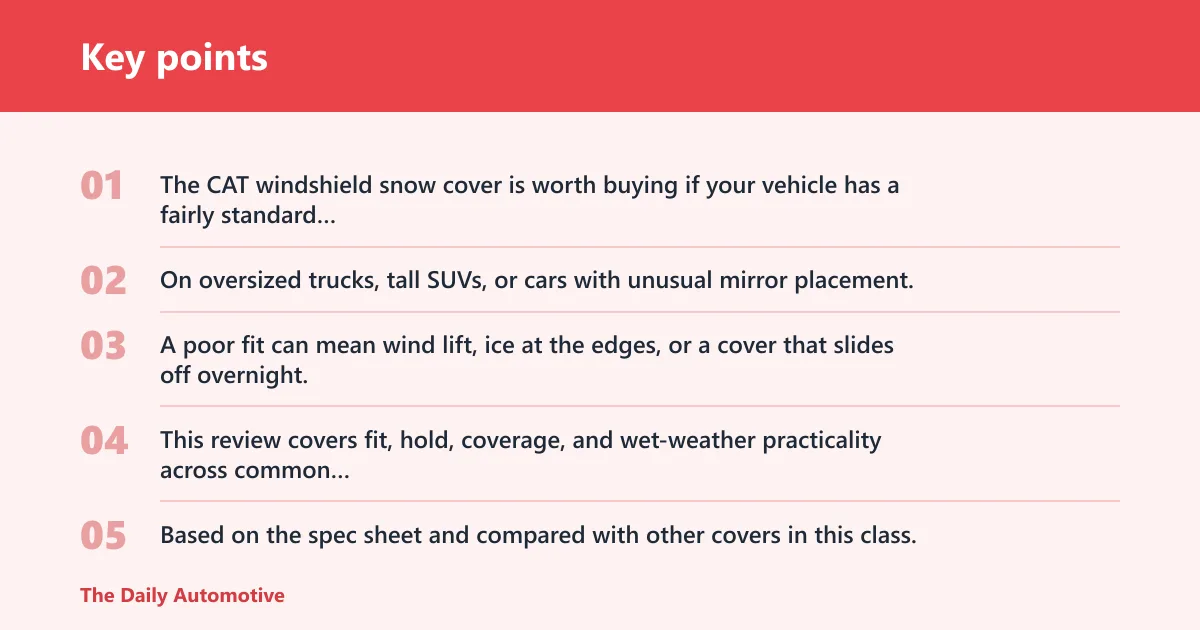

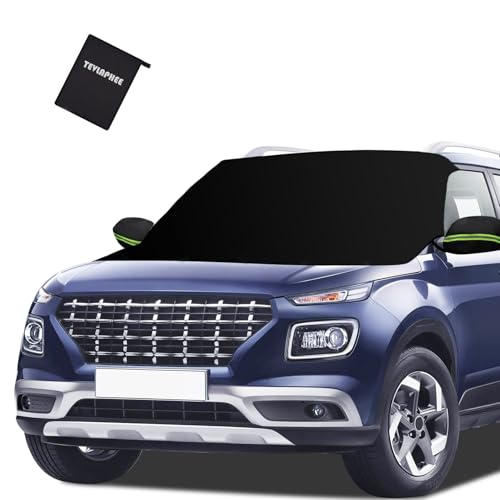
Based on the spec sheet and compared with other covers in this class, CAT is best treated as a size-matched, strap-secured option rather than a do-everything winter shell. ArcticFinds lists it at 78 by 45 inches and says it fits cars, trucks, vans, and SUVs, with anti-theft straps and weatherproof fabric. That is a useful starting point, but the real question is whether your windshield shape and parking conditions match that size.
📊 Popular Mechanics says ALTITACO’s rear cover is under $10. Source: The 9 Best Windshield Snow Covers to Protect Your Car This Winter.
Specs at a glance
| Spec | CAT windshield snow cover | What it means in practice |
|---|---|---|
| Size | 78 x 45 inches | Best for vehicles with a fairly standard windshield footprint and moderate hood depth |
| Stated fit | Cars, trucks, vans, SUVs | Fit still depends on width, height, mirror placement, and how much glass sits above the hood |
| Material | Weatherproof fabric | Good for snow and frost; wet slush and freezing rain still call for careful drying and storage |
| Attachment | Anti-theft straps | Helps in wind and discourages quick removal by someone else |
| Storage consideration | Bulky when wet | Drivers without a garage need a drying plan before throwing it in the trunk |
Who it is for
The CAT windshield snow cover is for winter drivers who want a simple cover with a theft-conscious attachment plan and a stated fit that reaches beyond small sedans. It makes the most sense for people parking outside overnight, especially when the main goal is to keep frost and light snow off the glass without relying on a loose, one-size-fits-all tarp.
It is a practical choice if you drive a car, crossover, SUV, van, or light truck with a windshield that is close to average in width and shape. If your mirror placement sits near the outer edges of the glass, or your hood rises steeply into a tall windshield, fit becomes less forgiving. That is where a buyer-fit check matters more than brand name.
Best-fit use cases
Picture a midsize SUV parked at curbside through a cold, dry night. The windshield is broad but not unusually tall, the mirrors sit in predictable positions, and the cover can be tensioned with the straps before wind picks up. That is the kind of setup where a 78 x 45 inch cover is more likely to stay planted and cover the glass evenly.
A common first-timer mistake is choosing a cat windshield snow cover based only on sedan, SUV, or truck labels instead of checking the windshield dimensions and coverage fit. Two SUVs can have very different windshields. One may be easy; the other may have mirror stalks and a taller roofline that leave corner gaps. Measure the glass, not the badge on the hatch.
What works
The CAT cover’s main strength is straightforward compatibility on standard shapes. A 78 x 45 inch panel gives enough span for many cars and crossover windshields, and the anti-theft straps are the right kind of feature for exposed parking. For a cover that may sit outside in wind, that matters as much as fabric type.
Weatherproof fabric suits the winter jobs this product is made for: frost, dry snow, and routine overnight protection. The design is aimed at preventing the buildup that turns a five-minute departure into scraping and brushing. For daily use, the appeal is not novelty. It is fewer steps on cold mornings.
Where the fit helps
Fit is strongest when the windshield has moderate width, the hood depth leaves enough overlap at the bottom, and the side mirrors do not sit so far outboard that they block the edge of the cover. On those vehicles, the cover has a better chance of sitting flat instead of tenting in the middle or lifting at the corners.
Mirror and wiper coverage are still separate questions. A cover can be good on the glass and poor around the hardware. If your car has prominent mirror housings or a wiper park area that sits high on the glass, check whether the edge coverage reaches beyond those points before you buy.
Install is simple enough for daily use
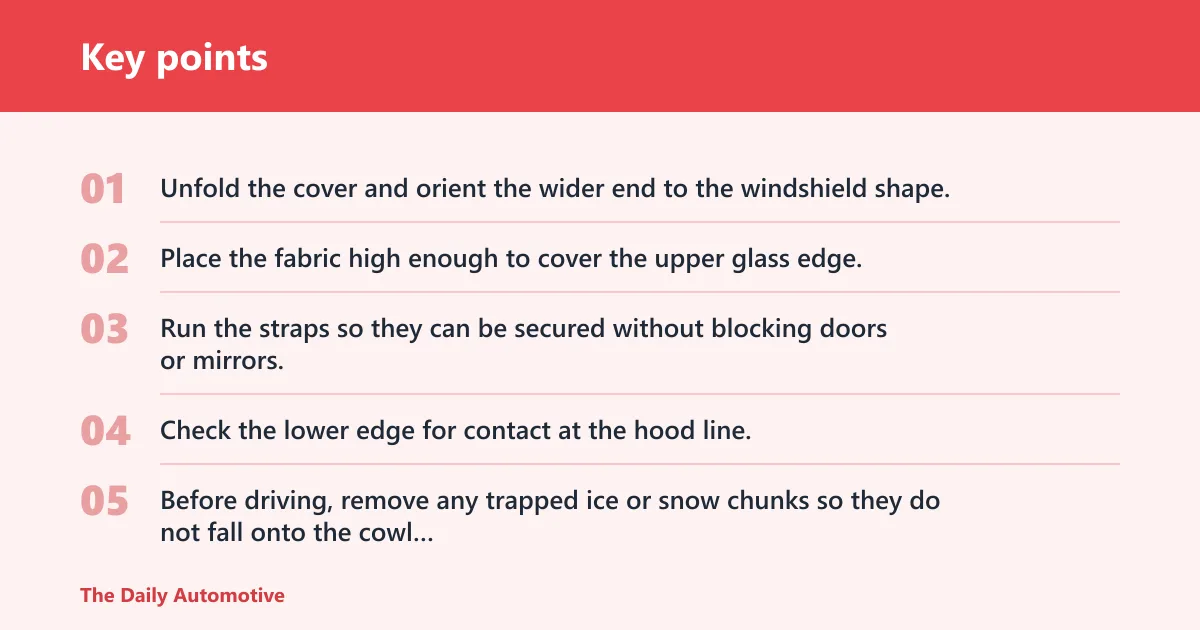
Most windshield covers are only practical if they go on quickly. CAT’s strap-based approach fits that routine better than designs that need multiple hooks or door-pinch steps. You want a setup that can be placed, tightened, and removed without fiddling in freezing gloves.
- Unfold the cover and orient the wider end to the windshield shape.
- Place the fabric high enough to cover the upper glass edge.
- Run the straps so they can be secured without blocking doors or mirrors.
- Check the lower edge for contact at the hood line.
- Before driving, remove any trapped ice or snow chunks so they do not fall onto the cowl or wiper area.
What does not work
The biggest drawback is fit risk in harsher parking conditions. High winds can lift any cover that lacks enough anchor points, and a cover that is only “close” in size can shift overnight. Once it shifts, the exposed corner is where frost starts first, then ice, then freezing contact with the glass.
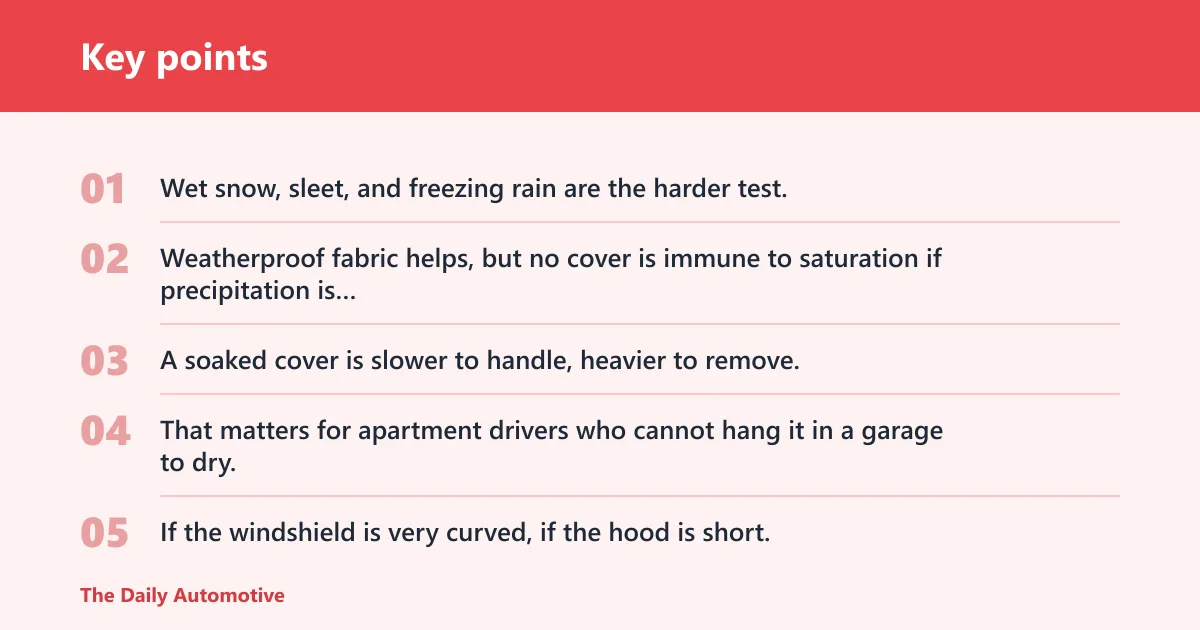
Wet snow, sleet, and freezing rain are the harder test. Weatherproof fabric helps, but no cover is immune to saturation if precipitation is heavy enough or long enough. A soaked cover is slower to handle, heavier to remove, and more awkward to store in a trunk. That matters for apartment drivers who cannot hang it in a garage to dry.
Failure cases to watch
Slipping is the first failure mode. If the windshield is very curved, if the hood is short, or if the parking spot is broadside to the wind, a strap-only hold can be borderline. The second failure mode is soak-through or edge seepage in wet snow and sleet. The third is freezing to paint or glass when the cover is left on after meltwater refreezes.
Bulk is the last annoyance, but it is a real one. A wet winter cover takes more trunk space than a scraper. If you live in an apartment and park outdoors all week, you need a place to dry it flat or hang it before stowing it. Otherwise the cover becomes a damp item you keep moving from trunk to back seat.
Buyer-fit matrix: will it fit your vehicle?
The best way to judge the CAT cover is by windshield width, mirror layout, hood depth, and the exposure of your parking spot. A car can be a “yes” on paper and still be a borderline fit if the windshield is extra tall or the mirrors sit wide. Use the matrix below as a practical screen before ordering.
| Vehicle / parking setup | Windshield width and shape | Mirror layout | Parking conditions | Fit call |
|---|---|---|---|---|
| Compact car | Moderate width, lightly curved | Mirrors sit close to the A-pillars | Open lot, light overnight frost | Good fit |
| Midsize sedan | Average width, standard hood depth | Mirror stalks do not crowd the edge | Street parking, moderate wind | Good fit |
| Crossovers and small SUVs | Wider glass, moderate height | Mirrors may sit near the outer edge | Apartment lot, light snow | Borderline fit |
| Tall SUV | Large windshield, more vertical angle | Wide mirror spacing, exposed corners | Windy curbside parking | Borderline fit |
| Pickup truck | Wide or upright windshield | Mirror placement can interfere with edge coverage | Exposed lot, drifting snow | Poor fit unless the glass matches the listed size closely |
| Van | Very tall or broad glass | Side mirrors may sit far outboard | Uncovered parking, wet storms | Poor fit |
How to check your vehicle before buying
Start with the glass, not the vehicle class. Measure the windshield width at its widest usable point and note how far the glass sits above the hood. Then check where the mirrors land relative to the edge. If the mirror housings or wiper park area sit outside the likely coverage zone, the fit is already in trouble.
Also think about where you park. A sheltered driveway is one thing. An exposed lot at the top of a hill is another. The more wind your car sees, the more valuable a cover with stronger anchoring becomes. If curb parking puts the driver side into blowing snow, borderline fit moves closer to poor fit.
How does it compare with AstroAI, EcoNour, and FrostGuard Plus?
CAT is the security-minded, straightforward-fit option. AstroAI gets the strongest third-party nod here, with Car and Driver calling it the best overall pick and noting reflective quilting and multiple sizes. EcoNour brings a broad size spread and a rear windshield cover. FrostGuard Plus leans hardest into hardware, with mirror and wiper coverage and door-anchored poles.
AstroAI
Car and Driver calls the AstroAI Windshield Cover the best overall pick, and notes reflective quilting plus multiple sizes available. That makes it a stronger general shopping choice if you want more sizing flexibility than CAT offers. The tradeoff is that reflective or quilted construction can hold moisture longer after a storm, so storage and drying matter.
EcoNour
Car and Driver says EcoNour uses Oxford polyester, comes in sizes from compact to XXL, and includes a rear windshield cover. That wider size range is useful if CAT’s 78 x 45 inch footprint looks borderline for your vehicle. The practical drawback is that more coverage also means more fabric to dry and fold after a wet storm. (caranddriver.com)
FrostGuard Plus
Popular Mechanics says FrostGuard Plus covers sideview mirrors and windshield wipers, and that is a real advantage for exposed parking. It is the better pick if your main concern is hardware coverage, not only the glass. Door-anchored poles can hold well, but they are also more involved to place and remove than a simple strap system.
Should you buy it
Buy the CAT windshield snow cover if you want a branded cover with a clear size listing, anti-theft straps, and a reasonable shot at fitting a standard windshield cleanly. It is a good match for drivers who park outside and want a simple frost and snow barrier without a more complex door-anchored design.
Skip it if your vehicle has a very wide windshield, a steeply curved glass shape, or mirrors that sit awkwardly close to the edge. In those cases, a larger multi-size option or a cover with stronger mirror and wiper coverage is the safer purchase. For size-sensitive buyers, fit beats brand every time.
What is the best Cat windshield snow cover?
The best Cat windshield snow cover is the one that matches your windshield width, mirror placement, and parking exposure. For the model covered here, the key spec is 78 x 45 inches with anti-theft straps and weatherproof fabric. That makes it a strong choice for standard shapes, but not a universal fit for every SUV or truck.
Does a Cat windshield snow cover fit SUVs and trucks?
It can, but only if the windshield is within the coverage the cover is built for. ArcticFinds says the Cat cover fits cars, trucks, vans, and SUVs, yet that is a category claim, not a guarantee. Tall windshields, broad mirrors, and steep hoods can push it into borderline or poor-fit territory.
Will a windshield snow cover stay on in high winds?
Sometimes, but not automatically. High winds expose weak hold-down designs, especially if the cover has too much slack or too little overlap at the edges. Anti-theft straps help, and Popular Mechanics notes some covers use magnets or sideview-mirror loops for a more secure fit. Exposed curb parking still raises the risk.
Is a Cat windshield snow cover better than scraping ice?
For many drivers, yes, because it saves time and reduces morning scraping. The advantage is strongest when the cover stays in place and the weather is ordinary frost or light snow. In wet snow or freezing rain, the cover still helps, but it does not remove the need to check for ice at the edges.
How do you install a windshield snow cover on a car?
Lay the cover across the windshield, align the top edge, and secure the lower attachment points so the fabric sits flat rather than loose. Good installation depends on mirror position, hood depth, and whether the straps or anchors can be tightened without leaving gaps. If the cover shifts, reset it before the storm builds.
What size windshield snow cover do I need for my vehicle?
Measure the usable windshield width and note the glass height relative to the hood. A common mistake is shopping by vehicle name alone. The right size must cover the glass with enough overlap to resist wind lift, but not so much extra fabric that it bunches near the mirrors or wipers.
Are windshield snow covers worth it for overnight parking?
Yes, especially if you park outside and face repeated frost, snow, or scraping. They are most worthwhile when the cover fits well and can be dried after wet weather. If you have no garage, pick a model you can fold, shake out, and store without leaving it damp in the trunk.
Can a windshield snow cover protect mirrors and wipers too?
Some can, but many do not. Popular Mechanics notes FrostGuard Plus covers sideview mirrors and windshield wipers, which is useful if those parts freeze often. If mirror and wiper coverage matters to you, check the product design closely. A glass-only cover can still leave those parts coated in snow or ice.
What should I look for in a snow cover for frozen mornings?
Look for fit, anchoring, weather resistance, and drying ease. Polyester, cotton insulation, reflective material, 600D polyester, and thermal shield designs each solve different parts of the problem. For frozen mornings, the best cover is the one that stays on, stays dry enough to handle, and covers the glass you actually need protected.
Products related to this article
Sponsored / affiliate links. As an Amazon Associate I earn from qualifying purchases. I may earn additional commission from eligible campaigns.