Mopar Windshield Washer Fluid Concentrate Review
Mopar Windshield Washer Fluid Concentrate is worth buying if you want an OEM-branded washer fluid and you accept paying more for dealership-level fit confidence. This guide compares Mopar’s concentrate with lower-cost alternatives and helps you choose the better buy for winter driving.
Verdict
That recommendation is narrow on purpose. If your priority is simple compatibility for a Chrysler, Jeep, or Ram, an OEM label can be reassuring. If your priority is cleaning power per dollar, a winter-ready pre-mix or a larger concentrate bottle usually gives you more fluid for the money, with less risk of paying extra for a badge.
Pros and cons
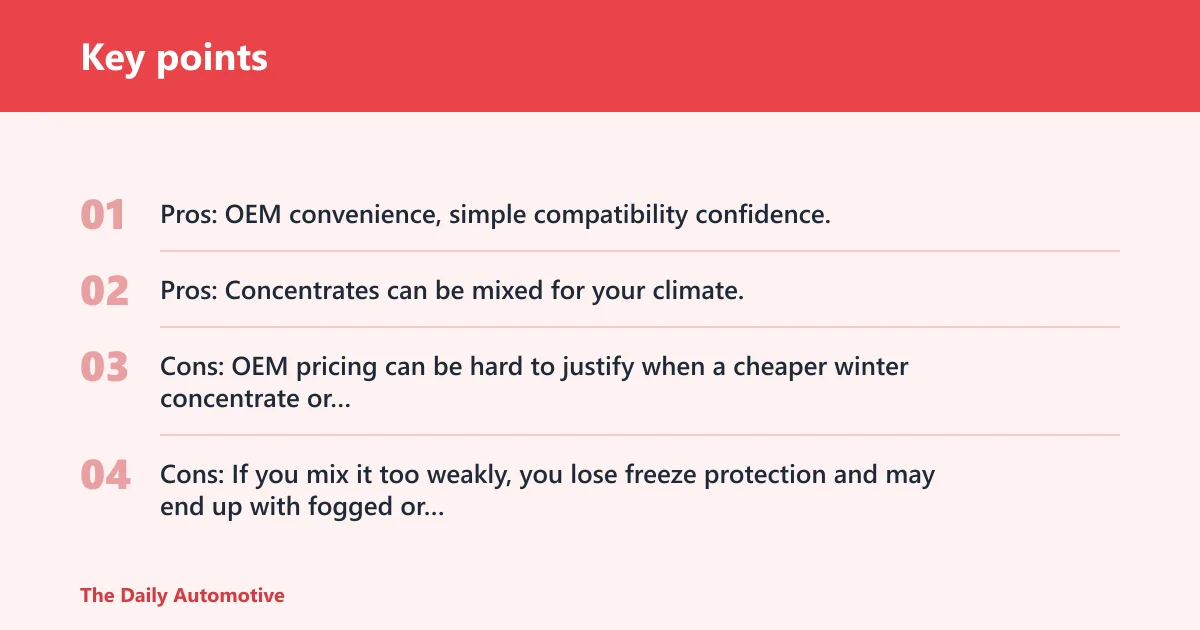
- Pros: OEM convenience, simple compatibility confidence, and a compact bottle that is easy to store.
- Pros: Concentrates can be mixed for your climate, which helps match freeze protection to winter conditions.
- Cons: OEM pricing can be hard to justify when a cheaper winter concentrate or ready-to-use fluid does the same job.
- Cons: If you mix it too weakly, you lose freeze protection and may end up with fogged or smeared glass.
Specs at a glance
| What to check | What matters for winter use | What to confirm before buying |
|---|---|---|
| Form | Concentrate or booster that must be mixed with water unless the label says otherwise | Whether your exact bottle is meant for a reservoir fill, a top-off, or a booster dose |
| Climate fit | Winter protection should match your local low temperature, not a milder climate | The freeze rating on the label and the final mix ratio after dilution |
| Cleaning job | Washer fluid should help remove bugs, tar, grime, and road film | Whether the formula is aimed at winter de-icing, all-season cleaning, or beading |
| Convenience | Small bottles save storage space and are easy to carry | How many gallons the bottle makes and whether the ratio is simple to measure |
Who it
Mopar concentrate is for Chrysler, Jeep, and Ram shoppers who want an OEM-branded washer-fluid choice and value a simple “buy the factory part” decision.
It is less compelling for drivers who mainly want the lowest cost per gallon. If your vehicle does not need OEM branding for peace of mind, a larger winter fluid jug or a cheaper concentrate may deliver the same cleaning performance with less spending.
Pros and cons for this buyer
- Best for: dealership shoppers, OEM-minded owners, and drivers who want a straightforward factory-compatible purchase.
- Best for: winter commuters who want a compact product that can be mixed for their climate band.
- Not ideal for: buyers focused only on the cheapest freeze protection per gallon.
- Not ideal for: anyone who wants zero measuring and prefers a ready-to-use winter jug.
What works in winter?
Winter is where concentrate either earns its place or loses the sale. A good washer-fluid formula can keep the reservoir and lines from freezing, help clear salt haze, and keep spray pattern performance usable when roads turn dirty and wet. The key is matching the mix to the cold you actually face.
Cleaning power matters too. Washer fluid concentrate is made to remove bugs, tar, grime, and oil film, which is why many drivers keep it on hand even outside deep winter. A formula that is too weak can smear the windshield instead of clearing it, especially after highway driving in slush or salt spray.
Say your reservoir holds 1 gallon and your local low is around 10F. A winter-ready mix makes sense because you need real freeze protection in the bottle, not just a cleaner that works in warm weather. Suppose the same driver uses a weak summer dilution in January; the fluid may still spray at first, then turn into slush in the lines.
A common DIY mistake is to assume every windshield washer concentrate will mix the same way and deliver the same cleaning performance. They are not. Some are boosters for a full tank, some are meant for a 1:100-style mix, and some are formulated to produce many gallons from one bottle. Mixing accuracy changes both cleaning performance and freeze protection.
Why concentrate can be a smart carry item
Concentrate takes less room than a stack of gallon jugs. That helps if you keep winter supplies in a garage, trunk, or apartment storage closet. It also lets you tailor the fill to the season instead of carrying a one-size-fits-all fluid through changing weather.
The tradeoff is simple: you have to measure correctly. If you over-dilute a winter formula, you can erase the very benefit you bought. If you under-dilute it, you may waste product without gaining useful extra protection.
What does not justify the price?
Mopar’s premium is hardest to defend when a cheaper concentrate or ready-to-use winter fluid delivers the same windshield cleaning in your climate. If you are not specifically paying for OEM compatibility confidence, the badge on the bottle may add cost without adding measurable benefit for the driver.
It also does not justify itself if you need a simple top-off and do not want to measure anything. A pre-mixed jug is easier. You open it, pour it in, and move on. That convenience matters more than branding for many winter drivers.
Mixing mistakes can erase the value fast. Too much water weakens freeze protection. Too little water, or the wrong bottle size for your reservoir, wastes money and can leave you short on coverage. If the manual calls for a specific service fluid or warns about certain additives, follow that guidance.
Another failure case is incompatible fluid layering. If you top off a reservoir with one formula that already contains detergent or water-beading chemistry, then mix in another with a different base, you may get reduced cleaning consistency. The safest move is to empty or dilute according to the vehicle manual when changing formulas, especially before deep winter.
What matters more than the label
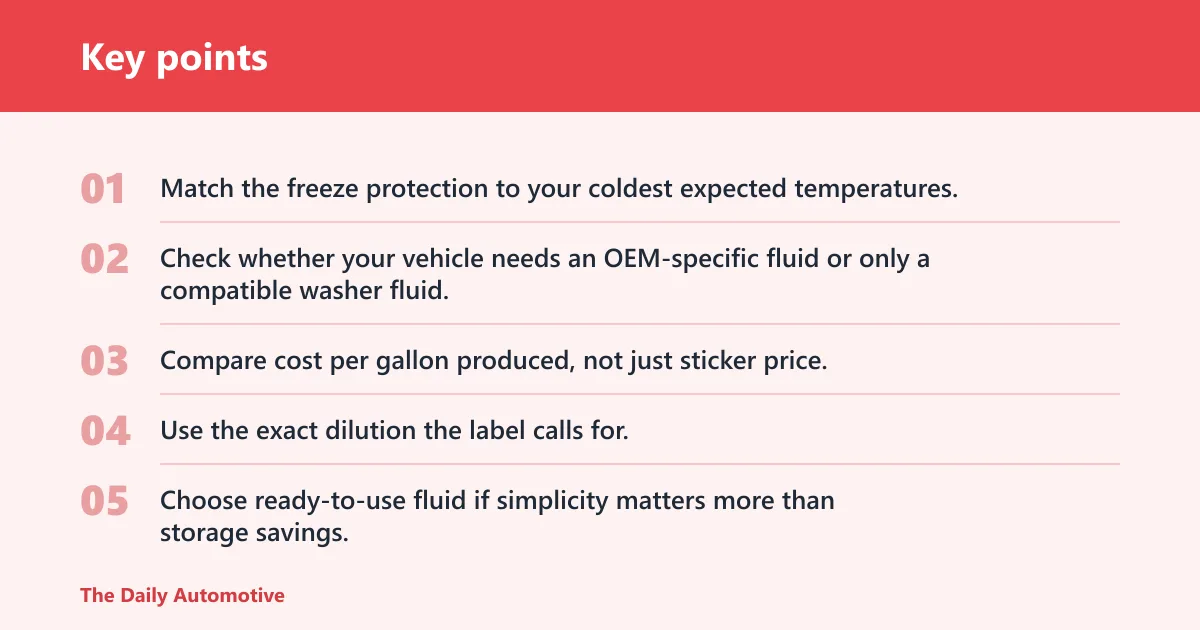
- Match the freeze protection to your coldest expected temperatures.
- Check whether your vehicle needs an OEM-specific fluid or only a compatible washer fluid.
- Compare cost per gallon produced, not just sticker price.
- Use the exact dilution the label calls for.
- Choose ready-to-use fluid if simplicity matters more than storage savings.
Alternatives
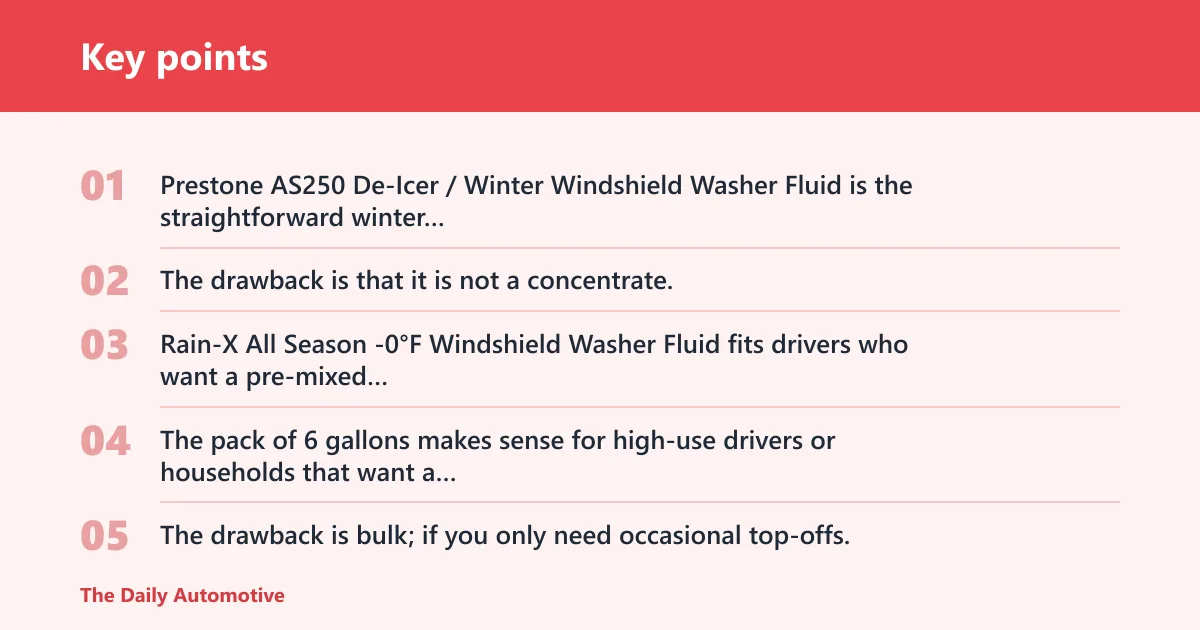

Prestone AS250 De-Icer / Winter Windshield Washer Fluid is the straightforward winter benchmark here. It is a ready-to-use winter formula. The drawback is that it is not a concentrate, so you give up the storage efficiency and adjustable mix ratio that some buyers want.

Rain-X All Season -0°F Windshield Washer Fluid fits drivers who want a pre-mixed all-season option with freeze protection already built in. The pack of 6 gallons makes sense for high-use drivers or households that want a stockpile. The drawback is bulk; if you only need occasional top-offs, buying six gallons at once can be more fluid than you want to store.

Super K Concentrate Windshield Washer Fluid is the value play for drivers who want a summer blend concentrate that makes a large batch from one bottle and helps remove mud and grime. Based on the listing, it is a routine top-off concentrate, not a winter de-icer. That means it is a poor substitute for cold-weather driving unless the label on your bottle specifies winter protection.
BMW’s Windshield Washer Fluid Concentrate & Booster – V600036 is another useful reference point for OEM shoppers. BMW lists it as a cleansing booster and says the 25 ml bottle can be added to a washer bottle up to about 5 liters; it is described as helping dissolve common oil-based contaminants such as bugs, tar, and grime. It is priced at $2.99. The drawback is scale: it is a tiny bottle, so you pay for OEM convenience more than bulk fluid volume.
Rain-X also appears in additive form, with a 16.9 oz washer fluid additive listing that leans on water-beading rather than OEM branding. That makes it attractive if you want visibility help in mixed weather. The drawback is that additive-style products can require more attention to correct mixing, especially when winter protection matters.
How the alternatives compare
For dealership shoppers, OEM-style concentration is mainly about confidence and fit, not a magical cleaning advantage. For cold-climate commuters, the better buy is usually the product that gives you the freeze protection you actually need at the lowest cost per usable gallon. Ready-to-use winter fluid wins on simplicity. Concentrate wins on storage and flexibility.
Winter washer fluid choice matrix
| Climate band | Reservoir size | Desired freeze protection | Mix ratio | Expected gallons produced | OEM concentrate justified? |
|---|---|---|---|---|---|
| Mild winter, above 20F | Any standard passenger-car reservoir | Light freeze protection, all-season use | Use the label mix or a ready-to-use fluid | Depends on bottle size | Usually no, unless you want OEM branding |
| Mixed winter, down to 0F | Standard reservoir or frequent top-off use | Protection around 0F | Measure exactly; do not over-dilute | Several gallons if the label says so | Maybe, if the vehicle brand matters to you |
| Cold winter, below 0F | Larger reservoir or daily commuter use | Protection around -20F to -34F | Use a winter formula or ready-to-use de-icer | Usually one to several gallons, depending on product | Only if the OEM bottle matches the rating and price makes sense |
| Deep winter and highway salt spray | Any size, with frequent refills | Sub-zero protection and reliable spray pattern | Choose a winter de-icer or a concentrate with a proven winter mix | Higher output matters more than bottle size | Usually no, because freeze rating matters more than the badge |
This matrix is the practical answer to the Mopar question. If you drive a Chrysler, Jeep, or Ram in a climate where OEM confidence matters, Mopar can be a sensible convenience buy. If you only care about winter performance, a cheaper fluid that matches your freeze target is usually the smarter pick.
Should you buy it?
Buy Mopar windshield washer concentrate if you want an OEM-branded solution, you value compatibility confidence, and you are willing to pay extra for that convenience. Skip it if you are shopping for the best winter performance per dollar, because BMW, Rain-X, and Prestone show how much value you can get from non-Mopar options.
For cold-weather driving, the best washer fluid is the one that matches your lowest expected temperature and your tolerance for measuring. If you want to keep things simple, pre-mixed winter fluid is the safest convenience buy. If you want storage efficiency and flexible use, a good concentrate can be the better long-term choice.
Frequently asked questions
Is Mopar windshield washer fluid concentrate worth buying?
Yes, if you want an OEM-branded washer fluid and are paying for dealer-level fit confidence rather than the lowest price. If your main goal is freeze protection and clean glass, a cheaper winter concentrate or ready-to-use de-icer usually gives you more value for the money.
How do you mix Mopar washer fluid concentrate correctly?
Follow the bottle label and the vehicle manual. Use the exact dilution ratio the product calls for, because too much water can reduce freeze protection and too much concentrate can waste product without improving winter performance. Measure carefully before you pour it into the reservoir.
Will washer fluid concentrate freeze in winter?
It can, if you over-dilute it or choose a formula that does not match your climate. Freeze protection depends on the final mix, not just the bottle on the shelf. For cold weather, pick a formula rated for your expected low temperature and keep the dilution accurate.
Is concentrate better than ready-to-use washer fluid?
Not always. Concentrate saves storage space and can be cheaper per gallon produced, but ready-to-use fluid is simpler because it needs no measuring. For winter driving, the better choice is the one that gives you the right freeze protection with the least chance of user error.
How much fluid does a small washer-fluid concentrate bottle make?
It varies by product. BMW’s 25 ml concentrate is described as enough to add to a washer bottle up to 5 liters, while other concentrates are marketed in far larger output terms, including 7 gallons, more than 13 gallons, 32 gallons, or 55 gallons per quart. Check the listing before buying.
Can I use a BMW or other OEM washer concentrate instead of Mopar?
Sometimes, if the product is compatible with your vehicle’s washer system and the label supports the climate and use case. BMW’s concentrate, for example, is a cleansing booster that helps dissolve bugs, tar, and grime, but it is not a Mopar part. The safer move is to verify the manual and the product label first.
What is the best washer fluid for cold weather driving?
The best choice is the fluid that matches your coldest expected temperature, whether that is 0F, -20F, -27F, or -34F. For many drivers, a ready-to-use winter de-icer is the least risky choice. Concentrates are best when you are confident in the mix ratio and want more storage flexibility.
Does washer fluid concentrate help with bugs and road grime?
Yes. That is one of its core jobs. BMW’s concentrate description says it helps dissolve oil contaminants such as bugs, tar, and grime, and washer fluid generally exists to remove bugs, dirt, and road film from the windshield. Winter formulas add freeze protection to that cleaning job.
Products related to this article
Sponsored / affiliate links. As an Amazon Associate I earn from qualifying purchases. I may earn additional commission from eligible campaigns.