What Is a Bagged Car? Air Suspension Meaning, Cost & Legality
A bagged car is a vehicle whose coil or leaf springs have been swapped for an adjustable air suspension system — rubber air springs that raise or lower ride height on command from a compressor and control unit. Get it wrong and you risk air-line leaks, a dead compressor, or a stance low enough to violate your state’s ground-clearance law. This guide covers how the system works, what a kit actually costs, the real drawbacks, and where it stands legally.
Quick Answer
A bagged car has air springs (rubber “air bags”) instead of coil or leaf springs, controlled by a compressor, air tank, and valves. Press a button and the springs inflate or deflate, raising or lowering the car. A basic kit runs about $2,000–$7,000 installed, and how low you can legally sit varies by state.
What Is a Bagged Car And How Does It Work
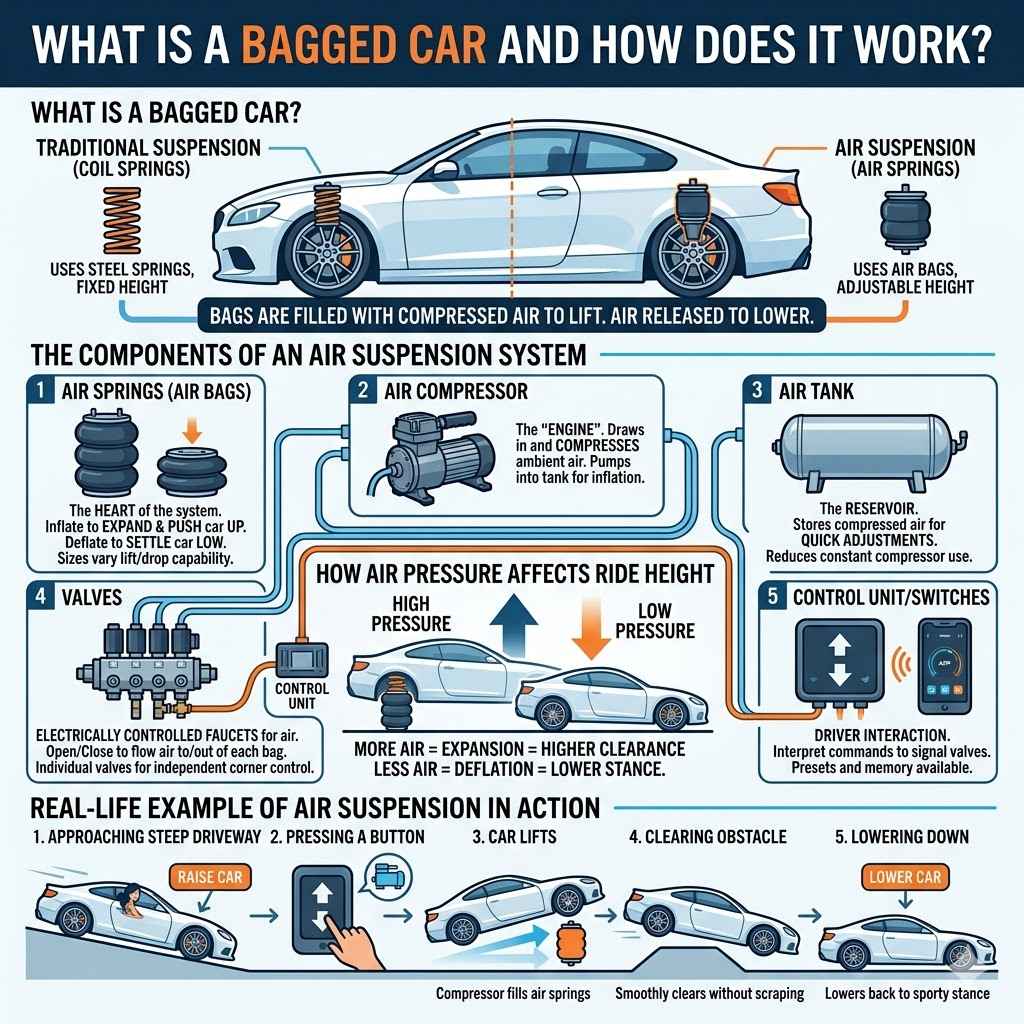
A bagged car is a vehicle that has been modified with an air suspension system. Instead of traditional coil springs or leaf springs, the car uses air springs — often called air bags — to support its weight and control its ride height. These air springs are durable rubber or polyurethane bellows filled with compressed air. When the pressure inside increases, the car lifts. When pressure is released, the car lowers — often low enough that a standard floor jack won’t fit underneath it.
This gives the driver the ability to adjust ride height on the fly, raising the car to clear obstacles or lowering it for a more aggressive look and, in some cases, better handling. The whole system is run by a compressor and a set of valves that allow for precise, repeatable adjustments — unlike a fixed stock or lowering-spring setup, which only sits at one height.
The Components of an Air Suspension System
Understanding the parts of an air suspension system is key to grasping what makes a bagged car unique. Each component plays a specific role.
Air Springs (Air Bags)
These are the heart of the system, typically heavy-duty rubber or polyurethane shaped like bellows or cylinders. When air is pumped in, they expand and push the chassis upward; when air is released, they deflate and let the car sit lower. Larger-diameter springs generally provide more lift.
Air Compressor
This is the “engine” of the system. It draws in ambient air, compresses it, and stores it in a tank, which then inflates the air springs. A compressor’s power and efficiency determine how quickly the suspension raises or lowers.
Air Tank
The tank stores compressed air so the system can make several adjustments without running the compressor constantly. A larger tank means more air on demand and fewer compressor cycles.
Solenoid Valves
These electrically controlled valves act like faucets for the air, opening and closing to move compressed air into or out of the air springs. A sophisticated system uses an individual valve per corner, enabling independent height control and automatic leveling.
Control Unit / Switches
This is how the driver interacts with the system — anything from simple up/down toggle switches to a digital controller with memory presets for different ride heights, sometimes paired with a smartphone app.
How Air Pressure Affects Ride Height
The relationship between air pressure and ride height is fundamental to how air suspension works. As the compressor pumps more air into the springs, they expand and push the car upward, increasing ground clearance. When the driver wants to lower the car, the control unit signals the valves to open and release air. As the springs deflate, the car settles lower.
This adjustability is the whole appeal of air suspension over a fixed lowering-spring setup: a driveway that would scrape a permanently slammed car is a non-issue when you can raise the suspension first, then lower it again once you’re back on level ground.
How Much Does an Air Suspension Kit Cost?
A complete air suspension kit typically runs $2,000 to $7,000 depending on the components and brand, with most popular kits landing around $3,500. Professional installation adds $500 to several thousand dollars more on top of parts, depending on labor rates and how much custom fabrication the vehicle needs.
📊 A complete air ride kit costs about $2,000–$7,000, and installation labor runs $500 or more on top of that. — Source: Bag Riders, Air Suspension Cost Guide
Individual components vary widely on their own: air tanks typically run $85–$300, compressors $200–$700 depending on a single or dual setup, manifolds $120–$850, and struts (front and rear together) $1,200–$3,200. A basic “all-in-one” kit with a manual switch will always cost less than a full digital management system with memory presets and automatic leveling.
Best Basic Air Suspension Kit Pick
Air Lift 1000 Universal Air Suspension Kit
A load-support air spring kit from Air Lift, one of the two brands named most often in this guide, built to bolt into an existing coil spring rather than replace the whole suspension.
- Best for: Entry-level riders who want adjustable support without a full bag-and-management build
- Why we picked it: Recognized brand named in this guide’s “Popular Kits and Brands” section, with a straightforward bolt-in install
- Main drawback: Adds load-leveling, not the extreme drop of a full bagged setup — pair it with real air springs for a true stanced look
Compare more air suspension components
 Option 1 Onboard Air Compressor Kit with Gauge
|
 Option 2 In-Cab Dual Gauge Digital Control Kit
|
 Option 3 Universal Double-Bellow Air Springs (Pair)
|
As an Amazon Associate we earn from qualifying purchases.
Bagged Car vs. Coilovers: What’s the Difference?
Both bagged air suspension and coilovers let you lower a car well below stock ride height, but they solve the problem differently. Coilovers use a threaded coil spring over an adjustable shock, so ride height is set with a wrench and stays fixed until you adjust it again. Air suspension replaces the spring entirely with an air-filled bellows, so ride height changes at the push of a button while you’re parked or between drives.
| Feature | Bagged (Air Suspension) | Coilovers | Best For |
|---|---|---|---|
| Ride height | Adjustable on demand, no tools | Fixed once set; needs a wrench to change | Bagged: daily drivers that need obstacle clearance |
| Typical total cost | $2,000–$7,000+ installed | $600–$2,500 installed | Coilovers: tighter budgets |
| Ride comfort | Cushioned, air absorbs bumps well | Firmer, more direct road feel | Bagged: comfort-focused builds |
| Maintenance | Compressor, tank, and lines to check for leaks | Simpler; mainly shocks and bushings | Coilovers: lower ongoing upkeep |
| Failure mode | Air leak can drop the car to the bump stops | Spring/shock wear is gradual, rarely sudden | Coilovers: fewer surprise failures |
Benefits Of Having A Bagged Car
People bag their cars for a variety of reasons, centered on the unique advantages this system offers. It’s not just about looks — it’s also about functionality and adaptability.
Enhanced Aesthetics and Style
One of the most visible benefits of a bagged car is its striking appearance. The ability to drastically lower a vehicle allows for an aggressive, “stanced” look that many enthusiasts admire.
Achieving the “Stance” Look
The term “stance” refers to how a car sits, particularly its relationship to the wheels and fenders. Bagging lets enthusiasts push that stance further than any fixed lowering spring can, dropping the fenders down close to — or resting on — the tire sidewalls for show, then raising the car back up to drive it home.
Customization and Personalization
Air suspension offers a level of adjustability that traditional suspension can’t match. Want a show-car look for an event? Lower it to the ground. Need to drive comfortably day to day? Raise it. This versatility makes each bagged car’s setup genuinely unique to its owner.
Improved Aerodynamics (Potentially)
Lowering a car can sometimes produce a small aerodynamic benefit, since a lower profile reduces the air flowing underneath the vehicle. The effect is more pronounced on race cars, but it can be a minor bonus on street vehicles too.
Improved Ride Comfort and Quality
Contrary to what some might expect, air suspension can actually improve ride comfort compared to stiff, lowered coil springs. The air springs act as a cushion, absorbing bumps and road imperfections more effectively.
Absorbing Road Imperfections
The compressible nature of air lets the suspension soak up bumps and rough surfaces better than a solid metal spring, softening what would otherwise be a jarring impact. This is especially noticeable on longer drives or roads that aren’t perfectly maintained.
Adjustable Ride Stiffness
With more advanced controllers, drivers can adjust not just height but also stiffness by changing air pressure — softer for cruising, firmer for spirited driving, all from the same system.
Practicality and Functionality
Beyond looks and comfort, air suspension offers genuine practical benefits that make owning a modified car easier day to day.
Clearing Obstacles and Steep Driveways
This is the most significant practical advantage. Many custom cars are lowered so much they can’t safely clear speed bumps, steep driveways, or rough terrain. With air suspension, the driver simply raises the vehicle for the necessary clearance, avoiding costly undercarriage damage.
Easier Entry and Exit
For extremely lowered vehicles, getting in and out can be a real challenge. Raising the car makes entry and exit more accessible, especially for passengers, adding a layer of everyday usability that a fixed slammed setup doesn’t have.
Loading and Unloading Cargo
Air suspension can also be used to lower the rear of a vehicle to make loading heavy items easier — useful for vehicles that regularly haul cargo or tow a trailer.
“Bagging a car simply means adding air suspension to it. This term comes from using ‘air bags’ or air springs instead of traditional coil springs or coil overs.”
Downsides of a Bagged Car (What to Consider First)
Air suspension isn’t free of trade-offs, and a fair look at bagged cars has to cover them alongside the benefits.
Higher Cost Than Springs or Coilovers
A bagged setup almost always costs more up front than a coilover kit for the same car — you’re paying for a compressor, tank, valves, wiring, and a controller on top of the air springs themselves, not just a spring and shock.
More Points of Failure
Every fitting, air line, and valve is a potential leak point. A slow leak can let a corner of the car sag overnight; a bigger failure can drop the car onto its bump stops. None of this is common with a properly installed, well-maintained system, but it’s a real risk a coil spring simply doesn’t have.
Added Weight and Complexity
The compressor, tank, and extra plumbing add weight the car didn’t carry before, and a more complex system generally means more that can eventually need attention compared to a simple spring-and-shock setup.
Cold-Weather Considerations
Moisture that collects in the air tank can freeze in cold climates if the tank isn’t drained regularly, which is why routine tank draining is a standard part of air suspension maintenance in colder regions.
Is a Bagged Car Legal? Ground Clearance & State Laws
Whether a bagged car is street-legal depends on where you live, and the rules vary more than most builders expect. Many states tie legal ride height to the height of the wheel rim — no part of the body or frame may sit lower than the bottom of the wheel — while others set a fixed maximum number of inches a vehicle can be lowered from stock. Almost every state also restricts adjusting ride height while the car is moving, aside from factory load-leveling systems.
Because these equipment rules are set at the state level and do change over time, the only reliable way to confirm your setup is legal is to check your own state DMV or motor vehicle code before finalizing a build — what’s fine in one state can be a fix-it ticket, or worse, in another. This is also why most air suspension setups are built to raise back up to a normal, obstacle-clearing height for everyday driving and only drop to the extreme “stanced” height when the car is parked or at a show.
How To Install An Air Suspension System On A Car
Installing an air suspension system is a significant undertaking that requires specific tools and knowledge. It involves removing the vehicle’s existing suspension components and integrating new electrical and pneumatic systems — this isn’t a job most owners tackle without prior mechanical experience.
Step-by-Step Installation Process
The process generally involves several key stages, from preparation to final testing. Follow the specific kit’s manufacturer instructions precisely, since mounting points and wiring diagrams vary by vehicle.
- Preparation and planning: Gather every component — air springs, compressor, tank, valves, control unit, wiring, and plumbing — and plan where each will mount, considering access for future maintenance. Disconnect the battery before any electrical work.
- Remove stock suspension components: Unbolt and carefully lower the original springs, shocks, and sometimes control arms. Some kits require minor chassis or mount modifications.
- Mount the air springs and shocks: Install the new air springs and, if included, matched performance shocks, making sure alignment between the chassis mount and the wheel-side mount is correct before tightening.
- Install the compressor, tank, and valves: Mount the compressor, air tank, and solenoid valves in an accessible spot — commonly the trunk or under the vehicle — and secure the tank firmly to prevent vibration damage.
- Run air lines and electrical wiring: Route air lines from the valves to each air spring, and wire the control unit, valves, compressor, and power source, keeping every line away from moving parts and road debris.
- Connect the control unit and test: Mount and wire the control unit inside the cabin, then power up the compressor, check every fitting for leaks with soapy water, and cycle the suspension through its full range before calling the install done.
Tools and Equipment Needed
A successful installation relies on having the right tools on hand — this isn’t a job for the average car owner without specialized equipment.
General Mechanic’s Tools
A comprehensive set of wrenches, sockets, screwdrivers, pliers, and a torque wrench. A good jack and sturdy jack stands are essential for safely lifting and supporting the vehicle.
Specialized Tools
A pipe cutter for air lines, a crimper for electrical connectors, and possibly a drill and grinder for mounting components. A multimeter is essential for electrical diagnostics.
Leak Detection Tools
A spray bottle with soapy water is the standard way to spot air leaks at fittings — bubbles form wherever air is escaping. Some professional shops use electronic leak detectors for harder-to-reach connections.
Air Spring and Solenoid Valve Design
Two components are worth understanding in more depth once you get past the basic parts list.
Air spring styles come in three main designs: double-bellows (two stacked convolutions, more travel), single or double convoluted (a similar bellows shape, common on aftermarket kits), and sleeve-style (a simple cylindrical bag, often used where space is tight). Each trades off differently between lift range, load capacity, and how much room it needs to package.
Solenoid valves are electromechanical valves: an electric current passed through a coil creates a magnetic field that pulls a plunger, which opens or closes the air path. Most kits use one valve per air spring (or per pair), which is what makes independent height control and automatic leveling possible.
Popular Air Suspension Kits and Brands
The aftermarket for air suspension is diverse, offering various solutions for different makes and models. Choosing the right kit depends on budget, desired features, and vehicle type.
Leading Brands in Air Suspension
Several reputable brands are known for their quality and innovation in the air suspension market, and often provide comprehensive kits designed for specific vehicles.
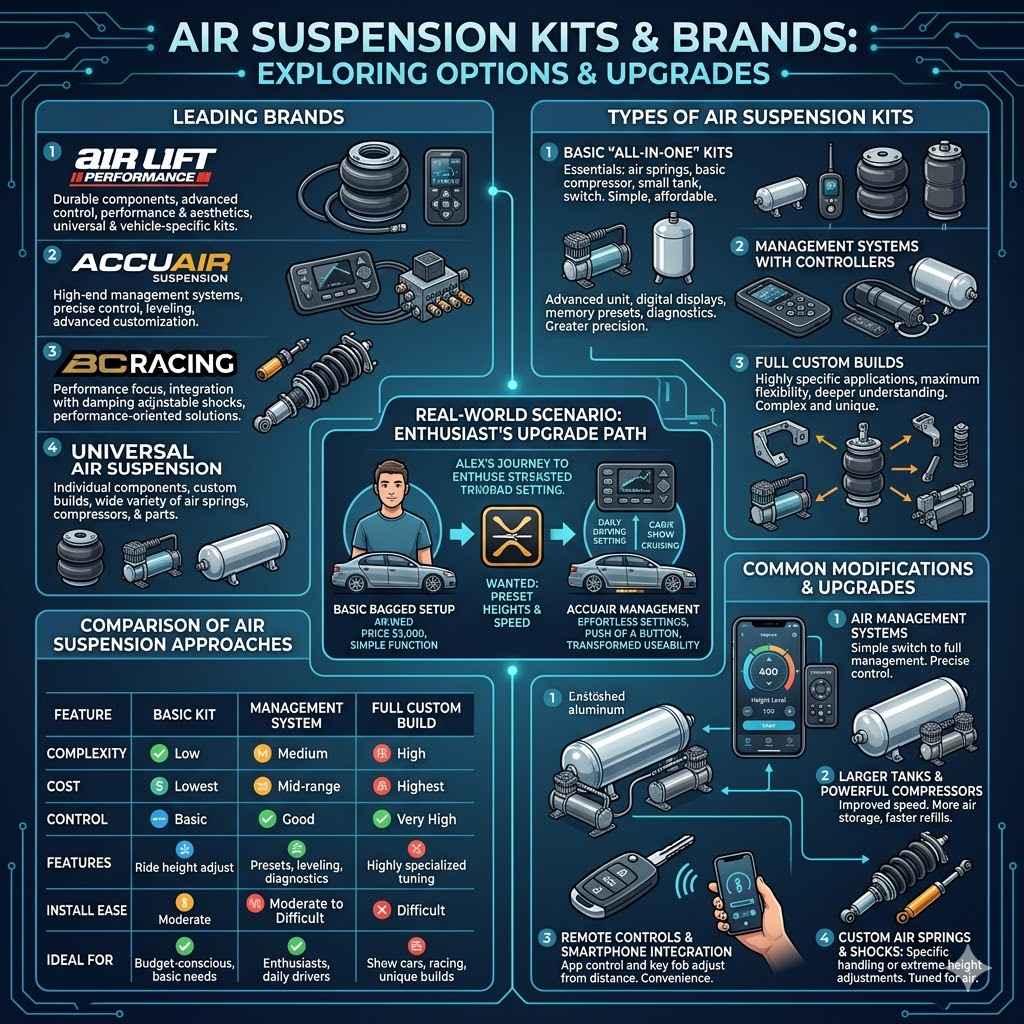
Air Lift Performance
One of the most well-known brands, offering a wide range of kits for many popular vehicles. Known for durable components, advanced control systems, and a focus on both performance and aesthetics, with both universal and vehicle-specific kits.
AccuAir Suspension
Recognized for high-end, sophisticated air management systems. AccuAir’s e-Level controllers offer precise control over ride height, leveling, and suspension tuning, with programmable presets that let a driver switch between a daily-driving height and a lowered show setting at the push of a button — often favored by builders chasing the ultimate in customization.
BC Racing
Primarily known for coilovers, BC Racing also offers air suspension components that can be integrated with their damping-adjustable shocks for a hybrid setup.
Universal Air Suspension
Offers a wide range of individual components — springs, shocks, compressors, and management systems — for custom builds or replacement parts, catering to those who want to build a unique system from the ground up.
Types of Air Suspension Kits
Air suspension kits can be broadly categorized based on complexity and features.
Basic “All-In-One” Kits
These include the essentials: air springs, a compressor, a small tank, and a basic control switch. Usually the most affordable option, providing straightforward adjustable ride height without advanced features.
Management Systems with Controllers
These go a step further with a more advanced control unit — digital displays, memory presets for different ride heights, and sometimes onboard diagnostics — for greater precision and convenience.
Full Custom Builds
For highly specific applications, a custom air suspension system can be designed and assembled from individual components across manufacturers, maximizing flexibility in tuning and aesthetics but requiring a deeper understanding of the system.
Comparison of Air Suspension Systems
Here’s a simplified comparison of different approaches to air suspension:
| Feature | Basic Kit | Management System | Full Custom Build |
|---|---|---|---|
| Complexity | Low | Medium | High |
| Cost | Lowest | Mid-range | Highest |
| Control Precision | Basic | Good | Very High |
| Features | Ride height adjust | Presets, leveling, diagnostics | Highly specialized tuning |
| Installation Ease | Moderate | Moderate to Difficult | Difficult |
| Ideal For | Budget-conscious, basic needs | Enthusiasts, daily drivers | Show cars, racing, unique builds |
Common Modifications and Upgrades
Once a basic air suspension system is installed, many owners look to upgrade or modify it further. These upgrades can improve performance, aesthetics, or functionality.
Air Management Systems
Upgrading from a simple switch to a full air management system with digital controllers and multiple presets is one of the most common upgrades, allowing easier and more precise control over the vehicle’s stance.
Larger Air Tanks and More Powerful Compressors
These upgrades improve how quickly the suspension raises or lowers. A larger tank holds more air, reducing compressor cycles, while a more powerful compressor refills the tank faster.
Remote Controls and Smartphone Integration
Modern systems increasingly allow remote adjustment via a key fob or smartphone app, offering convenience and the ability to change the car’s height from a distance.
Custom Air Spring and Shock Combinations
For specific handling characteristics or more extreme ride-height adjustments, enthusiasts may opt for different air spring types or performance shocks tuned specifically for their air suspension setup, since shocks and struts still have to work correctly with the air spring for predictable handling.
Frequently Asked Questions
What is a bagged car?
A bagged car is a vehicle that has been modified with an air suspension system instead of traditional springs, allowing its ride height to be adjusted using compressed air.
Why would someone want a bagged car?
People bag their cars for improved aesthetics, achieving a low “stanced” look, enhanced ride comfort, and the practical ability to raise the car to clear obstacles like speed bumps or steep driveways.
Is air suspension reliable?
Modern air suspension systems are generally reliable when properly installed and maintained. Like any mechanical system they can develop issues such as leaks or component failures over time, which is why regular checks of the air lines, fittings, and tank are part of routine upkeep.
Can any car be bagged?
While most cars can technically be fitted with an air suspension system, the complexity and cost vary significantly depending on the vehicle’s make, model, and existing suspension design.
How long does it take to install an air suspension system?
Installation time can range from a full weekend for a basic kit done by an experienced DIYer to several days or more for complex management systems or professional installations.
How much does it cost to bag a car?
A complete air suspension kit typically costs $2,000 to $7,000, with most popular kits landing around $3,500. Professional installation adds roughly $500 or more on top, depending on labor rates and how much custom work the vehicle needs.
Is a bagged car legal?
It depends on your state. Many states require that no part of the body or frame sit lower than the bottom of the wheel rim, and most restrict adjusting ride height while the car is in motion. Check your state DMV or motor vehicle equipment code before finalizing a build.
Conclusion
A bagged car is a vehicle with adjustable air springs that let you change its ride height instead of locking it to one fixed position like a coil spring or coilover would. That flexibility brings a distinctive stance, a smoother ride, and the practical ability to clear obstacles — but it also comes with a real cost ($2,000–$7,000 installed), more points of potential failure, and legality that depends on your state. With the right components, a realistic budget, and proper installation, a bagged car can be both a striking build and a genuinely usable daily driver.
Products related to this article
Sponsored / affiliate links. As an Amazon Associate I earn from qualifying purchases. I may earn additional commission from eligible campaigns.