What Is Down Force On A Car: Essential Physics
Down force on a car is a critical aerodynamic force that pushes a vehicle down onto the road surface as it moves faster. This downward push increases tire grip, improving handling, stability, and cornering ability, especially vital for performance driving and safety at high speeds.
Have you ever heard race car drivers or car enthusiasts talk about a vehicle needing “more grip” or “better traction” when speeding around a curve? Often, they are talking about down force. This concept sounds super technical, like something only NASA engineers need to worry about, but it directly relates to how safe and stable your car feels on the highway. Poor handling during fast maneuvers can be unnerving, making you wonder if your car just doesn’t like turns. Don’t worry! We are going to demystify what down force is, why it matters for your everyday drive, and how your car creates this important invisible push. By the end of this guide, you will understand the basic physics easily and feel much more confident about your vehicle’s abilities.
We will start with the simplest definition and then explore the physics behind keeping your tires firmly planted on the asphalt.
Understanding Aerodynamics: More Than Just Wind Resistance
When most people think about air moving around a car, they usually think about drag—that force that slows you down, like sticking your hand out of a moving car window. Aerodynamics is simply the study of how air moves around moving objects. While drag resists motion, engineers focus on another, more helpful force: down force.
At slow speeds (like city driving), the physics of your tires on the road is usually enough. But as speed increases, the air pushing on the car matters more and more. Down force is the trick engineers use to harness the air to help the tires grip better.
The Core Concept: Down Force vs. Lift
To truly understand down force, we must first understand its opposite: lift. This is the same principle that allows airplanes to fly!
When an airplane wing moves through the air, its curved shape makes the air travel faster over the top surface than under the bottom surface. According to Bernoulli’s principle (which we will touch on later), faster-moving air has lower pressure. This low pressure above the wing creates a vacuum-like effect, pulling the wing upward. This is lift.
On a standard road car that isn’t designed for racing, the shape of the body, especially the smooth roofline, often unintentionally creates lift as speed increases. This lift literally lightens the car’s weight on the tires. Less weight means less friction, which means less grip. If you are driving fast and cornering, less grip means you slide!
Down force is the intentional creation of a force that pushes the car down into the road, counteracting that unwanted lift and adding extra pressure to the tires.

What Is Down Force On A Car: The Essential Physics Explained Simply
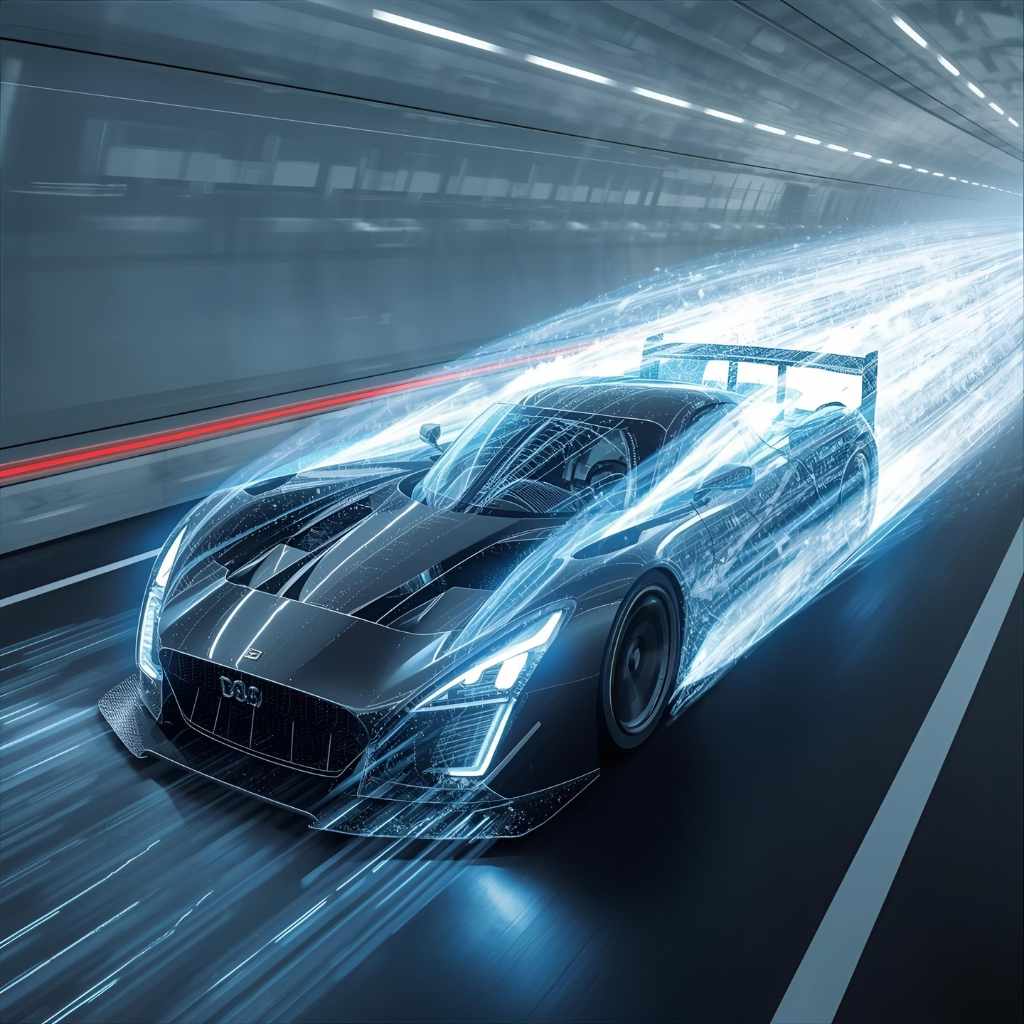
For those who need a little more detail without diving into calculus, down force works by manipulating airflow to create a high-pressure zone above the car and a low-pressure zone underneath the car. This pressure difference results in a net force pushing the car downward.
Bernoulli’s Principle: The Core Driver of Down Force
This principle is key to understanding almost all modern aerodynamics, whether it is lift on an airplane or down force on a race car. Daniel Bernoulli, an 18th-century mathematician, discovered that:
- When the speed of a fluid (like air) increases, its internal pressure decreases.
- When the speed of a fluid decreases, its internal pressure increases.
How does this apply to our car? It depends on the shape!
1. Creating Lift (Unwanted):
A typical car roof is somewhat curved to direct air smoothly over the top. This curve generally speeds up the air moving over the roof relative to the air moving underneath the flatter belly of the car. Faster air over the top = lower pressure up top. Lower pressure up top + standard pressure below = Lift!
2. Creating Down Force (Desired):
A highly specialized racing car or supercar uses wings and diffusers shaped like inverted airplane wings. These devices are engineered so that air travels much faster under the wing than over it. Faster air underneath = lower pressure underneath. This low pressure sucks the car toward the ground, creating down force.
Newton’s Third Law: Action and Reaction
While Bernoulli explains the pressure difference, Newton’s Third Law of Motion provides another important piece of the puzzle, especially concerning spoilers and wings.
Newton’s Third Law states that for every action, there is an equal and opposite reaction. When a spoiler or wing deflects air upward (the action), the air pushes back down on the spoiler with an equal and opposite force (the reaction). This reaction force is what we feel as down force pushing the rear of the car down.
For beginners, the easiest way to think about it is: If you angle a flat board in the wind, the wind pushes it one way, and the board pushes the wind the other way. If you angle it just right, the push you feel is toward the ground.
How Cars Generate Down Force: Key Components
You don’t need a massive rear wing to have some degree of down force management on your street car, though performance vehicles certainly leverage specialized parts.
Here are the primary tools used by automotive engineers to manage air and keep the car planted:
- Front Splitters and Canards: These are geometric pieces at the very front of the car. Splitters stick out below the bumper, forcing air traveling underneath the car to slow down and increase pressure, or forcing air up and over the car, adding stability to the front axle.
- Rear Wings (Spoilers): These are the most visible parts. They work exactly like inverted airplane wings, redirecting air upward to push the rear of the car down.
- Underbody Diffusers: This is perhaps the most effective, yet least visible, component. A diffuser is a ramped structure at the rear underside of the car. It smoothly manages the incredibly fast, low-pressure air that has traveled beneath the car and gradually slows it down before it rejoins the slower air behind the vehicle. This smooth expansion prevents turbulent drag and maximizes the low-pressure suction underneath the car.
For more on the physics and engineering behind vehicle stability, you can explore resources from recognized engineering institutions, such as introductory materials on fluid dynamics often covered in university physics programs, like those found on educational sites discussing the fundamentals of aerodynamics in transportation.
Comparing Drag and Down Force
Every component that creates down force almost always increases drag. This is the main trade-off automotive engineers must manage. More down force means better cornering, but it also means the engine has to work harder to overcome air resistance on long straightaways.
| Aerodynamic Force | Effect on Car | Goal | Analogy |
|---|---|---|---|
| Down Force | Pushes car down; increases tire grip | Cornering capability and high-speed stability | A suction cup sticking to the road |
| Lift | Pulls car up; decreases tire grip | Avoided at all costs in performance driving | An upside-down airplane wing |
| Drag | Pushes car backward; slows acceleration | Minimized for top speed and fuel economy | Pushing your hand against the wind |
Understanding this trade-off shows why a vehicle might have massive wings for a racetrack (where cornering speed matters most) but might have a smoother, trunk-integrated spoiler for a street car (where fuel economy and quiet cruising are more important).
Why Down Force Matters To You (The Everyday Driver)
While you might not be hitting 200 mph on your daily commute, down force principles still play a role in your vehicle’s safety and performance, especially if you have a modern crossover or sedan equipped with subtle aerodynamic aids.
1. Stability at Highway Speeds
Even standard vehicles can experience aerodynamic lift above 60 mph (about 100 km/h). If your car begins to lift slightly, the steering might feel lighter or less predictable when changing lanes quickly. Good design ensures that even without massive wings, the car remains neutral or produces a tiny amount of stabilizing down force.
2. Cornering Confidence
When you take a highway off-ramp, the faster you go, the more side grip your tires need to keep you pointing where you want to go. Down force chemically increases the effective weight on your tires. More effective weight equals more friction, which directly translates to a safer, more confident turn.
3. Braking Performance
This might surprise you, but down force also aids stopping! Increased downward pressure means slightly higher friction between the tires and the road, allowing the brakes to work more effectively before the tires lock up (assuming you have modern ABS working properly).
4. Appearance and Handling Balance
Performance cars are designed to be aerodynamically balanced. If the front wheels have too much grip and the rear wheels have too little (too much lift in the back), the car tends to oversteer (the rear slides out). Conversely, too much front down force without enough rear down force causes understeer (the front plows straight ahead). Engineers aim for a neutral balance, allowing the driver predictable control.
The Practical Application: Street Cars vs. Race Cars
It is important to differentiate between what you see on a Formula 1 car and what’s on your Honda Accord. Down force generation scales dramatically with speed squared, meaning it doubles or triples its effectiveness very quickly as speed increases.
For example, a race car wing designed to produce 500 lbs of down force at 120 mph might only produce 100 lbs at 70 mph. Therefore, the requirements for street cars are much milder.
Here is a quick rundown of typical aerodynamic needs:
| Vehicle Type | Primary Aerodynamic Goal | Typical Down Force/Lift Profile (at speed) | Key Components Employed |
|---|---|---|---|
| Economy Sedan | Minimize Drag and unwanted Lift | Slightly positive lift to near zero | Smooth underbody panels, slight roof slope |
| High-Performance Street Car | Stability and limited Down Force integration | Slight net Down Force or neutral | Integrated rear spoilers, front lip spoilers |
| Race Car (Track Use) | Maximum Down Force for Cornering Speed | Significant Net Down Force | Large wings, aggressive diffusers, flat floors |
How to Improve Your Car’s Aerodynamic Feel (Safe & Simple Steps)
As a regular driver, you generally cannot bolt on a massive race wing without creating dangerous handling characteristics at low speeds. However, there are a few simple checks and considerations you can make to ensure your car is performing as the factory intended.
1. Ensure Vehicle Ride Height is Correct
The gap between your car’s underbelly and the road is crucial for managing air pressure. If your suspension components (like springs or struts) are worn out, the car sags. Too low, and the underbody turbulence increases, causing drag and unpredictable lift. If it’s too high (perhaps from loading too much weight), the air underneath speeds up too much, causing lift.
- Action: If your car feels bouncy or sits obviously lower than it used to, have your suspension professionally inspected.
2. Check Factory Aerodynamic Components
Many modern cars have small plastic pieces along the bottom edge of the front bumper called “air dams” or “spats.” These direct air around the tires smoothly and stop it from getting trapped under the car, which helps reduce lift.
- Action: Glance under the front and rear bumpers. If you see large, broken, or missing plastic trim pieces, replace them. They are cheap and essential for factory stability.
3. Tire Pressure Matters Immensely
While not strictly aerodynamics, tire pressure directly impacts how the tire interacts with the air flowing over it and the road beneath it. Incorrect pressure changes the shape of the tire’s contact patch, which can mimic the effects of poor stability.
- Action: Check your tire pressure once a month using a reliable gauge. Ensure you match the pressures listed on the sticker inside your driver’s side doorjamb—not the maximum pressure listed on the tire sidewall.
4. Limit Unnecessary Roof Load
If you frequently use heavy roof racks or massive cargo boxes, you are disrupting the smooth airflow over your roof. This increases drag and almost always introduces aerodynamic instability (lift) higher up on the vehicle.
- Action: Remove roof racks when not in use to maintain factory aerodynamic efficiency and improve gas mileage.
Common Beginner Misconceptions About Down Force
It is easy to confuse mechanical grip with aerodynamic grip. Let’s clear up a few myths:
- Myth: Down force is only for fast cars. While its significant effects are visible at high speeds (over 80 mph), all cars manage airflow, and good design minimizes lift even at 65 mph.
- Myth: Bigger wings mean better handling. Not true! A wing sized for a race car on a street car will overwhelmingly increase drag, potentially creating more instability at low speeds because the front end is relatively lighter than the heavily pressed rear. This is called an unbalanced track.
- Myth: Down force is the same as weight. Down force is an external force generated by air moving over the car’s surfaces. Weight is the internal force of gravity pulling the car down. Down force adds to the effective weight on the tires, but they are different forces.

Frequently Asked Questions (FAQ) About Car Down Force
Here are quick answers to keep your newfound knowledge fresh and applicable:
Q1: Does my standard family sedan have any down force?
A: Most modern sedans are designed to be aerodynamically neutral or have very slight down force at highway speeds to counteract lift. They prioritize low drag over high down force.
Q2: How speed affects down force?
A: Down force increases exponentially with speed, meaning if you double your speed, the down force doesn’t just double—it usually increases by a factor of four (since drag and down force are often related to the square of velocity).
Q3: Can I feel down force when driving?
A: On a street car, you might feel it as increased confidence or a “planted” feeling when cornering quickly. On a dedicated track car, the feeling is much more obvious; the steering feels heavy and “locked in” at high speeds.
Q4: What is the difference between a spoiler and a wing?
A: A spoiler (like the small lip on your trunk) is designed primarily to spoil or disrupt airflow from going over the back smoothly, pushing the air down slightly. A wing is raised off the body and shaped like an inverted airfoil to create significant, measurable down force using pressure differences.
Q5: Does changing my wheels affect down force?
A: Yes, indirectly! Wheels create turbulence as they spin. Aerodynamically optimized wheels are designed to reduce this turbulence in the wheel wells, which can lead to a slight reduction in drag and better management of the air flowing under the car.
Q6: Is adding aftermarket splitters safe for normal driving?
A: Be cautious. If you add a cheap front splitter that severely overbalances the car’s aerodynamics (too much front grip compared to the rear), it can make your car prone to understeer at speed, which is unsafe for normal highway speeds. Always research parts meant for street use.
Conclusion: Steering with Confidence
We have walked through the essential physics of down force, moving from the concept of unwanted lift to engineering solutions like diffusers and wings. Remember, down force is simply the targeted use of moving air to press your tires more firmly onto the road. This added pressure is a key ingredient for safety, stability, and crisp handling, whether you are navigating a tight curve on a back road or making a sudden lane change on a busy expressway.
As the driver, your role is to respect the physics at play. Keep your suspension healthy, maintain correct tire pressures, and avoid adding unauthorized aerodynamic pieces that could throw off your car’s carefully balanced design. By understanding what is happening above and below your car, you gain confidence—the best tool any driver can have. You now know that when engineers talk about down force, they are talking about keeping your ride safe, predictable, and glued to the pavement.