Best Car Engine Hoists for Home Garages (2026): We Compared
For most home garages, a 2-ton folding engine hoist is a practical starting point because it fits tighter spaces, stores easier, and still covers most passenger-car and light-truck engine jobs when you keep the boom in its shortest positions. Under-capacity or poor reach can bend the setup, scrape the floor, or leave a drivetrain hanging mid-lift.
This guide compares folding and fixed-frame engine hoists for rated capacity, boom reach, storage footprint, caster design, and garage-fit practicality.
Quick comparison
| Product | Badge | Best for | Price | ||
|---|---|---|---|---|---|
 |
SJXHRFXY 2 Ton Folding Engine Hoist, Heavy Duty HydraulicSJXHRFXY | Our pick | 2 Ton · Folding · Heavy Duty | $119.99
Price as of 18 Oct 2026
|
View |
 |
AFF 3 Ton Cherry Picker Engine Hoist – Hydraulic EngineAFF | Upgrade pick | 3 Ton · Heavy Duty · Hydraulic | $1,459.69
Price as of 18 Oct 2026
|
View |
The main trade-off is clear. A folding 2-ton hoist is easier to store and move in a cramped garage, while a 3-ton fixed-duty crane brings more stiffness and headroom for heavier assemblies. The right pick depends on ceiling height, floor condition, and whether you are pulling an engine alone or with the transmission attached.
How we chose
We compared 2 heavy-duty engine hoists, then narrowed the field around the problems home-garage buyers face most often.
- Rated capacity and boom-position limits. Most consumer hoists sit in the 2-ton class, but usable capacity drops as the boom extends.
- Storage footprint. Folding frames matter when the hoist has to live against a wall or between jobs.
- Caster design and frame stiffness. Wheel size, pin fit, and welded construction affect movement on concrete and rougher garage floors.
- Hydraulic control. Smooth lifting matters more than raw lift speed, especially when aligning an engine and transmission.
- Garage-fit practicality. Ceiling clearance, swing room, and floor quality decide whether a hoist is safe to use at all.
Garage fit checklist
Use this before you buy. If the answer is fail in one of these rows, that hoist size or style is probably wrong for your garage.
| Garage fit factor | Pass | Fail | Recommendation |
|---|---|---|---|
| Ceiling height | You have enough room for the boom, chain, and engine to rise without hitting the door tracks or rafters | Hook or boom will contact the ceiling before the load clears the car | Pass: 2-ton folding hoist is workable. Fail: choose a different lift plan or a lower-profile setup. |
| Garage depth | You can roll the crane in, swing the load, and still keep the rear legs clear of the door and toolboxes | The boom cannot reach the engine bay without blocking the aisle or pinning the wheels | Pass: 2-ton folding hoist fits well. Fail: fixed-frame may be too awkward unless you have more depth. |
| Floor condition | Concrete is flat enough that caster wheels roll without binding | Cracks, lips, slopes, or rough patches make the crane rock or stick | Pass: any stable hoist with larger casters is acceptable. Fail: avoid budget wheels and reconsider the lift surface. |
| Vehicle type | Small 4-cylinder, V6, or small-block V8 work; complete assembly stays within the hoist’s safe range | Big-block V8 or diesel assembly, especially with accessories or transmission attached, pushes past the practical margin | Pass: 2-ton class is usually enough. Fail: step up to 3-ton or reduce the assembly weight. |
| Folding storage need | You need to tuck the hoist away after the job | You have permanent floor space and plan repeated use | Pass: folding hoist is the better fit. Fail: fixed-frame is acceptable and usually stiffer. |
Which engine hoist is best for occasional DIY use?
For occasional DIY work, the better choice is usually the folding 2-ton hoist with six wheels and a lower price point. It stores more easily, rolls into a tight bay with less fuss, and handles typical passenger-car engine pulls when the boom stays short and the load stays modest.
The drawback is the same one common to budget folding cranes: more pinned joints, more chance of play at the boom, and wheels that may not like cracked or rough concrete. That trade-off is acceptable if the hoist comes out a few times a year, not every week.
What size engine hoist do I need for a V8?
For many V8 jobs, a 2-ton engine hoist is enough, but the answer changes fast once you add the transmission, converter, manifolds, accessory brackets, or a leveler. Small-block V8s usually fit the 2-ton class more comfortably than big-block V8s, and the shortest boom position matters most because it delivers the highest capacity.
Small-block V8s versus big-block V8s
A small-block V8 with the intake, heads, and accessories removed is a different lift from a dressed big-block. The first often stays within the practical range of a 2-ton crane; the second can push you toward a 3-ton hoist or a cleaner teardown before lifting.
Suppose you are pulling a small-block V8 from a rear-wheel-drive car with the transmission left in place. The hoist still needs enough reserve capacity for the angle change and hook hardware, so a 2-ton setup works best only if the boom remains in its shortest or next-shortest position.
Where transmission weight changes the answer
A transmission adds more than annoyance. It changes balance, length, and the amount of moment the boom sees. That is why a “V8 only” answer can be misleading when the real job is an engine-plus-transmission pull.
In that case, a 3-ton crane is often the safer choice if garage space and budget allow it. If you stay with a 2-ton hoist, keep the extension short and use a leveler to control pitch.
Why the boom’s shortest position matters most
Most 2-ton hoists are not flat 2-ton machines across the full boom range. Capacity falls as reach increases. One common guide lists about 4,000 lb at the shortest position and about 1,000 lb at the longest, which is why the hook position matters as much as the headline rating.
The four boom settings commonly listed are 0.5 ton, 1 ton, 1.5 ton, and 2 ton. Use the shortest position that gives you the reach you need, because reach is what you pay for with lost capacity.
Should you buy a folding or fixed-frame engine hoist?
Buy folding if your garage doubles as storage space. Buy fixed-frame if the hoist will live in place, see frequent use, and you value stiffness over convenience. Folding models fit home garages better; fixed-frame cranes suit repeated shop work better.
Folding hoists for wall storage and occasional use
A folding engine hoist collapses for easier storage against a wall or in a corner. That is the clear advantage for home-garage users who only need the crane a few times a season.
The compromise is more pinned joints and more places for slop to show up. Over time, that can matter when the load is hanging off-center or when the floor is not perfectly flat.
Fixed-frame hoists for stiffness and frequent lifting
A fixed-frame hoist is usually heavier and stiffer. That makes it a better fit for frequent use, repeated engine pulls, and heavier assemblies where a firmer structure is worth the extra footprint.
The downside is obvious: it takes more permanent floor space. In a one-car garage, that can matter more than the extra rigidity.
What is the safest way to use a cherry picker in a home garage?
The safest approach is to inspect the hoist before the first lift, keep the boom as short as possible, work on level ground, and never assume the headline rating applies at full extension. Most lift problems come from worn pins, weak casters, hydraulic drift, or a floor that is too rough for stable rolling.
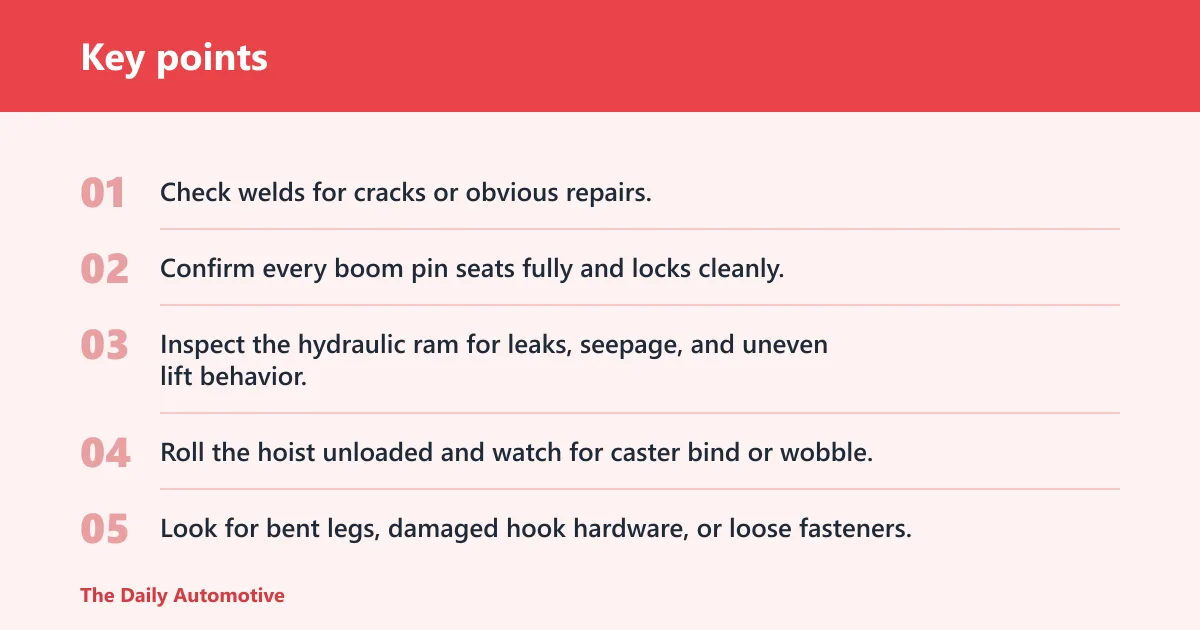
Inspect pins, welds, hydraulics, and casters before first lift
- Check welds for cracks or obvious repairs.
- Confirm every boom pin seats fully and locks cleanly.
- Inspect the hydraulic ram for leaks, seepage, and uneven lift behavior.
- Roll the hoist unloaded and watch for caster bind or wobble.
- Look for bent legs, damaged hook hardware, or loose fasteners.
A common first-timer mistake is to trust a hoist that rolls fine on a smooth showroom floor but binds on garage concrete. If the wheels stop or hop under light push, that same behavior can show up when the engine is halfway out of the bay.
Use boom extension carefully as capacity drops
Capacity loss with extension is not a footnote. It is the main safety limit. The farther the boom extends, the more leverage the load places on the crane, and the less weight you should trust it to handle.
That is why a 2-ton hoist is best treated as a short-reach tool for most DIY work. If the hook has to live near the longest position to clear your bumper or radiator support, the real working capacity is much lower than the headline number.
Stabilize the load on imperfect floors
Floor condition changes everything. Small cracks, slope, or rough patching can make a hoist wander or lean, especially when the engine is still partly inside the car.
Larger caster wheels usually move more easily over concrete seams and garage debris than small budget casters. They also help the base feel less twitchy when the load shifts during removal.
Bleeding and drift checks for the hydraulic ram
If the hoist drifts down or feels spongy, it may need bleeding or service before the next lift.
Do not ignore slow settling under load. Drift can signal air in the system, worn seals, or a valve problem. Any of those should be corrected before you suspend an engine again.
Do you need a load leveler with an engine hoist?
For simple straight-out engine pulls, a load leveler is optional. For awkward engines, manual tilt correction, or engine-and-transmission alignment, it becomes close to necessary. It gives you controlled pitch adjustment instead of guessing with chain angles and hook height.
When a leveler is optional for simple engine swaps
If the engine comes out level, the bay has enough clearance, and the accessories are removed, you may not need a leveler. That is especially true on smaller 4-cylinder swaps where the assembly is light and balanced.
When it becomes near-essential for alignment
As soon as the engine and transmission need to mate during installation, a leveler stops being a convenience and starts being a control tool. It helps you tilt the assembly to line up with the mounts, bellhousing, and input shaft without having to reset the chain every time.
The comparison here is simple: without a leveler, you move the whole crane to change angle. With one, you adjust tilt at the load itself.
How it helps with awkward balance points
Engines are rarely balanced in a perfect center point once the intake, manifolds, brackets, or transmission are attached. A leveler lets you shift the hook point and trim the nose-up or nose-down angle so the load stays controlled during removal and installation.
Top picks
SJXHRFXY 2 Ton Folding Engine Hoist: best for cramped garages
This is the better fit for most home-garage buyers who need a folding crane with a modest price and enough capacity for common car work.
What stands out is the practical package: 0.5-2T adjustable lifting, six wheels, and a listed max height of 6.9 ft. That combination makes it a sensible pick for small-block V8s, V6s, and most 4-cylinder engine pulls where storage space matters.
The honest drawback is that folding convenience comes with tradeoffs. More pinned joints can mean more flex than a fixed-frame hoist, and a budget wheel setup is still only as good as the floor beneath it.
AFF 3 Ton Cherry Picker Engine Hoist: best for heavier shop use
This is the stronger choice for frequent lifting, engine-and-transmission pulls, and heavier assemblies where stiffness matters more than easy storage.
Its four-position telescopic boom covers 3T, 2T, 1.5T, and 1T settings, which gives you more flexibility when the load is heavy and the hook needs to stay short. That makes it a better match for small-shop users and serious home mechanics who do repeat drivetrain work.
The drawback is cost and footprint. At $1,459.69, it is far beyond the budget range of the other hoist here, and a fixed-duty style is harder to store in a cramped garage.
Which one should you buy?
If you work in a tight one-car or two-car garage, start with the SJXHRFXY folding 2-ton hoist. It is the better fit for occasional DIY use, ordinary passenger-car engines, and storage-sensitive spaces where a wall-folding crane is easier to live with.
If you do frequent drivetrain work or lift heavier assemblies often, the AFF 3-ton hoist makes more sense. Its stiffer, heavy-duty construction is the better answer when floor space is less of a problem and the job regularly involves engines plus transmissions.
For most V6 and small-block V8 work, a 2-ton hoist is enough if you stay in the shortest boom positions and keep the assembly as light as practical. For big-block V8s and diesel applications, or any lift that includes a transmission, the safer move is to step up to more capacity or strip more weight before lifting.
Do not buy on rating alone. Match the hoist to the ceiling height, garage depth, and floor condition first, then decide whether folding storage or fixed-frame stiffness matters more to your work.
Frequently asked questions
How much capacity do you lose when the boom is extended?
Quite a lot.
Is a 2-ton engine hoist enough for a truck engine?
Sometimes. A 2-ton hoist is often the right answer for most car and light-truck work, but truck engines vary widely once you include accessories, accessory brackets, and transmission weight. Check the service manual, then assume less capacity as the boom reaches out.
What features make an engine hoist easier to store and move?
Look for a folding frame, compact footprint, six-wheel or wide-caster layout, and a boom that tucks down cleanly. Larger casters help on rough concrete, while fewer hassles with pins and joints usually make the hoist easier to roll, park, and tuck away.
Products related to this article
Sponsored / affiliate links. As an Amazon Associate I earn from qualifying purchases. I may earn additional commission from eligible campaigns.
 1.8L Handheld Steam Cleaner for Home & Car with 18 Accessories, 80-Min Runtime, Portable Steamer for Cleaning, 10S-Heat Up, 221℉/ 4Bar High Pressure Steam, 6 Steam Levels, Handle & Unit Dual Controls
 Powerty Heavy Duty 100lb Weight Capacity Truck Clothes Hanger Bar,27.5'' to 64" Wrinkle Adjustable Metal Clothes Rod for Sedans, SUVs, Trucks Cars