Legal Tint for Car Windows by State (2026 VLT Limits)
Legal window tint limits are set state by state and measured in VLT (visible light transmission) — the percentage of light your windows must still let through after tinting. Ohio requires at least 50% VLT on front side windows, California and New York require 70%, and Texas allows as little as 25%. Rear side windows and the back glass can almost always go much darker, sometimes down to 5% VLT, as long as the car keeps its exterior side mirrors.
Because two neighboring states can have very different rules, always confirm your own state’s exact limit before you install tint or drive a tinted car across state lines — several states changed their limits as recently as 2026.
What Is Window Tint and Why Do People Use It?
Window tint is a thin polyester film applied to a car’s windows to reduce the visible light, heat, and UV radiation that pass through the glass. Once installed, it works much like sunglasses for the car: sunlight and glare drop noticeably, the cabin stays cooler in direct sun, and far less UV reaches the dashboard and seats.
Drivers tint their windows for three main reasons. Privacy is the most common — tinted glass makes it harder for anyone outside the car to see what’s inside. Interior protection is a close second, since UV-blocking film slows the fading and cracking that sun exposure causes in leather and vinyl. Safety is the third reason: if a tinted window shatters, the film holds most of the broken glass together instead of letting it scatter across the seats.
How Is Window Tint Measured?
Every legal tint limit is expressed as a VLT percentage — Visible Light Transmission. VLT measures how much visible light actually passes through the glass and film combined, not the film alone. A 20% VLT window lets only 20% of light through and looks quite dark, while a 50% VLT window lets in half the light and looks noticeably lighter.
Lower VLT numbers mean darker glass, but darker isn’t automatically legal. Every state sets its own minimum VLT for each window position, and a tint shop verifies the finished film with a handheld tint meter before you drive off the lot.
Why Are There Laws for Window Tint?
Tint laws exist mainly for two safety reasons. The first is driver visibility: windows that are too dark make it harder to see pedestrians, cyclists, and hazards at night or in low light. The second is officer safety during traffic stops — police need a clear view into the cabin to check for weapons or other threats before they approach the car, and heavily tinted glass makes that harder.
State tint limits are essentially a compromise between a driver’s privacy and both of those safety concerns, which is why front windows — the ones that matter most for both visibility and officer safety — almost always carry the strictest limit on the car.
How Do Tint Laws Vary Across the U.S.?
Tint law is set state by state, not federally, so the rules change the moment you cross a border. Most states are strictest about the front side windows, since those affect the driver’s own visibility the most, and looser about the rear side windows and back window.
A handful of states — California, New York, Pennsylvania, Rhode Island, Vermont, and Delaware among them — require close to clear glass, 70% VLT or higher, on every window a driver can see out of. Others, like Texas, allow noticeably darker front windows. The laws generally cover the VLT for each window position, whether front and rear windows are treated differently, and whether SUVs, vans, and trucks get more leeway than sedans.
Common State Tint Laws
BEST FOR CHECKING YOUR OWN TINT’S LEGAL VLT%
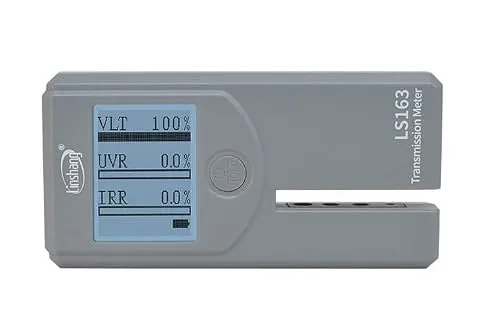 |
LS163 Digital Window Tint Transmission Meter – $90 This handheld meter reads a window’s actual VLT percentage on the spot, so you can confirm your tint meets your state’s legal limit instead of guessing by eye.
|
Here’s how five representative states compare. Always double-check your own state’s motor vehicle code before you tint, or before you drive a tinted car across a state line — these numbers do change, and several states adjusted their limits in 2025 and 2026 alone.
- California: Front side windows must allow at least 70% VLT; rear side and rear windows can be any darkness. This is one of the strictest limits in the country, and it applies equally to sedans, SUVs, and trucks.
- Texas: Front side windows need at least 25% VLT. Rear side and rear windows can be any darkness, but the vehicle must keep two functioning exterior side mirrors.
- Florida: Front side windows need at least 28% VLT. Rear side and rear windows can go to 15% VLT on sedans, or as dark as 6% VLT on SUVs, vans, and trucks.
- New York: Sedans need at least 70% VLT on every window, including the rear side and rear windows. SUVs, vans, and pickups only need 70% VLT on the front side windows — their rear side and rear windows can be any darkness.
- Ohio: Front side windows need at least 50% VLT; rear side and rear windows can be any darkness.
| State | Front Side VLT | Rear Side VLT | Back Window VLT | Notes |
|---|---|---|---|---|
| California | 70% | Any | Any | Also caps window reflectivity; strictest front-window limit on this list |
| Texas | 25% | Any | Any | Requires two working exterior side mirrors if rear windows are dark |
| Florida | 28% | 15% sedan / 6% SUV-van-truck | 15% sedan / 6% SUV-van-truck | Requires a certification sticker between film and glass |
| New York | 70% | 70% sedan / Any SUV-van-pickup | Any | Checked at the annual state safety inspection |
| Ohio | 50% | Any | Any | Windshield strip limited to the top 5 inches |
What About Windshields and Other Windows?
Nearly every state restricts windshield tint far more than side or rear glass, since the windshield affects the driver’s forward view the most. Most states allow a non-reflective strip only above the manufacturer’s AS-1 line, and the strip’s height varies: California allows roughly the top 4 inches, Ohio allows 5 inches, and Florida and New York both allow 6 inches. Below that line, most states don’t allow any windshield tint at all, factory or aftermarket.
Front side windows are almost always the strictest window on the car, for the visibility reasons above. Rear side windows and the back window get far more leeway — in some states they can go as dark as 5% VLT — because they matter less for the driver’s own line of sight. SUVs, vans, and pickups often get the most flexibility on rear glass, since their factory glass already reads darker than a sedan’s.
2026 Update: States That Recently Changed Their Tint Limits
Tint limits aren’t fixed forever — a handful of states adjusted their rules in 2025 and 2026. Utah lowered its front side window minimum from 43% to 35% VLT under HB 112, effective May 2025. North Dakota lowered its side and rear window minimum from 50% to 35% VLT under HB 1340, effective August 2025. Iowa signed HF 766 in May 2026, lowering its front side minimum from 70% to 50% VLT, though that change doesn’t take effect until July 1, 2026.
If you tinted your car more than a year or two ago, it’s worth re-checking your state’s current limit rather than assuming the numbers you remember are still correct.
Medical Exemptions for Darker Tints
Most states allow a medical exemption that lets a driver use darker-than-normal tint on the side windows, usually for conditions like lupus, photosensitivity, or certain skin conditions that require reduced UV and light exposure. Getting one typically means having a licensed physician sign a state-specific form or affidavit — Ohio requires a notarized doctor’s affidavit, New York uses Form MV-80W, and Florida issues a card the driver keeps in the vehicle to show if stopped.
Exemptions almost always apply only to the side windows, not the windshield, and many states still require the driver to carry proof of the exemption in the car. If you think you qualify, start with your state’s Department of Motor Vehicles website, since both the paperwork and the allowed VLT reduction vary by state.
How Are Tint Laws Enforced?
Officers typically check tint the same way a tint shop does: with a handheld tint meter that measures VLT by shining a calibrated light through the glass and reading how much comes out the other side. Tint checks usually happen during a routine stop for something else, like speeding, though a few states — California among them — will pull a car over for tint alone. See our page on how much police actually care about tint for more on how often that happens.
Penalties for illegal tint are usually a fix-it ticket rather than a major fine: expect somewhere between $25 and $200 depending on the state, plus a requirement to remove or lighten the tint and show proof it’s been fixed. New York’s fine tops out around $150 per offense, and illegal front tint will also fail the state’s mandatory annual safety inspection.
How to Choose Legal Window Tint
Picking a tint that’s both dark enough for privacy and legal to drive comes down to a short checklist:
- Check your state’s exact VLT minimum first, on your state DMV or highway patrol website, since these numbers change more often than most drivers assume.
- Ask a tint shop for legal options for your specific state and vehicle type, since some limits differ between sedans and SUVs.
- Confirm the finished VLT with a tint meter before you leave the shop, rather than trusting the film’s advertised percentage alone — installed VLT is glass plus film combined, and factory glass already blocks some light on its own.
- Consider film quality, not just darkness. Ceramic and carbon films block significantly more heat and UV than basic dyed film at the same VLT, for roughly $300-$500 on a sedan versus $100-$200 for dyed film.
- Keep your receipt and the shop’s VLT certification in the glovebox. Several states, including Florida, require or strongly recommend keeping this on hand in case you’re stopped.
DIY vs. Professional Tinting
DIY tint kits run about $20 to $100 and can work for a single small window, but getting a smooth, bubble-free result across an entire car is a real skill. Most first attempts show creases, bubbles, or peeling within a few months, and it’s easy to install a shade darker than your state actually allows without realizing it. If you want to try it yourself, our full guide to installing tint on a car window walks through the process step by step.
Professional installation costs more, typically $150 to $500 depending on the vehicle and film type, but a reputable shop verifies VLT with a meter before you leave and usually backs the work with a warranty against bubbling or peeling. For a full vehicle, professional installation is worth the extra cost for most drivers; DIY kits are more realistic for a single replacement window or a small trial patch.
Costs of Window Tinting
Tinting costs depend mainly on the car, the film type, and the shop. Typical ranges in the U.S.:
- Basic dyed tint: about $100-$200 for a sedan. Cheapest option, but fades and can turn purple within a few years.
- Ceramic or carbon tint: about $300-$500 for a sedan. Blocks more heat and UV, and typically lasts far longer than dyed film.
- SUVs and trucks: about $200-$600, since there are more windows and larger rear glass to cover.
- Windshield strip only: about $50-$100.
- Removing and redoing illegal tint: about $100-$300, on top of whatever the original tint cost.
Getting quotes from two or three shops is worth the extra few minutes — higher-quality tint costs more upfront but usually saves money over the life of the car by not needing to be redone.
Common Mistakes to Avoid
- Assuming your home state’s tint is legal everywhere. Some states enforce tint law against out-of-state vehicles too, so check before a long road trip.
- Buying the cheapest DIY kit available. Very cheap dyed film often bubbles or peels within a year and is a common source of failed re-tints.
- Skipping the VLT check. A tint that looks about right by eye is not the same as a tint that reads legal on a meter.
- Forgetting the side-mirror requirement. Several states that allow dark rear tint only allow it if the car has two working exterior side mirrors.
- Tinting the whole windshield. Almost every state restricts windshield tint to a narrow strip above the AS-1 line; a full windshield tint is one of the most commonly ticketed violations.
Benefits of Legal Window Tint
A tint that meets your state’s VLT limit still delivers most of the benefits drivers want: a noticeably cooler cabin in direct sun, less glare, more privacy, and slower fading of the dashboard and seats. The only thing legal tint doesn’t give you is the very darkest possible look — but a tint at the legal limit for your state still looks meaningfully darker than bare factory glass.
Environmental Impact of Window Tint
Tint also has a modest environmental upside. A cooler cabin means less air conditioning use, which reduces fuel consumption slightly in gas vehicles and helps preserve range in EVs. Quality ceramic film can last a decade or more, which cuts down on the waste and cost of repeated re-tinting compared with cheaper dyed film that needs replacing every few years.
What to Do If You Get a Tint Ticket
Most tint tickets are fix-it tickets rather than a flat fine. Typically you have somewhere between 10 and 30 days to have the tint lightened or removed and show proof — usually a shop receipt or a signed correction certificate — to the court or the issuing agency to get the fine waived or reduced. If you’re not sure what your state requires, call the number on the ticket or check your state DMV’s website before the deadline, since missing it can turn a fixable violation into a bigger fine.
The Bottom Line on Legal Window Tint
Legal window tint always comes down to your state’s VLT minimum for each window position, plus a few extra rules for windshields, mirrors, and reflectivity. California and New York sit at the strict end with 70% VLT on front windows; Ohio sits in the middle at 50%; Texas allows a darker 25%. Rear windows almost everywhere have far more room to go dark.
Before you tint — or before you drive a tinted car into a new state — check that state’s current DMV rules, since several states changed their limits as recently as 2026, and confirm the finished VLT with a meter rather than trusting the film alone.
FAQs
What does VLT mean for window tint?
VLT stands for Visible Light Transmission — the percentage of light that passes through the combined glass and film. A higher VLT, like 70%, means lighter, more transparent glass; a lower VLT, like 20%, means much darker glass.
Is it illegal to tint my windshield?
Tinting the entire windshield is illegal in almost every state. Most states allow a narrow non-reflective strip above the windshield’s AS-1 line, typically 4 to 6 inches from the top depending on the state.
How much does legal window tinting cost?
Professional tinting typically runs $150 to $500 for a full car, depending on film quality and vehicle size. Basic dyed film costs less but fades faster; ceramic and carbon films cost more but block significantly more heat and UV.
Can I get a ticket for illegal tint?
Yes. Fines typically range from $25 to $200 depending on the state, and most states require you to remove or lighten the tint and show proof within 10 to 30 days to avoid an additional penalty.
Are there exemptions for darker tints?
Many states allow a medical exemption for conditions like lupus or severe light sensitivity, usually with a signed form from a licensed physician. Exemptions typically apply only to side windows, not the windshield, and some states still require you to carry proof of the exemption in the vehicle.
Did any state change its tint law in 2026?
Yes. Utah lowered its front window minimum to 35% VLT in 2025, North Dakota lowered its side and rear minimum to 35% VLT in 2025, and Iowa lowered its front window minimum from 70% to 50% VLT effective July 1, 2026. Always check your state’s current rule rather than relying on older information.
Products related to this article
Sponsored / affiliate links. As an Amazon Associate I earn from qualifying purchases. I may earn additional commission from eligible campaigns.