Best Car Window Tints for Privacy (2026): We Compared
For privacy without making night driving miserable, a common rule of thumb is 20% VLT on rear glass, 35% VLT on front side windows where legal, and ceramic film if heat control matters most. Pick the wrong shade or a poor DIY kit, and you can end up with poor visibility, bubbling film, or a ticket. This guide ranks tint kits and films by privacy, heat control, legality, and install difficulty.
Quick picks
The best all-around choice is a ceramic pre-cut kit because it balances privacy, heat control, and easier installation better than a roll. If you want the cheapest entry point, dyed film gets you basic privacy fast, but it gives up durability and heat rejection.
| Pick | Best for | Key spec | Privacy use-case | Install risk |
|---|---|---|---|---|
| Ceramic pre-cut kit | Most drivers | Vehicle-specific fit, no trimming | Balanced daily privacy and comfort | Lower for beginners |
| Dyed polyester film | Budget buyers | Basic privacy, lower upfront cost | Short-term concealment | Medium to high if cut from a roll |
| Carbon film at low VLT | Parking and cargo security | Dark charcoal look, fade resistance | Strong daytime privacy | Medium |
| Pre-cut DIY kit | Beginners | Template match to the vehicle | Cleaner fit, less waste | Lowest of the group |
Quick comparison
| Product | Badge | Best for | Price | ||
|---|---|---|---|---|---|
 |
TOYOCO Nano Ceramic Car Window Tint Film Roll, 20% VLT, 30TOYOCO | Our pick | 30 in x 15 ft · Nano Ceramic · 20% VLT | $28.96
Price as of 21 Oct 2026
|
View |
 |
AUTOTEK Pre-Cut Car Window Tint Film Kit 5%-50% VLT withAUTOTEK | Upgrade pick | Pre-Cut Kit · Nano Treated · Ceramic Style | $79.98
Price as of 21 Oct 2026
|
View |
 |
Carbon Window Tint 35% VLT 20" x 100FT Roll – AutomotiveGAMA AUTOPARTS | Also great | 20" x 100FT · Carbon Film · 35% VLT | $84.99
Price as of 21 Oct 2026
|
View |
 |
RockRose 50% Nano Ceramic Car Window Tint 40 in x 6.5FTRockRose | Budget pick | 40 in x 6.5FT · Nano Ceramic · 50% VLT | $29.95
Price as of 21 Oct 2026
|
View |
Use this comparison to separate daily-driver tint from parking-security tint. The same shade can look harmless on a rear hatch and too dark on a front window after sunset.
How we chose
We ranked each option by privacy at different VLT levels, night-driving safety, and legal risk by window position. We also compared heat rejection, UV protection, signal compatibility, and install difficulty for beginners using either rolls or pre-cut kits.
The practical test is not “darkest wins.” It is whether the film gives enough concealment for your use case without making lane changes, backing up, or night parking harder than they need to be.
What VLT is best for privacy?
Lower VLT means less visible light passes through the film, so the cabin looks darker from outside. For privacy, 20% VLT is usually a safer daily-driving compromise than 5% VLT, while 35% VLT is better when you want some concealment without losing too much nighttime visibility.
How 5%, 20%, and 35% behave in daylight and at night
At 5% VLT, the cabin is hard to see into in daylight, especially on rear glass, but the same darkness can make parking lots, dim roads, and backing up more difficult after dark. At 20% VLT, privacy is still strong, but the glass remains more manageable for everyday use. At 35% VLT, visibility improves, yet outside observers can still make out shapes and movement in many lighting conditions.
Picture a sedan parked under a bright grocery-store lot light. At 5% VLT, rear-seat items are much harder to spot; at 35% VLT, a passerby may still see bags, a child seat, or a jacket on the back bench.
Which VLT fits each window position?
For front side windows, many drivers stay closer to 35% VLT because that window position affects mirror checks and side visibility. For rear side windows and rear glass, 20% VLT is a common privacy balance. Cargo areas on SUVs and hatchbacks can tolerate darker film better if the driver does not rely on rear visibility for every maneuver.
Why lower VLT can create problems after dark
Lower VLT raises privacy, but it also raises the risk of poor visibility at night, especially in rain or in unlit parking areas. That tradeoff matters more on front windows than on rear windows because the driver depends on front-side peripheral vision for lane changes, curb clearance, and turns.
Ceramic window tint: best for heat and signal clarity
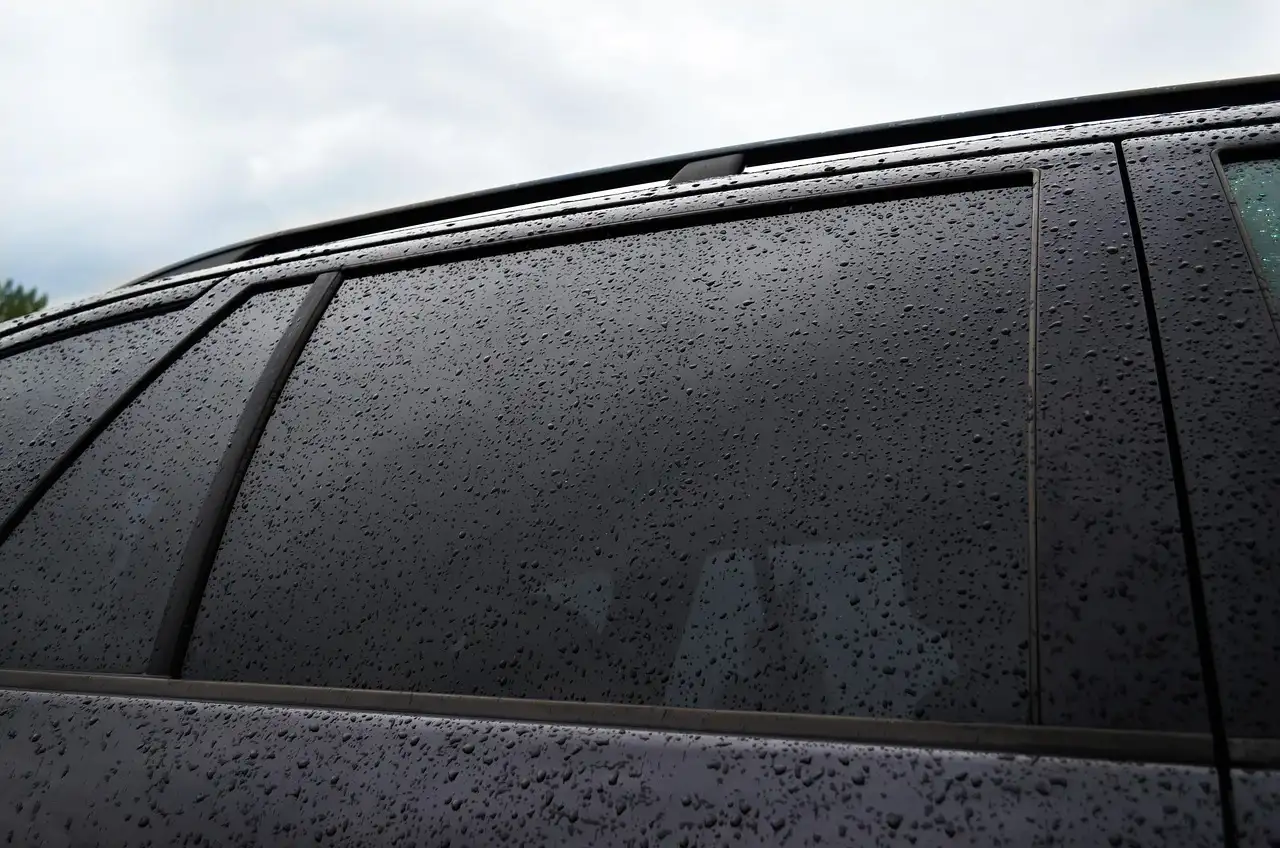
Ceramic film is the safest all-around choice for many modern cars because it pairs privacy with strong heat control and low signal interference. Nano-ceramic construction also helps it stay nonmetallic, which matters if you rely on phones, GPS, toll tags, or driver-assist hardware.
Nano-ceramic construction and why it matters
Unlike dyed film, ceramic film uses nano-ceramic material instead of relying only on pigment. That matters because privacy and heat control are not coming from color alone; the film is also built to reject solar energy better while avoiding the signal issues tied to some metallic films.
UV blocking and infrared heat rejection
Manufacturer claims for ceramic film commonly land near 95% to 99% UV blocking, and some ceramic products also report strong infrared rejection. For example, PAMAGOO 35% VLT Ceramic Tint Film is described as blocking at least 95% UV and around 88% infrared, while TOYOCO 20% VLT Ceramic Car Window Tint Film is said to block more than 99% UV. That kind of performance helps reduce cabin heat and interior fade, but the exact result depends on the car, glass type, and installation quality.
UV rejection protects skin and slows dashboard, seat, and trim fading. IR rejection is the heat-control side of the equation; better IR rejection usually means less cabin soak in hot climates and less punishment when the car sits in direct sun.
What ceramic is best
Ceramic is often the right choice if you want privacy, heat control, and low signal risk in one film. It is especially sensible for commuters, rideshare drivers, and owners who park outdoors all day. The tradeoff is cost: ceramic usually sits above dyed film and can cost more than a simple carbon roll.
Carbon window tint: best for dark privacy
Carbon film is the strong privacy option when you want a darker look without stepping into metallic film problems. It offers a matte charcoal appearance, good fade resistance, and signal-friendly behavior that suits daily use better than many bargain dark films.
Non-fading charcoal appearance
Carbon film is valued because it stays charcoal instead of turning purple as it ages. RockRose 5% Premium Carbon Window Tint Film is labeled 2-ply carbon, and GAMA AUTOPARTS’ carbon roll is described as a fade-resistant 2-ply film. That matters if you want privacy that still looks clean after months in the sun.
Privacy at dark VLTs
Carbon film works well at low VLT, including 5% VLT, for people who care more about hiding cargo or rear-seat contents than maximizing outward visibility. MotoShield Pro Nano Carbon is listed at 5% VLT, and that shade is firmly in the “hard to see through” range for rear windows and cargo areas.
Signal-friendly composition
Carbon film is usually safer for modern electronics than metallic tint. The GAMA AUTOPARTS roll is described as metal-free and signal-friendly for GPS, cell, and radio use. That does not make every carbon product identical, but it does explain why carbon often gets recommended for vehicles with antennas, toll tags, and driver-assist systems.
Dyed polyester tint film: best for low-cost privacy
Dyed polyester film is the entry-level choice when you want basic privacy with the lowest upfront cost. It can darken glass well enough for casual concealment, but it usually gives up heat rejection and long-term durability to cheaper construction.
Budget-friendly entry option
Dyed film is usually the easiest way to get dark glass on a tight budget. It works best when privacy is the main goal and you are not expecting premium heat rejection or long service life.
Basic privacy and limited heat rejection
Dyed tint can make it harder to see inside the vehicle, especially from a distance or in bright daylight. The limit is thermal performance: compared with ceramic, dyed film usually does less to block infrared heat, so the cabin can still build heat quickly in summer sun.
Fade risk and when it still makes sense
Dyed polyester can fade, haze, or lose visual consistency over time. It still makes sense for older vehicles, short-term ownership, or cargo vans where the owner wants quick privacy and is willing to accept lower durability.
Pre-cut kits vs rolls: which is easier to install?
Pre-cut kits are easier for most beginners because they reduce trimming, waste, and the risk of cutting too much. Rolls are better for experienced installers or unusual glass shapes, but they demand more patience and more cleanup if a cut goes wrong.
Vehicle-specific fit and reduced trimming
Pre-cut DIY tint kits are made to match a vehicle’s glass pattern, which cuts down the measuring and trimming that trip up first-time installers. AUTOTEK’s kit is listed as a pre-cut vehicle template database with no trimming required, and Mandark’s tint product is described as an 18-piece kit, which is the kind of format that usually makes the job more approachable.
When rolls make sense
Rolls make more sense for custom work, multiple vehicles, or experienced installers who already know how to map glass and cut cleanly. A roll also gives flexibility if the exact glass shape is unusual, but that flexibility comes with more waste if you miscut a panel.
Tools you need
At minimum, you need a squeegee, a felt squeegee, a cutting knife, fresh blades, and bubble-removal tools. Those tools help push out water, seat the film, trim edges cleanly, and fix minor defects before they set.
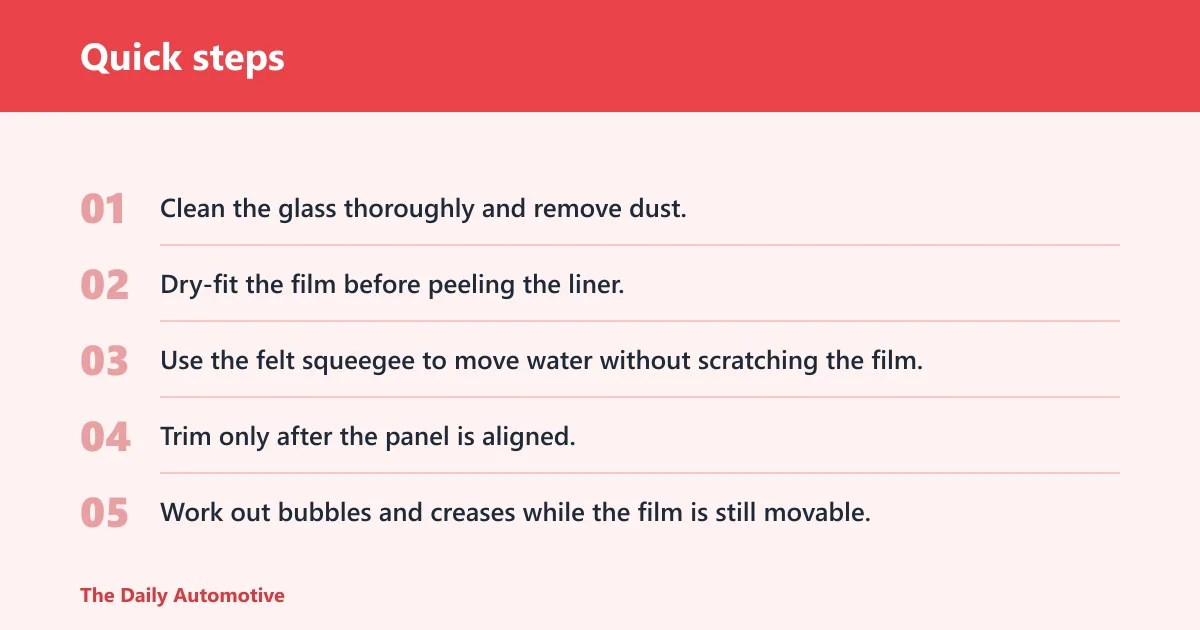
- Clean the glass thoroughly and remove dust.
- Dry-fit the film before peeling the liner.
- Use the felt squeegee to move water without scratching the film.
- Trim only after the panel is aligned.
- Work out bubbles and creases while the film is still movable.
Common install failures
Bubbles come from trapped water or dust. Creases usually come from handling the film too aggressively. Edge lift often comes from dirty glass, poor trimming, or rushed curing. A common first-timer mistake is trying to squeegee too hard in one pass, which can drag the film and create a wrinkle that never lays flat.
Suppose a compact SUV owner uses a full roll on rear glass without a helper. If the pattern shifts while the adhesive is still wet, the result can be a visible gap at the top edge and a bright line of dust along the lower seal.
Best picks by use case
Daily driving
Choose ceramic in the 20% to 35% range for rear and side windows if you want a strong privacy-to-visibility balance. That is the safest daily choice for most sedans because it reduces cabin heat without turning night driving into a guessing game.
Parking security
Choose carbon at a darker VLT, especially on rear glass and cargo windows, if your main goal is keeping bags, tools, or deliveries out of sight. Lower VLT gives stronger concealment when the car is parked, but it should be paired with careful window-position choices so the driver still sees well enough after dark.
Rideshare vehicles
Choose a lighter ceramic film on front side windows and a moderate shade on rear glass. Riders still want privacy, but the driver also needs clear visibility, clean rear-seat presentation, and a low chance of complaints about visibility or discomfort.
Tint decision matrix
| Tint type | VLT | Privacy level | Night visibility risk | Legality risk | Install difficulty | Signal compatibility | Best use case |
|---|---|---|---|---|---|---|---|
| Ceramic | 35% | Moderate | Low to moderate | Lower on many rear windows, higher on front windows in strict states | Medium, lower with pre-cut | Strong | Sedan daily driver, rideshare front side windows |
| Ceramic | 20% | High | Moderate | Higher on front windows, often better suited to rear glass | Medium | Strong | SUV rear glass, cargo concealment with comfort |
| Carbon | 5% | Very high | High | Highest risk on front windows, often better as rear-only privacy film | Medium to high | Usually strong | Parking security, cargo area, show or off-duty use |
| Dyed polyester | 35% | Moderate | Low to moderate | Moderate, depending on window position | Medium to high | Usually strong | Budget sedan, short-term privacy fix |
| Dyed polyester | 20% | High | Moderate | Higher on front windows, easier to over-darken | High if cut from a roll | Usually strong | Low-cost rear privacy with limited expectations |
For sedans, 35% on the front side windows and 20% on rear glass is the practical sweet spot. For SUVs, you can usually go darker in the rear without hurting day-to-day use as much. For rideshare owners, lighter film is the safer call because visibility complaints matter as much as privacy.
Which one should you buy?
Choose ceramic if you want the best balance of privacy, comfort, and daily usability. Choose carbon if you want darker privacy with a cleaner budget and good signal compatibility. Choose dyed film only if the goal is low-cost, short-term concealment and you can live with weaker heat rejection.
Choose a pre-cut kit if you want the safest DIY path. A roll makes sense when you already know how to trim film cleanly, or when you are fitting multiple vehicles and can absorb more waste.
Legal risk by window position
Tint shade legality varies by state and by window position. Front side windows are usually the most restricted, rear side windows are often more forgiving, and the windshield is the most sensitive area of all. If local law is strict, the smartest move is often a lighter ceramic film up front and a darker film only where legal in the rear.
How to think about UV and IR claims
UV protection helps protect skin and slow interior fading, but it is not the same as heat rejection. IR rejection is what matters more for cabin comfort in hot weather. Manufacturer-reported claims such as 95% UV blocking, 99% UV blocking, or 88% infrared should be treated as product claims, not a guarantee of identical real-world performance on every vehicle.
Say your SUV carries tools in the rear and you park outside all day. A 20% carbon or ceramic film on the rear glass can keep the cargo harder to see while reducing some cabin heat. A 5% film on the front side windows would improve privacy further, but it can make dusk driving and tight parking more difficult than most daily drivers need.
Frequently asked questions
What car window tint is best for privacy?
For most drivers, carbon or ceramic film around 20% VLT gives the best privacy-to-usability balance. Go darker only on rear glass or cargo areas if you can accept a higher night-visibility penalty. For front side windows, lighter film is usually the safer choice.
Is 5% tint too dark for everyday driving?
Usually, yes for front side windows. Five percent VLT gives very strong privacy, but it can make night parking, lane changes, and backing up harder. It makes more sense for rear glass or cargo security than for a daily driver that sees dark roads often.
Should I choose ceramic or carbon window tint?
Choose ceramic if heat control and signal clarity matter most. Choose carbon if you want a darker charcoal look with good privacy and fade resistance at a lower cost than many ceramic options. Both are better daily choices than dyed film when comfort matters.
Does window tint affect GPS or phone signal?
Most modern ceramic and carbon films are designed to be signal-friendly, especially nonmetallic versions. Problems are more likely with metallic films than with ceramic or carbon. Even then, any vehicle’s antennas, toll tags, and sensors can react differently depending on placement and tint stack-up.
Are pre-cut tint kits easier to install than rolls?
Yes. Pre-cut kits reduce trimming, guesswork, and waste, which is why beginners usually do better with them. Rolls offer more flexibility, but they are easier to miscut and usually take more time to fit cleanly around complex glass.
What tint shade is legal for car windows?
There is no single legal shade for every car. State laws vary by window position, vehicle type, and sometimes by whether the tint is on the windshield, front side windows, rear side windows, or rear glass. Check local rules before choosing a VLT.
Products related to this article
Sponsored / affiliate links. As an Amazon Associate I earn from qualifying purchases. I may earn additional commission from eligible campaigns.
 RockRose 5% Nano Ceramic Car Window Tint 24 in x 100FT 2PLY Privacy Film Heat Block, 99% UVR, and 85% IRR Block for Auto or Home Strong Adhesive, Easy Shrink, Plotter Friendly - CharcoalRockRose 20% Nano Ceramic Car Window Tint 36 in x 25FT 2PLY Privacy Film Heat Block, 99% UVR, and 85% IRR Block for Auto or Home Strong Adhesive, Easy Shrink, Plotter Friendly - Charcoal