What Is the Rear Window of a Car Called? Backlight, Back Glass & More
The rear window of a car is officially called the backlight (also spelled backlite) — the term used by auto glass professionals, manufacturers, and repair shops across the industry. Most drivers refer to it as the rear window, back glass, or rear windshield, and all three are correct depending on vehicle type. This guide covers every name for the rear window, what the defroster wires do, how it compares to the front windshield, and what replacement costs to expect.
Quick Answer
The rear window of a car is called the backlight or backlite — the official automotive industry term. Commonly known as the rear window, back glass, or rear windshield, the name varies by vehicle type: sedans use “rear window,” SUVs use “rear windshield,” and pickup trucks often use “back window.”
Table of Contents
What’s the Rear Window of a Car?
The rear window — also called the back window, back glass, or rear windshield — is the pane of glazing at the rear of a vehicle that provides rearward visibility and protects the cabin. In automotive industry terminology, the official term is the backlight (used by U.S. manufacturers) or backlite (preferred by European OEMs including BMW, Mercedes-Benz, and Volvo). The word “backlite” is a portmanteau of “back” and “lite” — a trade spelling of “light” that references the glass’s transparency.
But here’s where it gets interesting. In some cars, like hatchbacks or SUVs, it’s often called a rear windshield or backlite. For pickup trucks, it’s sometimes just a back window or rear glass. The name depends on the car’s design and what the manufacturer calls it. No matter the name, it’s the glass that gives you a view behind you.
Why Does the Rear Window Have Different Names?
Carmakers use terms based on the vehicle’s body style. Sedans, with their fixed rear windows, usually stick with “rear window.” The window is flat and doesn’t open, so the term fits.
Hatchbacks, SUVs, and minivans often have a “rear windshield” because it’s part of a movable hatch, like a windshield that lifts. “Backlite” is a technical term used in the auto industry, especially for modern glass with built-in features like defrosters. The different names reflect how the window functions and where it’s placed in the car.
What’s the Purpose of the Rear Window?
The rear window is a key safety feature. It lets you see what’s behind you when backing up, and it works with the rearview mirror to monitor traffic. In SUVs and hatchbacks, the rear windshield is part of the cargo door, making it easier to load large items when the hatch lifts.
The window also lets light into the car, making the back seat feel less cramped, and it keeps weather out — rain, snow, and dust — while protecting the interior.
How Is the Rear Window Made?
Rear windows are built for safety, not just visibility. Most are made of tempered glass — heat-treated to be several times stronger than standard glass. When tempered glass breaks, it shatters into small, rounded pieces rather than sharp shards, reducing injury risk.
Some vehicles, especially luxury models, use laminated glass for the rear window — two layers bonded with a plastic interlayer, the same construction used for front windshields. Rear windows are also curved to match the car’s body lines and often include factory tinting to reduce UV exposure and heat buildup inside the cabin.
Features of the Rear Window
Rear windows aren’t just plain glass — they often include several functional features:
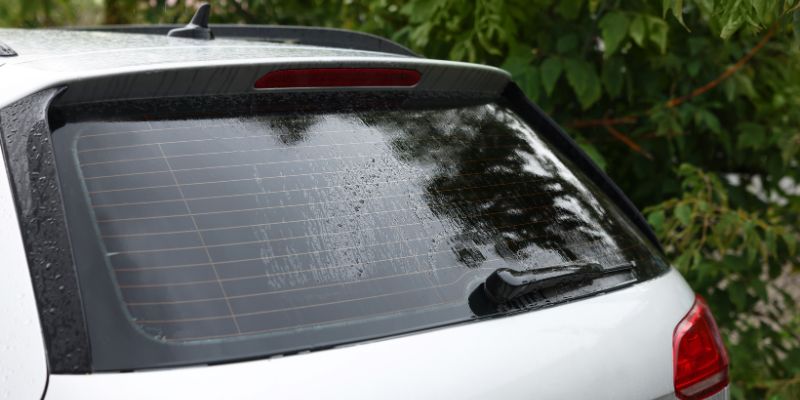
- Defroster: Thin conductive wire traces embedded in or printed on the glass heat up when activated, melting frost and clearing condensation.
- Wiper: SUVs and hatchbacks often have a rear wiper to clear rain or snow from the liftgate glass.
- Tint: Most rear windows include factory tinting for privacy and heat reduction.
- Antenna: Some vehicles have radio or GPS antenna elements printed directly onto the glass surface.
- Sliding Window: Many pickup trucks have a sliding rear window panel for cabin ventilation.
Types of Rear Windows by Vehicle
The rear window design changes with vehicle style:
- Sedan Rear Window: Fixed, flat or slightly curved. Does not open.
- Hatchback/SUV Rear Windshield: Larger, integrated into the liftgate. Lifts with the hatch.
- Pickup Truck Back Window: Fixed or sliding. The sliding version provides cabin ventilation.
- Minivan Rear Glass: Wide, tinted, usually with a wiper.
- Convertible Rear Window: Often plastic or small glass panel integrated into the soft top.
How Are Rear Windows Installed?
Rear windows are bonded to the car’s frame using urethane adhesive — a high-strength, flexible sealant that holds the glass in place and keeps water out. The glass is carefully aligned to the pinch weld, rubber seals are applied around the perimeter, and the car typically needs 1–2 hours of cure time before it can be driven safely.
For SUVs and hatchbacks, the rear windshield is integrated into the liftgate — the full assembly lifts, glass and all. On pickup trucks, a sliding rear window rides in a track and may use a rubber gasket instead of adhesive. Installation requires professional-grade tools to avoid cracking the glass during alignment.
Rear window replacement cost (2026): Most vehicles run $200–$600 for a full replacement including labor. Economy sedans land near $200; SUVs, trucks, and luxury models with integrated defrost wiring, antenna elements, or backup camera sensors push toward $500–$800. Vehicles requiring ADAS camera recalibration after glass replacement can reach $1,000–$1,200. If only a defroster wire trace is broken, a $10–$15 repair kit from any auto parts store fixes it in under 30 minutes.
Common Problems with Rear Windows
Rear windows are tough, but they’re not immune to damage:
- Cracks or Chips: Rocks or accidents can damage the glass — a chip can spread into a full crack quickly. Address chips early; see our guide on removing damage from car surfaces for related exterior repair tips.
- Defroster Failure: Individual wire traces can break, leaving foggy spots. A $15 repair kit from any auto parts store fixes most breaks.
- Leaking Seals: Worn rubber seals let water into the trunk or cargo area. Resealing with silicone is a straightforward fix.
- Wiper Issues: Rear wipers can jam or the motor can fail. Replacement motors typically run $150–$250 installed.
- Tint Peeling: Aftermarket tint film can bubble or fade over time, especially in high-UV climates.
Table: Rear Window Features by Vehicle Type
| Vehicle Type | Window Name | Features | Common Issues |
|---|---|---|---|
| Sedan | Rear Window | Tint, defroster | Cracks, defroster failure |
| SUV/Hatchback | Rear Windshield | Wiper, liftgate, tint | Wiper issues, seal leaks |
| Pickup Truck | Back Window | Sliding option, defroster | Chips, sliding mechanism jam |
| Minivan | Rear Glass | Wiper, tint, antenna | Wiper motor, tint peeling |
| Convertible | Rear Window | Plastic or glass, small size | Tears in plastic, fading |
How to Maintain Your Rear Window
- Clean Regularly: Use automotive glass cleaner weekly to remove road film and keep sightlines clear. The same approach covers all exterior glass — see how to clean car headlight glass for a full exterior glass care routine.
- Check Defroster: Test the defroster each fall before winter sets in to confirm all wire traces are functional.
- Inspect Seals: Check rubber seals annually and apply silicone sealant if gaps or cracks appear.
- Fix Chips Fast: Small chips in tempered glass can spread rapidly with temperature changes. Get them repaired immediately.
- Replace Wiper Blades: If your vehicle has a rear wiper, swap the blade annually to maintain clear wiping.
Rear Window vs. Front Windshield
Front windshields are always laminated for safety — two glass layers bonded with a plastic interlayer that holds fragments together on impact. Rear windows are typically tempered, which is lighter and less expensive. Front windshields are larger, more curved, and pricier to replace — typically $400–$700 versus $200–$600 for the rear. Rear windows commonly include tinting and defrosters, while front windshields must maintain high clarity and avoid heavy tinting.

Aftermarket Rear Windows and Modifications
Aftermarket rear windows can replace damaged OEM glass or add customization. Options include darker tint films, privacy glass upgrades, and power-sliding window conversions for trucks. Some owners add louvers — slatted exterior covers — for a retro look, though these reduce rearward visibility. Before any modification, check your state’s VLT (Visible Light Transmission) requirements to avoid tinting violations.
Safety and Legal Considerations
In the U.S., rear windows must be made of safety glass — either tempered or laminated — to meet federal motor vehicle safety standards. Tinting is regulated at the state level. Most states permit dark rear window tinting as long as the vehicle has functioning side mirrors, but the specific VLT percentage varies by state. Driving with a cracked or obstructed rear window can result in a fix-it ticket in many jurisdictions.
Why the Rear Window Matters
The rear window does more than most drivers realize. It provides the rearward visibility that backs up your mirrors and camera, seals the cabin from weather, carries the defroster that keeps winter driving safe, and in SUVs and trucks, it’s part of the cargo access system. It’s a precision-engineered component, and treating it that way — cleaning it regularly, fixing chips early, and replacing it properly — keeps it working reliably for the life of the vehicle.
Wrapping It Up
The rear window — whether called the backlight, backlite, back glass, or rear windshield — is a more engineered component than most drivers realize. It uses tempered or laminated safety glass, integrates defroster wires, may carry antenna elements, and on tech-equipped vehicles must be recalibrated after replacement. Keep it clean, address chips before they spread, and verify your state’s tint VLT rules before any modifications. For more car maintenance guidance, browse our how-to guide library.
FAQs
What’s the difference between a rear window and a rear windshield?
A rear window is typically fixed in place, as in a sedan. A rear windshield is integrated into a liftgate that opens, as in an SUV or hatchback. Both refer to the glass at the back of the vehicle — the difference is in how the surrounding structure works.
Can I replace my rear window myself?
It’s technically difficult and carries real risk — the glass is heavy, alignment is critical, and an improper urethane seal leads to leaks and structural issues. Most auto glass shops charge $200–$600 for a full replacement including labor, which is worth the cost for a safety-critical component.
Why does my rear window have wires in it?
Those are defroster heating elements — thin conductive wire traces printed onto the glass surface. When you switch on the rear defroster, they heat up to melt frost and clear condensation from the inside. If a trace breaks and leaves a foggy stripe, a $10–$15 defroster repair kit can fix it without replacing the glass.
Is it legal to tint my rear window?
In most U.S. states, rear window tinting is permitted as long as the vehicle has functioning side mirrors. Allowable VLT percentages vary by state, so check your local motor vehicle regulations before applying aftermarket tint.
What should I do if my rear window cracks?
Get it assessed immediately — tempered glass chips can spread quickly with temperature changes. Contact an auto glass shop as soon as possible. Rear window replacement typically costs $200–$600 depending on vehicle type and whether defroster or camera recalibration is required.
Products related to this article
Sponsored / affiliate links. As an Amazon Associate I earn from qualifying purchases. I may earn additional commission from eligible campaigns.