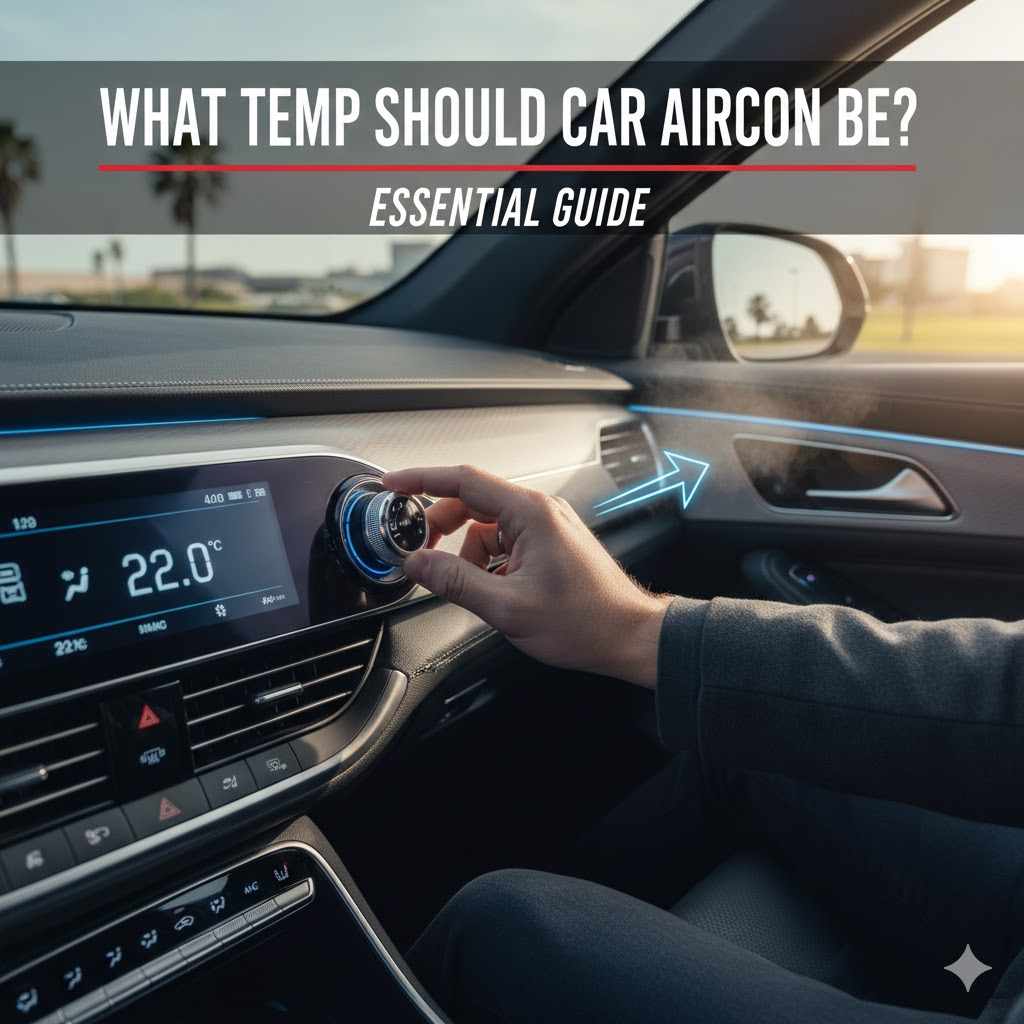
What Temp Should Car Aircon Be? Essential Guide
For optimal comfort and efficiency, the ideal car aircon temperature is usually between 68°F and 72°F (20°C to 22°C). This setting balances cooling power with fuel economy. However, the “best” temperature depends on the outside heat, humidity, and your personal preference. We will explore the science behind setting your car’s AC perfectly every time.
Isn’t it frustrating when you hop into a car baking in the summer sun, hit the AC button, and still feel sweaty? Or perhaps your aircon blasts air so cold it makes your fingers numb! Finding that “just right” temperature setting can feel like guesswork. As a driver, you want comfort without wasting gas or stressing over confusing dials.
The good news is that setting your car’s air conditioning correctly is simple once you understand a few key concepts. We are going to break down exactly what temperature to aim for, how your car’s system works, and practical tips for staying cool efficiently. Get ready to take full control of your car’s climate settings!
Understanding Car Air Conditioning: Why Temperature Isn’t Just One Number
When you adjust the temperature dial in your car, you are not just setting a fixed degree number; you are controlling a complex system. Understanding this helps you make smarter adjustments.
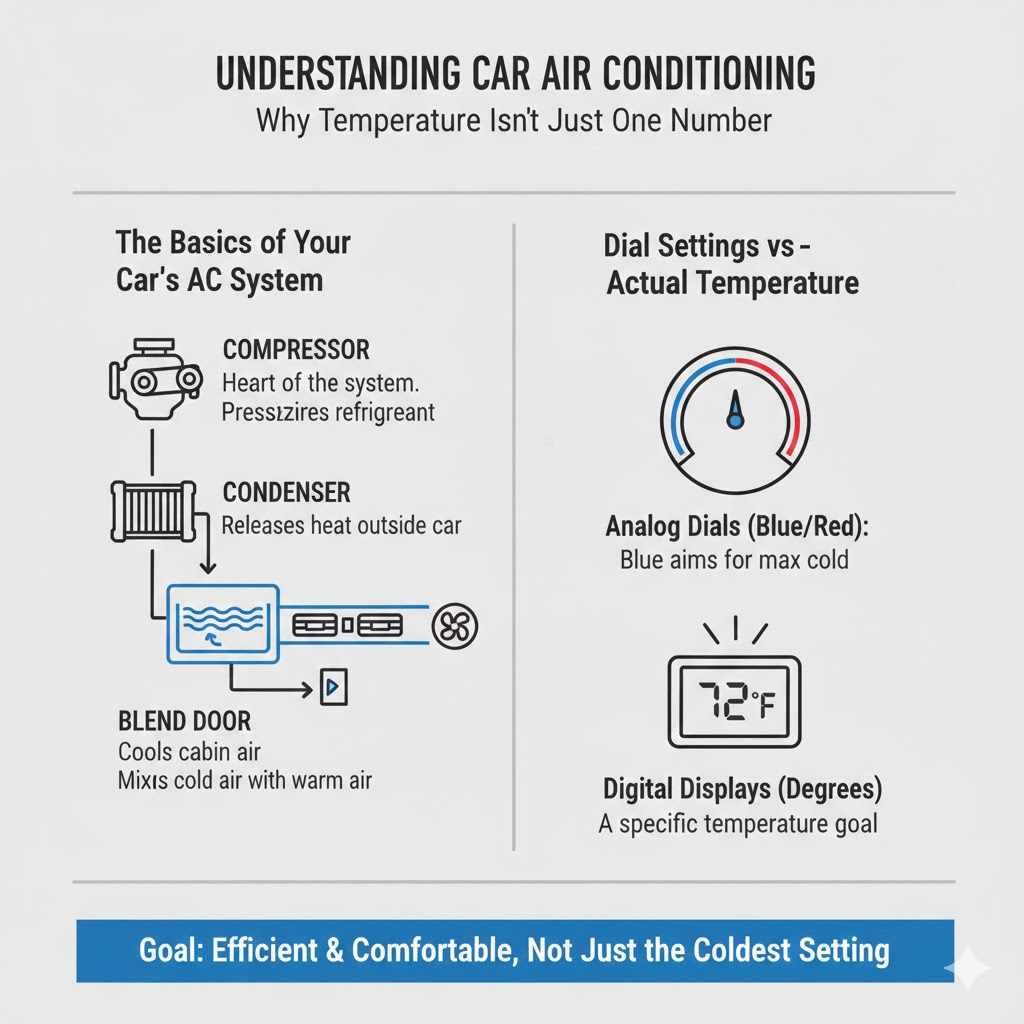
The Basics of Your Car’s AC System
Your car’s air conditioner works much like your home refrigerator. It uses a chemical called refrigerant to absorb heat from the cabin air and release it outside.
Here are the main parts involved in cooling your car:
- Compressor: This is the heart of the system. It pressurizes the refrigerant, making it cold enough to absorb heat.
- Condenser: Usually located in front of the radiator, this part releases the heat absorbed from the cabin into the outside air.
- Evaporator: This is inside your dashboard. As warm cabin air blows over the cold evaporator coils, the air cools down before entering the vents.
- Blend Door: This little door mixes cold air from the evaporator with warm air from the heater core to achieve the temperature you select on the dial.
The Difference Between AC Dial Settings and Actual Temperature
Many modern cars use color-coded dials (Blue for Cold, Red for Hot) or numbered settings (1 through 8). These markings are relative, not exact scientific measurements.
Analog Dials (Blue/Red): Pushing fully to blue aims for the coldest temperature the system can produce.
Digital Displays (Degrees): These are more precise. If your car shows Fahrenheit or Celsius, you can aim for a specific setting.
The goal isn’t necessarily the coldest setting, but the most efficient and comfortable setting.
What Temp Should Car Aircon Be? The Expert Recommended Range
When discussing optimal temperature, we look at established comfort zones and efficiency guidelines.
The Ideal Comfort Zone: 68°F to 72°F (20°C to 22°C)
For most people on an average hot day, setting your climate control between 68°F and 72°F (or 20°C to 22°C) provides excellent cooling without shocking your body or draining your battery excessively.
Why this range?
- Physiological Comfort: Human bodies generally regulate best when the ambient temperature is slightly below the surrounding heat, but not dramatically so. A difference of about 15°F to 20°F below the outside temperature is usually sustainable.
- Humidity Control: This range allows the AC to effectively dehumidify the air. Lowering humidity makes 70°F feel much cooler than 70°F in a swampy environment.
- Fuel Economy: The harder your AC compressor works (trying to reach 60°F when it’s 100°F outside), the more strain it puts on the engine, increasing fuel consumption.
When to Adjust: Adjusting for Extremes
While 70°F is the baseline, you should adjust based on conditions.
Table 1: Recommended AC Temperature Adjustments
| Outside Condition | Recommended Initial Setting | Reasoning |
|---|---|---|
| Extreme Heat (Above 95°F / 35°C) | 68°F (20°C) | Requires maximum initial cooling to remove latent heat stored in the cabin materials. |
| Moderate Heat (75°F – 95°F / 24°C – 35°C) | 70°F – 72°F (21°C – 22°C) | Perfect balance between comfort and efficient engine operation. |
| High Humidity (Muggy Days) | Set AC to MAX A/C, but keep temp at 72°F (22°C) | Focus on dehumidifying rather than just lowering temperature. Moisture makes heat feel worse. |
| Driving at Night | 74°F (23°C) or use Vents Only | Lower ambient temps mean less cooling load is needed. |
Beginner’s Step-by-Step Guide to Perfecting Your Car’s AC
You don’t need to be a mechanic to set up your AC perfectly. Follow these steps for immediate relief and long-term efficiency.
Step 1: Purge the Hot Air First
The single biggest mistake beginners make is immediately hitting the “MAX AC” button when the car has been sitting in the sun. The air ducts are filled with hot air that has been sitting near the engine bay.
- Roll down all your windows completely.
- Turn your fan speed to HIGH.
- Set the temperature dial fully to COLD (Blue).
- Drive like this for 1–2 minutes. This pushes out all the super-heated air stored in the vents and tubes.
Step 2: Close Up and Engage Cooling
Once the initial blast of hot air is gone, it’s time to engage the AC compressor properly.
- Roll up all the windows tightly.
- Turn the temperature setting to your target comfort level, typically 70°F (21°C).
- If your system has an “Auto” mode, engage it. This allows the car’s computer to manage the fan speed and air mix door for you.
- If you don’t have Auto, set the fan speed to medium (Level 3 or 4).
Step 3: Fine-Tuning the Flow (Vents and Recirculation)
The direction the air flows matters just as much as the temperature setting.
Choosing the Right Vents
Air directed at your face and upper body cools you down fastest because your body sheds heat primarily through the head and neck.
- Best Setting: Direct the vents toward the upper dashboard vents (those closest to the windshield) aimed slightly down toward your chest.
- Avoid: Pointing vents directly at your hands or feet, as this doesn’t provide immediate relief.
Understanding Recirculation (Recirc/Max AC)
The Recirculation button tells your car to keep cooling the air already inside the cabin rather than drawing in hot air from outside.
- Use Recirculation: When the outside temperature is extremely high (over 95°F) or when traffic is stopped. It cools the existing cold air faster.
- Use Fresh Air (Turn Off Recirc): After you have cooled the car down (after about 10 minutes of driving), switch off recirculation. This brings in fresh air, prevents that “stuffy” feeling, and helps prevent the evaporator from icing up.
Step 4: Maintaining Efficiency
Once you are comfortable, dial the temperature slightly warmer (to 72°F or 73°F) and reduce the fan speed if possible. The system will cycle the compressor on and off less frequently, saving gas while maintaining the set cabin temperature.
The Science Behind Aircon Efficiency and Fuel Economy
Many drivers worry that running the AC too much harms their gas mileage. While it is true that using the AC adds a load to the engine, driving with windows down at high speeds is often worse.
AC vs. Open Windows at Highway Speeds
This is a classic driving debate, and aerodynamics usually settle it.
Low Speeds (Under 40 mph): Open windows are generally more efficient than running the AC. The aerodynamic drag is minimal.
Highway Speeds (Over 45 mph): Open windows create significant aerodynamic drag, forcing the engine to work harder to maintain speed. In these conditions, running the AC at a reasonable temperature (70°F–72°F) is typically more fuel-efficient than driving with the windows fully down.
According to studies, open windows can decrease fuel economy by up to 10% at higher speeds due to drag. The load placed on the engine by the AC compressor is often less than the penalty for pushing air resistance out of the way.
When to Let the System Rest
To maintain system health and maximize lifespan, allow the AC to rest periodically.
1. Five Minutes Before Shutting Off: About five minutes before reaching your destination, turn the AC compressor off (usually by turning the temperature dial to the warm side or turning the A/C button off), but leave the fan running on high.
2. Why this works: This blows dry air across the evaporator coil. If you shut the car off immediately after running the AC, moisture remains trapped on the cold coil, creating a perfect environment for mold and mildew growth—this leads to that musty smell!
Troubleshooting Common AC Temperature Issues
If your aircon is running constantly but never reaches the desired temperature, there might be a deeper issue than just the setting.
Problem 1: Air is Cool, Not Cold
If the air coming out feels like a slightly cool breeze but never truly chills, the issue is likely low refrigerant. Refrigerant is the lifeblood of the AC system.
What to Check: Look for visual signs like oily residue around the AC lines or hoses, which indicates a leak.
The Fix: Do not simply add store-bought refrigerant cans unless you are sure the system is just low. Low refrigerant usually means there is a leak that needs professional repair. Low pressure will cause the system to stop cooling efficiently.
Problem 2: Air is Only Cold on One Side
If the driver’s side is icy but the passenger side is warm, this almost always points to a problem with the Blend Door Actuator.
What it is: This small electric motor controls the blend door (mentioned earlier) that mixes hot and cold air. If the motor fails or the door gets stuck on the “hot” setting for one side of the car, you get uneven temperatures.
The Fix: This often requires accessing the dashboard area to replace the actuator assembly.
Problem 3: The Air is Freezing Cold, Then Warm, Then Cold
This erratic behavior often suggests a problem with the cycling switch or the pressure sensor. The system is turning on and off too rapidly (short cycling) because it thinks the pressure is too high or too low when it is actually fine.
Problem 4: Musty or Mildew Smell
As mentioned above, this means biological growth is happening on the evaporator.
Temporary Fix: Run the fan with the AC off for five minutes before stopping (Step 4).
Permanent Fix: You need an evaporator cleaning service, where a technician sprays an antimicrobial foam or mist directly into the HVAC system to kill the bacteria.
Factors Affecting Perceived Temperature
Even if your thermometer reads 70°F, your personal feeling of comfort can change based on these external factors.
The Impact of Humidity
High humidity is the secret enemy of comfort. Water vapor in the air holds heat and prevents sweat from evaporating efficiently off your skin.
The Rule: When humidity is high, set your AC temperature slightly lower (like 68°F) and ensure the “AC” button is engaged (not just the fan). The AC system’s primary job becomes drying the air first, which makes you feel cooler even if the thermometer reading is the same.
Solar Load (Sun Exposure)
If your car is parked facing the sun, the interior plastic and vinyl surfaces absorb significant radiant heat.
Solution: Use a reflective sunshade whenever parking. A shaded car can start 10–15 degrees cooler than one baked in direct sunlight, meaning your AC doesn’t have to work nearly as hard to reach that optimal 70°F.
Cabin Air Filter Condition
A clogged or dirty cabin air filter severely restricts the volume of air moving across the cold evaporator coils.
The Result: Even if the AC system is working perfectly, you will feel weak airflow and poor cooling because the air isn’t moving fast enough.
Maintenance Check: If your fan speed seems weak even on the highest setting, check and replace your cabin air filter. This is a simple, inexpensive maintenance task anyone can handle. You can find great guides on replacement procedures from manufacturers like the U.S. Department of Energy’s Energy Efficiency & Renewable Energy site on vehicle maintenance, which often highlights basic upkeep like this.
Automatic Climate Control vs. Manual Settings
Modern vehicles often feature sophisticated automatic climate control systems. Knowing when to trust the computer versus when to take over manually is key.
Trusting “Auto” Mode
In “Auto” mode, the car’s computer monitors internal temperature sensors, external ambient sensors, and sometimes humidity sensors.
Pros: It manages fan speed, temperature blending, and vent direction smoothly to reach your set point and maintain it with minimal fluctuation. It is generally optimized for efficiency once the target is reached.
When to Use: After the initial purge (Step 1), setting the desired temperature (e.g., 72°F) and selecting “Auto” is often the easiest, most consistent method.
Manual Control for Specific Needs
Manual mode gives you direct command:
Use Manual When: You need immediate, targeted cooling (blast cold air at face level) or when troubleshooting a specific airflow issue.
The Trade-off: You must manually adjust the fan speed as the outside temperature changes, which can be distracting.
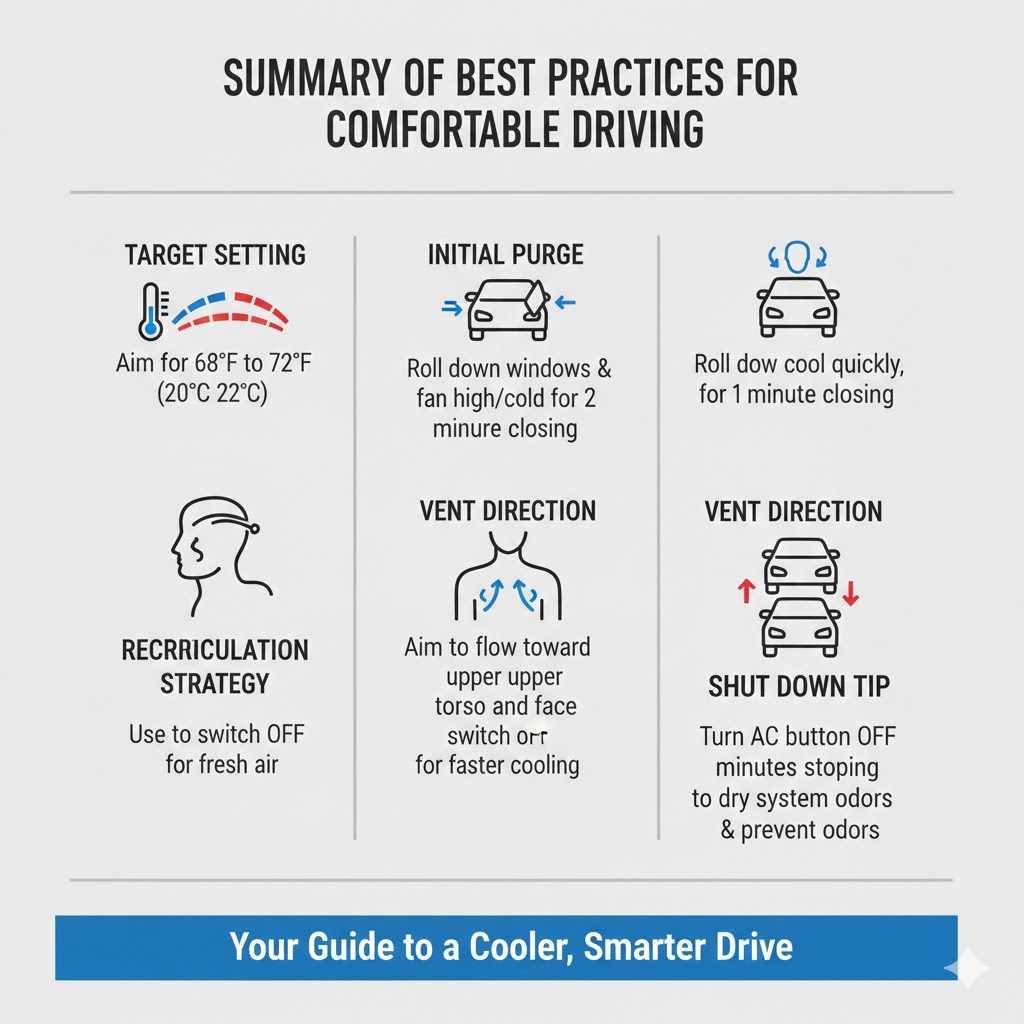
Summary of Best Practices for Comfortable Driving
To summarize the key takeaways for optimal performance and comfort:
- Target Setting: Aim for 68°F to 72°F (20°C to 22°C).
- Initial Purge: Always roll down windows and run the fan on high/cold for 1-2 minutes before closing up.
- Vent Direction: Aim flow toward your upper torso and face for faster perceived cooling.
- Recirculation Strategy: Use it to cool down quickly, then switch it off to bring in fresh air.
- Shut Down Tip: Turn the AC button off 5 minutes before stopping to dry out the system and prevent odors.
Frequently Asked Questions (FAQs) About Car Aircon Temperature
Q1: Is it bad for my car to run the AC on MAX/full cold all the time?
No, it is not inherently bad. Modern AC systems are designed for heavy use. However, running it at the absolute coldest setting constantly puts more strain on the engine and uses more fuel than setting it slightly warmer (like 70°F).
Q2: My car AC dial only goes from LO to HI. What temperature should I choose?
If you only have a ‘LO’ setting, it means your system will always run the coldest possible air the compressor can produce. In this case, you manage comfort by controlling the fan speed. Use a low fan speed for continuous comfort and a high fan speed when you first get in the car.
Q3: Why does the air sometimes blow warm when I have the AC on?
This usually means the AC compressor clutch is not engaging, or the refrigerant level is critically low. If it cycles on and off very quickly, the system may be low on refrigerant, or the pressure sensor is faulty.
Q4: Should I use the “Recirculate” button when I first turn on the AC?
Yes, absolutely. When the car cabin is hotter than the outside air (like after sitting in the sun), recirculation pulls the already-cooled air back over the evaporator coils, making the car cool down much faster than constantly pulling in super-hot outside air.
Q5: How often should I recharge my car’s AC refrigerant?
Refrigerant is not consumed like gas; it stays in a closed system. If you need to recharge it frequently (every year), you have a leak that needs professional repair. A healthy system should only need topping up every 5 to 10 years, if at all.
Q6: Does turning the temperature dial down help dehumidify the air better?
Yes, lowering the temperature forces the evaporator coil to get colder, which causes more moisture from the air to condense on the coil and drip out of the vehicle (that’s the water you see under the car). Drier air feels much more comfortable.
A Confident Conclusion on Car Climate Control
Mastering your car’s air conditioning is less about finding a magic number and more about understanding how the system interacts with your environment. By starting with a purge, aiming for that sweet spot between 68°F and 72°F, and using recirculation smartly, you gain immediate comfort and save wear and tear on your vehicle. Remember, your AC is designed to work hard for you, but giving it smart input—like letting it rest before you shut off the engine—ensures it stays reliable for many summers to come. Take control of those dials; a comfortable, cool ride is well within your reach!