What to Do If You Locked Keys Inside the Car
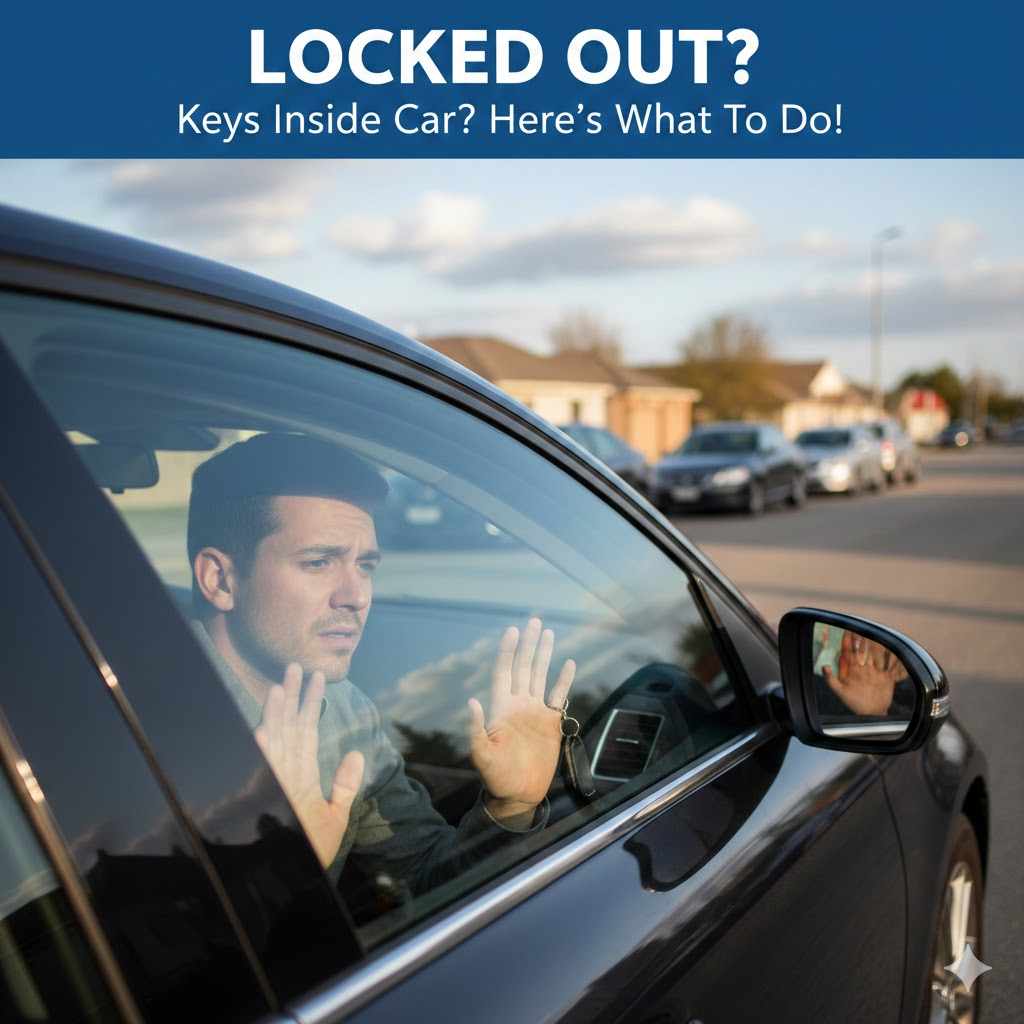
It happens to everyone at some point. You step out for a moment, and suddenly you hear that dreaded click. You’ve locked your keys inside your car.
This is a common and often frustrating problem, especially if you’re new to driving or just having a busy day. Don’t panic. We’ll walk you through what to do in a simple, step-by-step way.
Let’s figure out how to get back into your car quickly and easily.
Immediate Steps for Locked Keys Inside the Car
When you find yourself in this sticky situation, it’s easy to feel a wave of panic. But taking a deep breath and thinking clearly is the first and most important step. There are several actions you can take right away to address the problem.
These initial steps can help you get back on track without too much delay. We will explore the most common and effective solutions.
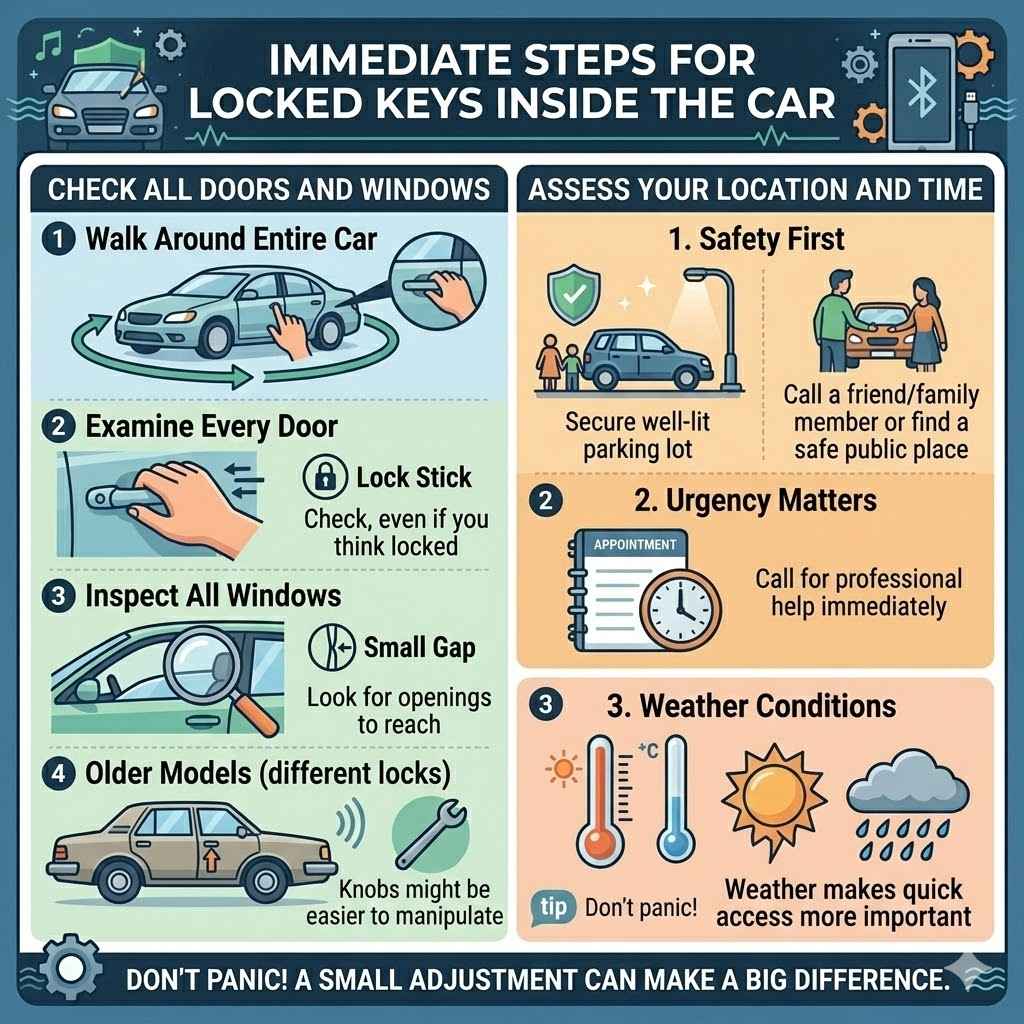
Check All Doors and Windows
Before you do anything else, make sure you’ve thoroughly checked every single door and window. Sometimes, one door might have been left unlocked, or a window might be open just enough to slip something through. This might sound obvious, but in the stress of the moment, it’s easy to overlook such simple solutions.
Walk around your entire car. Open each door handle, even if you think it’s locked. Sometimes a handle might stick or a lock might not have fully engaged.
Examine every window. Look for any gaps or openings. Even a small gap could be enough to try and reach in with a tool.
Consider older car models. Some older cars have different locking mechanisms. For example, some older vehicles might have a pull-up or pull-down knob on the inside of the door that could be easier to manipulate.
Assess Your Location and Time
Your immediate surroundings and the time of day can greatly influence the best course of action. Are you in a safe, well-lit area, or is it late at night on a deserted road? Do you have urgent appointments or commitments you need to get to?
Safety first. If you are in an unsafe area, your priority is to get to a safe place. If possible, call a friend or family member to come pick you up, or find a nearby public place like a busy store or gas station.
Urgency matters. If you have an important appointment, you’ll want to find the quickest solution. This might mean calling for professional help immediately rather than trying DIY methods.
Weather conditions. If it’s extremely hot or cold, or raining heavily, getting into your car quickly becomes more important for your comfort and safety. This might also push you towards professional services.
DIY Methods to Consider
While it’s often best to call a professional, there are a few DIY methods you might consider if you’re in a pinch and feel comfortable attempting them. These methods work best on older vehicles with less advanced locking systems. Be aware that attempting some of these can potentially damage your car if not done carefully.
It’s crucial to proceed with caution and understand the risks involved.
The Shoelace or String Method
This classic trick relies on the fact that many older car doors have a small post or knob that you pull up to unlock. A strong, thin shoelace or piece of string can be used to loop around this post and pull it up.
Find a sturdy, flat shoelace or a piece of string. A waxed shoelace might work better as it slides more easily. You’ll need enough length to loop around the lock post and have ends to pull on.
Create a slip knot in the middle of the shoelace. This knot should be able to tighten around the lock post.
Carefully insert the shoelace through the top of the door frame, above the weather stripping. You need to be gentle to avoid damaging the seal. The goal is to maneuver the shoelace until the slip knot is around the lock post.
Once the knot is around the post, pull the ends of the shoelace upwards and outwards simultaneously. This action should tighten the slip knot around the post and lift it, unlocking the door. This method requires a lot of patience and dexterity.
A real-life example of this method’s success was reported by a user online who managed to unlock their 1998 Honda Civic using a shoelace. They described it as taking nearly an hour of trial and error but ultimately working. This highlights that while possible, it’s not always a quick fix and depends on the car’s design.
The Coat Hanger Trick
Similar to the shoelace method, a wire coat hanger can be used to reach into the car and manually unlock the door. This requires bending the hanger into a specific shape.
Unbend a wire coat hanger until it’s mostly straight. Then, create a small hook or loop at one end. This hook will be used to snag the interior door lock mechanism.
Carefully insert the hooked end of the coat hanger through the gap between the window and the door frame. You may need to gently pry open the top of the door frame slightly to create enough space. Be extremely cautious not to scratch the paint or damage the window seals.
Maneuver the hook to reach the interior door lock. This could be a small lever, a knob, or a button depending on your car model. Once you have hooked the lock mechanism, try to pull or lift it to unlock the door.
This method is more effective on cars with vertical lock posts or levers. For cars with electronic lock buttons integrated into the door panel, this method is unlikely to work.
Statistics show that DIY methods like these have a success rate of around 30-40% for older car models, dropping significantly for cars manufactured after the early 2000s due to more complex security features. This suggests that while they can work, they are not always reliable.
Using a Wedge and Rod
For cars with slightly wider gaps between the door and the frame, a wedge (often an inflatable air wedge or a thin plastic wedge) can be used to create a larger opening. Once a gap is made, a long, thin rod or a straightened coat hanger can be used to reach the unlock button or lever.
Insert a slim wedge into the top corner of the door frame. Gently push the wedge in to create a small gap. If you are using an air wedge, inflate it slowly until a gap is formed.
Once the gap is sufficient, slide a long, thin rod or a straightened coat hanger through the gap. The goal is to reach the interior door handle or the electronic unlock button.
Carefully maneuver the rod or hanger to press the unlock button or pull the door handle. This requires precision and a good understanding of your car’s interior layout.
This method can be effective but carries a higher risk of damaging the door frame or the car’s paint if not done with extreme care. The cost of potential repairs could outweigh the savings of not calling a locksmith.
Consider a scenario where a parent accidentally locked their keys inside their minivan while their young child was still inside. They quickly used a plastic wedge to create a small opening and a long wooden dowel to press the electronic unlock button from the inside. This was a successful, albeit stressful, DIY solution.
The entire process took about 15 minutes.
When to Call Professional Help
While DIY methods can be tempting, there are many reasons why calling a professional is the safest and most efficient option. Modern cars have sophisticated locking systems and security features that make DIY attempts difficult and potentially damaging. Professionals have the right tools and expertise to handle these situations without causing harm to your vehicle.
Locksmith Services
Automotive locksmiths are specialists trained in vehicle entry. They have specialized tools designed to open car doors without damage. This is often the most reliable way to regain access to your locked car.
Prompt service. Most locksmiths offer 24/7 emergency services, meaning they can come to your location relatively quickly, even at odd hours.
Damage-free entry. Locksmiths use tools like slim jims, wedges, and specialized probes that are designed to manipulate the locking mechanism without scratching paint, breaking glass, or damaging weather stripping.
Expertise. They understand the various locking systems in different car makes and models, allowing them to choose the most effective and least intrusive method for your specific vehicle.
Cost-effectiveness. While there is a fee, it’s often less than the cost of repairing damage caused by unsuccessful DIY attempts or replacing a broken window.
A study by the National Automotive Service Task Force found that professional locksmiths have a success rate of over 95% in unlocking vehicles without causing any damage. This contrasts sharply with the success rates of DIY methods, especially on newer cars.
Roadside Assistance Programs
If you have a roadside assistance plan through your car insurance, a motor club (like AAA), or even some credit card companies, locked-out service is often included. This can be a very cost-effective solution.
Coverage details. Check your policy to understand what is covered. Most plans include lockout services, but there might be limits on the number of calls per year or specific types of vehicles.
Convenience. When you call your roadside assistance provider, they will dispatch a service vehicle to your location. This is typically a tow truck operator or a specialized locksmith they partner with.
Cost. If lockout service is covered, you may pay nothing extra, or just a small deductible. This is often significantly cheaper than calling an independent locksmith directly.
Verification. You may need to provide proof of membership or insurance to the service provider. Have your membership card or policy number readily available.
Consider the scenario of Sarah, who was locked out of her car at a shopping mall parking lot. She remembered her car insurance included roadside assistance. A quick call to her provider resulted in a technician arriving within 45 minutes who successfully unlocked her car using specialized tools.
She paid nothing extra for the service.
Police or Emergency Services
In some situations, particularly if there’s a child or pet locked inside the vehicle, or if you are in a dangerous location, police or emergency services might be able to help. However, their primary role is emergency response, so this should be a last resort for non-critical lockouts.
Emergency situations. If a child or pet is locked in a car, especially in extreme weather conditions, call 911 immediately. These situations are considered emergencies and will be prioritized.
Safety concerns. If you feel unsafe and are waiting for help in a remote or dangerous area, contacting local police can provide a sense of security while you wait for a locksmith or roadside assistance.
Limited capabilities. Police officers are not typically equipped with specialized tools for vehicle lockout. They may be able to force entry if it’s an emergency, but this will likely cause damage to your car.
Response time. Their response time will depend on other ongoing emergencies in the area. For a simple lockout without an immediate danger, they may not be able to assist or may advise you to call a locksmith.
It’s important to understand that police resources are for emergencies. While they might assist in extreme circumstances, they are not a substitute for professional automotive locksmith services for routine lockouts.
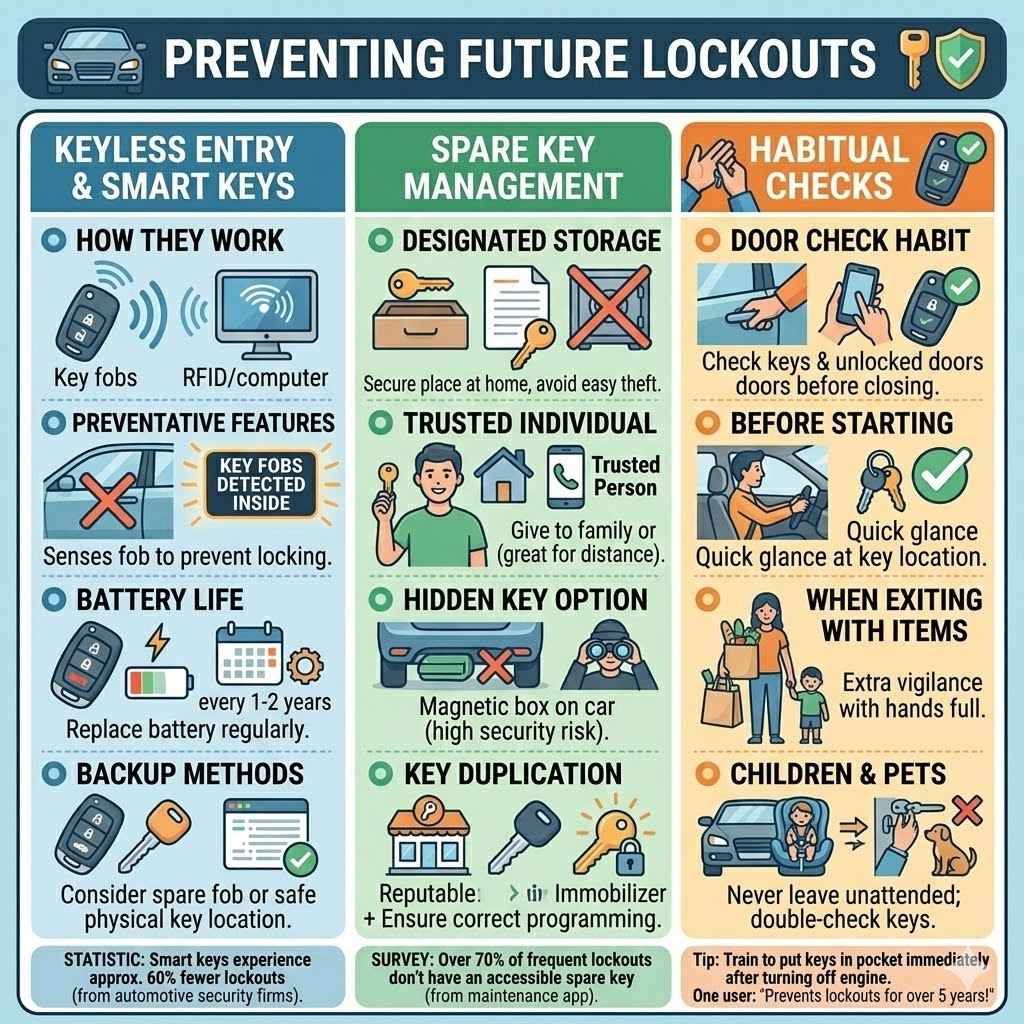
Preventing Future Lockouts
Once you’ve successfully regained access to your car, it’s a good time to think about how to avoid this stressful situation in the future. Simple habits and smart choices can save you a lot of trouble down the road.
Keyless Entry and Smart Keys
Many modern vehicles come equipped with keyless entry systems and smart keys. These technologies can significantly reduce the chances of locking your keys inside, as they often have features that prevent accidental locking when the key fob is not detected inside the vehicle.
How they work. Keyless entry systems use radio frequency identification (RFID) or other wireless technologies to allow you to unlock and start your car without physically inserting a key. The key fob transmits a signal that the car’s computer recognizes.
Preventative features. Most smart key systems are designed to detect if the key fob is inside the cabin. If the car’s computer senses the fob is inside, it will typically prevent the doors from locking when you try to close them.
Battery life. Remember that these fobs have batteries that need to be replaced periodically. If the battery is low, the system might not function correctly, potentially leading to lockouts.
Keep an eye on the battery indicator if your car has one, or replace the battery every 1-2 years as a preventative measure.
Backup methods. Even with advanced systems, it’s wise to have a backup plan. Some cars allow you to program a spare key fob, or you might consider keeping a spare physical key hidden in a secure location (though this is not recommended due to security risks).
Statistics from automotive security firms suggest that vehicles equipped with smart key technology experience approximately 60% fewer accidental lockouts compared to older vehicles with traditional key systems.
Spare Key Management
Having a spare key is your best defense against being locked out. The key is to keep that spare key in a safe and accessible place.
Designated storage. Keep your spare key in a secure place at home, such as a drawer or with your important documents. Avoid leaving it in a place where it could be easily stolen if your home is broken into.
Trusted individual. You can also give a spare key to a trusted family member or close friend. This is a good option if you live far from them, as they can bring it to you if needed.
Hidden key option. Some people choose to hide a spare key on their vehicle using a magnetic key box. However, this method comes with significant security risks, as these boxes can be found by thieves.
It is generally not recommended for valuable vehicles.
Key duplication services. When you get a spare key made, use a reputable locksmith or dealership. Ensure the new key is programmed correctly to your vehicle’s immobilizer system if applicable.
A survey by a car maintenance app found that over 70% of drivers who regularly experience lockouts do not have a spare key readily available or accessible when needed. This highlights the importance of proactive spare key management.
Habitual Checks
Developing a simple routine can prevent many lockout situations. These small checks become second nature over time.
The “door check” habit. Every time you exit your vehicle, make it a habit to quickly check that you have your keys and that the doors are unlocked before closing them.
Before starting. Before starting your car and driving away, quickly glance at your passenger seat or where you typically place your keys to ensure they are there.
When exiting with items. If you are carrying many items or have your hands full, be extra vigilant. This is often when people are most distracted and prone to locking keys inside.
Children and pets. If you have children or pets, never leave them unattended in the car, and always double-check that you have your keys before closing the door, as their actions can sometimes interfere with the locking process.
One user shared that they trained themselves to always put their keys in their pocket immediately after turning off the engine and before opening the door. This simple habit has prevented them from locking keys in their car for over five years, despite living in a busy urban environment.
Frequently Asked Questions
Question: What is the fastest way to get into a locked car?
Answer: The fastest way is usually to call a professional automotive locksmith or your roadside assistance service. They have the right tools and expertise to open your car quickly and without damage.
Question: Can I break my car window if I’m locked out?
Answer: While you can break a car window, it is generally not recommended as a first step. It is expensive to replace, and it can be dangerous. Only consider this in extreme emergencies, like if a child or pet is in danger, and call emergency services first.
Question: How much does it cost to have a locksmith unlock my car?
Answer: The cost can vary widely depending on your location, the time of day, and the complexity of your car’s locking system. You can expect to pay anywhere from $50 to $200 or more. It’s always a good idea to get a quote before they arrive.
Question: Are DIY methods safe for my car?
Answer: DIY methods can be risky. While they might work on older cars, they can cause damage to the paint, window seals, or internal locking mechanisms on newer vehicles. Professional services are generally safer for your car.
Question: What should I do if my car key is lost, not just locked inside?
Answer: If your key is lost, you will likely need to contact a dealership or a specialized automotive locksmith to get a replacement key made and programmed for your vehicle. This is a more involved process than simply unlocking the car.
Conclusion
Dealing with locked keys inside your car is a common problem, but it doesn’t have to be a disaster. By staying calm and knowing your options, you can resolve the situation effectively. Whether you attempt a simple DIY fix on an older car or call in the professionals for a modern vehicle, there are clear steps to get you back on the road.
Remember to have a spare key and make checking for your keys a habit to prevent future lockouts.