Best Car Batteries for Stop-Start Vehicles (2026): based on specs and reviews
For a stop-start vehicle, an AGM battery in the specified group size is often a good choice; if the car came with EFB, it is usually best to stay with that type, and lithium should only be used if the charging system and battery monitor support it. Pick wrong, and you can get shorter battery life, charging faults, and stop-start that quits working. This guide compares AGM, EFB, and lithium options by vehicle fit, climate, and charging requirements.
This guide is part of our Car battery basics: troubleshooting, charging and care series.
Best car battery for stop-start vehicles: AGM vs LiFePO4
The safest default is the WEIZE Platinum AGM Battery for most stop-start drivers, because AGM chemistry fits frequent restart duty, works with many factory charging systems, and avoids the compatibility risk that comes with lithium swaps. It is the better first stop for shoppers who want a replacement that is most likely to behave like the OEM battery.
📊 The Mighty Max battery is described as Group 47. Source: Best Battery For Stop Start Cars [Updated: October 2026].
Quick comparison
| Product | Badge | Best for | Price | ||
|---|---|---|---|---|---|
 |
BOSCH BAT414-2PK 12V Max Lithium Ion 2 Ah Battery 2-PackBosch | Budget pick | 12V · 2 Ah · Lithium Ion · 2-Pack | $68.98
Price as of 9 Oct 2026
|
View |
 |
Weize Platinum AGM Battery BCI Group 35 Automotive Battery,WEIZE | Our pick | 650 CCA · AGM · 100RC · Group 35 | $179.99
Price as of 9 Oct 2026
|
View |
The safest buy is the battery that matches your car’s group size and charging logic before you chase a higher CCA label. For most factory stop-start setups, AGM is the conservative choice; lithium only makes sense when the car explicitly supports it.

How we chose
Fitment came first. Group size, terminal layout, case height, hold-down style, and venting can make a battery fail at install even when the voltage and CCA look right.
System match came second. Stop-start cars often use smart charging, battery monitoring, and regeneration strategies that expect a certain chemistry and internal resistance.
Spec balance mattered too. CCA helps cranking, Ah helps accessory load support, and reserve capacity helps the battery tolerate repeated stop-start cycling.
Value was judged on lifespan cost, not sticker price alone. Warranty length, likely cycle life, and any coding or registration work all change the real replacement bill.
What is the best car battery for a stop-start vehicle?
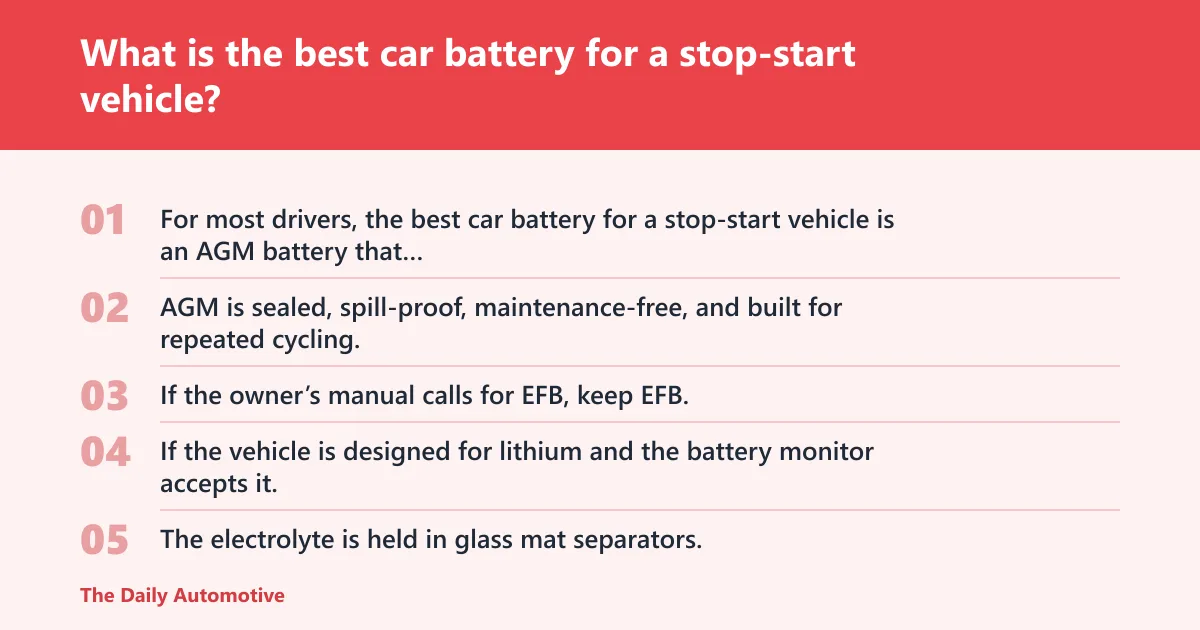
For most drivers, the best car battery for a stop-start vehicle is an AGM battery that matches the factory group size and electrical spec. AGM is sealed, spill-proof, maintenance-free, and built for repeated cycling, which makes it the safest broad fit for cars that shut off and restart at lights.
If the owner’s manual calls for EFB, keep EFB. If the vehicle is designed for lithium and the battery monitor accepts it, a LiFePO4 battery can work, but that is a narrower use case than many shoppers assume.
Why AGM is the default safe choice
AGM stands for Absorbent Glass Mat. The electrolyte is held in glass mat separators, so the battery is sealed and maintenance-free rather than venting acid under normal use like older flooded batteries.
That construction helps with cycle life and vibration resistance, both of which matter in stop-start driving. Frequent restarts and shallow charge swings are exactly where a conventional starter battery tends to wear out early.
When LiFePO4 makes sense
LiFePO4, or lithium iron phosphate, is a 12.8V nominal chemistry with a battery management system, or BMS, that protects against overcharge and overdischarge. It is lighter than lead-acid, and that weight savings can matter in specialty builds.
But the fit is narrower. A lithium battery can be the wrong choice if the alternator, smart charging logic, or battery monitor expects AGM behavior. The article’s lithium option is listed as 12.8V, 576Wh, Group 47, with a BMS and start-stop compatibility, which shows the kind of setup that can work only when the system is designed for it.
When the owner’s manual points you somewhere else
If the manual specifies EFB, AGM, or an OE part number, that instruction beats general advice. Some vehicles need battery registration or coding after replacement, especially when the battery monitoring system learns charge state and age from the old battery profile.
Ignoring that can cause undercharging, overcharging, or stop-start disablement. The battery may crank the engine, but the car can still complain or shorten the new battery’s life.
AGM battery: best for most stop-start drivers
AGM is the best fit for most stop-start drivers because it handles frequent engine restarts, repeated shallow cycling, and vibration better than a standard flooded starter battery. It is also maintenance-free and sealed, which reduces service concerns after installation.
Absorbent Glass Mat construction and sealed design
AGM batteries keep electrolyte absorbed in glass mat separators. That sealed, spill-resistant design makes them easier to live with in modern engine bays and helps them tolerate repeated discharge-recharge events.
Why cycle life and vibration resistance matter
Stop-start systems ask a battery to do more than crank once a day. They want reliable restarts, support for accessories while the engine is off, and decent recovery after short trips. AGM’s cycle life makes that duty less punishing than a normal starter battery.
What to check before you buy
- Group size: match the OEM BCI group number first.
- Terminal layout: positive and negative posts must land in the same place.
- Case height: some trays and hoods leave little room.
- Hold-down style: top clamp and side clamp systems are not interchangeable in many cars.
- Venting: some vehicles expect a vented battery setup.
Weize Platinum AGM Battery: best for a safe factory-style replacement
This is the cleaner choice for drivers who want an AGM replacement with stop-start-friendly chemistry and straightforward fitment cues. It is listed as Group 35, with 12V 55AH, 650 CCA, and a 100RC reserve rating, which gives it a balanced spec sheet for daily use.
What stands out is the AGM construction and the way the numbers fit the typical replacement brief: enough cranking power, usable reserve capacity, and a chemistry that matches many stop-start systems. The main drawback is that Group 35 is not the right fit for every vehicle, so you still need to verify tray size, terminal orientation, and hold-down hardware before ordering.
Mighty Max MM-H5: best for Group 47 fitment
This is the pick for shoppers who need a Group 47 battery and want a listed spec that is easy to compare against the factory battery. It is listed as 12V 60Ah with 680 CCA, and its dimensions are 9.53 x 6.88 x 7.48 inches.
The appeal is simple: it gives you a clear Group 47 starting point with a three-year warranty, which is useful when replacement labor is not cheap. The drawback is the same one that applies to any group-specific battery: the label can look right while terminal position, venting, or tray clearance is still wrong, so fitment still has to be checked line by line.
Is lithium battery better than AGM for stop-start cars?
Not usually. Lithium iron phosphate can be better for weight savings, but AGM is the better everyday answer for most stop-start cars because it is more likely to match the vehicle’s charging logic without extra work. Lithium only wins when the car is built for it or explicitly approved for it.
12.8V nominal voltage and BMS protection
A LiFePO4 battery has a 12.8V nominal voltage, but voltage alone does not make it a drop-in replacement. The BMS is the safety layer that controls overcharge, overdischarge, and cell balancing, and it has to cooperate with the car’s charging behavior.
Cost tradeoff and cold-weather limits
Lithium batteries usually cost more up front. That is the wrong trade for many drivers unless the weight savings or the cycle profile matters enough to offset the higher purchase price and the compatibility screening.
Cold weather is another caution point. A lithium battery can work in winter, but the system needs to be chosen with low-temperature starting behavior in mind, not just headline energy density.
Start-stop compatibility checks
Before choosing lithium, confirm that the car’s alternator strategy, battery monitor, and charging profile support LiFePO4. If the vehicle expects AGM behavior and the lithium pack lacks proper support, the result can be charging faults or shortened battery life.
Lithium iron phosphate battery: best for weight savings
The lithium option is best for a narrow set of vehicles where the charging system explicitly supports LiFePO4 and the owner wants the weight advantage. It is listed as 12.8V, 576Wh, Group 47, and it includes a BMS with start-stop compatibility.
The upside is obvious: lighter weight and modern protection electronics. The downside is compatibility risk, higher purchase cost, and less forgiveness when the car’s charging logic is not tuned for lithium behavior.
How do CCA, Ah, and reserve capacity affect stop-start use?
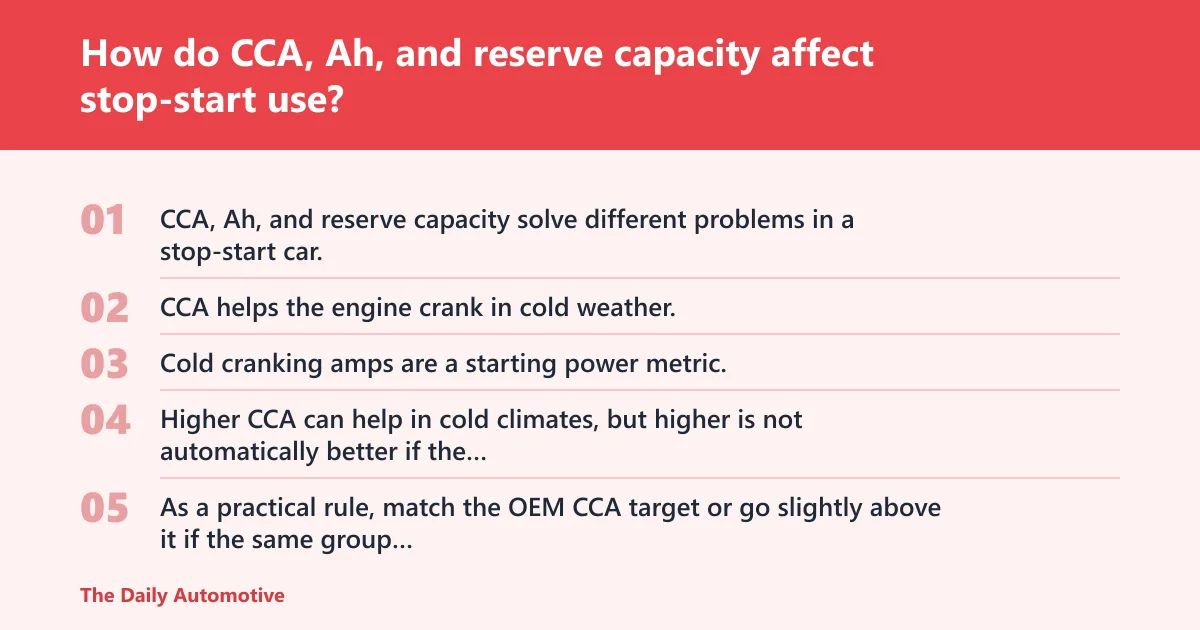
CCA, Ah, and reserve capacity solve different problems in a stop-start car. CCA helps the engine crank in cold weather, Ah helps support accessory loads and repeated idle-off events, and reserve capacity tells you how long the battery can keep supplying power if charging is delayed.
Cold starts and CCA
Cold cranking amps are a starting power metric. Higher CCA can help in cold climates, but higher is not automatically better if the battery is the wrong group size or has poor reserve capacity for the car’s stop-start duty.
As a practical rule, match the OEM CCA target or go slightly above it if the same group size and battery type are available. For many replacement batteries in the Group 34 and Group 47 space, that commonly means the mid-600s CCA range, such as the 650 CCA and 680 CCA examples listed here.
Accessory loads and Ah
Ah, or amp-hours, is the capacity rating. It matters when the car powers accessories while the engine is off, and it matters more in stop-start use than many shoppers realize because the battery is often asked to recover fast after each restart.
The Mighty Max is listed at 60Ah, and the WEIZE AGM at 55AH. Those are useful comparison points, but the correct choice still depends on the factory spec and available tray space.
Backup time and reserve capacity
Reserve capacity is measured in minutes and shows how long the battery can supply power before voltage falls too far. That matters in stop-start vehicles because the engine may sit off longer than a normal starter battery was designed to tolerate.
The WEIZE listing includes 100RC, which is a helpful sign for endurance. If a battery has strong CCA but weak reserve capacity, it may crank well and still fall short in real stop-start use.
Stop-start battery decision matrix
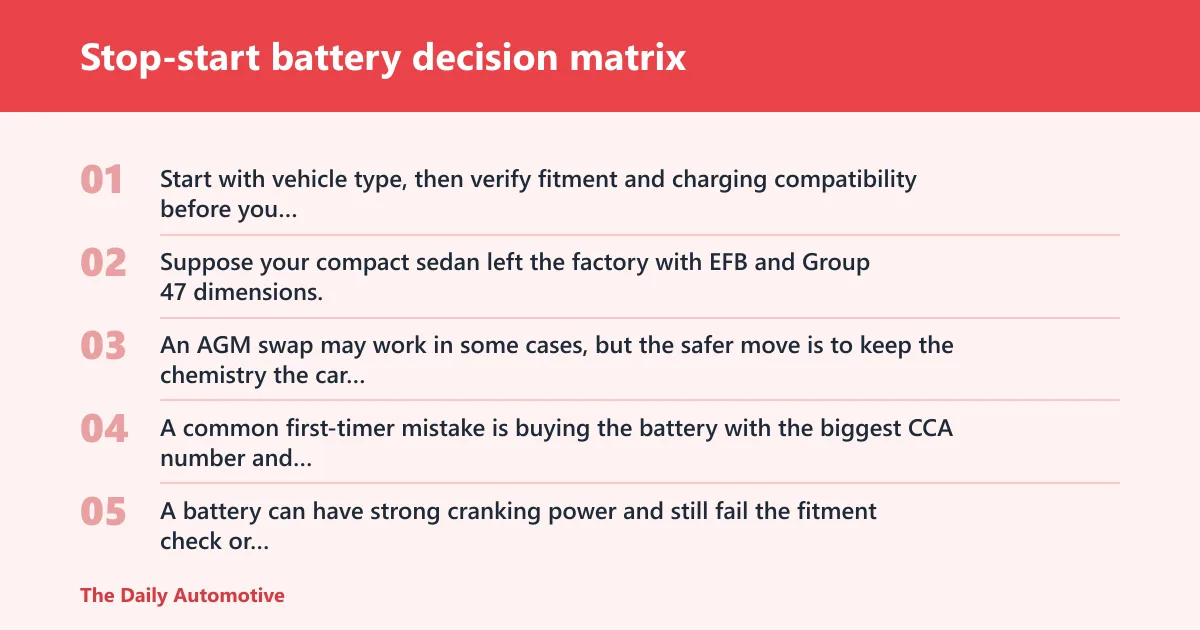
This matrix is the practical shortlist. Start with vehicle type, then verify fitment and charging compatibility before you compare price or warranty.
| Vehicle type | Best chemistry | Common group sizes | Fitment yes/no checks | Charging-system compatibility | Shortlist rule |
|---|---|---|---|---|---|
| Factory stop-start, no special battery notes | AGM | Group 35, Group 47 | Check tray size, terminal layout, hold-down, venting | Usually yes if OEM used AGM | Yes, if group and terminals match |
| Factory stop-start with EFB specified | EFB | OEM group only | Use the same case size and vent path | Yes, if EFB is the factory design | Yes, keep EFB rather than forcing AGM |
| Performance or weight-sensitive build with lithium approval | LiFePO4 | Group 47 if approved | Confirm height, hold-down, and terminal layout | Only if alternator and battery monitor support lithium | Yes, only with explicit support |
| Older vehicle without smart charging | AGM or EFB | Match OEM case size | Check venting and clamp style | Usually simple, but confirm charging voltage | Yes, AGM is the safer default |
| Any car with unknown battery spec | OEM spec first | Owner’s manual or label | Must verify all physical dimensions | Registration may be required | No until the manual is checked |
Say your car came with EFB
Suppose your compact sedan left the factory with EFB and Group 47 dimensions. An AGM swap may work in some cases, but the safer move is to keep the chemistry the car was designed around unless the manufacturer says AGM is approved.
A common first-timer mistake is chasing the highest CCA
A common first-timer mistake is buying the battery with the biggest CCA number and ignoring reserve capacity, case height, and terminal layout. A battery can have strong cranking power and still fail the fitment check or underperform in short-trip stop-start use.
How long should a stop-start car battery last?
A stop-start battery often lasts less time than a battery in a non-stop-start car because the operating cycle is harsher. AGM typically lasts longer than a standard flooded starter battery in this duty, but short trips, heat, and poor charging control can shorten any battery’s service life.
Warranty is only one clue. A three-year warranty, like the one listed for the Mighty Max MM-H5, may help with risk, but it does not replace proper fitment or a compatible charging system.
Do stop-start batteries need special charging?
Yes, in many cars they do. Stop-start vehicles often use smart charging, battery monitoring, and charging strategies that expect the correct chemistry and may require battery registration or coding after replacement. A generic charger can be fine for maintenance, but the vehicle itself may need the right battery profile.
That is why lithium is not a casual upgrade. A LiFePO4 battery with a BMS is only part of the equation; the alternator behavior and vehicle software still have to agree with it.
What size battery fits your car?
The right size is the BCI group size the car specifies, plus the correct terminal layout, case height, hold-down style, and venting. Group 34 and Group 47 are common stop-start battery sizes, but the correct answer is always the one that fits the tray and matches the factory spec.
BCI Group size basics
BCI group size is a physical fitment standard. It tells you the battery’s general footprint and terminal arrangement, which is why two batteries with similar CCA can still be incompatible.
Group 34 vs Group 47
Group 34 and Group 47 are not interchangeable by assumption. The case length, width, and height matter, and so do the post positions and clamp style. A battery can be close and still be wrong.
Terminal layout, case height, and hold-down checks
Before buying, check the positive terminal location, the negative terminal location, and whether the battery is top-post or a variant the tray expects. Then compare the physical dimensions against the battery tray and hood clearance.
The product data here gives two useful examples: the Mighty Max MM-H5 is 9.53 x 6.88 x 7.48 inches, and the MARXON Group 34 is listed at 10.87 x 6.61 x 6.89 inches. Those numbers show why group size and actual dimensions both matter.
Which one should you buy
If your car originally used AGM and you want the least risky replacement, start with the WEIZE Platinum AGM Battery. If your vehicle needs Group 47 and the dimensions line up, the Mighty Max MM-H5 is the cleaner fit from the data here. If your car explicitly supports LiFePO4, the lithium option can make sense for weight savings, but only after the charging system check passes.
For budget-minded buyers, the right answer is not the lowest sticker price. It is the battery that avoids coding headaches, fits the tray, and survives stop-start cycling long enough to beat the cost of a second replacement.
Frequently asked questions
What is the best car battery for a stop-start vehicle?
The best car battery for a stop-start vehicle is usually an AGM battery that matches the exact group size your car specifies. AGM is the most common safe choice because it handles frequent restarts, shallow cycling, and vibration better than a standard starter battery. EFB should stay in place if the factory spec calls for it.
Do stop-start cars need AGM batteries?
Not always, but many do. Some stop-start cars were designed for EFB, some for AGM, and a few can support lithium if the system is approved for it. The owner’s manual or factory battery label should decide the chemistry, not a generic rule.
Can I use a normal battery in a start-stop car?
You usually should not. A normal flooded starter battery can wear out early in a stop-start vehicle because it was not built for frequent engine restarts or repeated shallow discharge cycles. It may also cause poor stop-start behavior or charging issues.
How many CCA should a stop-start battery have?
It should have at least the CCA level the OEM specifies, and a little more can help in cold climates if the group size and chemistry stay correct. For many replacement batteries in common stop-start sizes, the numbers often land around the mid-600s, but the factory spec still matters most.
What size battery fits my stop-start car?
The right size is the exact BCI group the car calls for, such as Group 34 or Group 47, plus the correct terminal layout and case height. Do not rely on CCA alone. A battery can have the right electrical spec and still fail the physical fit check.
Do stop-start batteries need special charging?
Often yes. Many stop-start cars use smart charging and a battery monitor that expects a specific chemistry and may need battery registration after replacement. A lithium battery also needs a compatible charging system and BMS support, so confirm system requirements before you buy.
Products related to this article
Sponsored / affiliate links. As an Amazon Associate I earn from qualifying purchases. I may earn additional commission from eligible campaigns.