Why Is Carvana Considered Bad by Some Buyers?
Carvana can earn a bad reputation because convenience breaks in three places: delivery, paperwork, and condition mismatch. Any one can turn a simple used-car purchase into a costly headache. A late handoff, delayed registration, or car that arrives worse than described can mean fees, lost time, or a return dispute. This guide breaks down those failure points and what to check before you buy.
Why some buyers call Carvana bad
Carvana is an online used-car retailer, and it sells used vehicles only. The question is not whether the company exists. It is whether the specific car, paperwork, and delivery process arrive on time and match the listing.
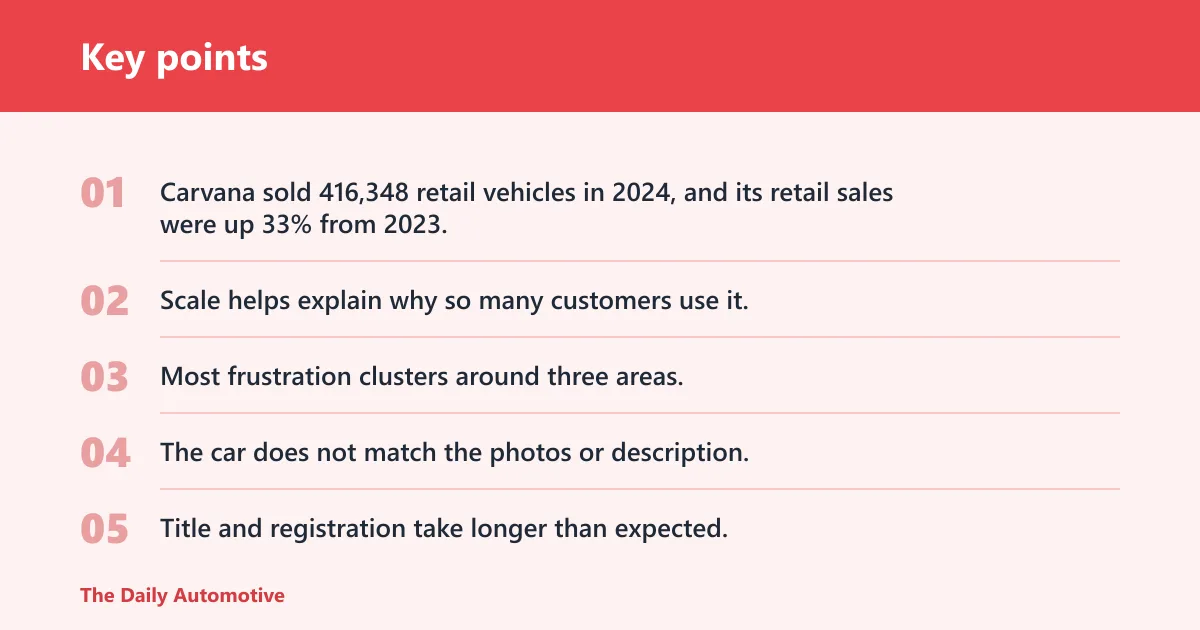
That distinction matters. Carvana sold 416,348 retail vehicles in 2024, and its retail sales were up 33% from 2023. Scale helps explain why so many customers use it, and why a small percentage of failed deliveries or paperwork delays can create a lot of complaints.
The three failure modes that drive complaints
Most frustration clusters around three areas. Delivery timing slips. The car does not match the photos or description. Title and registration take longer than expected. Buyers then face a chain reaction: temporary tags expire, insurance setup stalls, and the car may be hard to register on time.
That is why some reviews sound much harsher than the platform itself. A smooth online checkout can still end badly if the handoff is late or the paperwork does not follow through.
Convenience versus execution
Carvana’s appeal is convenience. Buyers can shop online, review photos, review a vehicle history report, arrange home delivery, or use vending-machine pickup in some markets. The risk is that convenience compresses the buyer’s inspection time and shifts more responsibility to the first few days after delivery.
Picture a buyer who needs a commuter car by Monday and accepts a Tuesday delivery without checking the title timeline. If the temporary tag expires before registration is complete, the car may sit unused even though the sale itself was valid.
What Carvana actually
Carvana is an online used-car retailer based in Arizona. It lists used vehicles with photos and a vehicle history report, then handles the purchase process digitally. Buyers can arrange home delivery or, in some locations, vending-machine pickup.
The site’s value proposition is straightforward: fewer dealership visits, less back-and-forth, and a defined return window. The tradeoff is that you need to verify the car carefully and track the paperwork as closely as you would on a private-party purchase.
Photos, history reports, and used-only inventory
Each listing should be treated as a starting point, not the final word. Photos can hide curb rash, tire wear, interior stains, or mismatched trim. The vehicle history report helps, but it does not replace a visual inspection. It can show ownership history, reported accidents, and title events, yet it will not catch every cosmetic or mechanical issue.
Carvana risk checklist table
| Risk area | What to verify before accepting delivery | What to do if it fails |
|---|---|---|
| Delivery timing | Confirm the delivery date, time window, contact number, and whether the vehicle will arrive with temp tags and paperwork | Document the delay, ask for a revised ETA in writing, and confirm whether the return clock starts at handoff |
| Listing mismatch | Compare photos, trim, mileage, tires, dash warning lights, exterior damage, and interior condition against the listing | Refuse acceptance if the mismatch is material, or use the return window immediately if you have already taken delivery |
| Title and registration delays | Ask when the title transfer will be filed, what temp tag timeline applies, and what documents you will receive first | Escalate support, keep copies of every message, and avoid assuming registration will clear without action |
| Financing and documents | Confirm pre-qualification, income and residency documents, proof of insurance, and your payment method before delivery day | Pause delivery until the file is complete so you do not lose time on a failed handoff or changed terms |
| Return-window actions | Know the 7-day window, the 400-mile limit, and the exact steps for scheduling a return | Act early, keep the car under the mileage cap, and do not wait until day 7 if the issue is clear on day 1 |
Is buying from Carvana a good idea?
It can be a good idea if you value convenience, can inspect quickly, and are comfortable managing risk in the first week. Carvana’s seven-day return policy is a real safety net, and it allows up to 400 miles. That helps, but it does not erase the need to check everything the day the car arrives.
Best fit for convenience-first shoppers
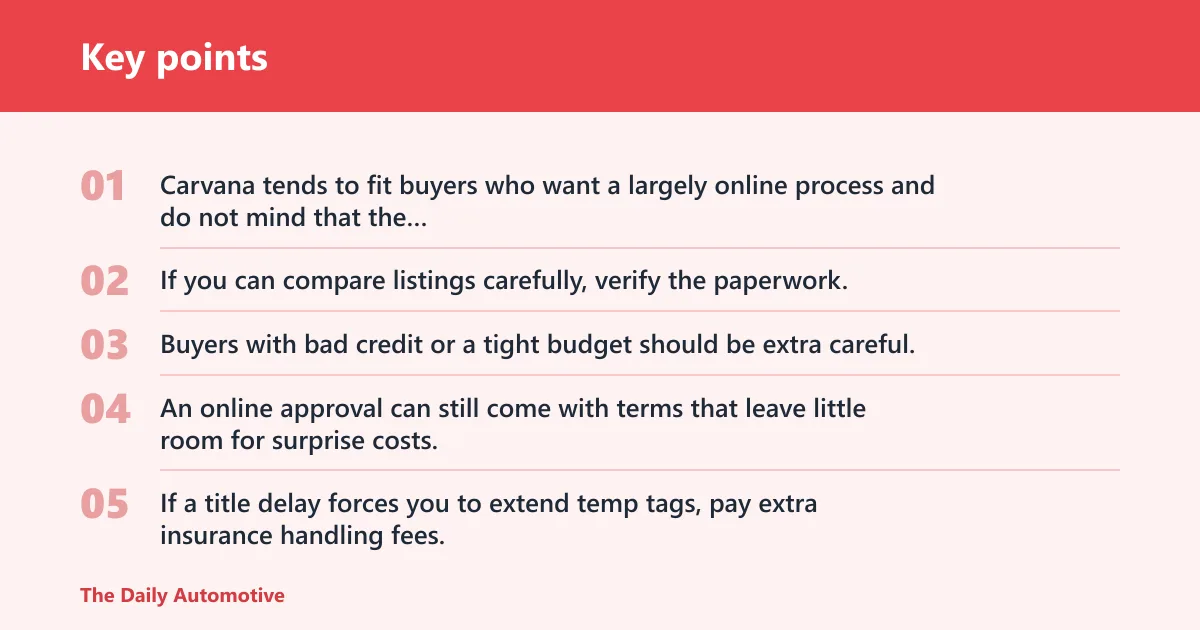
Carvana tends to fit buyers who want a largely online process and do not mind that the strongest protections come after delivery, not before it. If you can compare listings carefully, verify the paperwork, and act quickly if something is off, the model can work well.
When bad credit or a tight budget changes the math
Buyers with bad credit or a tight budget should be extra careful. An online approval can still come with terms that leave little room for surprise costs. If a title delay forces you to extend temp tags, pay extra insurance handling fees, or take time off work to resolve paperwork, the bargain may shrink fast.
A common first-timer mistake is focusing on the monthly payment and ignoring the cost of a delayed registration. A lower payment does not help if the car cannot be driven legally when needed.
When to skip it and shop locally
If you need to inspect a car in person before committing, local shopping may be safer. The same is true if your budget is so tight that a missed delivery, an extra week on temp tags, or a return process would create real strain.
What should you verify before delivery?
Before delivery, verify the listing, the mileage, the history report, and every document tied to the transaction. The first 24 hours matter most because that is when you can catch mismatch problems while the return option is still intact.
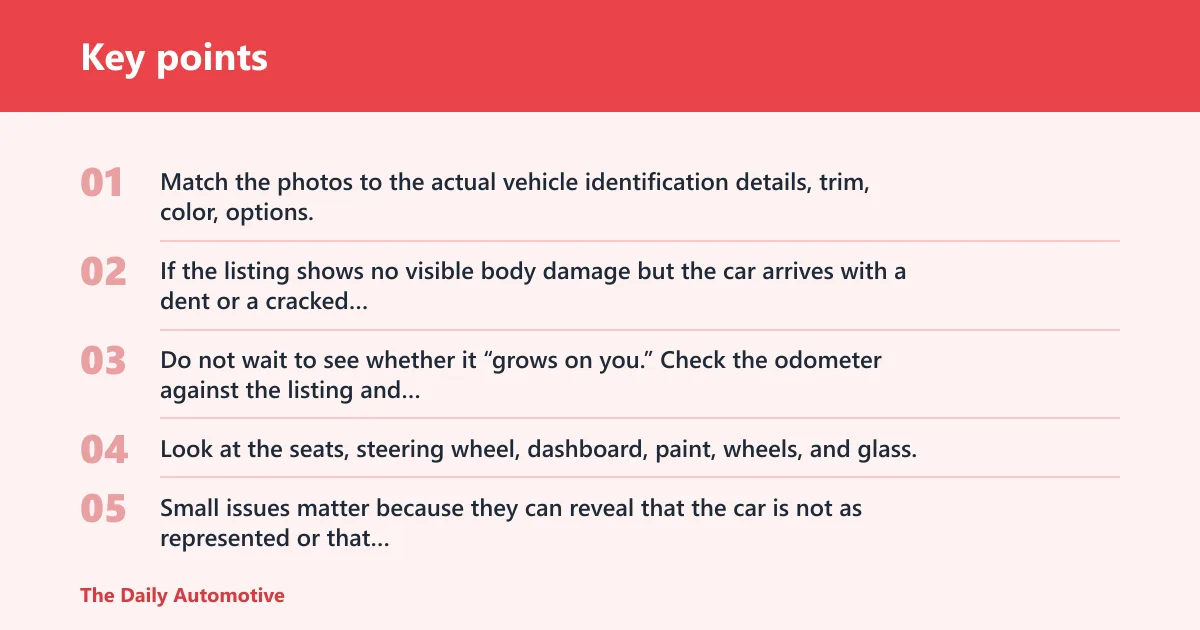
Photo and description match
Match the photos to the actual vehicle identification details, trim, color, options, and cosmetic condition. If the listing shows no visible body damage but the car arrives with a dent or a cracked lens, document it right away. Do not wait to see whether it “grows on you.”
Mileage, tire wear, and cosmetic condition
Check the odometer against the listing and inspect all four tires for uneven wear or low tread. Look at the seats, steering wheel, dashboard, paint, wheels, and glass. Small issues matter because they can reveal that the car is not as represented or that it was used harder than expected.
Suppose the listing says 32,100 miles and the car arrives with 34,000 miles. Even if the difference is small, that is still a verification problem worth flagging before you sign off.
History report flags and title events
Read the vehicle history report for ownership history, reported accidents, and title events. If the report shows salvage branding, flood history, or repeated title changes, ask for a plain explanation before delivery. A clean-looking photo set does not cancel a messy title record.
Insurance, payment, and delivery paperwork
Have proof of insurance ready, confirm the payment method, and make sure any income or residency documents requested by the financing team are already uploaded. This is where many handoffs stall. A missing file can turn delivery day into a reschedule.
Why title and registration delays matter
Title and registration handling is one of the most common complaint areas because delays can create downstream costs for the buyer. If the title transfer runs late, you may deal with temp-tag extensions, insurance friction, or legal exposure if the car is not registered on time.
Carvana’s title and registration handling score is listed at 7.3/10, which lines up with the complaints many shoppers report. That does not mean every registration stalls. It does mean buyers should watch the timeline closely instead of assuming the transfer is automatic.
How delays affect temp tags and insurance
Temporary tags are meant to bridge the gap between delivery and registration. If the paperwork lags, those tags can become a problem. Some insurers also want confirmation that the car is properly titled and registered before they finalize the file, which can create another round of follow-up.
What paperwork should arrive on time
Ask which documents you should receive at delivery, which ones are filed after, and when the title transfer is expected to move. Keep screenshots of messages, upload confirmations, and any delivery paperwork. If the timeline changes, you need a paper trail.
When to press support for action
If a promised filing date passes without movement, contact support immediately and ask for a status update in writing. Do not wait until the temp tag is nearly expired. The earlier you push, the more likely you are to avoid a driving gap.
How the seven-day return window works
Carvana gives buyers a seven-day return policy, and the window allows up to 400 miles. That is the platform’s biggest buyer safeguard, but it works only if you inspect quickly and move before the clock runs out.
Carvana’s return policy score is listed at 9.2/10, which is one reason the platform can still be a reasonable choice for cautious shoppers. The safety net is real. It is not an excuse to delay your own inspection.
Carvana considered bad by inspection checklist
- Walk around the car in daylight and photograph every panel, wheel, and glass surface.
- Compare the odometer, trim, and options against the listing.
- Check for warning lights, tire wear, fluid leaks, and interior damage.
- Confirm you received the expected paperwork and temp-tag details.
- Drive the car on local streets and at highway speed, if safe, to check braking, steering, and noise.
When to return the car instead of waiting
Return the car early if the mismatch is material, the paperwork is clearly wrong, or the vehicle feels unsafe. Waiting until day 6 reduces your options. If the issue is cosmetic only, you still need to decide whether the condition is acceptable before the mileage cap eats into your window.
What happens if the Carvana car doesn’t match the listing?
If the car does not match the listing, document the difference immediately and decide whether the issue is serious enough to use the return window. A small scratch may be tolerable. A different trim, wrong mileage, unresolved warning light, or a major body repair issue is a different matter.
Use photos, timestamps, and a short written summary. The stronger your record, the easier it is to show that the problem existed at delivery rather than after your use of the car.
Carvana’s financing and seller side
Financing on Carvana starts with online pre-qualification, then moves into document checks. Buyers may need to provide income and residency documents, proof of insurance, and a payment method choice before delivery is finalized. That process can be efficient, but only if your file is complete.
Carvana also buys cars from sellers through an online cash offer system. Sellers can usually arrange pickup or drop-off, but the final offer can change after inspection if the vehicle condition does not match what was entered online. That adjustment is normal enough to plan for.
Frequently asked questions
Why does Carvana have such bad reviews?
Many bad reviews come from three friction points: delivery delays, paperwork delays, and a car that does not match the listing. Those failures are especially frustrating because the buyer expects an easy online process. A legitimate company can still produce a bad experience when the handoff breaks down.
Is Carvana legit or just risky?
Carvana is legit. The risk is operational, not fake-platform risk. Buyers still need to verify the car, watch the title timeline, and act fast during the return window. For a cautious shopper, legitimacy is only the first question. Fit and follow-through matter more.
What problems do buyers run into with Carvana?
The most common problems are late delivery, paperwork that drags past expectations, and cars that arrive with condition issues not obvious in the listing. Buyers also report friction around temp tags, registration timing, and support follow-up. Those are practical problems, not abstract complaints.
What should I check before accepting a Carvana car?
Check the mileage, trim, tires, cosmetic condition, warning lights, and paperwork before you sign. Compare the car directly against the listing photos and the history report. If anything is materially off, document it immediately and decide whether to reject the delivery or return it right away.
How bad is Carvana for delivery and paperwork issues?
Delivery and paperwork are the two areas that most often turn a convenient purchase into a frustrating one. The platform’s delivery and handoff reliability score is listed at 7.8/10, while title and registration handling is 7.3/10. That is usable, but not low-risk.
Should I buy from Carvana if I want convenience?
Yes, if convenience is your top priority and you are willing to do fast due diligence after delivery. The return window helps, but it is best treated as a backup, not a substitute for inspection. If you need certainty before purchase, convenience alone is not enough.
Products related to this article
Sponsored / affiliate links. As an Amazon Associate I earn from qualifying purchases. I may earn additional commission from eligible campaigns.