Best Car Finance Options for Credit Union Members
The best car finance option for credit union members is usually the lowest total-cost loan you qualify for through your own credit union or a partner lender, after you compare APR, fees, term length, and vehicle limits. A headline APR can mislead you if fees are higher, the term runs longer, or the loan does not fit the car. This guide compares the main auto loan options, how membership rules affect eligibility, and how to judge the real cost before you sign.
Quick picks
| Best for | Pick | Why it fits | Watch for |
|---|---|---|---|
| Low APR and long terms | PenFed Credit Union auto loans | APR starting at 4.19%, terms from 36 to 84 months, loan amounts up to $150,000, no early payoff fees | Membership requires a $5 deposit before funding |
| Used cars and refinance shoppers | Navy Federal Credit Union auto loans | Often used as a long-term financing benchmark by members who want auto loans and refinancing options | Eligibility is membership-based and should be checked before application |
| Fast digital approval | Alliant Credit Union auto loans | Member-focused digital application flow, competitive rates, flexible underwriting | Digital speed still depends on document quality and vehicle details |
| Rate-sensitive members | First Tech Federal Credit Union auto loans | APR discount positioning and competitive rate promotions | Promo pricing may depend on membership or loan setup |
| Lowering a current payment | Service Credit Union auto refinance | Refinancing-focused option for a lower APR, smaller payment, or shorter payoff time | Not every existing loan qualifies for refinancing |
PenFed Credit Union auto loans
PenFed is a strong fit when you want a large loan, a broad term range, and no early payoff fee. Its auto loans start at 4.19% APR, loan amounts go up to $150,000, and terms run from 36 to 84 months. Membership is required, and PenFed says you can open membership with a $5 deposit.
Best for larger loan amounts
PenFed is the clearest fit for borrowers who need room on price, vehicle type, or loan structure. The high maximum loan amount helps if you are financing a pricier new car, a longer-term used car purchase, or a loan that includes more of the purchase price.
Membership and funding requirements
Do not treat PenFed’s APR as available before membership. You need to open membership first, and that $5 deposit is part of the process. Some lenders quote rates online before you know whether the credit union’s field of membership or account setup will allow funding.
Why the term range matters
Terms from 36 to 84 months give you room to choose between lower monthly payments and lower total interest. A longer term can make the payment easier to manage, but it also increases the amount of interest paid over time. That tradeoff matters more than a small APR gap.
Navy Federal Credit Union auto loans
Navy Federal is often used as a long-term financing benchmark by members who want auto financing with refinancing options. For many shoppers, the key draw is not one headline rate, but the mix of member eligibility, service, and the ability to keep a loan inside the same credit union relationship.
Best for long-term member relationships
If you already use Navy Federal for checking, savings, or other loans, keeping the auto loan there can simplify payments and account management. That does not make it the cheapest choice in every case, but it can be the cleaner fit when you want one lender for multiple products.
Used-car and refinance fit
Navy Federal is often compared on used-car financing and refinancing because those are the two places where members most often feel rate pressure. A used vehicle may also face tighter value checks, so the lender’s vehicle-age rules and mileage limits matter as much as the rate.
Approval friction to check first
Before applying, confirm whether your membership category is active and whether the car fits the lender’s age, mileage, and title rules. A strong credit score will not help if the vehicle is too old or the purchase type does not qualify.
Alliant Credit Union auto loans
Alliant is a practical comparison point for members who want a digital application flow and competitive pricing. It is often included in shortlists because of member-focused underwriting and the possibility of quick approval, but the real value is still whether the loan fits the car and your payment target.
Best for digital-first applicants
Alliant works well if you want a cleaner online process and fewer back-and-forth steps. That matters when you are shopping a car quickly, but it does not replace the need to verify income documents, vehicle details, and membership eligibility.
Same-day approval comparison
Same-day approval comparisons are useful only when your file is complete. If you have a clear income history, a clean title situation, and a straightforward vehicle purchase, a digital credit union can move faster than a branch-heavy lender. If any of those are unclear, the speed advantage shrinks.
When flexible underwriting helps
Flexible underwriting can help borrowers who are close to a lender’s standard approval box, such as those with thin credit files or a modest down payment. It is not a free pass. Vehicle value, payment-to-income fit, and membership rules still control the outcome.
First Tech Federal Credit Union auto loans
First Tech is best for borrowers who care about rate discounts and promotion-based pricing. That makes it useful for shoppers who can qualify on membership and product setup, then benefit from a lower APR because the structure fits the credit union’s offer.
Best for APR discount shoppers
If your top goal is the lowest rate you can qualify for, First Tech belongs on the comparison list. Small APR differences can matter over several years, especially on a larger loan or a long term. The discount matters most when you are financing a newer vehicle and expect to keep the loan in place for years.
Membership and promotion checks
Promotional pricing can come with membership steps, account requirements, or payment setup rules. Check those before you compare it against another lender. A rate discount loses value fast if the loan structure forces a longer term or a higher fee stack.
When a rate discount matters most
A lower APR matters most when you are keeping the car long enough for interest savings to build. It matters less if you plan to refinance soon, sell the car early, or choose a term so long that the payment savings come with much more interest.
Service Credit Union auto refinance
Service Credit Union is the refinance option in this list, which makes it most relevant when you already have an auto loan and want to lower APR, cut the monthly payment, or shorten the payoff time. Membership eligibility varies by field of membership, so the refinance path starts with account access, not rate shopping.
Best for lowering a current payment
Refinancing is the cleanest move when your current loan is too expensive for your budget or when your credit profile has improved since origination. A lower payment can help monthly cash flow, but only if the new loan does not add so much time that total interest climbs again.
When refinance makes sense
Refinancing makes sense when the new APR is materially lower, the remaining balance is large enough to justify the switch, and the title and payoff process is not complicated. It can also help if you want to shorten the term and pay less interest, even if the monthly payment stays similar.
Break-even checks before switching
Before you refinance, compare the interest savings against any fees, title work, and the time left on the current loan. If the savings are small and the loan is nearly paid down, the switch may not be worth it. If the balance is still high, the case is stronger.
Credit union loan decision matrix

Use this matrix when you want the best credit union loan type for your situation, not the lowest headline APR. The right answer changes with membership access, vehicle age, down payment, and whether you care more about payment, rate, or refinance flexibility.
| Borrower scenario | Best loan type | Recommended term length | Likely approval friction | Common eligibility blocker | Prioritize |
|---|---|---|---|---|---|
| New car, strong credit, high purchase price | PenFed auto loan | 60 to 84 months if payment control matters | Low to moderate | Membership not opened before funding | APR and total cost |
| Used car with decent equity and a stable job | Navy Federal auto loan | 48 to 72 months | Moderate | Vehicle age or mileage limit | Payment and vehicle fit |
| Buyer wants quick online approval | Alliant auto loan | 36 to 60 months | Low if documents are ready | Incomplete income or title details | Speed and flexibility |
| Rate-sensitive member with clean credit | First Tech auto loan | 36 to 72 months | Low | Promo conditions not met | APR |
| Current loan payment is too high | Service Credit Union auto refinance | Match remaining life or shorten it | Moderate | Existing loan not eligible for refinance | Refinance flexibility |
| Thin credit file, needs lower payment | Any credit union with flexible underwriting | 60 to 84 months if approved | Moderate to high | Debt-to-income or down payment gap | Payment and approval odds |
Say your monthly budget is tight and the dealer offers a 72-month loan with a manageable payment. That may look attractive, but a credit union loan with a shorter term and lower fees can still cost less overall if the payment gap is small enough.
Picture a borrower with a 92,000-mile used SUV and a modest down payment. A lender that allows more age and mileage room may approve the deal, while a stricter credit union can decline it even if the rate is strong.
Should you finance through a credit union or dealer?
Finance through a credit union when the total loan cost is lower after fees, term length, and vehicle rules are included. Finance through a dealer when a subvented APR or cash-back offer beats the credit union deal on total cost. The safer choice depends on the math, not the label.
When dealer APR beats a credit union rate
Dealer financing can win when the manufacturer subsidizes the rate on a new car. That is common on models where the automaker wants to move inventory. In those cases, a dealer rate plus a rebate can beat a credit union APR that looks lower on paper but comes with no incentive.
When a credit union is the safer choice
A credit union is often the safer choice when you want fee discipline, a clear payoff structure, or a lender that will consider more than a narrow dealer program. It can also be a better fit for used cars, refinancing, and buyers who want a direct relationship instead of a dealer-controlled contract.
How incentives change the math
Always compare the payment, total interest, fees, and any cash-back offer together. A low APR can still lose if the dealer offers a rebate that exceeds the interest savings, especially on shorter loan terms or when you plan to pay the loan off early.
How do you choose the right term and payment?
Choose the shortest term that fits your monthly budget. A shorter term generally reduces interest faster, 60 months often balances payment and cost, and 84 months lowers the payment most while raising total interest. Down payment size can improve approval odds and reduce how much you finance.
36 versus 60 versus 84 months
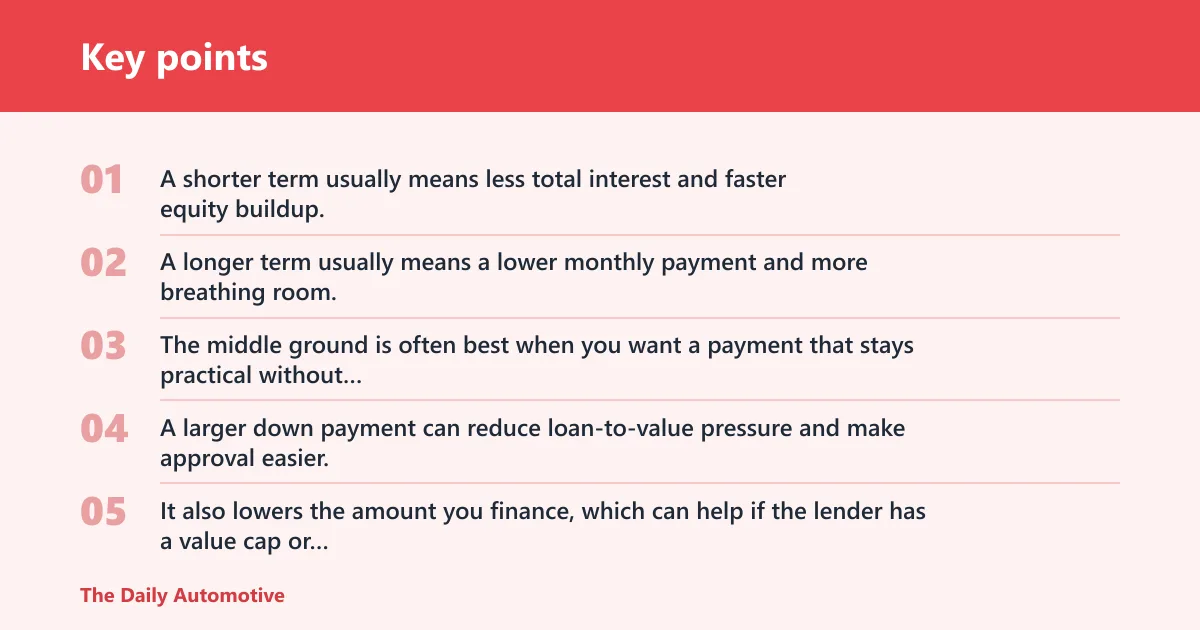
A shorter term usually means less total interest and faster equity buildup. A longer term usually means a lower monthly payment and more breathing room. The middle ground is often best when you want a payment that stays practical without stretching the loan so far that interest climbs too much.
How down payment changes approval and cost
A larger down payment can reduce loan-to-value pressure and make approval easier. It also lowers the amount you finance, which can help if the lender has a value cap or if you want to avoid being upside down early in the loan. Some lenders finance up to 100%, while others can go higher, but the rules vary widely.
How to keep total interest in check
Look at the monthly payment and the total paid over the life of the loan together. A common first-timer mistake is focusing only on the payment and accepting a much longer term. That can make the loan look affordable while quietly adding a large interest bill.
What membership checks should you make before applying?
Check membership first, because many credit unions require a savings account or share account before loan funding. Some are open to anyone, while others require geography, employer, school, or association ties. Vehicle age, mileage, and title rules also need to fit before you submit a full application.
Share account or savings account steps
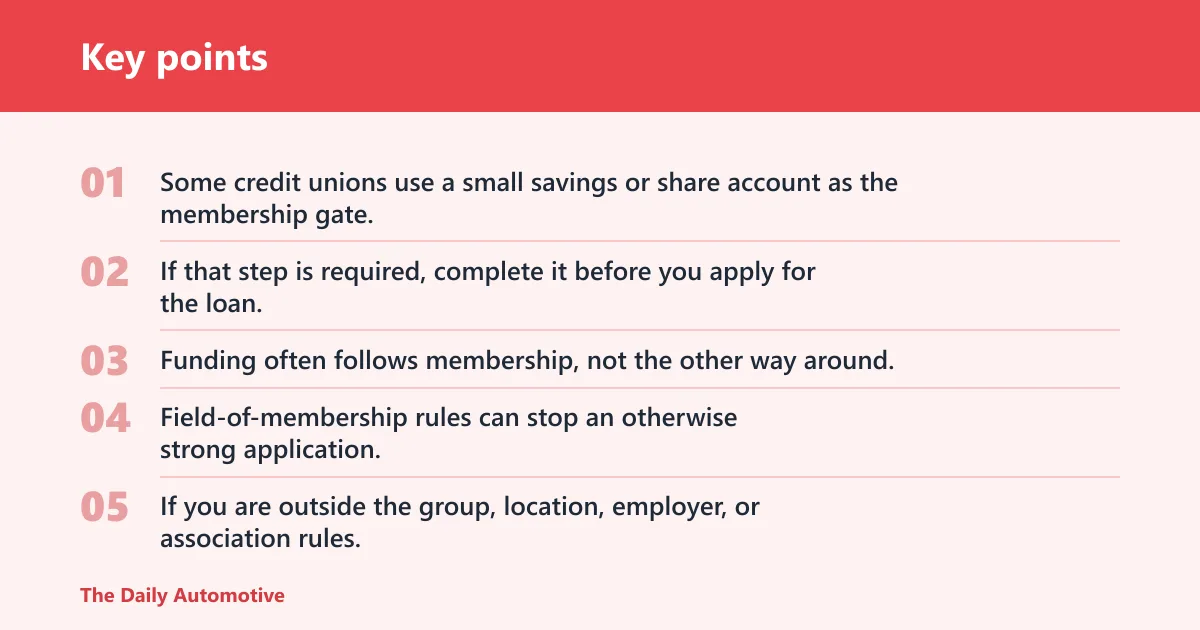
Some credit unions use a small savings or share account as the membership gate. If that step is required, complete it before you apply for the loan. Funding often follows membership, not the other way around.
Field-of-membership limits
Field-of-membership rules can stop an otherwise strong application. If you are outside the group, location, employer, or association rules, the lender may not be able to open the account. That can make a seemingly great rate unusable.
Vehicle age, mileage, and title checks
Vehicle rules can be the real blocker. NYU Federal Credit Union advertises auto loans from 3.75% APR, finances new cars up to 84 months, finances used cars up to 72 months, can finance up to 100% of value, adds 0.25% for vehicles with more than 75,000 miles, and does not finance vehicles over 10 years old. That is the kind of detail that decides approval.
Some lenders also set loan-to-value limits that depend on NADA-based value, down payment, and vehicle condition. If the car is a private-party purchase, an EV, or a motorcycle, ask whether the lender treats it as a standard auto loan or a separate policy bucket.
Frequently asked questions
What is the best car finance option for credit union members?
The best option is the one with the lowest total cost that you can actually qualify for, after you factor in membership, APR, term length, fees, and vehicle rules. For many members, that means comparing their own credit union first, then checking whether a partner lender or dealer program gives a better total deal.
How do credit union auto loan rates compare with banks and online lenders?
Credit union rates are often lower than bank rates, but the difference depends on credit quality, vehicle type, and term length. Online lenders can be competitive, especially for borrowers with strong credit, but a credit union may offer better fees, more flexible underwriting, or refinancing options.
Can credit union members get 100% financing on a car loan?
Yes, some credit unions can finance 100% of a vehicle’s value, and some can go higher depending on loan policy and borrower profile. Approval still depends on income, credit, vehicle age, mileage, and the lender’s own loan-to-value rules, so “100% financing” is not guaranteed.
Which credit union is best for used car financing?
The best choice for used cars is usually the credit union that accepts the car’s age and mileage without stretching the loan too far. Navy Federal and PenFed are common comparison points, while NYU Federal Credit Union shows how mileage and age caps can matter. Always match the car to the policy first.
Do credit unions offer refinancing on auto loans?
Yes, many do. Refinancing can lower your APR, cut the monthly payment, or shorten the payoff time. It makes the most sense when the current balance is still meaningful and the new loan’s savings are larger than any fees or paperwork costs.
Are there credit unions that finance EVs, motorcycles, or private-party purchases?
Yes, some credit unions finance those vehicle types, but the rules differ. EVs, motorcycles, and private-party purchases may have separate underwriting, value checks, or title requirements. Before you apply, confirm that the lender treats your vehicle and use case as eligible.
Products related to this article
Sponsored / affiliate links. As an Amazon Associate I earn from qualifying purchases. I may earn additional commission from eligible campaigns.
 Auto Car Dent Repair Puller Head Paintless-Dent Repair Removal Kit for Slide Hammer Pulling Tab Adapter Pulling Tabs Car Aluminum-alloy Puller Head Adapter Screw Glue-tabs for Slide Hammer and
 FH Group Car Seat Cover Front Set Striking Striped Car Seat Covers with Front Seat Covers and Rear Split Bench, Universal Fit Interior Accessories for Cars, Trucks, and SUVs – Gray