Why Is My Mechanic Not Picking Up the Phone?
If your mechanic won’t pick up, use a triage approach: call twice at different times, then move on after about 24 hours or one business day unless you already have a confirmed emergency slot. Waiting too long can turn a small repair into towing, downtime, and higher parts costs. This guide shows how to tell busy from unreachable, when to text or email, and when to find another shop fast.
Timing, shop backlog, and mobile mechanics

Most missed calls come from timing, not refusal. A shop may be on a job, buried under peak-hour calls, closed for the day, or screening voicemail through a scheduling system. Mobile mechanics also answer differently because they may be driving, in a service area, or limited to text-based intake.
Busy, closed, or filtered
A shop front service department often gets slammed right after opening, during lunch, and near closing. During those windows, calls stack up and voicemail routing may catch only the overflow. If the number rings without answer at 8 a.m. and again at 4 p.m., the issue may be backlog rather than avoidance.
Mobile mechanics and intake limits
Mobile mechanics usually work inside a defined service area and may reserve same-day slots for jobs they can diagnose quickly. They also may prefer text for address, symptoms, and photos, because that lets them screen whether the repair fits their equipment and schedule. Complex engine, transmission, or electrical work often still belongs at a shop.
What should I do if my mechanic is not answering?
Start with one call, one voicemail, and one text if the shop supports it. If the vehicle is safe to drive, wait through the timing window in the checklist below. If the car will not start, is overheating, or has brake warning signs, switch from waiting to roadside help or another provider.
- Call once during business hours.
- Leave one voicemail with the exact details that matter.
- Send a short text with the same information if texting is available.
- Wait for the timing window that matches the repair type.
- Escalate to roadside assistance or another mechanic if the no-response rule is met.
Emergency repair comes first
Tow-needed symptoms, a no-start condition in a blocking location, brake warnings, or overheating generally move the job into safety-first territory. In those cases, the right next call may be roadside assistance rather than repeated attempts to reach a mechanic. A shop callback is useful only if the car can wait safely.
How do I leave a clear voicemail for a mechanic?
A useful voicemail gives the shop enough information to decide whether to call back, quote a time, or ask for photos. Leave your callback number, vehicle year/make/model, symptom summary, location, and preferred contact window. Keep it short so it is easy to log into a scheduling system.
Five details that matter most
- Callback number.
- Vehicle year, make, and model.
- One-sentence symptom summary.
- Your location or where the car is parked.
- The best time to reach you.
What to say in one sentence
“This is Sam at 555-0148 about a car that will not start in my driveway; please call back this afternoon.” That sentence gives the shop a contact number, vehicle ID, a symptom, a location, and a window for follow-up.
What not to say
Do not leave a long story, a list of unrelated noises, or a request to “call whenever.” Do not hide the main problem behind extra detail. A voicemail that sounds rushed, vague, or incomplete is easier to miss, and it makes estimate callbacks slower.
Should you text instead of calling a mechanic?
Yes, if the shop accepts text or already used it with you. Text can work better than repeated calls because it creates a written trail, supports read receipts on some phones, and lets the shop answer between jobs. It also makes it easier to send photos or short video clips that speed triage.
When text gets a faster response
Text is often better when the issue is non-emergency but time-sensitive, such as an estimate callback, parts question, or appointment confirmation. It is also useful after one unanswered call, because the message can be reviewed later by a service adviser or mobile mechanic who is not at the desk.
What photos or video help
Short clips of warning lights, leaks, smoke, grinding noises, or a no-start dash can help the shop decide whether the car needs roadside help, a diagnostic visit, or a tow. Keep the media focused. A 10-second video is more useful than a two-minute recording of unrelated background noise.
How to keep a text thread useful
Use one thread per vehicle, keep dates and times visible, and reply in the same thread when the shop asks for more detail. That record can help with estimate approval, labor scope questions, and any later dispute over what was promised. It also makes missed-call follow-up simpler.
How long should you wait before following up with a mechanic?
For a same-day urgent repair, follow up after about 2 to 4 hours if you have not heard back. For a standard repair, wait one business day before escalating. If the shop is silent after about 24 hours or one business day, treat it as a no-response problem and move to the next contact method or provider.
Same-day urgent repairs
Same-day urgent means the car is drivable only with caution, or the repair blocks daily use. After the first call and voicemail, text within 30 minutes if the shop accepts it. If there is still no reply by mid-afternoon, call roadside assistance or a second shop.
Standard repair follow-up timing
Standard repair means the vehicle can wait without creating a safety issue. In that case, one day is a reasonable callback window because shops often need time to check parts availability, diagnostic fees, labor scope, and whether approval is needed before work starts.
When no reply becomes a red flag
No callback after repeated attempts, no voicemail routing, no online booking response, and no estimate update together signal a bigger problem than temporary busyness. If the shop cannot confirm whether the car is in queue, that is usually the point to switch.
Mechanic callback checklist
Use this checklist as a timed escalation path. It separates urgent work, ordinary repair flow, and true no-response cases so you do not wait longer than the repair justifies.
| Branch | Exact timing | Next contact method | One-sentence script | When to move on |
|---|---|---|---|---|
| Same-day urgent | Call now; text after 30 minutes; follow up again after 2 to 4 hours | Text, then roadside assistance if needed | “I need a same-day update on my 2017 Honda Civic with a no-start; please tell me if you can take it today.” | If no reply by mid-afternoon, or if the car is unsafe, move to roadside help or another mechanic. |
| Standard repair | Call once; wait one business day; check again the next morning | Text or email if the shop lists it | “Please confirm whether my 2014 Toyota Camry is in your queue and whether you need approval for the estimate.” | If there is no answer after 24 hours or one business day, call a second shop. |
| No-response red flag | Two calls at different times, one voicemail, one text, then stop waiting | Second mechanic, mobile mechanic, or roadside assistance | “I have not been able to reach your shop about my vehicle; I am moving the job elsewhere and need to confirm any next steps.” | Move on immediately if the shop misses repeated contacts, gives no estimate update, or cannot confirm business hours. |
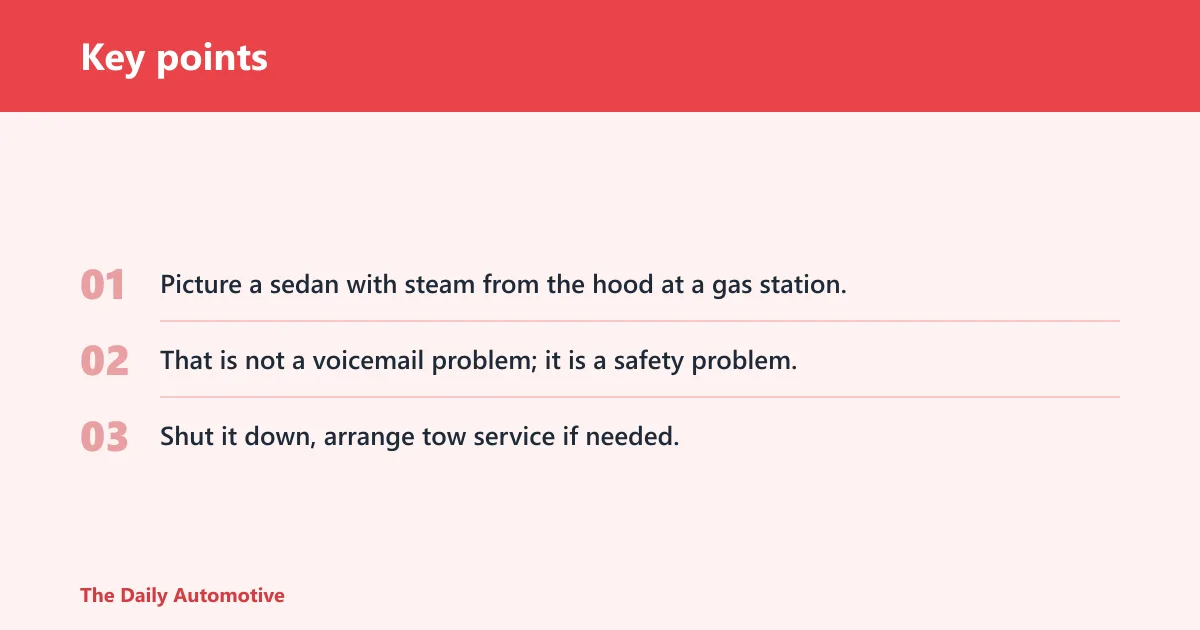
Say your car is overheating. Picture a sedan with steam from the hood at a gas station. That is not a voicemail problem; it is a safety problem. Shut it down, arrange tow service if needed, and contact the mechanic only after the car is secure.
When to call roadside assistance

Call roadside assistance when the vehicle cannot safely reach a shop, the symptom points to towing, or the mechanic is not likely to respond quickly enough for a safe next step. Roadside dispatch timelines vary, but the right use case is clear: battery support, jump-starts, tire changes, towing eligibility, and other immediate recovery tasks.
Tow-needed symptoms
A hard no-start, brake warning signs, a serious coolant leak, smoke, or overheating can make driving risky or impossible. Those symptoms usually justify roadside dispatch first, then repair scheduling after the car is stabilized or towed.
Battery and jump-start calls
If the problem looks electrical at the roadside, a jump-start request can solve the immediate issue faster than waiting for a shop callback. If the car starts and then stalls again, that is useful diagnostic information to send to the mechanic in text form.
How shops handle estimates and scheduling
Estimate delays often reflect workflow, not indifference. A service department may need to confirm parts availability, set labor scope, review a diagnostic fee, or wait for approval before work starts. Missed-call filters and online booking systems can also push phone calls into the background.
Parts availability and diagnostic fees
If the repair depends on a backordered part, the callback may wait until the adviser can confirm timing. If a diagnostic fee applies, the shop may need to explain what it covers before moving forward. That lag is normal when the estimate is still being built.
Approval before work starts
Many shops will not start beyond the diagnostic stage without written or recorded approval. A text reply is often enough for that, because it creates a clear record of what you authorized, what it costs, and what happens if the quote changes.
Booking backlog and online scheduling
Some shops route phones through online booking or a missed-call filter that pushes callers into a form instead of a live callback. If the website shows an open slot while the phone stays silent, the scheduling system may be the bottleneck. Book online if the shop allows it.
When to switch to another mechanic
Switch providers when silence is repeated, the shop cannot give a timing estimate, or the type of repair does not match the business. A mobile mechanic may not be right for complex repairs, while a busy shop front may not be right for a quick battery or tire issue. Move the car before the delay grows.
Signs the shop is not a fit
No answer during business hours, no voicemail response, no text reply, unclear hours, and no update on estimate status are all signs to stop waiting. If the shop cannot state whether it handles your issue in-house, it may not be the right match for the job.
How to move your car without losing time
If the vehicle is drivable, book the next shop before canceling the first. If it is not drivable, arrange roadside towing or ask the second shop whether it can receive the car directly. That sequence prevents a dead car from sitting through another day of silence.
What to send when you start over
Send the same five details again: callback number, year/make/model, symptom summary, location, and preferred contact window. Add any prior estimate, diagnostic fee note, or approved work so the next provider can pick up without repeating the same intake questions.
Why won’t my mechanic call me back?
A callback may stall because the estimate is still pending, the adviser is waiting on parts, the shop is buried in appointments, or your message did not include enough detail to route correctly. If a full business day passes with no update, treat that silence as a scheduling problem and move on.
What details should I include when contacting a mechanic?
Give the shop the vehicle year, make, model, mileage if known, the symptom in one sentence, the location of the car, and the best way and time to reach you. Add whether the car is drivable, whether it needs a tow, and whether you want a diagnostic or repair appointment.
Why does my phone not work?
If your phone is the reason the mechanic cannot reach you, fix that first: check signal, voicemail access, and whether calls are going to the right number. If the phone still will not work properly, use another number or ask a family member to relay the callback request so the repair does not stall.
Why won’t my phone work
A dead battery, service outage, or blocked calls can keep the shop from reaching you, even if the mechanic did everything right. If possible, send a text from another device, then confirm the callback number in the voicemail so the shop knows which line to use.
Why doesn’t my phone work
When the phone itself is the obstacle, the fastest fix is not a deep device diagnosis; it is a backup contact path. Use a second phone, ask the shop to call a different number, or move to email or text so the repair timeline keeps moving while you sort out the device.
Frequently asked questions
Why is my mechanic not picking up the phone?
The most common reasons are business hours, peak call volume, voicemail routing, or a shop process that filters calls into a queue. Mobile mechanics may also be on the road or limiting intake to text. After two attempts at different times, switch to voicemail or text.
Products related to this article
Sponsored / affiliate links. As an Amazon Associate I earn from qualifying purchases. I may earn additional commission from eligible campaigns.