Benefits of Regular Car Servicing: What It Prevents and Why
Regular car servicing can pay off: follow the maker’s schedule, often around every few thousand to roughly ten-odd thousand miles or every several months, because it can catch wear before it turns into breakdowns, higher repair bills, or failed safety checks. Left alone, oil degradation, worn brakes, weak batteries, and clogged filters can lead to overheating, loss of stopping power, or a tow bill. This guide maps each routine service item to the failure it helps prevent, plus when short-trip, used-car, and high-mileage drivers should shorten the interval.
What regular car servicing actually does
Regular servicing is preventative maintenance, not a repair visit after something fails. It checks wear items, safety items, and engine-health items before small faults spread, so you spend on routine parts and fluids instead of major damage, roadside recovery, or failed inspections later.
Service versus repair
A service is scheduled work meant to catch problems early. A repair happens after damage, warning lights, or drivability symptoms already exist. That timing matters: skipping service often defers cost rather than saving money, because untreated wear usually grows into a larger bill.
Service versus MOT
A service and an MOT are not the same thing. An MOT checks whether the car is roadworthy at that point in time. A service is scheduled maintenance that helps keep the car from reaching a failure state in the first place. Regular maintenance can also help avoid MOT failures.
Why timing matters before faults appear
Modern cars give warning signs, but not always early enough to prevent damage. Routine checks catch low fluids, contaminated oil, uneven tire wear, and brake wear before they become overheating, poor stopping distance, or internal component damage. That is the core value of servicing as a failure-prevention system.
What regular car servicing prevents
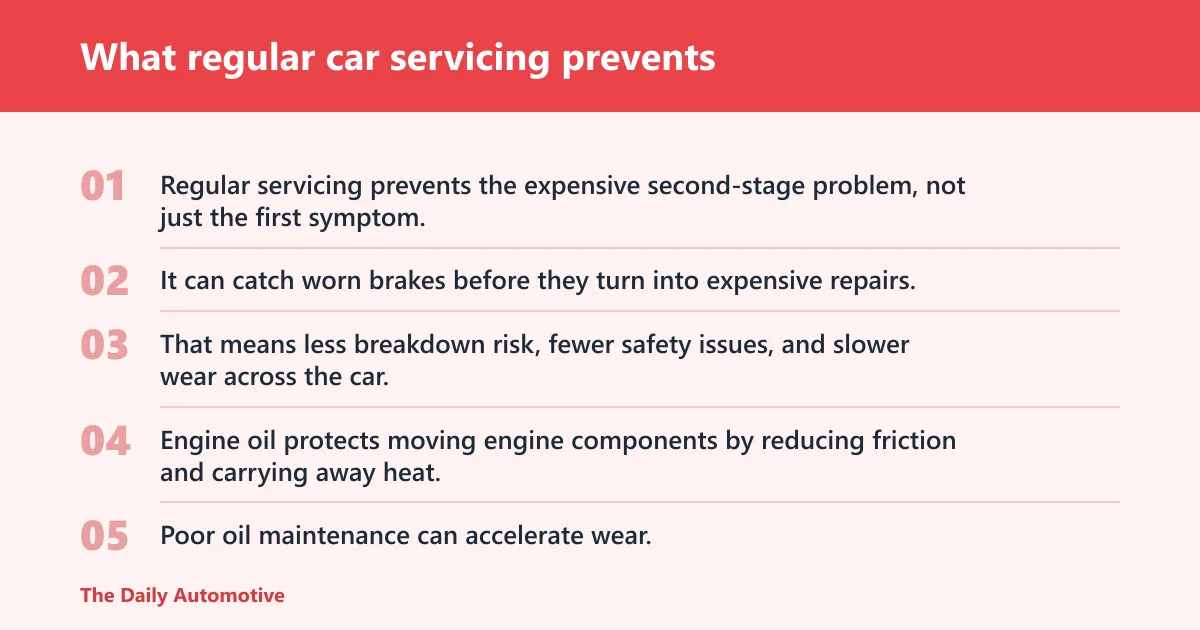
Regular servicing prevents the expensive second-stage problem, not just the first symptom. It can catch worn brakes before they turn into expensive repairs, catch low fluids before they cause bigger problems, and catch failing components early. That means less breakdown risk, fewer safety issues, and slower wear across the car.
Engine wear and overheating
Engine oil protects moving engine components by reducing friction and carrying away heat. Poor oil maintenance can accelerate wear, especially if oil level checks are skipped and oil changes run late. Low or degraded oil can increase the risk of internal wear, sludge, and overheating.
Brake failure and stopping-distance problems
Brake inspections are safety-critical. Worn pads, thin discs, or contaminated brake fluid reduce braking performance before the system fully fails. Regular servicing can catch worn brakes before they turn into expensive repairs, and it helps reduce accident risk caused by longer stopping distances.
Tire wear, poor handling, and instability
Tire pressure checks, tire rotations, and wheel alignment all affect handling and safety. Underinflation and misalignment wear tires unevenly and can reduce driving stability. Rotations help spread wear more evenly, while alignment keeps the car tracking straight and prevents one edge from scrubbing away early.
Transmission damage and rough shifting
Transmission fluid condition matters because it supports smooth shifting and internal protection. Low, dirty, or overheated fluid can lead to harsh shifts, slipping, or internal wear. Transmission failure is one of the most costly failures a service can help avoid, so fluid checks are not optional.
How each service item prevents a specific failure
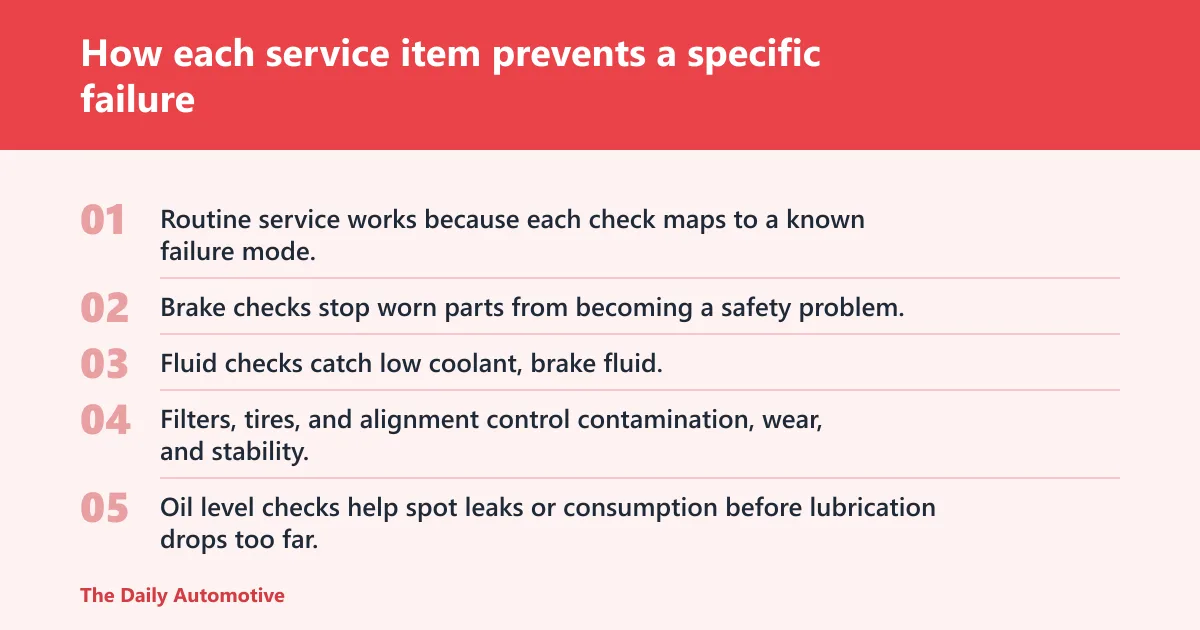
Routine service works because each check maps to a known failure mode. Oil changes protect engine components. Brake checks stop worn parts from becoming a safety problem. Fluid checks catch low coolant, brake fluid, or transmission fluid before they damage parts. Filters, tires, and alignment control contamination, wear, and stability.
Engine oil level checks and oil changes
Oil level checks help spot leaks or consumption before lubrication drops too far. Oil changes restore the oil’s protective properties after heat and contamination degrade it. That protects engine components, reduces friction, and helps prevent premature wear inside bearings, cam surfaces, and turbochargers where fitted.
Brake inspections and brake fluid checks
Brake inspections check pad thickness, disc condition, caliper movement, and fluid condition. Brake fluid absorbs moisture over time, which can reduce braking performance and corrode internal parts. A simple inspection can stop a worn-brake problem from turning into a full brake repair or a safety failure.
Coolant, transmission fluid, and other fluid checks
Coolant keeps temperatures in range. Low coolant can cause overheating, warped parts, and head-gasket damage. Transmission fluid supports hydraulic pressure and lubrication; low fluid can cause failures in clutches or valve body components. Routine fluid checks are cheap compared with the repairs they help prevent.
Air and oil filters
Air filters keep dirt out of the intake stream, and oil filters trap contamination before it circulates through the engine. Clogged or overdue filters reduce efficiency and can increase wear. Replacement intervals vary by maker and driving conditions, but filters should be treated as wear parts, not decoration.
Tire pressure, rotations, and wheel alignment
Correct tire pressure supports grip, wear, and fuel use. Rotations help tires wear at similar rates, especially on front-wheel-drive cars where the front tires do more work. Wheel alignment affects steering feel, straight-line stability, and tire wear. Ignore it, and you often buy tires sooner than necessary.
Early engine warning signs
Servicing also surfaces early engine warning signs before they become major repairs. Leaks, rough idle, misfires, coolant loss, dirty throttle bodies, and unusual noises are easier to address when caught during routine checks. That early detection is one reason regular servicing improves reliability.
Example situations
Say your hatchback does mostly school runs and grocery trips in winter. The engine may never get fully warm, so moisture and fuel dilution can build in the oil faster than the odometer suggests. Short-trip driving often deserves shorter service intervals than the calendar alone implies.
Picture a 2.0-litre diesel with a slight pull to one side and front tires worn on the inner edge. That is not just a tire problem. It can point to alignment drift, which keeps scrubbing rubber away until the tires are noisy, unstable, and worn out early.
| Routine check | Component at risk | Likely symptom if ignored | Worst-case failure prevented | Rough cost-risk band |
|---|---|---|---|---|
| Oil level check | Engine internals | Oil warning light, ticking, rough running | Severe engine wear or seizure | Low check cost; very high repair risk |
| Oil change | Bearings, cam surfaces, turbo parts | Dirty oil, sludge, rising engine noise | Accelerated wear and engine damage | Low to moderate; high failure avoidance |
| Brake inspection | Pads, discs, calipers | Squeal, vibration, long pedal travel | Brake loss or accident risk | Low to moderate; safety-critical |
| Coolant check | Radiator, hoses, engine head | Temperature rise, heater issues, leaks | Overheating and head-gasket damage | Low; very high repair risk |
| Brake fluid check | Hydraulic braking system | Spongy pedal, reduced braking feel | Extended stopping distance or brake fade | Low; safety-critical |
| Transmission fluid check | Gearbox internals | Harsh or delayed shifts | Transmission failure | Low; very high repair risk |
| Air filter replacement | Engine intake system | Reduced power, poorer efficiency | Contamination-related wear and efficiency loss | Low; moderate prevention value |
| Tire pressure and rotation | Tires, suspension load balance | Uneven wear, wandering, noise | Poor handling and early tire replacement | Low; medium replacement savings |
| Wheel alignment | Tires and steering stability | Pulling, off-center steering wheel | Rapid tire wear and instability | Moderate; medium to high tire savings |
Does regular servicing improve fuel efficiency?
Yes, regular servicing can improve fuel efficiency, but the gain is usually modest rather than dramatic. The biggest benefits come from correct tire pressure, clean filters, fresh fluids, and proper wheel alignment. Those items reduce drag, friction, and contamination that quietly waste fuel over time.
Where the fuel savings come from
Underinflated tires increase rolling resistance. Dirty air filters can restrict airflow. Poor alignment makes tires scrub against the road. Old oil and neglected fluids increase friction and resistance inside the drivetrain. Fixing those issues does not transform a car, but it can stop avoidable fuel waste.
What is worth expecting and what is not
Do not expect servicing to erase the gap between a small petrol car and a heavy SUV. It will not. What it can do is keep the car near its designed efficiency by making sure basic losses are not stacking up. That is a useful, measurable difference over time.
How often should you service a car?
Most manufacturers list service intervals by mileage, time, or both, and the shorter interval usually matters more for harsh use. A common rule of thumb is servicing every several thousand to around ten-odd thousand miles or every several months, but short trips, towing, dusty roads, or heavy traffic can justify shorter gaps.
Low-mileage drivers
If you drive very little, time still matters because fluids age even when miles do not build up. Battery health, oil contamination, brake corrosion, and moisture in fluids can still become issues. For low-mileage owners, a yearly service is often the safer baseline, even if mileage is low.
High-mileage drivers
High-mileage drivers should follow the mileage side of the interval closely and often more conservatively. More miles means more heat cycles, more tire wear, and faster fluid degradation. If the car does long commutes, fleet-style use, or constant motorway running, condition checks deserve extra attention.
Short-trip and stop-start driving
Short-trip use is hard on oil and exhaust-related components because the engine may not reach full operating temperature often enough. Stop-start traffic also stresses brakes, cooling, and the battery. Short-trip cars usually benefit from shorter service intervals than mixed-use cars of the same age.
Used-car ownership and missing history
Used-car buyers should be more cautious if service history is incomplete. Missing records do not prove neglect, but they remove proof of upkeep. That makes fresh fluid changes, filter replacement, brake inspection, and tire checks a sensible reset point after purchase.
- Check the owner’s manual for the maker’s interval and severe-use schedule.
- Shorten the interval if the car does short trips, heavy traffic, towing, or dusty driving.
- Book sooner if fluids are low, brakes are noisy, tires wear unevenly, or shifts feel rough.
- Keep records for oil, filters, brakes, tires, alignment, and fluid changes.
Does servicing increase resale value?
Yes, servicing can increase resale value because documented service history gives buyers proof that the car has been maintained. It does not erase age or mileage, but it reduces doubt. A full record often supports stronger offers than a car with gaps, missing invoices, or no maintenance evidence.
Why a documented maintenance record matters
Buyers and dealers usually want evidence of oil changes, brake work, fluid service, filter replacement, tire care, and scheduled inspections. That record suggests the car is less likely to hide neglected wear. It also shows the owner followed the manufacturer’s schedule rather than waiting for faults.
Which records matter most
Keep dated invoices or digital records for services that affect wear and safety. Oil changes, brake work, coolant service, transmission fluid changes, alignment, and tire rotations matter most. A tidy service history is often more persuasive than a long verbal promise that the car was “looked after.”
What happens if you skip car servicing?
Skipping servicing can increase wear, let faults go unnoticed, and raise the chance of a larger bill later. Low fluids, old oil, worn brakes, and neglected filters do not stay small for long. The result is usually more noise, worse economy, weaker safety margins, and a greater breakdown risk.
Parts that wear out faster
Engine components, brake pads, discs, tires, suspension bushings, filters, and transmission parts all suffer when service is late. Consistent servicing is said to extend the lifespan of vehicle components, while neglected maintenance lets contamination, heat, and friction do their work faster.
Book now warning signs
Book a service now if you notice an oil warning light, coolant loss, brake squeal, a spongy pedal, rough shifting, pulling to one side, steering-wheel vibration, poor fuel economy, or a strong burning smell. Those symptoms suggest the car has moved beyond simple routine prevention.
Frequently asked questions
What are the benefits of regular car servicing?
Regular servicing helps the car run smoothly, safely, and efficiently. It reduces breakdown risk, catches worn brakes and low fluids early, slows engine wear, supports steadier fuel use, and preserves resale value through documented service history. The biggest benefit is often avoiding a much larger repair later.
How often should a car be serviced?
Most cars are serviced every 6,000–12,000 miles or 6–12 months, but the right interval depends on the maker’s schedule and the way the car is driven. Short-trip, stop-start, towing, and high-mileage use usually justify shorter intervals than gentle mixed driving.
What checks are included in a car service?
Simple tasks include checking oil levels, tire pressure, and brakes. A fuller service also covers fluids such as coolant, brake fluid, and transmission fluid, plus air and oil filters, tire condition, rotation, alignment checks, and a look for leaks, wear, and warning signs.
Can regular servicing help prevent breakdowns?
Yes. Regular servicing can catch failing components early, before they fail on the road. That includes low fluids, worn brakes, clogged filters, uneven tires, and transmission problems. It does not prevent every failure, but it cuts the chance of being stranded with a preventable fault.
Is a service the same as an MOT?
No. An MOT checks whether the car is roadworthy at the time of the test. A service is scheduled maintenance that helps stop faults from developing in the first place. They overlap in some inspections, but they do different jobs and should not be treated as interchangeable.
Products related to this article
Sponsored / affiliate links. As an Amazon Associate I earn from qualifying purchases. I may earn additional commission from eligible campaigns.