Will an EMP Kill a Car Battery Truth Explained
Many folks wonder, Will an EMP Kill a Car Battery? Truth Explained can seem tricky at first. EMP stands for Electromagnetic Pulse, and it’s something that sounds like it could fry your car.
But don’t worry! We’re going to break it down in a way that’s super easy to get. You’ll learn exactly what happens and what you might need to do.
Let’s make this simple together.
Understanding EMPs And Cars
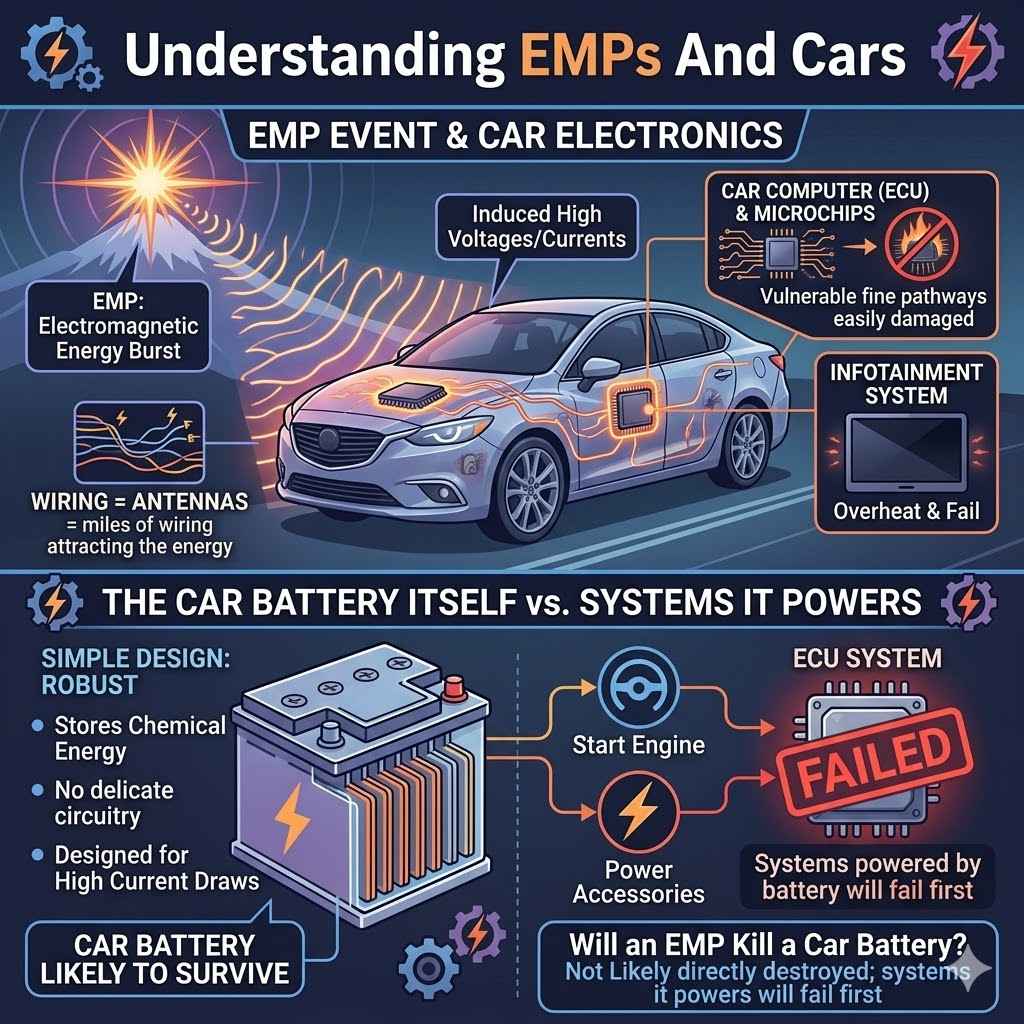
An EMP is a powerful burst of electromagnetic energy. It can come from a nuclear explosion or even a solar flare. Think of it like a massive surge of electricity hitting everything around.
When this happens, it can cause problems for electronics. Cars have lots of electronics inside them, like the computer that runs the engine and the radio.
This surge can overload these sensitive parts. It’s like plugging too many things into one outlet and blowing a fuse. For a car, this means some electronic components might stop working.
This is why people worry about EMPs and their cars. The main question is always, Will an EMP Kill a Car Battery? Truth Explained is about looking at how the car’s battery itself is affected, not just the fancy computer bits.
Some sources say an EMP could directly damage a car battery. Others say it’s more about the connected electronics. The truth is a bit of both, and it depends on the EMP’s strength and how your car is built.
We’ll explore how different parts of your car are affected.
What Is An EMP Event
An EMP event is a sudden, powerful release of electromagnetic energy. This energy travels outward like a wave. The most well-known cause is a nuclear detonation high in the atmosphere.
This type of EMP creates a broad electromagnetic pulse that can affect a very large area. It’s designed to disable electronics over a wide region.
However, EMPs can also be generated by natural phenomena. The sun is a major source of these events. Giant solar flares and coronal mass ejections (CMEs) can send out waves of charged particles and electromagnetic radiation.
These solar EMPs can also impact Earth’s magnetic field and potentially disrupt our technology.
The effect of an EMP depends on several factors. These include the intensity of the pulse, its distance from the target, and the shielding properties of the affected object. A direct hit from a strong EMP is more likely to cause damage than a weaker one or one that is further away.
How EMPs Affect Electronics
When an EMP sweeps over an electronic device, it induces high voltages and currents in conductive materials. Think of all the wires and circuits inside a car. These induced currents can be much higher than what these components are designed to handle.
This causes them to overheat and fail.
Sensitive microchips, like those found in engine control units (ECUs) or infotainment systems, are particularly vulnerable. These tiny components have very fine pathways that can be easily burned out by a sudden surge. It’s like a lightning strike hitting a computer; it often fries the main board.
The longer and more numerous the conductive pathways, the more susceptible a device is. A car has many miles of wiring, acting like antennas that can pick up the EMP energy. This is why car electronics are a major concern during an EMP event.
The question, Will an EMP Kill a Car Battery? Truth Explained, looks at the battery’s specific role.
The Car Battery Itself
Now, let’s talk about the car battery specifically. A car battery is essentially a large, relatively simple electrochemical device. It stores electrical energy chemically and releases it when needed to start the engine or power accessories when the engine is off.
Compared to the complex microchips in your car’s computer, a car battery is quite robust. It’s designed to handle high current draws (when you start the engine) and to be recharged by the alternator. It doesn’t have the delicate circuitry that a modern infotainment system or engine control unit has.
Because of its simpler design and its role in providing power, the car battery is less likely to be directly destroyed by the induced currents of an EMP. It’s more likely that the systems it powers will fail first. However, the surge could still have some indirect effects.
Will An EMP Kill A Car Battery Specifics
When we ask, Will an EMP Kill a Car Battery? Truth Explained, we need to look at the direct impact on the battery itself and the indirect impact through the car’s systems. A standard lead-acid car battery is a heavy-duty piece of equipment.
It’s built to withstand a lot of electrical stress.
The primary components of a car battery are lead plates and an electrolyte solution. These are not as easily damaged by a quick electromagnetic pulse as a silicon-based microchip. The battery’s main job is to store and deliver power, not to process complex electronic signals.
However, an EMP can still cause issues. The massive surge of electricity could potentially damage the battery’s internal connections or cause a temporary overcharge. If the car’s charging system (the alternator and voltage regulator) is damaged by the EMP, it could lead to the battery being overcharged or undercharged over time, affecting its lifespan.
Direct Damage To The Battery
Direct physical damage to a car battery from an EMP is unlikely for most typical EMP events. The battery casing is made of thick plastic, and the internal components are relatively simple. It doesn’t have the fine, delicate wires or semiconductor junctions that are easily vaporized by high voltages.
However, in an extremely powerful, close-range EMP event, it’s theoretically possible for the surge to cause internal damage. This could manifest as damaged plates or connections within the battery. This scenario is less common than the damage to the car’s more sensitive electronic control units (ECUs).
Think of it like this: if a strong gust of wind blows, it might rattle a windowpane, but it’s unlikely to shatter a thick brick wall. The car battery is more like the brick wall in this analogy, while the car’s computer is more like the windowpane.
Indirect Effects On The Battery
The more significant threat to a car battery from an EMP comes indirectly, through the failure of other car systems. The car’s alternator is responsible for recharging the battery while the engine is running. The voltage regulator, often integrated with the alternator or as a separate module, controls the charging rate to prevent overcharging.
If an EMP surge damages the alternator or the voltage regulator, it can lead to abnormal charging of the battery. If the voltage regulator fails, the alternator might overcharge the battery, boiling the electrolyte and damaging the plates. Conversely, if the alternator itself is damaged, it may stop charging the battery altogether, leading to a dead battery once the car’s stored charge is depleted.
So, while the EMP might not directly destroy the battery itself, it can disable the systems that keep it healthy and charged, rendering it useless over time. This is a crucial part of the “Will an EMP Kill a Car Battery? Truth Explained” conversation.
Modern Cars And EMP Vulnerability
Modern cars are packed with electronics. They rely on sophisticated computer systems for everything from fuel injection and ignition timing to anti-lock brakes and infotainment. These systems are much more susceptible to EMP damage than older, simpler vehicles.
An EMP event could easily fry the engine control unit (ECU), the transmission control module (TCM), the body control module (BCM), and numerous other electronic components. When these crucial systems fail, the car will not run, regardless of the battery’s condition.
The battery might be fine, but the car simply won’t start or operate because its “brain” and other vital electronic organs have been damaged. This is a common misconception: people assume if the car doesn’t start, the battery is dead, when in reality, it could be a fried computer.
Protecting Your Car From EMPs
The question, Will an EMP Kill a Car Battery? Truth Explained, also leads to thinking about what can be done to prevent damage. Protecting a car from an EMP is challenging, especially for modern vehicles.
However, there are strategies that can increase the chances of survival for both the battery and the vehicle’s electronics.
The most effective method of protecting electronics from EMPs is shielding. This involves creating a Faraday cage, which is an enclosure made of conductive material that blocks electromagnetic fields. While it’s not practical to put your entire car in a Faraday cage permanently, there are ways to use this principle for storage.
For older cars with fewer electronics, the risk is lower. But even those can be affected by the connected systems. For newer cars, the focus shifts to protecting the sensitive electronic modules and, by extension, ensuring the battery remains functional.
Faraday Cages For Cars
A Faraday cage works by distributing the electromagnetic charge around the outside of the enclosure, preventing it from entering the interior. For a car, this would mean building a metal enclosure around the entire vehicle. This is a significant undertaking and not something most people can do at home.
However, smaller Faraday cages can be used to protect individual electronic components. For example, if you wanted to protect a spare ECU or other critical electronic parts, you could store them in a metal box. A properly constructed metal container, like a galvanized steel trash can with a tight-fitting lid, can offer some protection.
Some people have explored wrapping their vehicles in specialized EMP-resistant materials. These materials are designed to reflect or absorb electromagnetic energy. The effectiveness can vary, and proper installation is key.
For a car battery specifically, if it were removed and placed inside a well-constructed Faraday cage, it would have a much higher chance of surviving an EMP event.
Modifying Your Vehicle
Modifying a vehicle for EMP protection is complex and can be expensive. One approach is to add surge protectors to critical electronic systems. These devices are designed to absorb excess voltage and divert it safely away, similar to how they are used in home electrical systems.
Another strategy involves careful wiring. Some experts suggest adding extra shielding to key wires and connections. This can help reduce the amount of EMP energy that is induced into the car’s electrical system.
For the battery itself, ensuring it is disconnected or isolated during an EMP event would be ideal, but this is impractical for a vehicle that needs to be ready to go. The best approach is often to protect the systems that manage the battery’s health.
Pre-EMP Preparedness
If you live in an area known for solar activity or are concerned about other EMP threats, there are steps you can take before an event occurs. Keeping your car’s battery in good condition is always wise. A healthy battery is less likely to fail even under stress.
Consider having a backup plan for transportation. Relying solely on one vehicle, especially a modern one, can be risky. Having a bicycle or access to public transportation could be useful if your car is disabled.
For those who are seriously concerned, storing spare parts like a new alternator, voltage regulator, or even an entire ECU in a Faraday cage could be a good investment. This way, if the original components are damaged, you have replacements ready.
Real-Life Scenarios And Examples
While widespread EMP events are rare, smaller-scale incidents offer insights. In 1989, a severe geomagnetic storm caused a major blackout in Quebec, Canada. This storm, caused by a solar flare, disrupted power grids and damaged some electronic equipment.
During this event, many electronic systems experienced disruptions. While there aren’t widespread reports of car batteries being directly destroyed, the failure of power grids meant that cars reliant on those grids for charging would eventually have issues. This highlights the indirect impact on batteries.
Another notable event was the Carrington Event in 1859. This was an incredibly powerful solar storm that caused telegraph systems worldwide to fail. While cars didn’t exist then, the intensity of the storm gives us an idea of the potential electromagnetic forces involved.
Imagine a modern car experiencing a similar force. The sensitive electronics would likely be severely impacted. This reinforces the idea that the battery might survive, but the car would be inoperable due to other system failures.
EMP And Car Battery Lifespan
Understanding, Will an EMP Kill a Car Battery? Truth Explained, also touches upon the long-term effects. An EMP event might not immediately destroy a car battery, but it can shorten its lifespan.
The key is the damage to the car’s charging system and voltage regulation.
If the alternator or voltage regulator is damaged, the battery might be subjected to fluctuating or excessive charging. Constant overcharging can cause the electrolyte to evaporate, leading to plate damage and reduced capacity. Undercharging can lead to sulfation, where lead sulfate crystals build up on the battery plates, hindering its ability to hold a charge.
Over time, these issues can significantly reduce the battery’s effectiveness and eventually lead to its failure. So, even if the battery survives the initial EMP pulse, its continued health depends on the integrity of the car’s other electrical systems.
Sulfation And Overcharging Effects
Sulfation is a natural process that occurs in lead-acid batteries as they discharge. However, if a battery is left in a discharged state for too long, the sulfate crystals can harden and become difficult or impossible to dissolve during the charging process. This reduces the battery’s surface area for chemical reactions, thus lowering its capacity.
Overcharging, on the other hand, can cause the electrolyte to overheat and boil. This process can warp or damage the battery plates and, in extreme cases, cause them to shed material. It also leads to increased water loss from the electrolyte.
If the electrolyte level drops too low, the plates can be exposed to air, leading to rapid deterioration.
Both sulfation and overcharging are detrimental to a battery’s health and lifespan. If an EMP causes damage to the voltage regulator, either of these conditions can occur, leading to premature battery failure.
Testing Battery Health Post-EMP
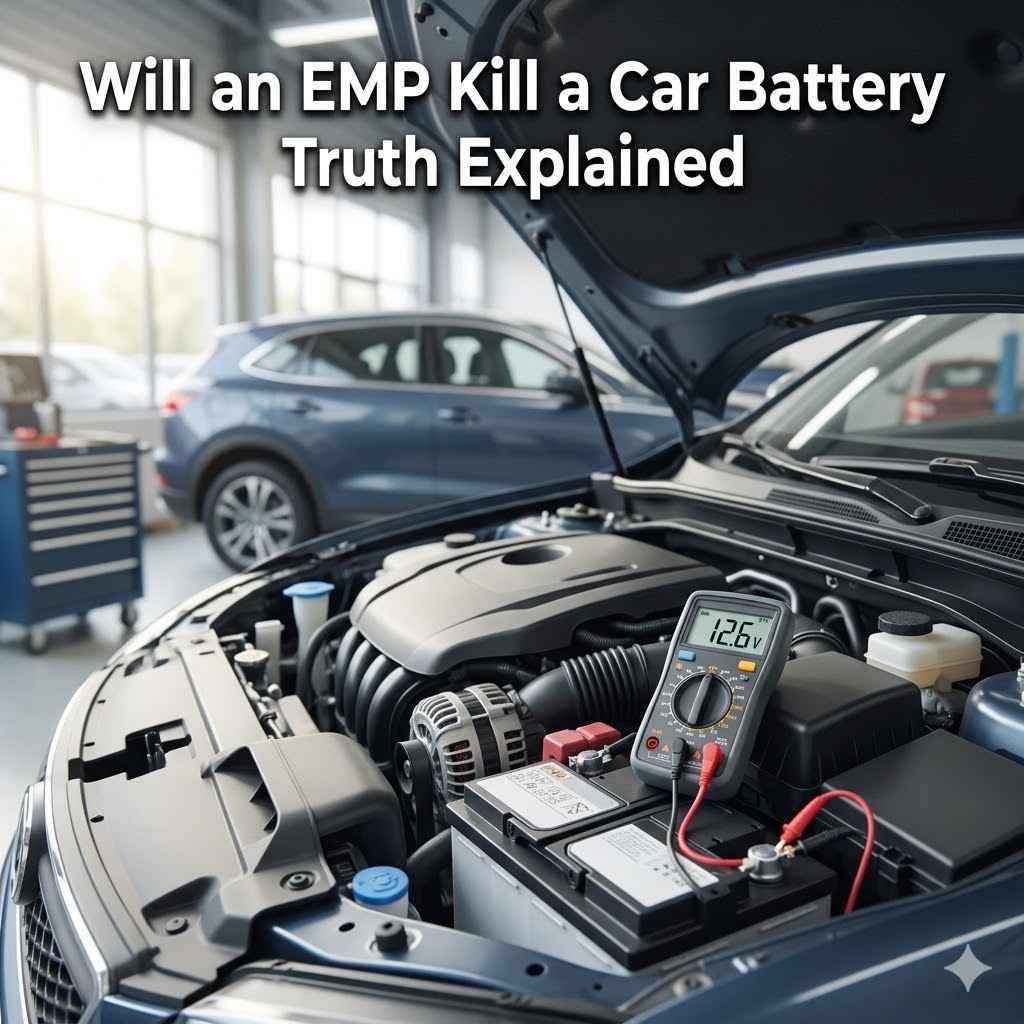
After a significant EMP event, it’s crucial to test your car battery’s health, along with other electronic components. Simple visual checks might not reveal underlying issues. A multimeter can be used to check the battery’s voltage.
A fully charged lead-acid battery should read around 12.6 volts when the engine is off. If the voltage is significantly lower, it may indicate a problem with the battery or the charging system. After attempting to start the car, the voltage should rise to around 13.7 to 14.7 volts, indicating the alternator is charging the battery correctly.
If the voltage doesn’t rise, or if it goes too high, the charging system is likely damaged. In such cases, the battery might still be functional for a short period, but it won’t be able to recharge, and its lifespan will be compromised.
Older Versus Newer Cars
The difference in vulnerability between older and newer cars is substantial. An older car from the 1970s or 1980s might have a mechanical fuel pump, a carburetor, and very few electronic control units. These vehicles are far more EMP-resistant.
Their simpler mechanical systems are less susceptible to electromagnetic surges. While an EMP could still potentially damage the battery or alternator, the overall impact on the car’s functionality would likely be less severe. The battery might continue to function, and the car might still be drivable after a basic check.
Newer cars, by contrast, are heavily reliant on a network of computers. A single damaged ECU can render the entire vehicle inoperable. The battery’s condition becomes secondary if the car’s “brain” is fried.
The Final Answer To Will an EMP Kill A Car Battery Truth Explained
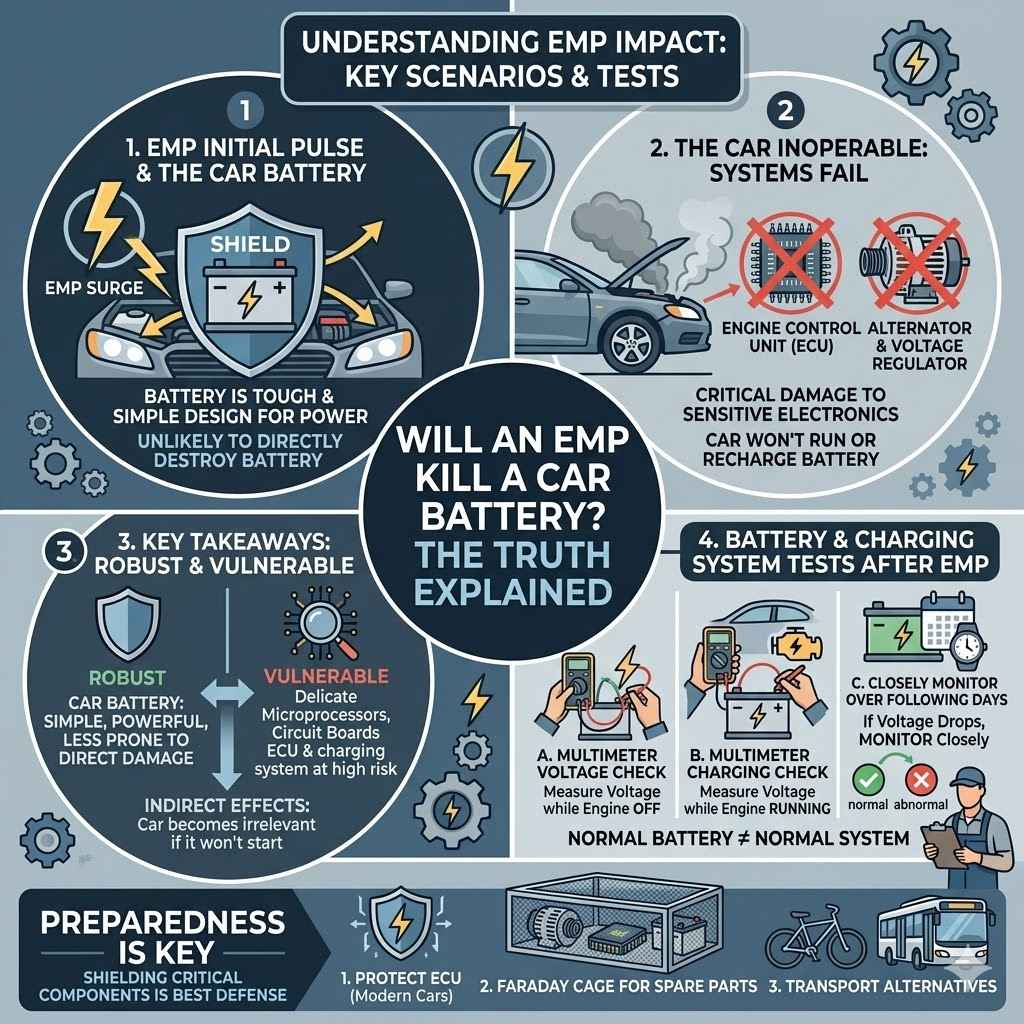
So, to finally answer the question, Will an EMP Kill a Car Battery? Truth Explained is that it’s unlikely to directly destroy the battery itself in most scenarios. A car battery is a tough, simple device designed for power delivery.
However, the critical point is that an EMP can absolutely render a car inoperable by damaging the car’s sensitive electronic control units and its charging system (alternator and voltage regulator). If these systems fail, the car won’t run, and the battery won’t be recharged, leading to its eventual demise.
The battery might survive the initial pulse, but the car’s inability to function and recharge it means it will eventually be useless. Therefore, while the battery itself might not be the first thing to go, its continued utility is threatened by the EMP’s impact on other vehicle systems.
Key Takeaways On EMP Impact
The main takeaway is that the battery is one of the more robust components in a car. Its simple construction makes it less prone to immediate damage from an EMP surge compared to delicate microprocessors and circuit boards.
However, the indirect effects are significant. The car’s ability to operate and maintain the battery’s charge is what’s truly at risk. If the engine control unit or alternator is damaged, the car becomes a non-starter, and the battery becomes irrelevant.
For those who wish to protect their vehicles, focusing on shielding critical electronic components and ensuring the integrity of the charging system offers the best strategy.
Battery Testing After An Event
If you suspect an EMP event has occurred, test your car’s battery. Check its voltage with a multimeter. Also, test the charging system by measuring the voltage while the engine is running.
If the voltage is abnormal, the charging system is likely damaged.
Even if the battery voltage seems normal initially, monitor it closely over the following days. If the car starts fine but then dies later, it could indicate a problem with the charging system preventing the battery from being recharged.
Consider a professional inspection if you are concerned. Mechanics can perform more in-depth tests to identify subtle damage that might not be apparent with basic checks.
Preparedness Is Key
Being prepared is the best defense. For modern cars, protecting the electronic control units is paramount. For older cars, the risk is lower, but still present.
Having a plan for transportation alternatives and potentially storing essential spare parts in a Faraday cage can be wise. This proactive approach offers peace of mind and increases the chances of keeping your vehicle operational.
Frequently Asked Questions
Question: Will a solar flare EMP destroy a car battery instantly
Answer: A typical solar flare EMP is unlikely to instantly destroy a car battery. Car batteries are robust. The bigger concern is damage to the car’s electronics, which would prevent the car from running and recharging the battery.
Question: Can I protect my car battery from an EMP
Answer: Directly protecting the car battery itself is difficult while it’s in the car. However, if you remove the battery and store it in a well-constructed Faraday cage, it has a much better chance of survival.
Question: What is the most vulnerable part of a car to an EMP
Answer: The most vulnerable parts of a modern car to an EMP are its electronic control units (ECUs), such as the engine control module, transmission control module, and body control module. These contain sensitive microchips.
Question: If my car doesn’t start after an EMP, is it definitely the battery
Answer: Not necessarily. While a dead battery can prevent a car from starting, an EMP is more likely to damage the car’s computer systems or charging system, making it inoperable even if the battery is fine.
Question: How can I test my car’s charging system after a possible EMP
Answer: Use a multimeter. With the engine off, a fully charged battery should read around 12.6 volts. With the engine running, the voltage should be between 13.7 and 14.7 volts.
If these readings are abnormal, the charging system may be damaged.
Wrap Up
The answer to Will an EMP Kill a Car Battery? Truth Explained is that the battery itself is usually resilient. However, an EMP can disable your car by damaging its electronics and charging systems.
This means your battery won’t be recharged, making the car unusable.