3 Best Car Batteries for Car Audio (2026): We Compared
For most car-audio builds, AGM is the strongest all-around choice; use lithium only for high-output bass systems with the right charging setup, and stay with flooded lead-acid only for stock-level upgrades. Pick the wrong battery, and you can get voltage sag, dim lights, shorter battery life, and amp shutdowns. This guide compares the three battery types for daily driving, tight-space installs, and serious bass output.
Quick comparison
| Product | Badge | Best for | Price | ||
|---|---|---|---|---|---|
 |
XS Power D3400R 3300 Amp AGM Battery with M6 TerminalXS Power | Our pick | Group 34R · 3300 Amp · AGM | $419.99
Price as of 25 Oct 2026
|
View |
 |
OPTIMA Batteries High Performance 34/78 RedTop Sealed AGMOPTIMA | Pair with it | Group 34/78 · 800 CCA · RedTop AGM | $284.28
Price as of 25 Oct 2026
|
View |
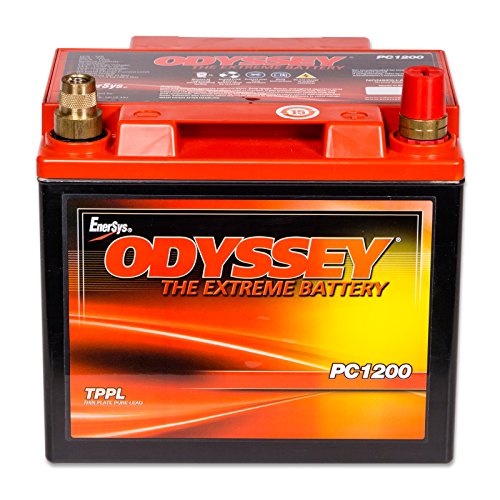 |
Odyssey PC1200T Automotive Light Truck BatteryOdyssey | Also great | Automotive · Light Truck · Battery | $371.99
Price as of 25 Oct 2026
|
View |
 |
Mighty Max Battery MM-G31M, 12V 110Ah, Group Size 31MMighty Max Battery | Budget pick | Group 31M · 825 CCA · Marine AGM | $249.99
Price as of 25 Oct 2026
|
View |
The table below breaks out daily-driver use, compact installs, and high-output bass so you can match the battery to the load instead of chasing one number. The right choice depends on amplifier RMS, engine-off listening, fitment, and whether the charging system can support the battery you choose.
How we chose
This comparison focuses on four things that matter in real installs: amplifier RMS range, engine-off runtime, fitment limits, and charging-system support. It also weighs AGM traits such as sealed construction, low internal resistance, vibration resistance, reserve capacity, and high-burst current delivery against lithium LFP traits such as high power density, light weight, stable voltage, BMS protection, and charging voltage limits.
We also separated CCA from audio performance. CCA helps with starting, but it is not the same as audio output or engine-off playback time.
Finally, the picks reflect common installation constraints such as Group 34R fitment, terminal orientation, and whether M6 terminal hardware will mate cleanly with amp lugs or bus bars.
AGM car audio battery: best for daily drivers
The XS Power D3400R is the safest all-around pick for drivers who want stronger bass performance without turning the car into a dedicated audio project. It fits the common daily-driver use case because AGM batteries are sealed, vibration-resistant, and built to deliver high burst current when the bass hits.
It lists 80 Ah capacity and 3300A max output, plus 160 minutes of reserve capacity. That combination makes it more useful than a starting battery when the system needs engine-off listening, but it still needs a charging system that can keep up with the amplifier load.
The main drawback is size and cost. Group 34R fitment, reverse polarity, and M6 terminal hardware all need a pre-buy check, and the battery is not the right answer if the issue is a weak alternator, poor ground, or undersized wire.
Lithium LFP car audio battery: best for tight installs
Lithium LFP fits best when space and weight matter more than long idle runtime, especially in compact trunks or custom enclosures where a lighter battery frees room for enclosure volume or mounting flexibility. For audio, the appeal is high power density, stable voltage, and a smaller package for the same usable output window.
Its main advantage is voltage stability under load, but that only helps if the charging voltage stays within the battery’s limits and the battery’s BMS or cell balancing is designed for the system. A lithium battery is not a shortcut around bad wiring, poor fuse sizing, or a charging system that cannot hold the needed voltage.
The drawback is that lithium demands more care than AGM. It is a better match for a clean install with known charging behavior than for a casual upgrade that still needs wiring, alternator, and mounting work.
Secondary battery system: best for high-output bass
A secondary battery system is the right move for serious bass systems that already have proper wiring, solid grounds, and charging-system support. It is best when the amplifier RMS load is high enough that a single battery cannot hold voltage during long, repeated bass bursts.
This is not the first fix for dimming lights. If the alternator is weak or the Big 3 wiring is poor, the system should be corrected before adding another battery. A secondary battery helps most when it is paired with correct mounting, adequate fuse protection, and wire sized for the current path.
The drawback is complexity. More battery capacity adds weight, cost, and installation work, and it can still be underused if the charging system is not strong enough to recharge it between drives.
Car battery decision table
This table is the practical short list. It maps battery type to amplifier RMS load, engine-off listening, physical size and weight, and the installation work that usually comes with each choice.
| Battery type | Best amplifier RMS range | Expected engine-off listening | Size and weight | Installation requirements |
|---|---|---|---|---|
| AGM battery | About 500W to 2000W in a daily-driver build | Moderate. Reserve capacity matters more than CCA for this use | Medium to large; often heavy, with fitment checks for Group 34R or similar trays | Direct replacement is common; verify terminal orientation, cable length, fuse sizing, and charging-system health |
| Lithium LFP battery | About 1000W to 3000W when the charging system is already sorted | Short to moderate, depending on Ah and load; stable voltage helps but load still governs runtime | Compact and light; ideal where weight or space is tight | Check BMS support, charging voltage limits, mounting, and whether the alternator can hold the correct voltage under load |
| Secondary battery system | About 2000W and up, especially for repeated bass events | Longest headroom for engine-off playback when correctly sized | Heaviest option once the second battery, brackets, and cables are counted | Needs proper mounting, dedicated cabling, fuse protection, and charging-system support; Big 3 upgrades are commonly part of the plan |
How many amp hours do you need for car audio?
For car audio, amp hours tell you how much stored energy the battery has for engine-off use, but the right number depends on amplifier load, listening level, and how long you expect the system to run without the engine. A compact system may be fine with modest Ah, while a bass-heavy build usually needs far more headroom.
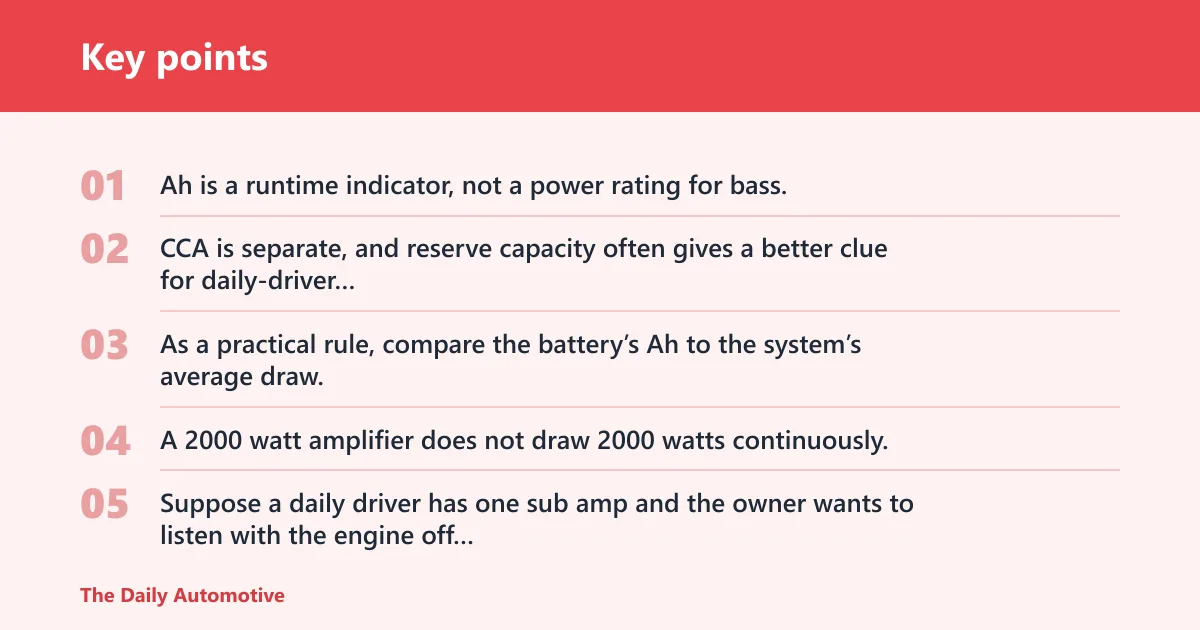
Ah is a runtime indicator, not a power rating for bass. CCA is separate, and reserve capacity often gives a better clue for daily-driver playback because it shows stored energy in minutes rather than only starting ability.
As a practical rule, compare the battery’s Ah to the system’s average draw, not just the amplifier’s advertised peak. A 2000 watt amplifier does not draw 2000 watts continuously, but a long bass session can still drain a small battery fast if the charging system is off.
Suppose a daily driver has one sub amp and the owner wants to listen with the engine off during a tailgate or parking lot stop. A battery with more reserve capacity and higher Ah will usually last longer than a compact starting battery, but the actual runtime still falls as volume rises and impedance changes.
Ah versus CCA
Ah helps answer how long the system can play. CCA helps answer how well the battery starts the car in cold weather. They are both useful, but they do not mean the same thing, and a high CCA number does not make a battery better for audio by itself.
Reserve capacity for daily use
Reserve capacity, listed in minutes, is one of the better numbers for engine-off playback. XS Power lists the D3400 at 160 minutes of reserve capacity, and the D6500 at 174 minutes. Those figures do not guarantee the same runtime at every load, but they do show how much stored energy the battery can hold before the system needs a recharge.
Do you need a second battery for car audio?
You need a second battery when the system’s current demand is high enough that the main battery cannot keep voltage stable through long bass bursts, engine-off playback, or repeated demo use. It is most useful in high-output builds, not as a first fix for weak wiring, a poor ground, or an undersized alternator.
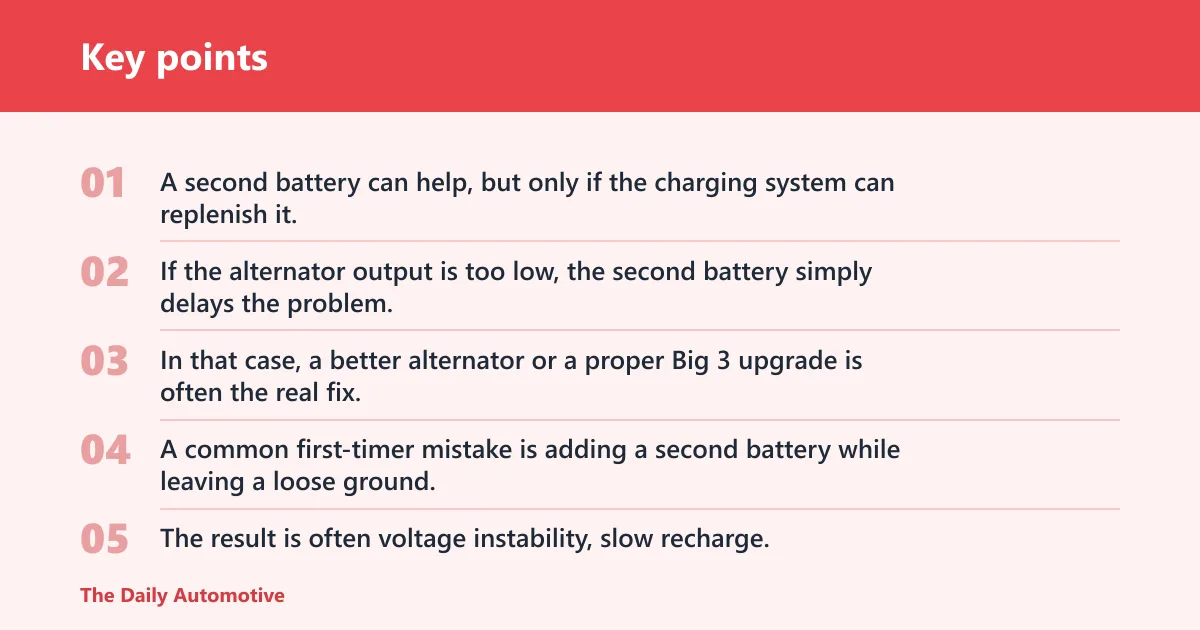
A second battery can help, but only if the charging system can replenish it. If the alternator output is too low, the second battery simply delays the problem. In that case, a better alternator or a proper Big 3 upgrade is often the real fix.
A common first-timer mistake is adding a second battery while leaving a loose ground, a tired alternator, and a small fuse in place. The result is often voltage instability, slow recharge, and a system that still dims at the same song peaks.
When a second battery makes sense
Choose a second battery when the amplifier RMS load is high, the vehicle already has solid charging support, and the install has room for secure mounting. It is also useful when the system spends time parked with the audio on and the owner wants more buffer than a single battery can provide.
When it does not
Do not add one to hide bad wiring. If the existing battery is small, the alternator is weak, or the cables are undersized, fix those first. A second battery adds capacity; it does not correct a poor charging path.
Can an AGM battery power a subwoofer system?
Yes, an AGM battery can power a subwoofer system, and it is often the best fit for daily drivers because it is sealed, vibration-resistant, and good at high-burst current delivery. It is especially useful when you want stronger bass without changing the car’s whole electrical layout.
AGM is usually the safer choice when the system is moderate to moderately high in power and the vehicle still needs everyday starting reliability. Its lower internal resistance helps reduce voltage sag during bass hits, which is why it is common in audio builds.
The limit is size and system demand. An AGM battery can still be overwhelmed if the amplifier load is too high, the wiring is undersized, or the alternator cannot recharge it fast enough between sessions.
What battery is best for a 2000 watt car audio system?
For a 2000 watt system, the best battery is usually AGM if the car is a daily driver and the electrical system is otherwise close to stock. If the install is tight and the charging system is upgraded, lithium LFP can work well. For repeated demo or SPL use, a secondary battery system is often the better path.
The key is not the watt number alone. Wiring losses, amplifier efficiency, and listening style all change the load. A clean 2000 watt build with good cable and a strong alternator may do well with one large AGM battery, while a bass-heavy system that sits at high output for long stretches may need more support.
Practical sizing check
- Estimate the real amplifier demand, not just the box rating.
- Check alternator output and the condition of the charging cables.
- Compare the battery’s Ah and reserve capacity to the expected engine-off time.
- Verify that the battery tray, terminal orientation, and weight fit the vehicle.
- Confirm fuse size and wire gauge for the actual current path.
Which one should you buy?
Buy AGM if you want the best all-around answer for daily driving, moderate bass, and easier installation. Buy lithium LFP if your build is tight on space or weight and the charging system is already ready for it. Buy a secondary battery system if the goal is high-output bass and the vehicle already has the alternator, wiring, and mounting support to match.
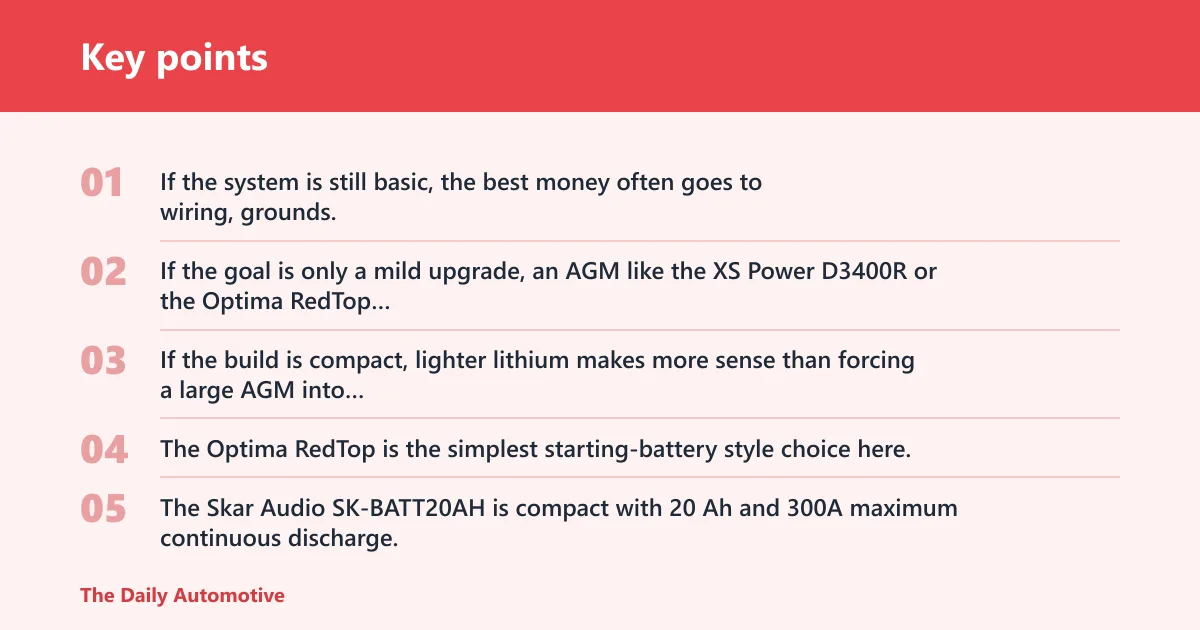
If the system is still basic, the best money often goes to wiring, grounds, and charging support before a second battery. If the goal is only a mild upgrade, an AGM like the XS Power D3400R or the Optima RedTop is usually the cleaner fit. If the build is compact, lighter lithium makes more sense than forcing a large AGM into a small tray.
The Optima RedTop is the simplest starting-battery style choice here, with 55 Ah and 750A CCA, but its CCA is about starting, not audio output. The Skar Audio SK-BATT20AH is compact with 20 Ah and 300A maximum continuous discharge, so it fits smaller roles rather than large bass builds. The Renogy AGM Battery at 100 Ah and the Kinetik HC2400-BLU at 110 Ah show how capacity can rise when the install has room for it, but both still depend on the charging system. The XS Power PS1200L is positioned for 1500W / 3000W use, which makes it the more specialized option when the build calls for lithium support.
Picture a trunk install where the battery tray only accepts a Group 34R case and the owner wants clean fitment without custom brackets. A reverse-polarity AGM with M6 terminal hardware is the easier path. A larger or heavier battery may offer more capacity on paper, but it can become the wrong buy the moment the terminals, tray, or cable reach do not line up.
Frequently asked questions
What is the best car battery for car audio?
For most car-audio upgrades, AGM is the best car battery because it balances sealed construction, vibration resistance, reserve capacity, and high-burst current delivery. Lithium LFP is better for lighter, tighter installs and higher-end electrical support. Secondary battery systems are for bigger bass builds that already have strong charging hardware.
Will a lithium battery stop headlight dimming?
Not by itself. Lithium can hold voltage well, but headlight dimming usually points to a charging-system or wiring problem. If the alternator, grounds, or cable size are not up to the load, the dimming can continue even with a lithium battery installed.
What size battery do I need for my amplifier?
Start with the amplifier’s RMS load, then check the battery’s Ah, reserve capacity, and fitment. A 2000 watt system may be fine with a strong AGM in a daily driver, while higher output or longer engine-off play can call for lithium or a second battery. The tray and terminal orientation must also match.
Products related to this article
Sponsored / affiliate links. As an Amazon Associate I earn from qualifying purchases. I may earn additional commission from eligible campaigns.