Wires for Car Battery: AWG Gauge Guide and Best Cable Picks
The right wire for a car battery depends on the job: 4 to 6 AWG copper cable handles most starting and inverter connections, while thinner 8 to 10 AWG wire suits accessories, and heavy loads need 1 or 2 AWG or thicker.
Wire gauge and amp capacity matter more than the label on the package. A cable that is too thin for the load overheats and drops voltage, which can leave you with a weak jump-start or an inverter that cuts out under load. The three cable sets below cover the most common jobs: a 4AWG inverter cable, 6-gauge jumper cables for jump-starting, and bulk 2AWG copper cable for heavier custom wiring.
What Gauge Wire Do You Need for a Car Battery?
The gauge you need depends on how much current the circuit carries and how far the wire has to run. If you are chasing a different battery problem instead of shopping for cable, see how to charge a car battery without a charger or check whether your battery terminal connectors need replacing first, since a loose or corroded terminal can look like a bad cable.
| Wire Gauge (AWG) | Typical Max Amps | Common Use |
|---|---|---|
| 10 AWG | ~30A | Accessory wiring, radio, lights, starter trigger wire |
| 8 AWG | ~40A | Smaller vehicles, low-power accessories |
| 6 AWG | ~50-60A | Standard jumper cables, mid-size alternator leads |
| 4 AWG | ~100-125A | Battery-to-starter cable, small inverters, winches |
| 2 AWG | ~150-200A | Heavy-duty inverters, high-output alternators, welding-style cable |
| 1/0-2/0 AWG | ~250-300A | Large inverters, solar/EV battery banks, hard-cranking diesel engines |
Cable length matters too. A run under 3 feet can often use one gauge thinner than a 10-foot run carrying the same amp load, because voltage drop increases with distance. When you are unsure which way to round, size up rather than down.
CARTMAN 4AWG 24-Inch Battery Inverter Cable Set
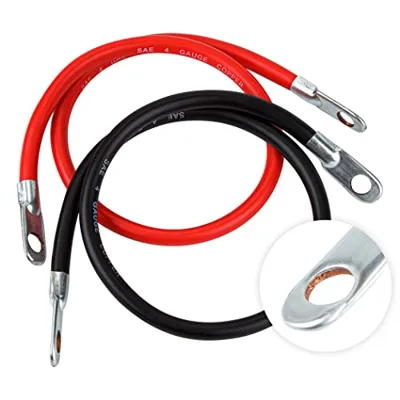
The CARTMAN 4AWG 24-Inch Battery Inverter Cable Set is a solid pick for anyone upgrading a vehicle’s electrical system, whether that is a car, truck, RV, or a solar setup. The pre-installed ring terminals and clearly marked positive and negative cables make it a straightforward swap for a worn or undersized battery-to-inverter connection.
Pros:
- Durable copper construction for long-lasting use.
- Pre-installed ring terminals for a quick, secure connection.
- Versatile use for automotive, RV, and solar applications.
- Easy installation with clearly marked positive and negative cables.
Cons:
- May be overkill for small-scale, low-current applications.
- Fixed 24-inch length may not suit every layout.
The 4AWG gauge handles high current capacity, which makes this set suitable for heavier applications like off-road electrical setups or high-output alternators. The 24-inch length gives enough reach for most under-hood or battery-bank installs without excess slack, and the copper conductors help keep energy loss low, which matters most in solar applications where every bit of efficiency counts.
To check today’s price, click here.
Energizer Jumper Cables for Car Battery
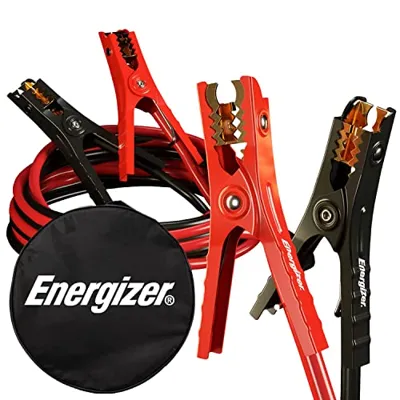
The Energizer Jumper Cables are built for the moment a battery dies unexpectedly. Whether you are a daily commuter, a road-trip driver, or someone who just wants a reliable tool in the trunk, this set covers the classic jump-start scenario: a dead or weak battery that needs a boost from another vehicle.
Pros:
- Heavy-duty construction built for repeated use.
- 16-foot length reaches between vehicles parked at awkward angles.
- Comes with a carrying bag for storage and portability.
- Energizer brand backing for quality and reliability.
Cons:
- 6-gauge thickness is bulkier than some drivers prefer for glovebox storage.
- Fixed red housing, so no color options.
The heavy-duty construction is built to handle repeated jump-starts in rough weather without the clamps or insulation breaking down. The 16-foot length gives real flexibility in tight or awkward parking situations, and the included carrying bag keeps the cables tangle-free in a trunk or garage until you actually need them.
To check today’s price, click here.
Shirbly 2 AWG Pure Copper Battery Cable (10FT Red + 10FT Black)
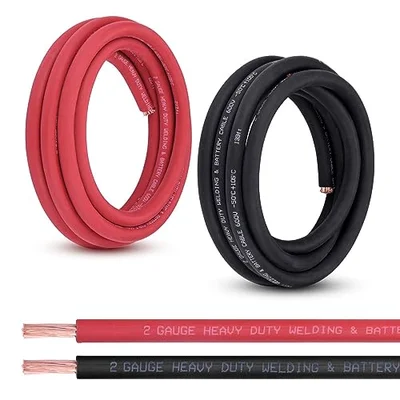
The Shirbly 2 Gauge Battery Cable is a good option if you need bulk cable to build your own connection rather than a pre-terminated set. This fully annealed pure copper cable (OFC) uses fine-stranded copper wire with a solvent-resistant EPDM rubber insulation sheath. It is rated for up to 600 volts and built for tough conditions, withstanding temperatures from -58 degrees F to 221 degrees F (-50 degrees C to 105 degrees C), and it resists most solvents.
The EPDM insulation sheath is heat-resistant, wear-resistant, tear-resistant, moisture-resistant, and oil-resistant, which makes it a reasonable choice for outdoor and marine-adjacent applications, not just under the hood. It is soft enough to bend into tight spaces without kinking. Because this ships as raw cable with no terminals attached, plan to crimp or solder your own lugs sized for the connection you are building.
To check today’s price, click here.
Frequently Asked Questions
What Gauge Wire Do You Need for a Car Battery?
Most passenger cars use 4 to 6 AWG cable for the main battery-to-starter connection and 8 to 10 AWG for smaller accessory wiring. Heavy loads such as power inverters, winches, or aftermarket amplifiers need thicker 1 or 2 AWG cable, and high-draw setups like large inverters or solar battery banks often step up to 1/0 or 2/0 gauge to keep voltage drop low over longer cable runs.
What Are the Benefits of the CARTMAN 4AWG Cables?
CARTMAN’s 4AWG cables use copper conductors with pre-installed ring terminals, so they handle moderate to heavy loads such as inverters, winches, or accessory wiring on cars, trucks, RVs, and solar setups. The 24-inch length covers most under-hood or battery-bank distances without leaving excess slack to tuck away.
How Do Energizer Jumper Cables Improve Jump-Starting?
The Energizer set uses heavy-duty 6-gauge wire and 16 feet of reach, which is enough to connect two vehicles parked nose-to-nose or side by side. Color-coded, insulated clamps make it harder to cross the polarity by mistake, and the included carrying bag keeps the cables organized in a trunk or garage for roadside emergencies.
Is the Shirbly 2 AWG Cable Good for Automotive and Solar Use?
Yes. The Shirbly cable is pure copper (OFC), rated up to 600 volts, and rated to handle temperatures from -58 degrees F to 221 degrees F, so it holds up in engine bays, solar battery banks, and generator setups. It ships as 10 feet of red and 10 feet of black cable without pre-installed terminals, so you will need to crimp or solder your own lugs for the connection you need.
Can You Use Welding Cable as Battery Cable?
Welding cable and battery cable are often the same underlying product: fine-stranded, flexible copper wire with a thick rubber or EPDM jacket rated for high current and rough conditions. That is why cable sold as 2 AWG welding cable, like the Shirbly set above, works fine as heavy-duty battery or inverter cable, as long as you add terminal lugs sized for your connection.
Conclusion
Choosing the right wire for your car battery comes down to matching gauge to amp load, not picking the thickest or cheapest option available. The CARTMAN 4AWG set is built for inverter and accessory connections on cars, trucks, RVs, and solar setups. The Energizer jumper cables solve a different problem entirely: getting a dead battery started with a boost from another vehicle. The Shirbly 2 AWG cable is the pick when you need bulk copper cable to build a custom high-amp connection yourself.
Use the gauge table above to match wire size to your actual amp draw and cable length, always keep positive and negative connections clearly marked, and size up rather than down whenever you are unsure. A properly sized cable protects your battery, your electronics, and your vehicle’s electrical system for the long run.
Products related to this article
Sponsored / affiliate links. As an Amazon Associate I earn from qualifying purchases. I may earn additional commission from eligible campaigns.