Sun Reflector for Car: How to Choose the Right Fit
Choose a sun reflector that matches your windshield shape and the maker’s stated fit range; a loose or short shade leaves glass exposed and cabin temperatures rise fast. A shade that misses the edges can still leave the dash, steering wheel, and infotainment screen in direct sun, and that gap often matters more than star ratings. This guide explains how to measure the windshield, check mirror and sensor cutouts, and spot coverage mistakes before you buy.
The best first choice is the one that covers the full glass without forcing around a rearview mirror, rain sensor housing, or camera pod. Fit decides whether the reflector blocks direct light or leaves heat leaks at the edges.
Top pick: fit-first windshield shade


What the top pick should solve first
A good windshield shade should do three jobs at once: cover the visible glass, stay flat enough to reduce light seepage, and store easily enough that you will actually use it. If it is awkward, bulky, or slow to deploy, daily parking habits usually defeat the product before summer ends.
For shoppers comparing materials and styles, the most useful filters are windshield width and height, mirror clearance, sensor clearance, and whether the shade reaches the lower corners. Measurements beat brand claims every time.
Quick picks by use case

- Best for daily hot-weather parking: A 240T polyester shade with an overlapping design, because it gives better edge coverage and generally handles repeated use better than thin single-layer fabric.
- Best for larger windshields: A larger universal shade with stated dimensions near 64 x 32 inches or 63 x 33.8 inches, provided your windshield actually fits that range.
- Best for fast setup and storage: A foldable frame design with a pouch, since fast deployment matters as much as reflective performance for everyday drivers.
- Best budget option with suction cups: A simpler shade that uses suction cups for mounting stability, if you can accept that the cups can weaken over time.
Those picks separate by use case, not by hype. A shade that works well for a compact sedan may still miss the upper corners of a truck or a tall crossover.
Quick product notes
EcoNour fits windshields up to 64 x 32 inches and uses 240T polyester construction with an overlapping design that extends up to 8 inches. That combination favors coverage on many mainstream vehicles, especially when edge sealing matters more than a minimalist fold.
Big Ant uses reflective aluminum foil plus double-layer bubble material. That pairing suits shoppers who want more heat reflection and a little extra insulation, though bulk can matter when you remove it every day.
Clothclose is sized at 55 x 32 inches and claims to block up to 98% of UV rays. It is a smaller-width option, so the windshield measurement matters before you rely on that UV claim.
Magnelex is listed at 63 x 33.8 inches and uses 240T reflective polyester. That makes it a closer match for larger glass than compact shades, but it still depends on your mirror placement and rake angle.
SINGARO measures 55 L x 26.7 W inches, which places it in a smaller-coverage class that can fit some compact vehicles but may leave exposed edges on wider windshields.
GWUSKDT is sized at 58 x 27.5 inches and uses a five-layer bubble insulation structure. The layered build points toward better thermal resistance, but the size still has to match your windshield.
SHINEHOME targets the Honda Accord specifically. Vehicle-specific fit can help when you want fewer edge gaps than a broad universal design usually allows.
The auto gear guide also includes a sunshade umbrella with a 10 rib design, plus BNYD as a foldable reflective sun visor with suction cups. Those two styles show the tradeoff clearly: quick setup on one side, holding strength on the other.
Sun reflector fit checklist and sizing worksheet
Use this checklist before buying. It gives you a practical way to avoid the most common mistake: selecting a shade by vehicle class instead of actual glass size. Windshield width and height should drive the purchase, followed by clearance for mirrors and sensors.
| What to measure or check | How to check it | Fit target | Risk if ignored |
|---|---|---|---|
| Windshield width | Measure the widest usable glass span from side to side | Match the stated width range or stay slightly under it | Short coverage at the A-pillars and outer edges |
| Windshield height | Measure from the top glass edge to the dashboard line | Shade height should reach low enough to cover the exposed area | Sun hits the dash, cluster, or infotainment screen |
| Rearview mirror clearance | Check where the mirror sits relative to the upper center glass | Leave space for the mirror stalk without creating a large opening | Heat leak near the top center and poor fit around the mirror |
| Rain sensor or camera housing | Look for a pod behind the mirror or on the upper glass | Choose a shade with a cutout or flexible edge near the housing | Shade bows away from the glass and leaves a bright gap |
| Edge coverage | Compare shade shape to the curved corners of the windshield | Prefer overlapping or shaped edges for better contact | Light leaks at the corners and faster cabin heat buildup |
| Storage space | Check glove box, seatback pocket, or cargo nook availability | Pick a foldable design if you need daily carry convenience | Bulky shades get left at home or bent during storage |
Size bands that often line up with common vehicles: 64 x 32 inches and 63 x 33.8 inches usually suit larger windshields; 55 x 32 inches often suits mid-size glass; 55 x 26.7 inches and 58 x 27.5 inches lean smaller and can work on compact vehicles with limited width. Those are not guarantees. Measure first.
Fit risks that create heat leaks: a shade that stops above the dash line, a center gap around a mirror or sensor, a short outer edge at the A-pillar, or a wide windshield that outgrows a universal fit. Any one of those can reduce how much heat the shade actually blocks.
Measurement steps
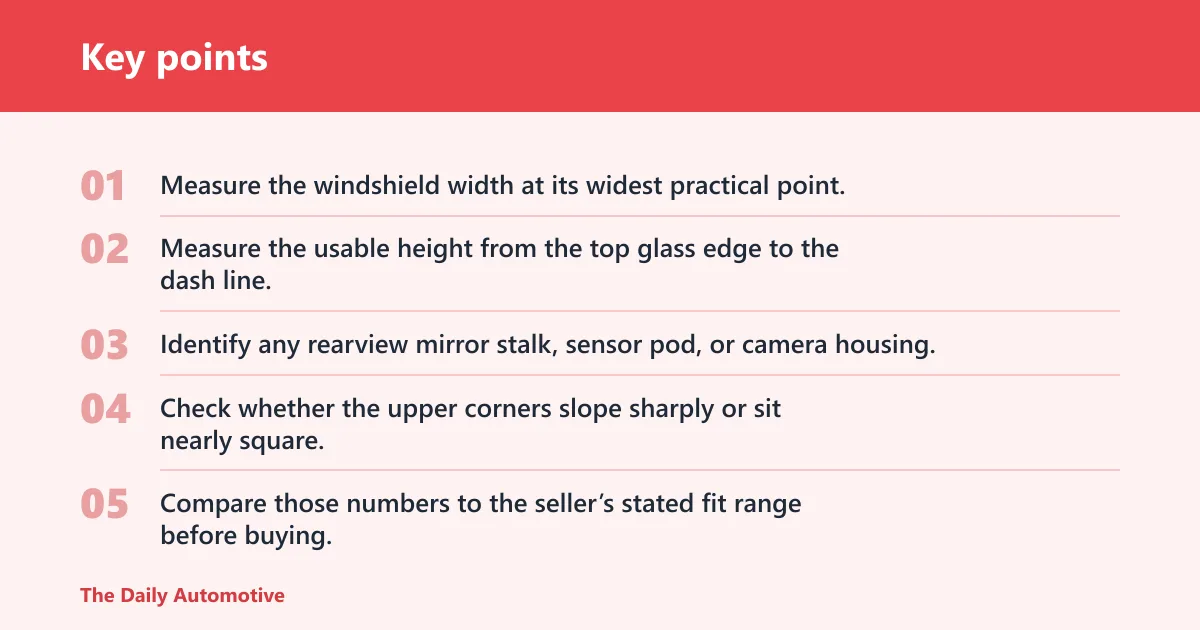
- Measure the windshield width at its widest practical point.
- Measure the usable height from the top glass edge to the dash line.
- Identify any rearview mirror stalk, sensor pod, or camera housing.
- Check whether the upper corners slope sharply or sit nearly square.
- Compare those numbers to the seller’s stated fit range before buying.
Say your compact sedan measures close to 55 inches wide and has a clean mirror mount, a 55 x 32 shade may be workable. Now suppose the same car has a sensor pod that sits lower than expected; the same shade can still leave a gap that lets sunlight reach the dash.
What size sun reflector do you need for your car?
You need the shade size that matches your windshield width and height, not the vehicle badge on the trunk. A universal label can cover many hatchbacks, sedans, and SUVs, but it still fails when the glass is too tall, too wide, or shaped around a sensor housing.
Using width and height, not guesses
Start with the glass dimensions. Then compare them to the maker’s stated range. If the shade is short on height, it can still leave the dashboard exposed even when the width seems close enough. If it is short on width, the corners usually leak sunlight first.
Commonly cited sizes include about 64 x 32 inches, 63 x 33.8 inches, 55 x 32 inches, and 55 x 26.7 inches. Those numbers are most useful when you place them next to your own windshield measurement, because a small mismatch can affect edge coverage more than people expect.
How the common size bands compare
The larger sizes are better starting points for bigger windshields, especially when the top edge is wide and the windshield sits more upright. Smaller sizes fit narrower glass more comfortably and are easier to store, but they can miss the corners on a broad or steeply raked windshield.
A common first-timer mistake is choosing by sedan, SUV, or truck label alone. Two vehicles in the same class can have very different glass shapes, and the shade that fits one can leave open strips on the other.
When a universal fit is too small
If the shade barely reaches the side edges or has to be stretched hard around the mirror area, it is too small. A stretched shade usually creates the very heat leaks buyers hoped to avoid, and it also tends to wear out faster at the folds.
Which materials work best for daily heat?
For daily hot-weather parking, the strongest material choice is the one that balances heat blocking with repeat use. 240T polyester is common in higher-end universal shades because it is durable and marketed for UV blocking, while reflective aluminum foil and bubble insulation lean harder toward heat reflection and thermal resistance.
240T polyester for durability and UV blocking
240T polyester appears in multiple ranked products, including EcoNour and Magnelex. It is a practical choice for drivers who need a shade that can be folded, opened, and stored often without feeling flimsy, and it is often paired with UV-blocking claims.
That durability matters in hot climates where the shade goes in and out of the car daily. A material that tolerates repeated handling is less likely to crease badly or tear at the corners.
Reflective aluminum foil with bubble insulation
Reflective aluminum foil is aimed at heat reflection, and it is often paired with bubble insulation for a second layer of thermal resistance. Big Ant uses reflective aluminum foil plus double-layer bubble material, while GWUSKDT uses a five-layer bubble insulation structure.
That kind of construction can help when parked heat is the main problem. The tradeoff is bulk, which can make the shade slower to fold and harder to stash in a tight cabin.
Double-layer versus single-layer designs
Double-layer design usually means fewer light leaks and better heat rejection than a single-layer shade. The extra layer helps seal the glass surface more fully and reduces the chance that a bright strip at the edge becomes a hot spot on the dash.
Single-layer shades can still work, especially on smaller windshields, but they are more sensitive to fit errors. If the fit is already marginal, a single layer often shows the problem faster.
Suppose a midsize SUV has a windshield that measures just beyond a compact shade’s stated width. A single-layer cover may look acceptable from the curb, but once the sun shifts, the open edge near the mirror can let heat build on the steering wheel and center stack.
Will a universal shade fit your SUV or truck?
A universal shade can fit many SUVs and some trucks, but it is not a guarantee. It works best when the windshield is within the stated size range and the glass shape is fairly conventional. Large, tall, or steeply raked windshields often need more coverage than a basic universal design provides.
When universal fit is good enough
Universal fit is usually good enough for hatchbacks, sedans, and many crossovers with standard glass proportions. If the shade matches the windshield dimensions and clears the mirror area without leaving a large opening, it can do the job well enough for daily parking.
When oversized glass needs more coverage
Oversized windshields create two problems: they can exceed the shade’s width, and they can expose a larger lower section near the dash. In that case, a larger universal size or a vehicle-specific shade is the safer choice.
SHINEHOME, which targets the Honda Accord specifically, points to the advantage of a more tailored fit when a universal design leaves too much daylight around the edges.
Overlap, edge coverage, and common miss points
Overlapping design is useful because it extends coverage at the windshield edges. EcoNour’s overlapping design extends up to 8 inches, which is the kind of feature that helps on curved or broad glass where the corners are the first failure point.
The common miss points are predictable: the top center around the mirror, the upper corners at the A-pillars, and the lower edge above the dash. If any of those areas stay exposed, the interior still heats up faster than it should.
How to choose and store a windshield sun shade
Choose the style you will use every day. Foldable frames favor compact storage and quick removal, while a sun shade umbrella favors very fast deployment. Suction cups can help with holding strength, but they should not be treated as a substitute for proper windshield fit.
Foldable frame versus sunshade umbrella
A foldable frame shade usually packs flatter, often with a pouch, and is easier to keep in a door pocket or cargo bin. That matters when you want a reflector that does not become cabin clutter.
A sun shade umbrella uses a rib structure for stability and usually opens quickly. The auto gear guide includes a sunshade umbrella with a 10 rib design, which reflects the appeal of fast setup when parking in direct sun is part of the daily routine.
Where suction cups help and where they do not
Suction cups can help keep a smaller or budget shade anchored to the glass, and the Auto Gear Guide highlights BNYD as a foldable reflective sun visor with suction cups. They are useful when the shade shape needs a little extra holding power.
They are not a cure for a poor fit. If the shade is short, the suction cups may keep it from falling, but they will not close the open gap that lets light and heat in.
How to store it without bending or creasing it
Store the shade flat or folded along its intended creases, then place it in its pouch if one is included. Avoid forcing a wide shade behind a seat where it gets bent at an odd angle, because repeated twisting can damage the frame or make the folds harder to open.
Also avoid stuffing a reflective shade under heavy cargo. The pressure can deform bubble insulation or weaken the edges, which matters more on daily-use shades than on occasional-use ones.
A practical rule: if the shade takes more than a few seconds to retrieve, open, and put away, you are less likely to use it consistently. Convenience affects real-world performance because an unused shade protects nothing.
Do windshield sun shades really keep a car cooler?
Yes, but only in the practical sense that matters here: they reduce heat buildup and make the cabin easier to start in after parking. They do not make a parked car cold, and they do not eliminate all heat soak if the windshield fit is poor or the glass is still exposed at the edges.
They also help with long-term interior aging by blocking UV rays that can fade dashboards and upholstery. That protection is separate from immediate cooling, so a buyer should judge both goals instead of treating them as the same outcome.
What is the best material for a car sun reflector?
For most daily drivers, 240T polyester is the best all-around starting point because it balances durability, UV-blocking claims, and storage convenience. If maximum heat reflection is the priority, reflective aluminum foil with bubble insulation usually offers stronger thermal resistance, though it tends to be bulkier.
That tradeoff matters in hot climates. A thicker reflective build can work better in parked heat, while a lighter polyester shade may be easier to handle every day. The best material is the one that fits your windshield and your storage habits.
How do I choose between a foldable shade and a sunshade umbrella?
Choose a foldable shade if you want something flatter to store and easier to tuck away after parking. Choose a sunshade umbrella if fast deployment is the top priority and you want a ribbed structure that opens quickly.
Foldable shades often win on storage convenience. Umbrella styles often win on speed. If your daily routine involves short stops and frequent parking, the quicker option may get used more consistently, even if it is less compact.
Frequently asked questions
What size sun reflector do I need for my car?
Measure windshield width and height first, then compare those numbers to the shade’s stated fit range. Common cited sizes include 64 x 32 inches, 63 x 33.8 inches, 55 x 32 inches, and 55 x 26.7 inches. The right choice is the one that covers the full glass without forcing around the mirror or sensors.
Will a universal sun reflector fit my SUV or truck?
Sometimes, but not always. Universal fit works well when the windshield size and shape stay within the stated range. Large or steeply raked SUV and truck windshields often need more coverage than a generic shade can provide, especially at the corners and mirror area.
How do I store a windshield sun reflector without damaging it?
Fold it along its intended creases, keep it in the pouch if one is included, and avoid crushing it under cargo. Long-term damage usually comes from odd bends, hard pressure, or repeated twisting, especially on shades with bubble layers or a foldable frame.
Are double-layer sun shades better than single-layer ones?
Usually yes, because double-layer or overlapping designs reduce light leaks and improve heat rejection. They are not magic, though. If the shade is the wrong size, even a better build still leaves exposed areas that let heat into the cabin.
Products related to this article
Sponsored / affiliate links. As an Amazon Associate I earn from qualifying purchases. I may earn additional commission from eligible campaigns.