2012 Genesis Stuck in Neutral Fix Guide
It can be quite frustrating when your 2012 Hyundai Genesis suddenly refuses to move out of neutral. You might feel stuck, and for someone new to car repairs, figuring out why this happens and how to fix it can seem tough. This guide is here to make things easy.
We’ll walk you through what might be causing your car to get stuck in neutral and give you a simple, step-by-step solution. Let’s get your car back on the road.
Understanding Your 2012 Genesis Stuck in Neutral Problem
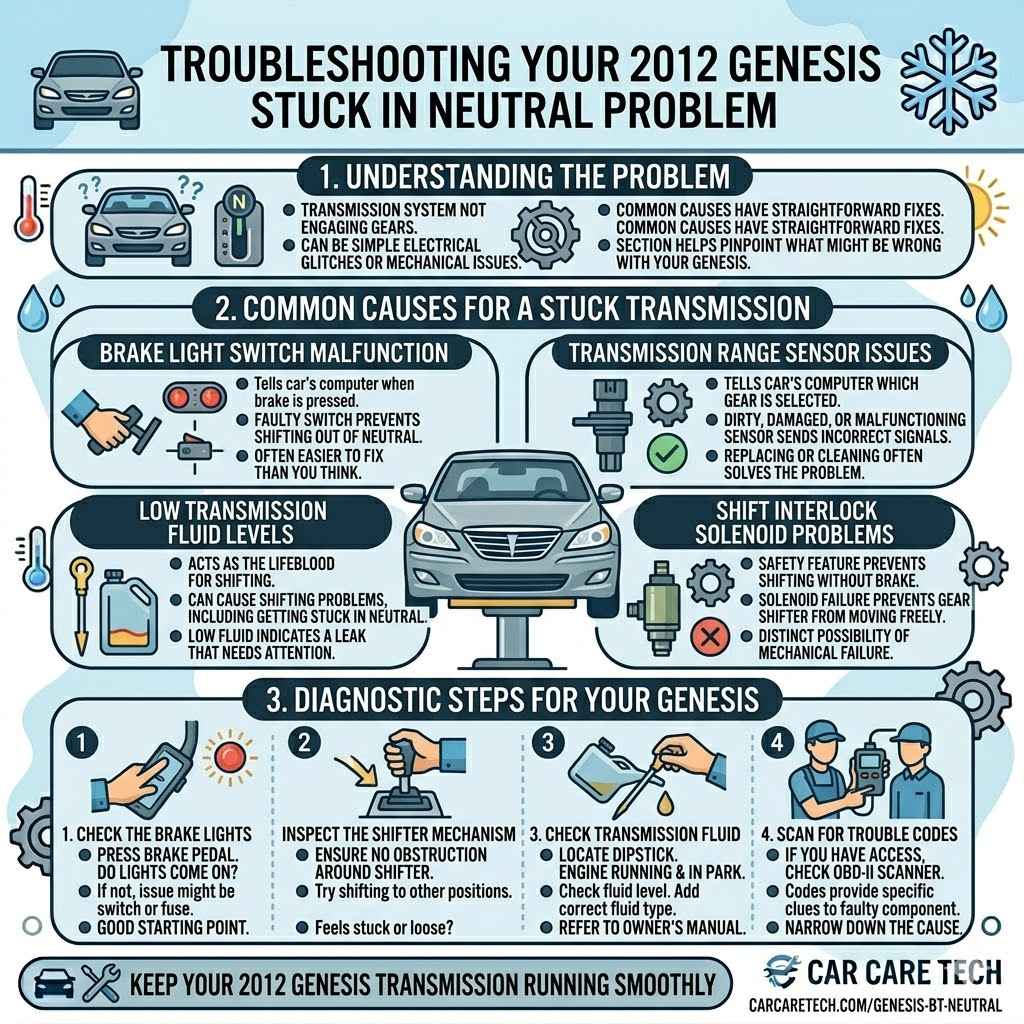
When your 2012 Hyundai Genesis is stuck in neutral, it means the transmission system isn’t engaging any gear. This can happen for various reasons, from simple electrical glitches to more serious mechanical issues. For many car owners, especially those without much experience in automotive repair, diagnosing this problem can be a bit confusing.
The good news is that many common causes have straightforward fixes. This section will help you pinpoint what might be wrong with your Genesis.
Common Causes for a Stuck Transmission
Several factors can lead to a transmission getting stuck in neutral. Understanding these common culprits is the first step toward resolving the issue. We’ll look at the most frequent reasons your 2012 Hyundai Genesis might be experiencing this problem.
Brake Light Switch Malfunction
The brake light switch plays a crucial role in your car’s ability to shift gears. It tells the car’s computer when you’re pressing the brake pedal. If this switch isn’t working correctly, the computer might not receive the signal that it’s safe to shift out of neutral.
This is a surprisingly common issue and often easier to fix than you might think. A faulty switch can prevent the gear selector from moving.
Transmission Range Sensor Issues
The transmission range sensor, also known as the neutral safety switch, tells the car’s computer which gear position is selected. If this sensor is dirty, damaged, or malfunctioning, it can send incorrect signals. This can lead to the car believing it’s still in neutral even when you try to shift into drive or reverse.
Replacing or cleaning this sensor can often solve the problem.
Low Transmission Fluid Levels
Transmission fluid is like the lifeblood of your automatic transmission. It lubricates moving parts, cools the transmission, and helps in hydraulic pressure needed for shifting. If the fluid level is too low, it can cause shifting problems, including getting stuck in neutral.
Low fluid can also indicate a leak that needs immediate attention. Checking and topping up transmission fluid is a basic maintenance step that can prevent major headaches.
Shift Interlock Solenoid Problems
The shift interlock solenoid is a safety feature that prevents you from shifting out of park unless the brake pedal is pressed. If this solenoid fails, it can prevent the gear shifter from moving freely between gears, potentially leaving the car stuck in neutral. This is a more mechanical component, but its failure is a distinct possibility.
Diagnostic Steps for Your Genesis
Before you start pulling parts, it’s smart to go through a few basic checks. These steps can help you narrow down the cause of your 2012 Hyundai Genesis being stuck in neutral. They are simple and can save you time and money.
Check the brake lights.
Press the brake pedal. Do your brake lights come on? If not, the issue might be with the brake light switch or its fuse.
This is a good starting point because it’s an external check.
Inspect the shifter mechanism.
Ensure there’s no obstruction around the gear shifter. Sometimes, foreign objects can interfere with its movement. Gently try to move the shifter to other positions to see if it feels stuck or loose.
Check transmission fluid.
Locate the transmission fluid dipstick. With the engine running and the transmission in park, check the fluid level. If it’s low, add the correct type of transmission fluid.
Be sure to check your owner’s manual for the specific fluid type.
Scan for trouble codes.
If you have access to an OBD-II scanner, check for any diagnostic trouble codes. These codes can provide specific clues about what system is reporting an error, potentially pointing directly to the faulty component.
Fixing Your 2012 Hyundai Genesis Stuck in Neutral
Once you have a better idea of what’s causing your 2012 Hyundai Genesis to be stuck in neutral, it’s time to look at the fixes. Some problems are simple DIY jobs, while others might require professional help. We’ll cover the most common solutions you can try yourself.
Replacing the Brake Light Switch
The brake light switch is usually located near the brake pedal. It’s a small, often plastic component that can wear out over time. Replacing it is a common fix for cars stuck in neutral.
Locate the switch. It’s typically mounted above the brake pedal arm.
You might need a flashlight to see it clearly. It has a lever that is pressed by the brake pedal arm when the pedal is released.
Disconnect the electrical connector.
Carefully pull the connector off the switch. There might be a small clip holding it in place.
Remove the old switch.
Depending on the design, you might need to twist it to release it or simply pull it straight out. Some switches are held in by a retaining clip.
Install the new switch.
Insert the new switch into its spot, ensuring it’s seated properly. Reconnect the electrical connector.
Test the brake lights and shifter.
Start your car and press the brake pedal. Your brake lights should illuminate. Then, try shifting out of neutral.
A new brake light switch can cost anywhere from $15 to $50, and installation is usually straightforward. Many drivers can complete this repair in under an hour.
Addressing the Transmission Range Sensor
The transmission range sensor (neutral safety switch) can also be the culprit. This component tells the car’s computer which gear is selected. If it fails, the car might not recognize that you’re trying to shift.
Access the sensor.
This sensor is typically located on the transmission itself. You may need to remove a cover or other components to get to it. Consult your Genesis service manual for the exact location.
Remove the electrical connector.
Similar to the brake light switch, disconnect the wiring harness from the sensor.
Unbolt and remove the old sensor.
There will be bolts holding the sensor in place. Remove these and carefully pull the sensor out. Be aware that some transmission fluid might leak out.
Install the new sensor.
Place the new sensor in the correct position and secure it with the bolts. Reattach the electrical connector.
Check transmission fluid and clear codes.
After installation, top up any lost transmission fluid and use an OBD-II scanner to clear any stored diagnostic codes. Test your car’s shifting ability.
Replacing this sensor can range from $50 to $150 for the part. The labor can add more if you’re not doing it yourself.
Topping Up Transmission Fluid
If your transmission fluid is low, this is the easiest fix. Low fluid can cause the transmission to slip or get stuck.
Ensure the engine is running and the car is in Park.
This is important for an accurate fluid level reading.
Locate the transmission fluid dipstick.
It’s often a brightly colored loop, similar to the oil dipstick but usually placed elsewhere.
Pull out the dipstick, wipe it clean, and reinsert it fully.
Make sure it’s all the way in.
Pull out the dipstick again and check the fluid level.
There will be markings for “low” and “full.”
Add the correct transmission fluid if low.
Refer to your 2012 Hyundai Genesis owner’s manual for the specific type of fluid needed. Add fluid slowly, checking the level frequently to avoid overfilling.
Transmission fluid is relatively inexpensive, usually $5 to $15 per quart. This is a quick check that can save your transmission.
When to Seek Professional Help
While many issues can be resolved with DIY steps, some problems require an expert. If you’ve tried the basic fixes and your 2012 Hyundai Genesis is still stuck in neutral, it’s time to call a mechanic.
Complex internal transmission problems.
If the issue is with the gears, clutches, or other internal components of the transmission, it will likely require specialized tools and knowledge to repair.
Electrical system faults beyond sensors.
Problems with the car’s main computer (ECU) or complex wiring harness issues are best handled by automotive electricians or dealerships.
You are not comfortable with the repair.
If at any point you feel unsure or uncomfortable performing a repair, it’s always safer to let a professional handle it. Safety should always come first.
A professional mechanic can perform advanced diagnostics, including checking transmission pressure, control module data, and electrical systems with specialized equipment. They can also perform complex repairs like rebuilding the transmission or replacing the transmission control module.
The 2012 Hyundai Genesis Stuck in Neutral? Fix Guide for Common Scenarios
Let’s look at a couple of situations people often face with their 2012 Hyundai Genesis and how this 2012 Hyundai Genesis Stuck in Neutral? Fix Guide can help. These examples highlight common problems and their solutions.
Scenario 1: Car won’t shift out of park, stuck in neutral
A common complaint is that the car won’t even move from park, and when it does, it seems to be stuck in neutral. This often points to the shift interlock system.
Problem: Gear shifter won’t budge from Park.
You press the brake, but the shifter is locked. This could be the brake light switch not sending the “brake pressed” signal.
Solution: Check brake lights first. If they don’t work, replace the brake light switch. If brake lights work, the shift interlock solenoid might be faulty. This solenoid is usually located under the center console around the shifter. Replacement involves removing trim pieces and the shifter assembly.
This solenoid is a safety device that links your brake pedal to the shifter.
Outcome: After replacing the brake light switch, the car shifts normally.
The car now moves freely between gears, and the brake lights function correctly.
Scenario 2: Transmission light on, stuck in neutral
Sometimes, the transmission warning light comes on the dashboard, and the car is stuck in neutral. This often means the transmission control module (TCM) has detected an issue.
Problem: Transmission warning light is illuminated.
The car is unresponsive to gear changes, staying in neutral.
Solution: Scan for diagnostic trouble codes (DTCs) using an OBD-II scanner. Common codes related to this issue are P0705 (Transmission Range Sensor Circuit Malfunction) or codes related to specific gear failures. If the code points to the transmission range sensor, replace it. If codes indicate a faulty TCM, this is a more complex repair that may require dealership intervention.
The TCM is the brain of the transmission.
Outcome: Replacing the transmission range sensor and clearing codes resolves the issue.
The warning light turns off, and the car shifts through all gears smoothly.
Maintenance Tips for Your Hyundai Genesis Transmission
Preventing your 2012 Hyundai Genesis from getting stuck in neutral in the first place is key. Regular maintenance can save you a lot of trouble and expense down the road. Paying attention to your transmission can keep it running smoothly.
Regularly check transmission fluid levels and condition.
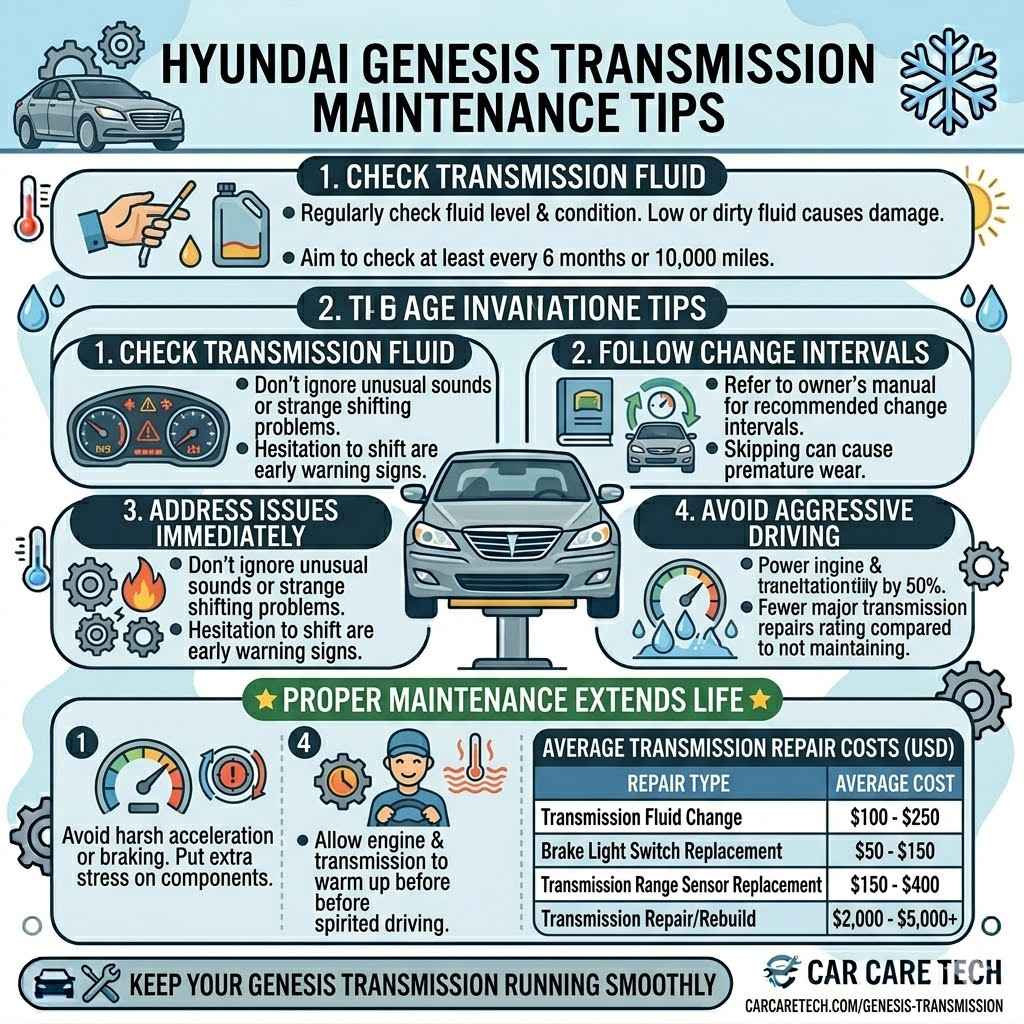
This is one of the most important checks you can do. Low or dirty fluid can lead to serious transmission damage. Aim to check it at least every six months or 10,000 miles.
Follow the recommended transmission fluid change intervals.
Your owner’s manual will specify how often the transmission fluid should be changed. This interval is based on driving conditions and mileage. Skipping this can cause premature wear.
Address any strange noises or shifting problems immediately.
Don’t ignore unusual sounds like grinding or whining, or if the transmission hesitates to shift. These are early warning signs that something is wrong.
Avoid aggressive driving, especially when the transmission is cold.
Harsh acceleration or braking can put extra stress on transmission components. Allow the engine and transmission to warm up before engaging in spirited driving.
Statistics show that proper transmission maintenance can extend the life of a transmission by up to 50%. For example, a 2018 study by the Automotive Aftermarket Industry Association (AAIA) indicated that vehicles with regular fluid services experienced fewer major transmission repairs compared to those that did not.
Table showing average costs for transmission repair:
| Repair Type | Average Cost (USD) |
|---|---|
| Transmission Fluid Change | $100 – $250 |
| Brake Light Switch Replacement | $50 – $150 |
| Transmission Range Sensor Replacement | $150 – $400 |
| Transmission Repair/Rebuild | $2,000 – $5,000+ |
Frequently Asked Questions
Question: Why is my 2012 Hyundai Genesis stuck in neutral after a battery replacement?
Answer: A battery replacement can sometimes reset the car’s computer systems. If the computer needs to relearn certain parameters, it might temporarily cause shifting issues or leave the car in a default neutral state. Try driving the car gently for a few miles to allow the computer to recalibrate.
If the issue persists, check the brake light switch and transmission range sensor.
Question: Can I drive my 2012 Genesis if it’s stuck in neutral?
Answer: No, you cannot safely drive your car if it is stuck in neutral. The transmission needs to engage a gear (Drive or Reverse) to move the vehicle. If it’s stuck in neutral, the engine is disconnected from the wheels, and the car will not move.
You will need to address the issue before driving.
Question: How much does it typically cost to fix a 2012 Hyundai Genesis stuck in neutral?
Answer: The cost can vary widely. A simple fix like replacing the brake light switch might cost between $50 and $150. Replacing the transmission range sensor could be $150 to $400.
More serious internal transmission problems can cost thousands of dollars for repair or replacement.
Question: Is there a way to manually shift my 2012 Genesis out of neutral?
Answer: Some vehicles have an emergency shift release, often located under a small cover near the gear shifter. However, you need to consult your owner’s manual for specific instructions and be aware that using this might be a temporary fix and doesn’t address the underlying problem. It’s generally recommended to fix the root cause.
Question: What if my 2012 Hyundai Genesis transmission fluid is very dark and smells burnt?
Answer: Dark, burnt-smelling transmission fluid is a strong indicator of internal transmission damage due to overheating or excessive wear. This typically requires immediate professional attention. A simple fluid change might not be enough, and a transmission overhaul or replacement could be necessary.
Summary
When your 2012 Hyundai Genesis gets stuck in neutral, it can be alarming. This guide has shown you common causes like brake light switches and sensors. We’ve provided simple fixes such as checking fluid and replacing parts.
Remember to maintain your transmission regularly. If you encounter persistent issues, professional help is available.